Lecture no: 11 (Brief) history of mobile telephony Global System - - PowerPoint PPT Presentation

lecture no 11
SMART_READER_LITE
LIVE PREVIEW

Lecture no: 11 (Brief) history of mobile telephony Global System - - PowerPoint PPT Presentation

RADIO SYSTEMS ETI 051 Contents Lecture no: 11 (Brief) history of mobile telephony Global System for Mobile Communications (GSM) Wide-band Code-Division Multiple Access (WCDMA) GSM and WCDMA Ove Edfors, Department of


slide-1
SLIDE 1

2010-05-11 Ove Edfors - ETI 051 1

Ove Edfors, Department of Electrical and Information Technology Ove.Edfors@eit.lth.se

RADIO SYSTEMS – ETI 051

Lecture no: 11

GSM and WCDMA

2010-05-11 Ove Edfors - ETI 051 2

Contents

  • (Brief) history of mobile ”telephony”
  • Global System for Mobile Communications (GSM)
  • Wide-band Code-Division Multiple Access (WCDMA)

2010-05-11 Ove Edfors - ETI 051 3

HISTORY OF MOBILE ”TELEPHONY”

2010-05-11 Ove Edfors - ETI 051 4

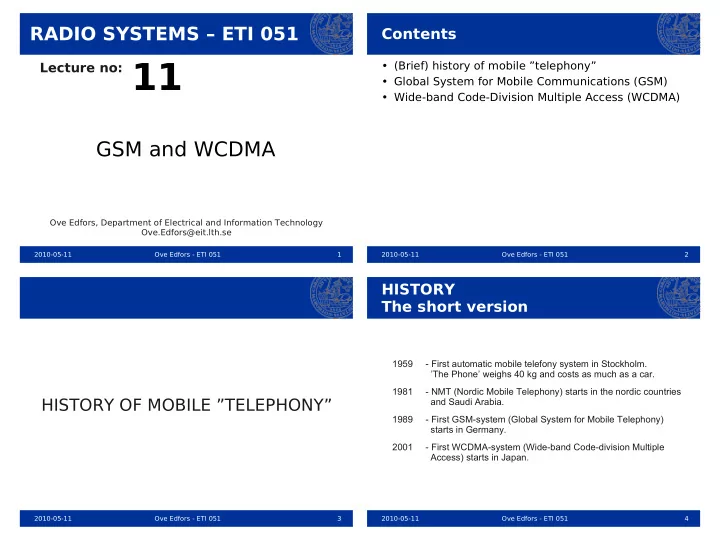
HISTORY The short version

1959

  • First automatic mobile telefony system in Stockholm.

’The Phone’ weighs 40 kg and costs as much as a car. 1981

  • NMT (Nordic Mobile Telephony) starts in the nordic countries

and Saudi Arabia. 1989

  • First GSM-system (Global System for Mobile Telephony)

starts in Germany. 2001

  • First WCDMA-system (Wide-band Code-division Multiple

Access) starts in Japan.

slide-2
SLIDE 2

2010-05-11 Ove Edfors - ETI 051 5

HISTORY Generations

Analog technology. Examples are NMT in the nordic countries and AMPS in North America. No data communication. Digital technology. Examples are GSM (first in Europe) and CdmaOne in North America. Slow data communication. New enhancements have increased datarate to 50-100 kbit/sec. Still evolving! Digital technology. Examples are WCDMA (Europe) and Cdma2000 (North America). Focus on both speech and data/ multimedia. Initially up to 2 Mbit/sec. Evolving towards higher data rates! 2010-05-11 Ove Edfors - ETI 051 6

GLOBAL SYSTEM FOR MOBILE COMMUNICATIONS (GSM)

2010-05-11 Ove Edfors - ETI 051 7

GSM Simplified system overview

BSS BSS

AUC HLR EIR VLR VLR BSC MSC BTS BTS BTS BTS BTS MSC BSC Interface to

  • ther networks

BTS Base Transceiver Station BSC Base Station Controller BSS Base Station Sub-system MSC Mobile Switching Center VLR Visitor Location Register EIR Equipment Identity Register AUC AUthentication Center HLR Home Location Register 2010-05-11 Ove Edfors - ETI 051 8

GSM Simplified block diagram

Speech coder Channel encoder Burst formatting Modulator/ transmitter Receiver Viterbi equalizer Viterbi decoder Speech decoder bits quality info. (Encryption not included in figure)

slide-3
SLIDE 3

2010-05-11 Ove Edfors - ETI 051 9

GSM Some specification parameters

(initial specification)

2010-05-11 Ove Edfors - ETI 051 10

GSM GMSK modulation

2010-05-11 Ove Edfors - ETI 051 11

GSM Power spectrum

2010-05-11 Ove Edfors - ETI 051 12

GSM TDMA/FDMA structure

ARFCN Absolute Radio Frequency Channel Number

slide-4
SLIDE 4

2010-05-11 Ove Edfors - ETI 051 13

GSM Frames and multiframes

Super frame 51 Multiframes Timeslot 156.25 Bits 576.92 μs Frame 8 Timeslots 4 . 61 5 m s Multiframe 26 Frames 1 2 m s 6 . 1 2 s 2010-05-11 Ove Edfors - ETI 051 14

GSM Up/down-link time slots

2 3 4 5 6 7 0 1 2 3 4 5 6 7 0 1 2 3 4 5 6 7 0 1 1 ARFCN ARFCN 45 MHz Time slot index Time slot index Frame Downlink Uplink

The MS transmits to the BS three time-slots after it receives a transmission from the BS. Using this strategy, the duplex scheme is a combination

  • f TDD and FDD, and the MS avoids simultaneous transmission

and reception.

2010-05-11 Ove Edfors - ETI 051 15

GSM Some of the time slots

RACH burst

41 synchronization bits 36 data bits (encrypted) 3 stop bits 68.25 bits extended guard period

SCH burst FCCH burst

142 zeros 3 start bits 3 start bits 3 start bits 8 start bits

Normal

26 training bits 64 training bits 58 data bits (encrypted) 39 data bits (encrypted) 3 stop bits 3 stop bits 3 stop bits 8.25 bits guard period 8.25 bits guard period 8.25 bits guard period 58 data bits (encrypted) 39 data bits (encrypted)

FCCH Frequency Correction CHannel SCH Synchronization CHannel RACH Random Access CHannel

2010-05-11 Ove Edfors - ETI 051 16

GSM Viterbi equalizer

slide-5
SLIDE 5

2010-05-11 Ove Edfors - ETI 051 17

GSM Channel coding of speech

The speech code bits are in three categories, with different levels

  • f protection against channel errors.

Uncoded

Block code 2010-05-11 Ove Edfors - ETI 051 18

GSM Encryption

2010-05-11 Ove Edfors - ETI 051 19

GSM GPRS and EDGE

GSM has evolved into a high-speed packet radio system in two steps

GPRS

General Packet Radio Services where empty time slots can be used to transmit data packets. Four new coding schemes are used (CS-1, ..., CS-4) with different levels

  • f protection.

EDGE

Enhanced Data-rate for GSM Evolution where, in addition to GPRS, a new 8PSK modulation is introduced. Eight new modulation and coding schemes are used (MCS-1, ..., MCS-8) with different levels of protection.

Up to 115 kbit/sec Up to 384 kbit/sec

2010-05-11 Ove Edfors - ETI 051 20

GSM GPRS network

SGSN Serving GPRS Support Node GGSN Gateway GPRS Support Node ISP Internet Service Provider

slide-6
SLIDE 6

2010-05-11 Ove Edfors - ETI 051 21

GSM EDGE 8PSK modulation

3 8 2×3 8 3×3 8

Linear 8-PSK ... but with rotation of signal constellation for each symbol We avoid transitions close to origin, thus getting a lower amplitude variation!

2010-05-11 Ove Edfors - ETI 051 22

WIDE-BAND CODE-DIVISION MULTIPLE ACCESS (WCDMA)

2010-05-11 Ove Edfors - ETI 051 23

WCDMA Some parameters

Carrier spacing 5 MHz Chip rate 3.84 Mchips/sec Uplink spreading factor 4 to 256 Downlink spreading factor 4 to 512 Like we discussed during Lecture 9, all cells use the same frequency band!

2010-05-11 Ove Edfors - ETI 051 24

WCDMA Direct-Sequence CDMA

What we learned during Lecture 9: data spreading code spread spectrum signal In WCDMA we do this a bit different: data spreading code spread spectrum signal scrambling Users/channels are separated by different codes. The total spreading is a combination of spreading and scrambling.

slide-7
SLIDE 7

2010-05-11 Ove Edfors - ETI 051 25

WCDMA Channelization and scrambling

data

channelization code

spread spectrum signal

scrambling

The different channelization/spreading codes are orthogonal and have different spreading factors between 4 and 512. Scrambling makes the total spreading (spreading + scrambling) unique between different sources.

2010-05-11 Ove Edfors - ETI 051 26

WCDMA

Orthogonal Variable Spreading Factor

The OVSF codes used for variable rate spreading can be viewed as a code tree. We can create several orthogonal channels by picking spreading codes from different branches of the tree.

2010-05-11 Ove Edfors - ETI 051 27

WCDMA Downlink

2010-05-11 Ove Edfors - ETI 051 28

WCDMA Uplink

slide-8
SLIDE 8

2010-05-11 Ove Edfors - ETI 051 29

WCDMA Spectrum mask

2010-05-11 Ove Edfors - ETI 051 30

WCDMA Data rate and spreading factor

Data rate Time Spreading factor Time

We always spread to the full bandwidth.

Transmit power Time

Transmit power and generated interference to

  • thers vary

accordingly.

2010-05-11 Ove Edfors - ETI 051 31

WCDMA Data rate and interference

In simple words, with a limited interference allowed, we can have many low data-rate channels or a few high data-rate channels.

Interference MS 1 MS 2 MS 3 Time

The interference level also varies with propagation loss, which makes power control important!

2010-05-11 Ove Edfors - ETI 051 32

WCDMA Soft handover

BS 1 BS 2

Since all base stations used the same frequency band, a terminal close to the cell boundary can receive “the same” signal from more than

  • ne base station and increase the quality of the received signal.

C e l l b

  • u

n d a r y