Physics 460 F 2006 Lect 25 1
Lecture 25: Surfaces Scanning Tunneling Microscope Special - - PowerPoint PPT Presentation
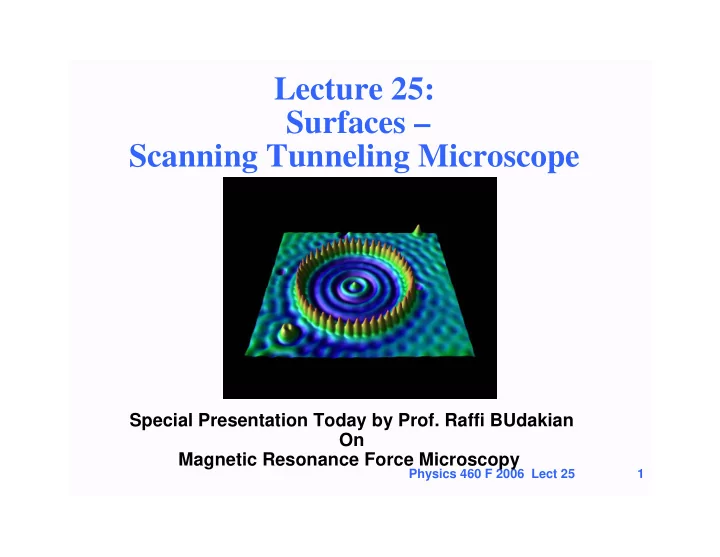
Lecture 25: Surfaces Scanning Tunneling Microscope Special Presentation Today by Prof. Raffi BUdakian On Magnetic Resonance Force Microscopy Physics 460 F 2006 Lect 25 1 Outline Surfaces of crystals Example surfaces of
Physics 460 F 2006 Lect 25 2
Outline
- Surfaces of crystals
- Example – surfaces of semiconductors –
GaAs
- Tunneling in quantum mechanics
Particles can tunnel through barriers
- Scanning tunneling microscope -- STM
- Examples of GaAs, Mn on GaAs, adatoms on Cu,
atoms on GaN surface that illustrate growth, ….
- AFM – very brief
Physics 460 F 2006 Lect 25 3
Surface structure – example: GaAs
[100] Ga terminated [100] As terminated [110] Ga-As terminated (non-polar)
Figure from w3.rz-berlin.mpg.de/pc/ElecSpec/MBE/mbe.html
Physics 460 F 2006 Lect 25 4
Surface structure – example: GaAs
(110) surface -Ga-As terminated Note the As atoms are slightly higher than the Ga atoms Top view of (110) surface Note zig-zag chains
- f Ga and As atoms
Conventional Cubic Cell in the bulk crystal
Figures from PhD thesis of Dale Kitchen, U of Illinois, 2006
Physics 460 F 2006 Lect 25 5
“Seeing” atomic scale features
“Scanning Tunneling Microscope” Measures electric current from tip to surface as tip is moved Probe manipulated by electric controls
- --- very sharp tip
Surface Feature on surface
Physics 460 F 2006 Lect 25 6
Scanning Tunneling Microscope
Nobel Prize 1985 Extra atom on surface Electrons “Tunnel” from tip to surface Rate of tunneling extremely sensitive to distance
- f tip from surface due to quantum effects
Tip Single atom at tip Surface “reconstruction”
Physics 460 F 2006 Lect 25 7
“Tunneling” in quantum mechanics
- In Quantum Mechanics has a non-zero probability to
be in region that is “classically forbidden”
- A particle can tunnel through a barrier even though it
does not have enough energy to get over the barrier
Position x Potential Energy V(x) Energy of particle 0 < E < V0 A particle on the left has some probability to tunnel through the potential barrier to the right side V=V0 V=0 Energy
Physics 460 F 2006 Lect 25 8
Schrodinger Equation
- Basic equation of Quantum Mechanics
where we consider only one dimension m = mass of particle V(x) = potential energy at point x E = eigenvalue = energy of quantum state Ψ (x) = wavefunction n (x) = | Ψ (x) |2 = probability density ∆
- Key issue for tunneling: What happens if the energy
E is less than the potential V at some point x [ - (h2/2m)d2/dx2 + V(x) ] Ψ (x) = E Ψ (x)
Physics 460 F 2006 Lect 25 9
Schrodinger Equation II
- Consider the case where V = constant = V0
which can be written
- r
[ - (h2/2m)(d2/dx2)+ V0 ] Ψ (x) = E Ψ (x) (h2/2m) )(d2/dx2) Ψ (x) = [V0 - E ] Ψ (x) (d2/dx2)Ψ (x) = - k2 Ψ (x), k2 = (E - V0)(2m/h2)
- If E > V0, Ψ (x) ~ e-ikx (the same as before)
- The wavefuntion decays exponentially in the
region where E < V
- If E < V0, define κ2 = - k2,
Ψ (x) ~ e- κx
Physics 460 F 2006 Lect 25 10
“Tunneling” in quantum mechanics
- In Quantum Mechanics has a non-zero probability to
be in region that is “classically forbidden”
- A particle can tunnel through a barrier even though it
does not have enough energy to get over the barrier
Position x Potential Energy V(x) Energy of particle 0 < E < V0 V=V0 V=0
Ψ (x) = ALeft e-ikx Ψ (x) = ARight e-ikx
Potential Energy V(x) Probability of tunneling = | ARicht |2 | ALeft |2
Physics 460 F 2006 Lect 25 11
Scanning Tunneling Microscope
Extra atom on surface Electrons “Tunnel” from tip to surface Probability for an electron to “tunnel” from the metal tip to the surface varies rapidly with the distance Tip Single atom at tip Surface “reconstruction”
Physics 460 F 2006 Lect 25 12
STM images – example: GaAs
(110) Surface (110) Surface model top view Image of As atoms Model showing Ga and As zig-zag chains
Figures from PhD thesis of Dale Kitchen, U of Illinois, 2006
Physics 460 F 2006 Lect 25 13
STM image - Mn atom on GaAs
GaAs (110) Surface with one added Mn atom at position indicated by x
Figures from PhD thesis of Dale Kitchen, U of Illinois, 2006
Physics 460 F 2006 Lect 25 14
STM image – subsurface atoms
Figures from PhD thesis of Dale Kitchen, U of Illinois, 2006
Shape indicates the directions of the electron bonds Bonds to surface atoms Bonds to the
- ther neighbors
GaAs (110) surface with Zn, Mn, Fe or Co atoms substituted for Ga in the first layer below the surface
Physics 460 F 2006 Lect 25 15
Observation of atoms, electron waves with Scanning Tunneling Microscope
Physics 460 F 2006 Lect 25 16
Observation of atoms, electron waves with Scanning Tunneling Microscope
Corral of atoms placed one at the time by maneuvering atoms with STM Electron standing waves inside the “corral” Extra atom Surface Atoms
Figure by D. Eigler, et. al, IBM Research
Physics 460 F 2006 Lect 25 17
Surface of GaN observed by STM
Figure by D. Smith, reproduced in Electronic Structure”, by R. M. Martin, Cambridge University Press 2004
Atomic scale structure of surface Spiral growth -- A common way that crystals grow -- by adding atoms at a step, the higher layer grows over the lower layer – continues in a spiral “Step” on surface where the surface height changes by one layer Step Side view Step Side view Adding atoms at step makes step move to cover lower layer
Physics 460 F 2006 Lect 25 18
Atomic Force Microscope
Works for insulators, …. Si (111) surface
From http://www.physik.uni-augsburg.de/exp6/research/sxm/sxm_e.shtml
Article in Physics Today, December, 2006
Physics 460 F 2006 Lect 25 19
Summary
- Surfaces of crystals
- Example – surfaces of semiconductors –
GaAs
- Tunneling in quantum mechanics
Particles can tunnel through barriers Exponential decay where E < V
- STM – electrons tunnel through space between
tip and sample Leads to the extreme sensitivity of tunneling current to the distanceof tip to sample Dominated by a single atom on tip
- Examples of GaAs, Mn on GaAs, adatoms on Cu,
atoms on GaN surface that illustrate growth, ….
- AFM – very brief
Physics 460 F 2006 Lect 25 20
Next Lecture
- Nanostructures
Magnetic, superconducting
- Final lecture ---- Summary of course