
SLIDE 1
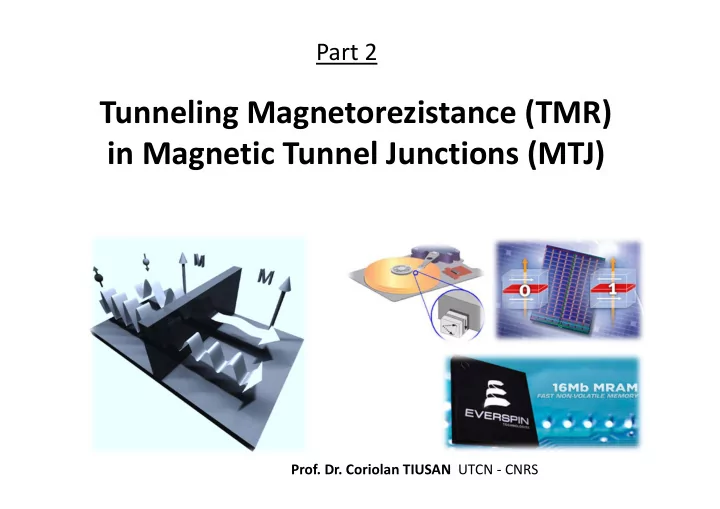
Tunneling Magnetorezistance (TMR) in Magnetic Tunnel Junctions (MTJ)
Part 2
- Prof. Dr. Coriolan TIUSAN UTCN ‐ CNRS
Tunneling Magnetorezistance (TMR) in Magnetic Tunnel Junctions (MTJ) - - PowerPoint PPT Presentation
Part 2 Tunneling Magnetorezistance (TMR) in Magnetic Tunnel Junctions (MTJ) Prof. Dr. Coriolan TIUSAN UTCN CNRS Tunneling Magnetorezistance (TMR) consequence of spin dependent tunneling Tunnel effect (1928 George Gamow): NONZERO transmission
The nature of particles as waves (de Broglie) determines the tunnel effect Pure QM approach No Classical approach Incident wave Transmitted wave Reflected wave
Tunnel effect (1928 George Gamow): NONZERO transmission of particle‐associated wave across a thin potential barrier Tunnel junction: = two metallic layers separated by a thin insulator: => electron propagation by tunneling
M1 M2
Tunneling Magnetorezistance (TMR)
consequence of spin‐dependent tunneling
2
Free electrons => Plane wave
Some quantum mechanics
UB E
d d
Ae Be
ikx
ikx ikx
2
2m k E
metal barrier Schrödinger
2
2 ( )
B
m U E
2
2 U E m
B
metal U U barrier
Transmission probability: Tunnel current (conductivity):
L R T
lead
Total (net) current when biasing the junction
( ) ( ) ( ) ( ) ( )
LR RL FD FD L R L R
I I I n E T E n E eV f E f E eV dE
( ) ( ) ( ) ( ) 1 ( )
FD FD LR L L R R
I n E f E T E n E f E dE
V
3
FM1/ I / FM2 trilayer Metallic layers = ferromagnetic
Spin dependent
, ,
B
h FM U U barrier
2
2 U E m
Spin dependent transmission probability
T(E) FM1 FM2
M1 M2
I
MAGNETIC TUNNEL JUNCTION – elementary brick of spintronics
QM
Spin dependent current
1 2 1 2
( ) ( ) ( ) ( ) ( ) J n E T E n E f E f E dE
4
Two current model (2 independent channels) Spin conservation during tunneling spin up: J spin down: J
tot
1 2 1 2 1 2
( ) ( ) ( ) ( ) ( ) ( ) ( ) ( ) ( )
F F
J V n E T E n E eV f E f E eV dE T OK J V n E n E eV
Spin transport by quantum tunneling
Mechanisms of TMR
Quantum Mechanics
U EF
eV
EF+eV
5
Tunnel magnetoresistance:
P P AP
R R R R R TMR
R Rp RAP
FM1 I FM2 M1 M2 Hrot
Slonczewski:Phys. Rev. B39, 6995, (1989) 2
R=f (cos())
FM1 I FM2 M1 M2 Hrot FM1 I FM2 M1 M2 Hrot
Slonczewski:Phys. Rev. B39, 6995, (1989) 2
R=f (cos())
) 2 ( 1 ) 2 ( 1 ) 2 ( 1 ) 2 ( 1 ) 2 ( 1
with n n n n P
2 1 2 1
1 2 P P P P R R R R R
P P AP
) , θ ), θ cos( 2 2
2 1 M
M R R R R R
ap p ap p
Spin-valve effect
MAGNETIC TUNNEL JUNCTION – Tunnel Magnetoresistive (TMR) effect
6
MAGNETIC TUNNEL JUNCTION – Large spin valve effect
HD‐Read HDD Field, rotation
FM1 FM2
M1 M2
Current I=f()
=> sensors
I: Spin dependent tunneling
Polarizer Analyzer
( ) I f
Spin dependent tunnel current
n E n E n E n E P
I
7
Control of magnetic properties of electrodes
R anti parallel R parallel
Hc1 Hc2
d T exp
Control of barrier structure at nanometer scale
U EF
eV
1 2
U EF
eV
1 2
U EF
eV
1 2
R=f()=R(H)
Isolant FM1 FM2
Key parameters for MTJ
8
HC1<H<HC2 ? Operating at low fields:
M H R H (3) Hc 2 Hc
– M1 – M2
(3)
2
(2)
1
Hc Hc R high
1
– M1+ M 2
(2) (1) R low
M1+M 2
(1)
Operating an MTJ: M(H ) <=> R(H) (I) Control of magnetic properties
Hard‐soft architecture
9
JTM: M(H )<=> R(H)
M H R H Hc 2 Hc 2 (2)
1
Hc R high Hc 1 (1) R low
|H|<HC2
M1+M 2
(1)
– M1+ M 2
(2)
Minor loop:
(I) Control of magnetic properties
Hard‐soft architecture
10
large K ‐ soft low K ‐ soft F1 low K ‐ soft Hardening: difficult task in 3d FM thin films
2 materials K cristalline phase Fe(bcc) vs Co(hcp)
Exchange biased SyAF reduces stray‐fields and Hard/soft dipolar coupling F1 low K ‐ soft F2 RKKY (2) Exchange biasing (1) Clasically
aspect ratios of FM electrodes Complex micromagnetic problems
For applications Beyond static => Complex micromagnetic problems Dynamic magnetic properties related to fast and homogeneous magnetization switching have to be
Typical Magnetoresistance versus magnetic field
hard–soft MTJ exchange‐biased MTJ Pillar shape, aspect ratio, FM material, switching mechanisms (field, spin‐current/torques, thermal assisted…).
11
(II) Control of barrier structure
T exp d U Control of d Control of U
50nm 50nm
C C'
100 nA
courant
0.1 nA
CC ’
D D'
DD'
Tunnel cartography
Homogeneity of tunnel current
inhomogène homogenuous
Optimisation of buffer layer ==> small roughness Control of epitaxial growth in epitaxial (single crystal or textured) MTJs
Image TEM 50nm
0 nm 0.7 nm 0 nm
A A'
0.5 nm
AA'
Image AFM
V.DaCosta, C. Tiusan, T. Dimopoulos, K. Ounadjela, PRL 85, 876 (2000)
12
Polycrystalline MTJs : random distribution of crystallographic axes (amorphous barrier) free electron model (constant potential + plane waves) Tunnel transport independent of propagation direction Single crystal electrodes : anisotropy of space properties dependent of propagation direction potential : crystal periodicity beyond the free‐electrons model: Bloch waves
nk ikr nk
Fully epitaxial systems Conservation of symmetry across the stack
ikr
! Model systems where theory and experiment confront
Single crystal MTJs
Magnetic tunnel junction – underlying Physics
13
The first observation of reproducible, large room temperature magnetoresistance in a CoFe/Al2O3/Co MTJ
Moodera J S, Kinder L R, Wong T M and Meservey R
(I) Polycrystalline MTJs (Al2O3 based) 1995 discovery of the TMR effect at RT Hystorically, first MTJ systems
14
Early experiments and models
Tedrow and Meservey Measure the spin polarization of the tunnelling current originating from various ferromagnetic metals across an alumina insulating barrier in ferromagnet/insulator/superconductor (FM/I/S) tunnel junctions superconducting Al film which acts as a spin detector Applied H II plane The results of these early experiments on SDT were interpreted in terms of the DOS of the ferromagnetic electrodes at EF
inconsistency between measured P and PFM
The inconsistency between the experimental and theoretical SP = consequence of the fact that the tunneling conductance depends not only on the number of electrons at the Fermi energy but also on the tunneling probability, which is different for various electronic states in the ferromagnet
FM
n n P n n
15
Electronic bands in bulk fcc Ni in the [110] direction for the majority‐spin (a) and minority‐spin (b) electrons. The heavy curves show the free‐electron‐like bands which dominate tunnelling. k↑and k ↓ are the Fermi wavevectors which determine the spin polarization of the tunnelling current:
Using an accurate analysis of the electronic band structure, Stearns found that PFM = 45% for Fe and 10% for Ni, which are consistent with the experimental data Takes into account features of band structure in tunneling Stearns: introduces the notion of TDOS (tunneling density of states)
early indication that the understanding of SDT requires detailed knowledge of the electronic structure of MTJs transmission probability depends on the effective mass which is different for different bands localized d electrons => large effective mass and therefore decay very rapidly into the barrier region the dispersive s‐like electrons decay slowly
the nearly free‐electron (most dispersive bands) dominate the tunnelling current
16
1975, first observation of TMR effect in Fe/Ge/Co MTJ (4.2K)
Consistency between measured SP (Tedrow‐Meservey) and TMR values Assumptions: two independent current model (up, dn spin) tunneling from DOS up1‐up2, dn1‐dn2 in P and up1‐dn2, dn1‐up2 in AP
1 2 1 2 1 2 1 2 P AP
G n n n n G n n n n
1 2 1 2
2 1
P AP AP P AP P
G G R R PP TMR G R PP
with
17
First accurate theoretical consideration of TMR
Slonczewski J C Phys. Rev. B 39 6995 (1989)
Tunnelling between two identical ferromagnetic electrodes separated by a rectangular potential The ferromagnets described by two parabolic bands exchange splitted Explains the spin‐valve effect
FM1 I FM2 M1 M2 Hrot
2
R=f (cos())
FM1 I FM2 M1 M2 Hrot FM1 I FM2 M1 M2 Hrot
2
R=f (cos())
Additional term depending on barrier attenuation rate
SP depends on both electrode and barrier
18
Angular dependence of TMR
Moodera J S and Kinder L R 1996 J. Appl. Phys. 79 4724
FM1 I FM2 M1 M2 Hrot FM1 I FM2 M1 M2 Hrot FM1 I FM2 M1 M2 Hrot
Voltage dependence
Intrinsic mecanisms barrier decreased by V reduces P (see Slonczewki factor) electrode DOS dependence on energy extrinsic mecanisms: scattering by magnons at FM/I interface Zhang S et al, 1997 Phys. Rev.Lett. 79 3744 + other complex mechanisms related to tunneling ! Important for applications Confirms Slonczewski and open area of angular sensors
Recent experiments
19
Temperature dependence Co/Al2O3/Co MTJ
due to spin‐wave excitations, as does the surface magnetization (P and M follow Bloch 3/2 law)
Shang C H, et al, 1998 Phys. Rev. B 58 R2917
(Tsymbal) + other complex mechanism (e.g. electronic structure, deffect assisted tunneling in realistic barriers, multiple hopping, etc…) Important for applications
Vedyayev A et al, 2001 Phys. Rev. B 63 064429 Tsymbal E et al , 2002 Phys. Rev. B 66 073201 Glazman L I, and Matveev K A 1988 Sov. Phys. JETP 67 1267
TMR decreases with increasing T
20
Ferromagnet dependence
TMR at 2 K as a function of Al2O3 thickness for Fe(211), Fe(110), and Fe(100) epitaxial electrodes in Fe/Al2O3/CoFe
S: Yuasa et al, Europhys. Lett. 52 344 (2000)
TMR tuned via the FM material nature TMR tuned via FM layer cristaline orientation
Directly via the tunneling polarization Various FM materials tested as electrodes: Half‐ and full‐Heusler: NiMnSb, Co2MnSi,
combined with various other barriers SrTiO3, CeO2, ZnO,… LSMO/STO/LSMO MTJ TMR>100%
Sun J Z 2001 Physica C 350 215
Given the TMR dependence of the DOS
MTJs with epiaxial electrodes and amorphous barrier
21
Barrier and interface dependence
de Teresa et al: the tunnelling spin polarization depends explicitly on the insulating barrier
De Teresa et al., Science 286, 507 (1999)
LSMO as spin analyzer (100% positive SP)
for Co/SrTiO3/LSMO
Polarization (amplitude, sign) depends on hybridization at FM/I interface Selection at interface of tunneling electrons (Al2O3 selects s‐like electrons, STO selects d‐like electrons…)
22
Magnetic tunnel junction ‐ Historically
1st generation 2nd generation MgO age
Best (counterintuitive result) TMR =70‐80%) CoFeB/Al2O3
Al2O3 age Other (oxides) barriers have been checked but less sucessfull
23
1995 Moodera, Miyazaki (TMR ~ 20% with amorphous Al2O3 Bests results : CoFeB/Al2O3 (TMR ~ 80%)
Best result (2008): Tohoku (H. Ohno) : 604% RT (1144% 5K) textured CoFeB/MgO/CoFeB (sputtering)
1996 2000 2004 2008 2012 250 500 1040 1120
5K
Nancy
Anelva Tohoku
5K
Nancy Tohoku AIST
Al2O3 barriers MgO barriers MgO epitaxial barriers (Nancy) MgO and CoxFe1-x, Fe1-xVx
Anelva
IBM
AIST AIST Nancy Nancy CSIC MPI NVE Sony Fujitsu IBM INESC Fujitsu IBM MIT Tohoku Tohoku
TMR at 300K (%) Y
5K
Magnetic tunnel junction ‐ Historically
NANCY
24
Fe Fe MgO 2nm
Why Fe(001)/MgO(001)/Fe(001) epitaxial MTJs
[100]Fe [110]MgO [100]MgO
Fe bcc a = 2.87Å MgO NaCl type a= 4.21Å Epitaxial growth ‐45° rotation
Ideal crystallographic structure Symmetry conservation Conservation of kII
MODEL SYSTEM Confront QM theory and experiment
Single crystal MTJ– underlying physics
25
Fe(001)/MgO(001)/Fe(001)
Conservation of kII Landauer formalism
the state (k||; j) to the state (k||; i)
Modeling of tunnel transport in single crystal MTJs Fe(001)/MgO(001)/Fe(001)
MULTICHANNEL TRANSPORT
‐ spin independent channels
(two current model Fert‐Campbell) Bloch wave preserve the symmetry invariance properties of the crystal
Single crystal MTJ– underlying physics
26
Complex FS MgO Im Im k(kx,ky)
Majority Surface spectral density Fe(001)
G(kII) The partial conductance G(kII) is a direct result of the overlapping of the majority spin surface spectral densities in the two electrodes, exponentially filtered through the MgO barrier.
Large MgO thickness transport « dominated» by kII=0 (asympthotic regime)
Tunnel Transmission T(kII,I,j), for a kII channel matching of the real Fermi Surface of the FM metal with the complex FS of insulator
Tunnel transport in single crystal MTJs Fe(001)/MgO(001)/Fe(001)
27
[100]Fe
1 2’ 5
[100]
Majority spin 2 2’ 5
[100]
Minority spin
1 EF EF
Fe(001) : half‐metal* % 1 => P 1 =100% But other channels exist: 1, 5, 2, 2’ and T(kII0) 0
Spin majoritaire
H () [001]Fe
Asympthotic regime : transport along kII=0
s
pz dz2 px , py 3dxz, 3dyz
dx
2 ‐y 2
3dxy
Wave Functions regrouped by symmetry TUNNELING CHANNELS: Selection of Bloch wave functions in Fe
*Symmetry depenedent half metallicity SDHM
28
LKKR: Butler, Zhang, Schulthess, MacLaren, Phys. Rev. B, 63 054416 (2001) Mathon, Umerski, Phys. Rev. B, 63 220403(R) (2001)
Large MgO thickness: 1 propagation dominates large polarisation, large TMR (> 1000%)
[110]MgO [100]MgO
T~ e-2d 1 < 5 << 2, 2’
kz=i (q=0, point )
EF
5 1
Importance of the asympthotic regime
29
Experimentally
(1) Complex MBE or UHV sputtering growth
Various growth sources (e‐gun, Knudsen cell, magnetrons) Variable growth/in‐situ annealing temperature (70‐1273K) in‐situ analysis RHEED, Auger, XPS, photoemission,…
UHV 10‐11 Torr
30
Fe Fe
Courtesy E. Snoek CEMES, Toulouse
‐10 ‐5 5 10 15 20 25 5 10 15 20 25 30 35
Time (s)
1 2 3 4 6 5
10 20 30 40 50
1 MC
Time (s)
v=0.089 ml/s
1 2 3 4 5 6
RHEED Intensity(a.u.) Imax Imin
Atomic level control of insulator thickness RHEED feature Surface –diffraction technique 3 ML MgO
31
100 µm
(2) UV, EBEAM lithography patterning of MTJ pillars
0,0 0,5
50
Current(µA) Voltage(Volt)
200 400 8000 10000 12000 14000 16000 18000
R (ohms) H (Oe) R
25 50 75 100
TMR(%)
32
Experimentally in Nancy … TMR in Fe(001)/MgO/Fe
UV, EBEAM lithography
JTM Fe/MgO/Fe MTJ
MgO barrier 100‐150 Å Fe 200 Å Co Capping MgO (100) substrate 500Å Fe
CEMES, Toulouse
200 400 600 100 200 300 400 4K 300K
TMR(%) H(Oe)
Giant TMR ~ 200% (RT), 340% (10K)
Electron transport physics: beyond the free electron model TMR amplitude: explained by spin and symmetry dependent transport
Giant TMR in Fe/MgO/Fe epitaxial MTJs
C Tiusan et al, Appl. Phy. Lett. 88, 62512, (2006).
NANCY AIST
33
0,0 0,5 1,0 0,5 1,0 1,5 2,0 2,5
3
0,0 0,3 25 50
G/Gp(0) Voltage(V)
(G(V)-G(0))/G(0) (%)
Configurație P
Top of Δ5 band 0,2eV
G
1
G
G1+ G 5
V
5 channel activated at low voltages Spins UP Both 1 cand 5 contribute to tunneling
Symmetry dependent tunneling‐ demonstrated by tunneling spectroscopy
/ ( )
F
dI dV n E eV
34
However, record TMR in sputtered MTJs Epitaxial MTJ
Imperfect filtering: multichannel transport coherent+diffusive, incoherent
Defects: dislocations
CEMES, Toulouse
C Tiusan et al, Appl. Phy. Lett. 88, 62512, (2006)
(2013).
WR 604% RT (1144% 5K)
UHV Sputtered structures Annealed at HT No disclocations, grain to grain epitaxy
TMR limited to 250% (Fe/MgO, 410% Co/MgO)
35
Modulation of tunnel transport in single crystal Fe/MgO/Fe MTJs
MTJ: multi channel transport; channel=[spin, symmetry]
Insulator FM Emitter: selects the different i injected symmetries FM Collector: selects / impose the reception states i filter Symmetry dependent attenuation rate
3 sub‐systems coupled by the wave function matching at the interfaces
interface quality/ chemistry, interfacial electronic structure Strong impact on the tunnel characteristics By controlling the interfacial structure Engineering of spin filtering
Single crystal epitaxial MTJ: model system where theory and experiment meet => QM experiments
36
100% Surface polarization copeting with 100% 1 bulk polarization
X G E F Energy
Minority spin
E F+0.2eV
[Stroscio et al.,
Surface electronic structure (minority spin)
Fe(001) minority spin surf. State: dz2 like orbital 1 symmetry (s, pz, dz2)
Strong contribution of IRS to the Minority spin tunneling
UP‐RIGHT
1 2’ 5
[100]
EF
2 2’ 5
[100]
1 EF
UP‐LEFT
Bulk electronic structure kII=0 (asymptotic regime)
AP
No up 1 in left electrode at EF Small conductivity related to 5 electrons (kII=0) ! IRS in (kII≠0)
38
Enhanced magnetoresistance by monoatomic roughness in epitaxial Fe/MgO/Fe tunnel junctions Fe Fe MgO
0.0 0.5 1.0 100 110 120
MgO Fe 1 Fe 2
Fe (MC) îlots Fe
1.2
TMR (%) Quenching IRS, increases TMR
TUNNELING ANISOTROPIC MAGNETORESISTANCE (TAMR) RELATIVISTIC EFFECTS (spin‐orbit interaction) on the TMR
Angular dependence of the tunneling resistance attributed to a significant anisotropy in the DOS linked to the magnetization direction along different crystal axes –SOC related
!!! 2nd FM electrode not necessary
39
40
Spin‐orbit coupling effect by minority interface resonance states in single‐crystal magnetic tunnel junctions SO negligible in 3D FM metals, however large in IRS If IRS activated = large SO efects in transport
IRS demonstrated by tunneling spectroscopy experiments (see next slide)
41
By tunneling spectroscopy on probe empty states in the Right electrode (occupied in the L but seing larger barrier)
42
Interfacial SO effects at Fe/MgO interface responsible on large PMA
Anatomy of perpendicular magnetic anisotropy in Fe/MgO magnetic tunnel junctions: the origin of the large PMA values is far beyond simply considering the hybridization between Fe‐3d and O‐2p orbitals anisotropy energy is not localized at the interface but it rather propagates into the bulk showing an attenuating oscillatory behavior depending on the
The MgO thickness has no influence on PMA, and the PMA oscillates as a function of Fe thickness with a period of 2 ML
Even if SO is small in 3D metals, for some orbitals it can be significant, Lifts degenerancies for some states and affects the occupation and energies !important for anisotropies, transport, etc…
Engineering of the voltage response in single crystal MTJ by interfacial chemistry/ electronic structure
C Tiusan et al, Appl. Phy. Lett. 88, 62512, (2006).
0.0 0.5 1.0
40 80 120 160
TMR (%) Voltage (V)
Carbon clean
Applications: MTJ operated at finite voltage TMR(V) extremely important Optimization of the output signal by interfacial structure
Fe MgO Fe Co
Clean Fe(001)
200 400 600
Counts (arb. units) Kinetic Energy (eV)
[11]
Clean Fe/MgO interface
c(2x2) C on Fe(001)
Kinetic Energy (eV)
C
Counts (arb. units)
[11]
C layer at Fe/MgO interface
43
candidate : bcc Co(001) Yuasa, Ando, App. Phys. Lett., 89 042505 (2006)
1 5
effect in Fe/MgO-based MTJs
candidate : bcc Cr(001)
Engineering of TMR in single crystal MTJ by metallic adlayers
Fe MgO Fe Co M
44
Fe MgO Fe Co
Symmetry dependent interfacial barriers M Concept:
Fe
Cr
Fe Cr
tCr 1
MgO Fe
Cr
Fe Cr
tCr 1
MgO
EF
1 5
3.0 2.0 1.0 0.0
H 2 2’ Energy (eV) 1 5
3.0 2.0 1.0 0.0
H 2 2’ Energy (eV)
Cr (001) symmetry dependent barrier (1eV) attenuation of 1 propagation
candidate : M=bcc Cr(001)
1 2’ 5
[100]
Majority spin
EF
Fe
45
MgO (001) 26nm Fe 0 - 9ML Cr 6nm Fe 20nm Co capping MgO (001) 26nm Fe 0 - 9ML Cr 6nm Fe 20nm Co capping
Lattice mismatches Fe‐Cr 1.5% Cr‐MgO 2.25% (rotation 45°) Symmetry conservation
10 20 30 40 50 60 70 80 90 closed shutter
RHEED Intensity rod [00] Deposition time (s)
2D growth Cr on Fe
Layer by layer growth of Cr on Fe : precise control of thickness
46
Cr(001) behaves as a metallic tunnel barrier LKKR
47
Insertion of thin Fe between Cr and MgO
Fe Cr Cr Fe Fe Fe Fe Fe MgO MgO EF EF e- e- 1 2 3 1 2 3
V < 0 V > 0
Fe Cr Cr Fe Fe Fe Fe Fe MgO MgO EF EF e- e- 1 2 3 1 2 3
V < 0 V > 0
[100]Cr [110]MgO [100]MgO
MgO Fe Cr
[100]Fe
Fe
[100]Fe
Fe
[100]Fe [100]Cr [110]MgO [100]MgO
MgO Fe Cr
[100]Fe
Fe
[100]Fe
Fe
[100]Fe
Potential profiles for 1 in parallel configuration (P)
Building quantum well structure for 1
48
0.0 0.5 1.0 1
Bias (V) 1
[ GP(AP) - GP(0) ] / GP(0)
Standard tFe = 7 ML
Symmetry dependent quantum well structure for 1 electrons (RT)
Increasing tFe : conductivity maxima shifted towards lower voltages quantum well states for 1
Derivatives of GP
0.0
d
2IP / dV 2 (a.u)
3 2 2 1 3 2 1 S 21ML 14ML 7ML Voltage (V)
Fe Cr Cr Fe Fe Fe Fe Fe MgO MgO EF EF e- e- 1 2 3 1 2 3
V < 0 V > 0
Fe Cr Cr Fe Fe Fe Fe Fe MgO MgO EF EF e- e- 1 2 3 1 2 3
V < 0 V > 0
49
Polarisation (TMR) amplitude tunning using FeCo alloy bcc electrodes
Preserve bcc(001) symmetry and all filtering proeprties of MgO(100) but enhance polarization of FM: adjunction of Co in Fe shift upwards EF, enhances spectral density of majority 1, shifts downwards the minority IRS
50
51
Textured MTJS grown by MBE grain‐to‐grain epitaxy
~25 nm
Similar TMR ratios and conductivity vs voltage curves
I. TMR: current control via the magnetization
configuration
FM1 FM2
FM2 FM1
I ~ cos
Incident electron
cos sin
Reflexion of component
Transmission of component
Current induced spin transfer torque
Spin filtering in an ideal FM removes from the current the component of the spin angular moment This is adsorbed by the magnetization, => torque. sin Torque
S
52
Recall Bauer, Slonczewski torque in half‐metals
Particle density:
Particle transport
Current density: Continuity equation: where Spin density:
Spin transport
Spin current density: where
Vector of Pauli matrices
Continuity equation:
Spin accumulation External torques
Anathomy of spin torque (QM)
53
See M. Chshiev, Th 03/09
Spin density:
i i i i i
* * x
i i i i i
* * y
i i i i i
* * z
2 m
Spin current density:
i i i i i
v v Q ˆ ˆ Re
* * x
i i i i i
v v Q ˆ ˆ Re
* * z
i i i i i
i i v v Q ˆ ˆ Re
* * y
Tensor quantity with elements with i=x,y,z in spin space and j=x,y,z in real space
ij
xx
yx
zx
Current flows in x direction
54
General continuity equation (spin+magnetization)
All external torques
For example, Landau‐Lifshitz‐Gilbert torque density: exchange, anisotropies, external fields damping
Spin accumulation
Current‐induced contribution to the torque density
(M. D. Stiles and A. Zangwill, PRB 66 (2002) 014407)
55
Magnetization dynamics (LLG equation + spin torque)
Magnetization control strategy in STT‐RAM and ST‐HFO Magnetization manipulation by spin transfer torque
When a current is applied, the direction of the spin transfer torque is either parallel to the damping torque or antiparallel to it, depending on the sign of the current Spin current influences the magnetization dynamics (LLG eq.)
STT direction depends
Field like
Heff mxHeff
precession damping
56
Trajectories of spin‐torque‐driven dynamics for the magnetization vector M
D.C. Ralph, M.D. Stiles / J. Magn. Magn. Mater. 320, 1190, (2008)
=> From steady precession to switch through spin current For the sign of the current that produces a spin‐torque contribution in the same direction as the damping, there are no current induced instabilities in the free‐layer orientation. The current increases the value of the effective damping, and M simply spirals more rapidly back to the Heff direction. For the sign of the current that produces a spin‐torque contribution opposite to the direction of the damping (STT=acts as negative damping) => large angle magnetization dynamics excited
57
MTJ: Experimental request for out‐of‐equilibrium spin torque analysis torque ~exp(‐kd) => thin barriers required + high curent density density J for stable precession and switching (106 ‐107 A/cm2)
Spin torque effects in MTJs
nanometric MTJ pillars required
Complex patterning (lithographic) issues
58
Current driven magnetization switching
First experiments on pillars: Cornell (Katine et al, PRL 2000) CNRS/Thales (Grollier et al, APL 2001) IBM (Sun et al, APL 2002)
typical switching current MTJ 106A/cm2): target 5*105A/cm2 tailoring materials with low damping and large polarization (e.g. Heusler) switching time can be as short as 0.1 ns (Chappert et al)
MTJ: Out of equillibrium torque
Applications: STT‐MRAM
Tohuku team Average Jc 8x10⁵ A/cm2
59
STT‐MRAM ‐ Potentially The Future Of Non‐Volatile Memory Switching of reprogrammable devices (example: MRAM)
1) By external magnetic field (present generation of MRAM, nonlocal, risk of « cross‐talk » limits integration)
Current pulse
2) «Electronic» reversal by spin transfer from current (ST‐MRAM: next generation of MRAM, with demonstrations by EVERSPIN, Sony, Hitachi, NEC, etc)
60
Spin torque nano‐oscillator: Spin torque compensates damping
(a) in‐plane magnetized fixed (polarizer) layer and an out‐of‐plane magnetized free layer. (b) Microwave spectra as a function of d.c. current bias I at zero applied magnetic field Adapted from ursula.ebels@cea.fr Comparison Voltage controlled Oscillator vs Spin Torque Oscillator
a b
61
Spin Transfer Oscillators (STO) (communications, microwave pilot) STO Advantages: Enhance tunning range GHz; direct oscillation in the microwave range (5‐40 GHz) agility: control of frequency by dc current amplitude, (frequency modulation , fast switching) Fast tuning (ns) high quality factor small size ( 0.1m) (on‐chip integration) oscillations without applied field Remaining chalanges: Large Output Power and Small Linewidth increase of power by synchronization of a large of number N of STO ( x N2 )
f/ff 18000 in point contacts
Future telecommunications: multi standard / multi band applications require to cover a large range
VCO’s ‐ Limited frequency tuning range ( few hundred MHz) ‐ Large space due to inductances (mm²) ‐ Long tuning time (µs to ms)
MgO MTJs with large TMR good candidates
62
? STT experiments without patterned nanopillars
YES: zero bias (equillibrium) torque in continuous MTJ structures with extremelly thin barriers
Fe Fe MgO
Net charge current I=0 Spin current ≠ 0 The equilibrium torque determines an effective interfacial exchange coupling (Heinsenberg) – J cos
J.C. Slonczewski, PRB 39, 6995, (1989). 63
MTJ: equilibrium (zero bias) torque
Net charge current I=0 Spin current ≠ 0 ;
yz zz xz
Q Q Q torque
Vector in the spin space Direction of MAX MB J.C. Slonczewski, PRB 39, 6995, (1989).
The equilibrium torque determines an effective interfacial exchange coupling (Heinsenberg) – J cos
sin cos ) (
BQ
J J Ec Q t t S
Ec= energy of exchange coupling Free electrons – asymptotic expression
kd F
e k k k k k k k k k k k k d E U J
2 2 2 2 2 2 2 3 2 2
) )( ( ) ( ) )( ( 8 8 ) (
kd
) (
F
E U
2
d
) (
2
k k k
Sign of coupling AF: k2<kk F: k2>kk
) , ( ) , ( ) , ( ) , ( 2 ) , ( t x t x t t im t Q x x x x x
= x,y,z in spin space and = x,y,z in real space
64
Fe Fe MgO
Courtesy E. Snoek CEMES, Toulouse
4 6 8 10 12 14 16 18
0,0 J (erg/cm
2)
MgO thickness (Å)
J <0 ~exp(‐d)/d2
by spin polarized tunneling
Equilibrium coupling Signature of torque (nonzero spin current) for zero charge current
300
1 Field (Oe) M/Ms
AF Magnetic interactions
0,000 0,005 0,010 0,015 0,020
tMgO=6.2Å Hex (Oe) 1/tFe (Å
Heinseberg interfacial coupling
NANCY: First experimental proof of:
MTJ: equilibrium (zero bias) torque in Fe/MgO/Fe MTJs
Spin current decays exp with tMgO => extremelly thin MgO required
Continuous MML films
65
66
Kerr and/or VSM
Annealed bottom Fe layer Desposition of Fe islands ‐variable size (RHEED) Complete stack
Fe 1 Fe 1 MgO Fe 1 Fe 2
Mobile shutter 0 to 2 – 3 Fe monolayer
50 100
0,0 0,5 1,0
MX / MS Champ appliqué (Oe) Coupling related shift
Deposition techniques: ‐ Fe Knudsen cell ‐ MgO electron gun
60 80 100 0,8 0,9 1,0
H (Oe) hP MX / MS hS
Engineering of coupling by interfacial electronic structure (Fe/MgO)
56th Annual MMM, Scottsdale, Arizona 30 Oct‐3 Nov 2011
Smooth bottom Fe interface (annealed) Bottom Fe interface with Fe islands ≠ sizes
0,0 0,5 1,0 1,5 2,0 2,5 0,0 0,5 1,0 1,5 2,0
J / J (0 mc Fe) Fe on Fe coverage (ML) tMgO = 2,75 plans 3 plans 3,25 plans 3,4 plans
Normalized coupling
Engineering of coupling by interfacial electronic structure (Fe/MgO)
From SW – modelling => J
56th Annual MMM, Scottsdale, Arizona 30 Oct‐3 Nov 2011
67
SENSORS
Tunnel junctions would then offer a superior signal to noise ratio than metal based CIP or CPP sensors.
DATA STORAGE
Tehrani et al, IEEE.Trans.Magn., 35, 2814, (1999).
Johnson IEEE Spectrum 33, (2000).
Nakashio J.Appl.Phys.89, 7356 (2001). MICROWAVE APPLICATIONS
(DC voltage induced by AC flowing current) Tulapurkar A A et al Nature 438, 339, (2005).
negative damping STT in pillars produces M steady precession Kiselev S I et al Nature 425 380 (2003). The requirements of the properties, especially the product of resistance and area (R.A) are different for these various applications.
Main applications of MTJs
68
Schematics of four generations of magnetic sensing technology Comparison of Magnetic Sensing Technology Parameters
69
>250 Gb/inch2
Conventional magnetic storage media –magnetized magnetic grains Data reading/writing speed: GHz TMR reading element
70
Future of HDD read heads?
71
72
magnetic random access memories (MRAM)
2011
Everspin (Freescale 2006)
73
Electric characteristics High resistance low power consumption Large R high signal/noise Perpendicular transport, low mean free path high integration potential Exponential variation of current with voltage, barrier thickness Magnetic characteristics non volatile Other characteristics no mechanic pieces stable against radiations
Magnetic random access memories (MRAM)
High density
DRAM High speed of SRAM Radiation Hard Non destructive read- out Low cost memory
74
Perpendicular MTJs, basis for STT‐MRAM
Thermal stability factor Ea/kBT >40 for non volatility PMA provides Large Hk which ensures thermal stability for scaling below 20nm Micromagnetic switching features non dependent on pilar shape/aspect ratio => reproducibility Smaler intrinsic threshold current IC0 for current‐induced swithing proportional to E: smaller in PMA‐MTJ (E=Ea) than in IPA‐MTJ (E=Ea+Edemag=Ea+4Ms
2 = large)
2
C s K B Bg
e e I M H V E g
75
MTJs with FM having PMA next‐generation of high‐density non‐volatile memory and logic chips with high thermal stability and low critical current for current‐induced magnetization switching Requests for MTJ integration with CMOS in MRAM high tunnel magnetoresistance (TMR) ratio over 100%, switching current lower than the corresponding transistor drive current high thermal stability for sufficient retention time, annealing treatment stability at 350–400°C for back end process. Ta/CoFeB/MgO/CoFeB/Ta p‐MTJs with the smallest feature size of 17 nm
Ikeda S et al, Nature Materials 9, 721–724 (2010)
Feature size 40nm TMR=120% RT Other modern issues
E assisted switching
76
Domain wall devices
No mechanical moving parts Domain walls moved by STT effects MTJ reads (0) and (1) by TMR effect
77
From 2D to 3D memories
78
79
SST based applications => MTJs with Heusler electrodes
Heusler alloys half‐metals: large spin polarization (100%) low Gilbert damping, important for STT based applications (switching, HFO)
= 100%
80
TMR in Heusler based MTJs, both AlOx and MgO barriers
Development of the TMR ratio for MTJs with Heusler electrodes
Handbook of Magnetic Materials, Vol. 21 (Ed. K.H.J. Buschow) (2010) ZHAOQIANG BAI et al, SPIN 02, 1230006 (2012)
However small damping = easy M manipulation by STT by large mag‐noise => necessity to tune damping (i.e. by spin Hall effect)
81
Permalloy/Pt bilayer Modulation of effective damping constant using spin Hall effect
82
MTJs with M manipulated by STT of spin currents generated by spin‐orbitronic effects
Spin‐Torque Switching with the Giant Spin Hall Effect of Tantalum
MTJ devices
Buhrman and Ralph groups, Cornell Univ. Work performed at Cornell NanoScale Facility
83
84