Models in spintronics (Part II) OUTLINE : Spin-dependent transport - - PowerPoint PPT Presentation

models in spintronics part ii
SMART_READER_LITE
LIVE PREVIEW

Models in spintronics (Part II) OUTLINE : Spin-dependent transport - - PowerPoint PPT Presentation

Models in spintronics (Part II) OUTLINE : Spin-dependent transport in magnetic tunnel junctions -Introduction to tunnel effect -magnetic tunnel junctions and tunnel MR -Julliere model -Slonczewskis model (free electron gas) -Crystalline


slide-1
SLIDE 1

B.Dieny « Models in spintronics » 2009 European School on Magnetism, Timisoara

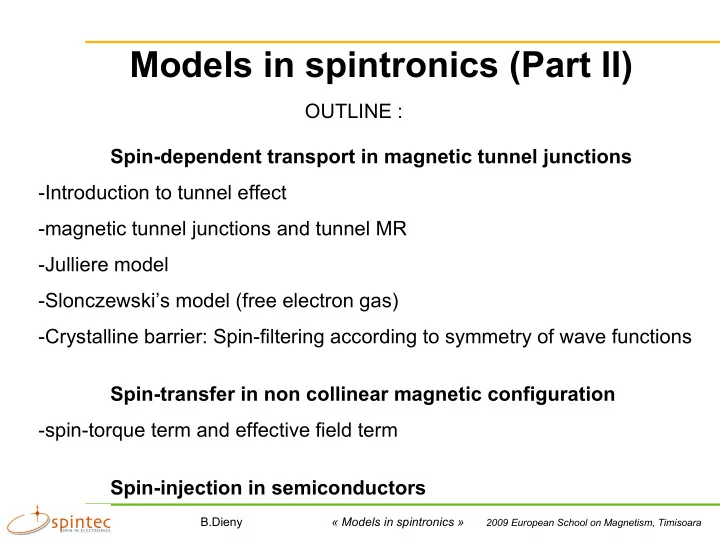
Models in spintronics (Part II)

OUTLINE : Spin-dependent transport in magnetic tunnel junctions

  • Introduction to tunnel effect
  • magnetic tunnel junctions and tunnel MR
  • Julliere model
  • Slonczewski’s model (free electron gas)
  • Crystalline barrier: Spin-filtering according to symmetry of wave functions

Spin-transfer in non collinear magnetic configuration

  • spin-torque term and effective field term

Spin-injection in semiconductors

slide-2
SLIDE 2

B.Dieny « Models in spintronics » 2009 European School on Magnetism, Timisoara

Magnetic tunnel junctions

Magnetic Tunnel junction

Reference layer :CoFe 3nm Storage layer: CoFe 4 nm IrMn 7nm Al2O3 barrier 1.5nm

  • r

NiFe CoFe Al(Zr)Ox CoFe IrMn NiFe Structure of a magnetic tunnel junction Acts as a couple polarizer/analyzer with the spin

  • f the electrons.
  • First observation of TMR at low T in MTJ:

Julliere (1975) (Fe/Ge/Co)

  • TMR at 300K :

Moodera et al, PRL (1995); Myazaki et al, JMMM(1995). in AlOx based junctions

R/R~50%

slide-3
SLIDE 3

B.Dieny « Models in spintronics » 2009 European School on Magnetism, Timisoara

Giant TMR of MgO tunnel barriers

S.S.P.Parkin et al, Nature Mat. (2004), nmat1256. S.Yuasa et al, Nature Mat. (2004), nmat 1257. Very well textured MgO barriers grown by sputtering or MBE on bcc CoFe or Fe magnetic electrodes, or on amorphous CoFeB electrodes followed by annealing to recrystallize the electrode.

Yuasa et al, APL89, 042505(2006)

slide-4
SLIDE 4

B.Dieny « Models in spintronics » 2009 European School on Magnetism, Timisoara

slide-5
SLIDE 5

B.Dieny « Models in spintronics » 2009 European School on Magnetism, Timisoara

M1 IF M2 V

  • P. LeClair et al.,
  • Appl. Phys. Lett. 80, 625 (2002)

Barrier height h is spin-dependent Tunnel current varies exponentially with Inject spin polarized electrons through spin-split insulator

2 , ,

2 

   

 mE 

) (

1

  

 

  t

e P

…… but T = 4.2 K (TcEuS ~ 16 K) Pinjectée ~ 90 % if M1, M2 normal metal ~ 130 % if M1 Gd (ferromagnetic)

with

e T<TC bias Eexch J J

h

EuS

Also magnetic oxides (Fe3O4, Fe2CoO4…)

Tunneling through magnetic insulators : spin filters

slide-6
SLIDE 6

B.Dieny « Models in spintronics » 2009 European School on Magnetism, Timisoara

Tunnel effect

Quantum mechanical origin

F

A classical particle cannot enter the barrier zone if F<E0 In quantum mechanics, electrons obey Schrödinger equation (1D model):

   E x V dx d m    ) ( 2

2 2 2

x

Off the barrier

  E dx d m  

2 2 2

2 

Plane waves

ikx

e  

2

2  mE k  

In the barrier

  ) ( 2

2 2 2

E E dx d m    

qx

e  

2

2  E m q   

Evanescent waves

slide-7
SLIDE 7

B.Dieny « Models in spintronics » 2009 European School on Magnetism, Timisoara

  • 1.5
  • 1
  • 0.5

0.5 1 1.5

  • 2
  • 1.5
  • 1
  • 0.5

0.5 1 1.5 2 2.5 3

Energy, Wave Function

x

Energy

ikx ikx

e re- +

ikx

te

x

e k

±

Tunneling through a simple rectangular barrier Continuity of wave function and derivative through interfaces

qx qx

Be Ae 

 x ik

te

2

x ik x ik

re e

1 1

   

q ik q ik k qe t

qa

  

 2 1

1

4

slide-8
SLIDE 8

B.Dieny « Models in spintronics » 2009 European School on Magnetism, Timisoara

Transmission through a simple rectangular barrier

  

2 2 2 2 2 2 2 *

1 1

16 k q k q k e q tt P

qa

   

Typically, E~1eV, m~free electron 1/q~0.2nm Tunnel barrier must be at most a few nm thick to get reasonable tunneling rate through it Probability of tunneling = t.t*

slide-9
SLIDE 9

B.Dieny « Models in spintronics » 2009 European School on Magnetism, Timisoara

Case of more general barrier

   E x V dx d m    ) ( 2

2 2 2

 

   ) ( ) ( 2

2 2 2 2

x q E x V m dx d    

W.K.B approximation:

 

x

du u q

e

) (

What is neglected?: ) ( ) ( ) ( x x q dx x d     dx x d x q x dx x dq dx x d ) ( ) ( ) ( ) ( ) (

2 2

      ) ( ) ( ) ( ) ( ) (

2 2 2

x x q x dx x dq dx x d      

 

2

) ( 2 ) (  E x V m x q   dx dq x q  ) (

2

WKB OK if i.e. smoothly varying barrier

slide-10
SLIDE 10

B.Dieny « Models in spintronics » 2009 European School on Magnetism, Timisoara

How to calculate electrical current through barrier? At zero bias voltage, same current from left to right and right to left. Need to apply a bias voltage, to create a dissymetry in tunneling current eV

F F F F

Je (V=0)=0

slide-11
SLIDE 11

B.Dieny « Models in spintronics » 2009 European School on Magnetism, Timisoara

How to calculate electrical current through barrier? Cont’d The probability for an electron to tunnel through the barrier is (WKB):

  

x

du u q

e tt E P

) ( 2 *

) (

// 3

) ( ) ( ² 4 dE E f dE E P h m dt dN

E x x

 

 

Electrical current:

 

// 3 1 2 2 1

) ( ) ( ) ( ² 4 dE eV E f E f dE E P h m e dt dN dt dN e J

E x x e

 

  

           

Nb of electrons tunneling per unit time:

Fermi-Dirac distribution

 

1 exp 1 ,            T k v r f

B F

   

slide-12
SLIDE 12

B.Dieny « Models in spintronics » 2009 European School on Magnetism, Timisoara

For low bias: still rectangular barrier

02 . 1 10

10 16 . 3

s

e s V J

 Linear J(V) at low bias

Approximate expressions of J(V) in free electron model

from Simons (1963)

F 0

s For intermediate bias 0<V<0: trapezoïdal barrier

F 0

s

                                                       

2 / 1 2 / 1 2 10

2 025 . 1 exp 2 2 025 . 1 exp 2 10 2 . 6 V s V V s V s J    

Conductance  when V  For large bias V>0: Fowler Nordheim

Injection in conduction band

F 0

s

slide-13
SLIDE 13

B.Dieny « Models in spintronics » 2009 European School on Magnetism, Timisoara

Exemple of experimental I(V) characteristics in tunnel junction

T.Dimopoulos et al

Dynamic conductance=dI/dV

Tunnel barrier of MgO

slide-14
SLIDE 14

B.Dieny « Models in spintronics » 2009 European School on Magnetism, Timisoara

eV

EF

EF

F

1

F

Insulator

) ( ) ( ) ( ) (

F F F F

E D E D E D E D P

   

  

2 1 2 1

1 2 P P P P R R TMR

P

   

Jullière,Phys. Lett. A54 225 (1975)

Parallel configuration

Ferro 1 Ferro 2 Isolant

Antiparallel configuration

) ( ) (

2 1 F F

E D E D J

  

 

Julliere model of TMR

   

 

2 1 2 1

D D D D J parallel

   

 

2 1 2 1

D D D D J

el antiparall

P~50% in Fe, Co R/R~40 - 70% with alumina barriers

) (

2 F f E

D f W i    P

Fermi Golden rule: proba of tunneling Nb of electrons candidate for tunneling

) (

F i E

D 

 tunneling current in each spin channel

2 1 2 1

1 2 P P P P R R TMR

AP

   

slide-15
SLIDE 15

B.Dieny « Models in spintronics » 2009 European School on Magnetism, Timisoara

Spin polarization of 3d metals

- Exchange spliting - half metallic gap  D(E) E D(E)  E

  • 1

1 2 300K

Intensité (u.a.)

E-EF (eV)

 spin up

 spin down

D(E) E D(E) E s(E) s(E)

Metals Half metals

NiMnSb (Ristoiu et al.) Half metals are 100% spin polarized !

Heussler alloys LaSrMnO3 Fe3O4 CrO2 … Parkin et al Photoemission intensity

slide-16
SLIDE 16

B.Dieny « Models in spintronics » 2009 European School on Magnetism, Timisoara

Slonczewski’s model (1989)

Model of band structure derived from M.B.Stearns JMMM 5, 167 (1977). Hybridization between s and d electrons. « Itinerant free electrons » ie free electrons (parabolic bands) but with band splitting.

Schrödinger equation solved for both spin channels assuming continuity of through the interfaces

q

dx d  and

  

2 ' 2 2 2 ' 2 2 '

16

    

k q k q k k e q J

qa

  

For each spin channel:

’ refer to spin state in the left and right electrodes

slide-17
SLIDE 17

B.Dieny « Models in spintronics » 2009 European School on Magnetism, Timisoara

Slonczewski’s model (1989) cont’d Spin  and spin  channels conduct in parallel:

   

    J J J J J J

el Antiparall Parallel

and

 

   

2 2 2 2 2 2 2 2

16            

      

k q k q k k q k k e q J J

qa el antiparall Parallel

Tunnel magnetoresistance:

² 2

1 2 P P J J J G G

parallel el antiparall Parallel Parallel

    

with

                    

        F F F F F F F F

k k q k k q k k k k P

2 2

slide-18
SLIDE 18

B.Dieny « Models in spintronics » 2009 European School on Magnetism, Timisoara

Slonczewski’s model (1989) cont’d

2

2  E m q   

Case of high barrier:

 



F F

k k q ,

   

  

F F F F

k k k k P

Free electrons:

k mk mE m E DOS   

2 2 2 3

2 ) (    

   

   D D D D P

Back to Julliere formula

In Julliere’s model, only the polarization within the magnetic electrodes influences the TMR. In slonczewski’s model, the barrier height also plays a role.

                    

        F F F F F F F F

k k q k k q k k k k P

2 2

² 2

1 2 P P G G R R

Parallel el Antiparall

    

slide-19
SLIDE 19

B.Dieny « Models in spintronics » 2009 European School on Magnetism, Timisoara

Utility of Julliere/Slonczewski Models

  • AlOx tunnel barriers are amorphous. In

amorphous materials, all electronic effects related to crystal symmetry are smeared out. Evanescent waves in alumina have “free like”

  • character. Free electrons model work OK in

this case.

  • These models semi-quantitatively account for

the relationship between bulk polarization of the electrodes and TMR in alumina based MTJ

  • However, they fail with crystalline barriers.

Additional band structures effect in the electrodes and barrier must be taken into account

slide-20
SLIDE 20

B.Dieny « Models in spintronics » 2009 European School on Magnetism, Timisoara

Fig.4 J. Hayakawa et al. Jap. J. Appl. Physics 2005 Also, Yuasa et al. Applied Physics Letters, 2005

Magnetic tunnel junctions based on MgO tunnel barriers

  • As-deposited, CoFeB amorphous, MgO polycristalline
  • Upon annealing, recrystallization of CoFeB from the MgO interfaces and

improvement in MgO crystallinity with (100) bcc texture

slide-21
SLIDE 21

B.Dieny « Models in spintronics » 2009 European School on Magnetism, Timisoara

Tunneling through crystalline MgO barriers (cont’d)

MgO barriers crystalline (bcc):

  • Evanescent waves have symmetries

respecting the crystal symmetry.

  • The evanescent wave vectors strongly

depends on the wave function symmetry gap Ab initio calculation from Butler et al.: Decay rate of 1 much smaller than decay rate of 5 or 2’. If the occupation of these various symmetries is spin-dependent, this provides a new mechanism for spin- filtering in MgO

slide-22
SLIDE 22

B.Dieny « Models in spintronics » 2009 European School on Magnetism, Timisoara

For bcc Fe, at EF in (001), the 1 symmetry Bloch state is only present for majority. bcc Fe ↑

majority only minority only

no minority 1

W.Butler, Alabama Univ

Tunneling through crystalline MgO barriers (cont’d)

in Fe

slide-23
SLIDE 23

B.Dieny « Models in spintronics » 2009 European School on Magnetism, Timisoara

“Tunneling DOS” for k|| = 0 depends strongly on symmetry of Bloch states in Fe. Tunneling through crystalline MgO barriers (cont’d)

  • Figures show the density of states (DOS) for electrons incident from the left in

a particular Bloch state for each atomic layer.

  • One particular majority band (1) readily enters the MgO and decays slowly

inside the MgO.

W.Butler, Alabama Univ

slide-24
SLIDE 24

B.Dieny « Models in spintronics » 2009 European School on Magnetism, Timisoara

  • Density of states on each atomic layer at k|| = 0 for FeCo/MgO/FeCo tunnel

junction (boundary condition is – single Bloch state incident from left).

Parallel Alignment of FeCo Moments Anti-Parallel Alignment of FeCo Moments

Layer number Layer number

Zhang and Butler PRB 70, 172407 (2004).

Majority bcc FeCo has only one band at the Fermi energy, a 1 band. There is no 5 band at Fermi energy – consequence even larger TMR!

W.Butler, Alabama Univ

Tunneling through crystalline MgO barriers (cont’d)

slide-25
SLIDE 25

B.Dieny « Models in spintronics » 2009 European School on Magnetism, Timisoara

Spin alignment up-up down- down up-down

  • r

down=up

GP/GAP

Fe|MgO|Fe

2.55 X10⁹ 7.08 X10⁷ 2.41 X10⁷ 54.3

Co|MgO|Co

8.62 X10⁸ 7.51 X10⁷ 3.60 X10⁶ 147.2

FeCo|MgO|FeCo

1.19 X10⁹ 2.55 X10⁶ 1.74 X10⁶ 353.5 The conductances above were calculated by integrating over the entire Fermi surface. They assumed 8 layers of MgO. Co|MgO|Co and CoFe|MgO|CoFe are predicted to show extremely high TMR for well ordered interfaces.

W.Butler, Alabama Univ

Tunneling through crystalline MgO barriers (cont’d)

slide-26
SLIDE 26

B.Dieny « Models in spintronics » 2009 European School on Magnetism, Timisoara

Summary on magnetic tunnel junctions Tunneling: a quantum effect TMR amplitude not only due to spin-polarization in the ferromagnetic electrodes but also to characteristics of the barrier. Influence of the barrier height Spin-dependent hybridization effects may take place at Ferro/oxide interface With crystalline barrier, spin-filtering effect according to symmetry of wave function. Very large TMR amplitude obtained with MgO barriers.

slide-27
SLIDE 27

B.Dieny « Models in spintronics » 2009 European School on Magnetism, Timisoara

Models in spintronics (Part II)

OUTLINE : Spin-dependent transport in magnetic tunnel junctions

  • Introduction to tunnel effect
  • magnetic tunnel junctions and tunnel MR
  • Julliere model
  • Slonczewski’s model (free electron gas)
  • Crystalline barrier: Spin-filtering according to symmetry of wave functions

Spin-transfer in non collinear magnetic configuration

  • spin-torque term and effective field term

Spin-injection in semiconductors

slide-28
SLIDE 28

B.Dieny « Models in spintronics » 2009 European School on Magnetism, Timisoara

Possibility to generate magnetic excitations or flip the magnetization in a magnetic thin film by a spin polarized current predicted by Slonczewski (JMMM.159, L1(1996)) and Berger (Phys.Rev.B54, 9359 (1996)). First experimental observation of magnetic excitations due to spin polarized current: M.Tsoi et al, Phys.Rev.Lett.80, 4281 (1998) and of current induced switching : Katine et al, Phys.Rev.Lett.84, 3149 (2000) on Co/Cu/Co sandwiches (Jc ~2-4.107A/cm²)

Spin transfer effect in CPP geometry

slide-29
SLIDE 29

B.Dieny « Models in spintronics » 2009 European School on Magnetism, Timisoara

M.D.Stiles et al, Phys.Rev.B.66, 014407 (2002)

Diffusive picture:

Conduction electron flow

Polarizing layer Free layer

Conduction electron flow

Polarizing layer Free layer

~1nm

Co Co Cu

Physical origin of Spin transfer

GMR, TMR: Acting on electrical current via the magnetization orientation Spin transfer is the reciprocal effect: Acting on the magnetization via the spin polarized current Reorientation of the direction of polarization of current via incoherent precession/relaxation of the electron spin around the local exchange field  Torque on the F magnetization

slide-30
SLIDE 30

B.Dieny « Models in spintronics » 2009 European School on Magnetism, Timisoara

Reorientation of the direction of polarization of the spin current as the spin polarized electrons penetrate in the magnetic layer :

Torque on F magnetization Ballistic QM picture:

Physical origin of Spin transfer (cont’d)

Schematic band structure of Cu/Co : Cu Co F Spin  Cu Co F Spin  Cu Co

transmitted reflected

slide-31
SLIDE 31

B.Dieny « Models in spintronics » 2009 European School on Magnetism, Timisoara

Physical origin of Spin transfer (sd model) Consider two populations of electrons:

  • 1)s conduction electrons (spin-polarized)
  • 2) d more localized electrons responsible for magnetization

The spin-polarized conduction electrons and localized d electrons interact by exchange interactions

) ( ) ( 2

2 d

.S σ 

sd

J r U m p H   

Hamiltonien of propagating s electrons:

In non-colinear geometry, exchange of angular momentum takes place between the two populations of electrons but total angular moment is conserved.

Kinetic Potential Exchange sd Pauli matrices vector

Unit vector//M

) , ( electrons s to due

  • n

Torque t r J sd

d

s S S

d 

 

s=local spin-density of s electrons

slide-32
SLIDE 32

B.Dieny « Models in spintronics » 2009 European School on Magnetism, Timisoara

Physical origin of Spin transfer (sd model) (cont’d)

Local spin density at r and t : Electron wave-function

) , ( t r  ) , ( 2 ) , ( ) , (

*

t r t r t r   σ s   

Temporal variation of local spin density:

            dt d dt d t r dt d σ σ s   

* *

2 ) , (

Schrödinger equation :

) , ( ) , ( t r H i t r dt d     

(1) (2)

Substitution (2) in (1) :

 

 

    σ σ s  

* *

2 1 ) , ( H H i t r dt d  

 

) , ( , ) , ( t r J t r t r dt d

sd

s S J s

d s

    

…

s

J

Is the spin density current 3x3 tensor Spin space x real space

   

 

t r t r m , , Im 2

* 2

 

r s

σ J           

 

) , ( ) , ( t r t r  

Precession of s spin density around Sd

slide-33
SLIDE 33

B.Dieny « Models in spintronics » 2009 European School on Magnetism, Timisoara

Physical origin of Spin transfer (sd model) (cont’d)

 

) , ( ,

  • rque

transfer t

  • Spin

t r J t r t

sd transfer

s S J S

d s d

       

In steady state (ballistic systems):

The exchange interaction between spin-polarized s electrons and more localized d electrons is responsible for spin-torque. This interaction yields a precessional motion of spin-density of s electrons around the local magnetization. In ballistic regime, the spin-transfer torque is also equal to the divergence of spin-current

In diffusive systems:

 

) , ( , t r J t r t

sd SF transfer

s S s J S

d s d

        

Takes into account the spin-memory loss by scattering with spin lifetime

SF

LLG equation for magnetization dynamics with spin-transfer torque:

t J t

B sd

                 

d d eff d d

S S m H S S    

slide-34
SLIDE 34

B.Dieny « Models in spintronics » 2009 European School on Magnetism, Timisoara

Physical origin of Spin transfer (sd model) (cont’d)

Tunnel barrier

m M T  

L B sd

J 

 

 

R L L y R L x B sd

m m J M M M M M T      

Perpendicular torque or interlayer exchange coupling (IEC) In-plane torque or Slonczewski torque mx, my can be fully calculated by solving Schrodinger equation in non-colinear geometry

slide-35
SLIDE 35

B.Dieny « Models in spintronics » 2009 European School on Magnetism, Timisoara

X(Å)

Out-of equilibrium magnetization due to tunneling electrons with normal incidence on the barrier

Physical origin of Spin transfer (sd model) (cont’d) X(Å)

Resulting local in-plane and perpendicular torque Coherent oscillations due to spin precession Damped oscillations due to averaging on incidence

Tunnel barrier Tunnel barrier

slide-36
SLIDE 36

B.Dieny « Models in spintronics » 2009 European School on Magnetism, Timisoara

Two terms in spin-transfer: perpendicular + in-plane torques

H

Precession from effective field Current-induced torque (Spin-torque) Damping torque (intrinsic Gilbert damping )

M

Effective field term (conserves energy) Gilbert Damping term Spin-torque term: ~damping (or antidamping) term

   

dt dM M M M M aI M bI H M dt dM

p p eff

            . .

a and b are coefficients proportional to the spin polarization of the current

Not conservative

Effective term seems weak in metallic pillars (~10% of spin-torque term) but more important in MTJ (~30 to 50% of ST term) ( Modified LLG)

slide-37
SLIDE 37

B.Dieny « Models in spintronics » 2009 European School on Magnetism, Timisoara

Current induced switching: experiments

Experiments conducted on nanopillars (d<150nm) to minimize Oersted field effect

Synthetic pinned layer Free layer

NiFe Cu

J

J>0 (electrons going from the pinned to free layer)

buffer

IrMn

AP2

AP1

(CoFe/Cu) laminated

Ru

J J

Cu

F

(CoFe/Cu) laminated

130nm H>0

x y z

Synthetic pinned layer Free layer

NiFe Cu

J

J>0 (electrons going from the pinned to free layer)

buffer

IrMn

AP2

AP1

(CoFe/Cu) laminated

Ru

J J

Cu

F

(CoFe/Cu) laminated

130nm H>0

x y z x y z

Samples from Headway

I = -0.4 mA 8,7 8,8 8,9 9 9,1

  • 400
  • 200

200 400 H(Oe) R(ohms) H = -4 Oe 8,7 8,8 8,9 9 9,1

  • 8
  • 4

4 8 I(mA) R(ohms) I = -0.4 mA 8,7 8,8 8,9 9 9,1

  • 400
  • 200

200 400 H(Oe) R(ohms) H = -4 Oe 8,7 8,8 8,9 9 9,1

  • 8
  • 4

4 8 I(mA) R(ohms)

Field scan Current scan

(jcAP-P = 1.18*107A/cm²) (jcP-AP = 1.95*107A/cm²) H>0 favors AP J>0 favors P

slide-38
SLIDE 38

B.Dieny « Models in spintronics » 2009 European School on Magnetism, Timisoara

  • 8
  • 6
  • 4
  • 2

2 4 6 8

  • 400
  • 300
  • 200
  • 100

100 200 300 400

H(Oe) I(mA)

I P-AP I AP-P I start I end Hp-ap Hap-p H start H end

H = -98 Oe 8,7 8,8 8,9 9 9,1

  • 8
  • 4

4 8 I(mA) R(ohms) I = -3 mA 8,7 8,8 8,9 9 9,1

  • 400
  • 200

200 400 H(Oe) R(ohms) H = -227 Oe 8,7 8,8 8,9 9 9,1

  • 8
  • 4

4 8 I(mA) R(ohms)

P AP P/AP

I = 3 mA 8,8 8,9 9 9,1 9,2

  • 400
  • 200

200 400 H(Oe) R(ohms)

Only P stable Only AP stable Both P/AP are stable (hysteresis) Nor P, nor AP are stable (excitations) Nor P, nor AP are stable (excitations)

Current induced switching: Stability phase diagram

slide-39
SLIDE 39

B.Dieny « Models in spintronics » 2009 European School on Magnetism, Timisoara

Static Dynamic (measured with spectrum analyzer)

2 4 6 8 10 0.05 0.10 0.15 0.20 0.25 0.30 0.35

Power (nV²/Hz) Frequency (GHz)

5mA 4.5mA 4mA 3.5mA 3mA 2.5mA

H = -9 Oe

2 4 6 8 10 0.05 0.10 0.15 0.20 0.25 0.30 0.35

Power (nV²/Hz) Frequency (GHz)

5mA 4.5mA 4mA 3.5mA 3mA 2.5mA

H = -9 Oe

Steady states excitations when field and spin-transfer torque have opposite influence

P AP

P/AP

excitations excitations

slide-40
SLIDE 40

B.Dieny « Models in spintronics » 2009 European School on Magnetism, Timisoara

In diffusive limit:

e

J div

 

 

1 l 2 1 l 2

2 2 sf 2 2 J

      m m M Jm       div Charge current and spin current in complex geometry

S.Zhang, et al, PRL 88, 236601 (2002); M.D. Stiles, A. Zangwill, J. Appl. Phys. 91 (2002) 6812; M.D. Stiles and A. Zangwill, Phys.

  • Rev. B 66, 014407, 2002; A. Shpiro, P.M. Levy, S. Zhang, Phys. Rev. B 67 (2003) 104430

Diffusion of charge (with conservation of charge) Diffusion of spin (without spin conservation due to spin-torque and spin- relaxation

Spin-torque :

 

m M T   

2 2 J

1 l 2   

Torque exerted by the local spin-accumulation on the local magnetization because of their exchange interaction 4 Unknowns: 4 Unknowns:

z y x

m m m 

4 Equations: 4 Equations:

1 diffusion of e + 3 diffusion of m Contains both Slonczewski (in-plane) and field-like (perpendicular) torque components lSF=spin-diffusion length lJ=spin-reorientation length

 

m M J         2 2

m

Charge current : Spin current :

 

m M Je     , 2 2    

slide-41
SLIDE 41

B.Dieny « Models in spintronics » 2009 European School on Magnetism, Timisoara

Approach built around a finite element solver. Calculation of the solutions of charge and spin-diffusion equations in FEM approximation

Finite element approach for solving transport equations

Cu Cu

M1 M2

100nm 100nm 100nm

Cu

in out 2D system

Cu Cu

M1 M2

100nm 100nm 100nm

Cu

in out 2D system

2D or 3D possible but 3D requires large computer memory Typically 20 000 nodes

slide-42
SLIDE 42

B.Dieny « Models in spintronics » 2009 European School on Magnetism, Timisoara

2D CPP structure with nanoconstriction

0.05 0.0

( Je,x, Je,y)

Cu 100nm /Co 3nm/Cu 2nm/Co 3nm/Cu 100nm

Mapping of voltage (color scale) and charge current (arrows)

0V 50mV Co3 Co3 Cu Cu Cu 2 10nm

slide-43
SLIDE 43

B.Dieny « Models in spintronics » 2009 European School on Magnetism, Timisoara

( Jm,yx, Jm,yy)

my

+9.50·10-4

  • 9.50·10-4

Parallel state

2D CPP structure with nanoconstriction

x y z y-spin-accumulation and y-spin-current

Cu Co Cu Co Cu

slide-44
SLIDE 44

B.Dieny « Models in spintronics » 2009 European School on Magnetism, Timisoara

my

+9.50·10-4

  • 9.50·10-4

Perpendicular state

2D CPP structure with nanoconstriction ( Jm,yx, Jm,yy)

x y z y-spin-accumulation and y-spin-current

Cu Co Cu Co Cu

slide-45
SLIDE 45

B.Dieny « Models in spintronics » 2009 European School on Magnetism, Timisoara

my

+9.50·10-4

  • 9.50·10-4

Antiparallel state

2D CPP structure with nanoconstriction ( Jm,yx, Jm,yy)

x y z y-spin-accumulation and y-spin-current

e e e e e e Very strong lateral spin  current converging to pinholevery large spin accumulation in pinhole Cu Co Cu Co Cu

slide-46
SLIDE 46

B.Dieny « Models in spintronics » 2009 European School on Magnetism, Timisoara

Streamline –charge current Streamline –spin current (Jm,yx, Jm,yy)

Antiparallel state

Striking apparition of vortices spin-current close to the antiparallel state Appears when large local spin-accumulation and long l

SF

compared to mean-free paths

Charge and y-spin currents in AP configuration

x y z

Cu Co Co Cu Cu Cu Co Co Cu Cu

slide-47
SLIDE 47

B.Dieny « Models in spintronics » 2009 European School on Magnetism, Timisoara

Multiple nanoconstrictions (spin-torque amplitude)

Color scale=in-plane spin-torque amplitude for 90° configuration Spin-torque exerted locally at the exit of pinholes. Aside from the pinhole, quiet magnetization which can quench the magnetic excitations generated by the spin-

  • torque. There is an optimum pinhole density.

CoCo

slide-48
SLIDE 48

B.Dieny « Models in spintronics » 2009 European School on Magnetism, Timisoara

Angular variation of CPP-GMR with nanoconstriction

No PH

20.5

PH 10nm

5.5

45 90 135 180 225 270 315 360 0,0 0,2 0,4 0,6 0,8 1,0 PH 10 nm no PH

reduuced resistance

angle (deg)

  

2 2

cos 1 cos 1    r

JC Slonczewski JMMM 247, 324 (2002)

1D

diam=10nm

Uniform current No particular features observed on angular variation of CPP-GMR associated with smooth/turbulent spin-current. Angular variation of CPP GMR through nanoconstriction well represented by Slonczewski’s expression

slide-49
SLIDE 49

B.Dieny « Models in spintronics » 2009 European School on Magnetism, Timisoara

45 90 135 180

  • 6,0x10
  • 6
  • 5,0x10
  • 6
  • 4,0x10
  • 6
  • 3,0x10
  • 6
  • 2,0x10
  • 6
  • 1,0x10
  • 6

0,0

Field-like torque noPH PH 10nm PH 2nm

mean value of the torque (au)

angle (deg)

45 90 135 180 0,00000 0,00005 0,00010 0,00015 0,00020 0,00025 0,00030

Torque Slonczewski noPH PH 10nm PH 2nm

mean value of the torque (au)

angle (deg)

Angular variation of spin-torque with nanoconstriction

 

               

2 sin 2 cos sin

2 1 2

    

JC Slonczewski JMMM 247, 324 (2002)

1.60

PH 2nm

2.30

PH 10nm

4.75

No PH

 1.60

PH 2nm

2.30

PH 10nm

4.75

No PH

In-plane torque Perpendicular torque

2 orders of magnitude smaller than in-plane T

diam=10nm diam=2nm

1D

diam=10nm diam=2nm Uniform current

slide-50
SLIDE 50

B.Dieny « Models in spintronics » 2009 European School on Magnetism, Timisoara

Summary on spin-transfer torque Due to exchange interactions between spin-polarized conduction electrons and those responsible to local magnetization. Two terms: in-plane torque + perpendicular torque In-plane torque acts as damping or antidamping. If antidamping action of spin-torque larger than Gilbert damping, spin- torque pumps energy into the spin-polarized current and can induce magnetization switching or steady magnetic excitations. Perpendicular torque acts as an effective field parallel to the spin polarization. Perpendicular torque negligible in metallic magnetic multilayers but ~30% of in-plane torque in MTJ

slide-51
SLIDE 51

B.Dieny « Models in spintronics » 2009 European School on Magnetism, Timisoara

Models in spintronics (Part II)

OUTLINE : Spin-dependent transport in magnetic tunnel junctions

  • Introduction to tunnel effect
  • magnetic tunnel junctions and tunnel MR
  • Julliere model
  • Slonczewski’s model (free electron gas)
  • Crystalline barrier: Spin-filtering according to symmetry of wave functions

Spin-transfer in non collinear magnetic configuration

  • spin-torque term and effective field term

Spin-injection in semiconductors

slide-52
SLIDE 52

B.Dieny « Models in spintronics » 2009 European School on Magnetism, Timisoara

Three terminal device : Spin rotation transistor

  • Spin polarized electrons are injected into the semiconductor channel
  • The spins are controlled by electric field (Rashba effect) or magnetic fields (id. MRAM) while

they drift along the channel

  • Spin-dependent collection at drain

Transconductance expected to oscillate with gate voltage

I I

Datta and Das, APL 1990

E 

V

Spin-injection into the semiconductor

Fe GaAs

Spin-detection Spin-manipulation (precession due to Rashba effect)

Fe

slide-53
SLIDE 53

B.Dieny « Models in spintronics » 2009 European School on Magnetism, Timisoara

J.Strand et al, Phys.Rev.Lett., 91, 036602 (2003) Spin-LED: recombination of spin-polarized electrons and holes in a AlGaAs/GaAs/ AlGaAs quantum well and emission of a circularly polarized photons. Measurement of the spin-polarization from the polarization of the emitted light. Weakly efficient spin injection directly from metal to semiconductor

Spin-polarization of only a few% observed when injecting from metal directly into a semiconductor

slide-54
SLIDE 54

B.Dieny « Models in spintronics » 2009 European School on Magnetism, Timisoara

ZnMnSe Efficient spin injection from magnetic semiconductor to non-mag. semiconductor

B.Jonker et al (2004)

Spin-polarization of injected electrons in GaAs: 82% at 4.5K! Efficient spin-injection from magnetic SC

Need to find magnetic SC with higher Tc

slide-55
SLIDE 55

B.Dieny « Models in spintronics » 2009 European School on Magnetism, Timisoara

Efficient spin injection from a ferromagnetic metal into a semiconductor through a tunnel barrier Luminescence polarization

T(K)

35% light polarization 70% spin polarization

Safarov et al (Marseille, 2006), Alvaredo et al (IBM Zurich, 2006)

slide-56
SLIDE 56

B.Dieny « Models in spintronics » 2009 European School on Magnetism, Timisoara

Weak spin-injection efficiency: Impedance mismatch issue

C.Schmidt et al, PRB 62, R4790 (2000); Rashba, PRB62, 16267 (2000)

V j j

RSC

RSC

RF RF

SC F

R R V j  

  SC F

R R V j  

 

1 2 2         

      SC SC F F F F

R R R R R R R j j j

Weak polarization because resistance of the stack fully dominated by spin- independent SC resistance. Even worse if spin-flip is taken into account.

Case of direct injection from ferromagnetic metal into semiconductor:

slide-57
SLIDE 57

B.Dieny « Models in spintronics » 2009 European School on Magnetism, Timisoara

Weak spin-injection efficiency: Impedance mismatch issue (cont’d)

V j j

Rb

Rb

RF RF RSC

RSC

   

SC b b F F b b F F

R R R R R R R R R j j j 2          

         

For

   

   

F F SC b b

R R R R R 2

 

             

          

F F F F F F F F b b b b

D D D D k k k k R R R R j j j

can be large

Case of injection from ferromagnetic metal into semiconductor through a tunnel barrier : Efficient spin-injection For free electrons

slide-58
SLIDE 58

B.Dieny « Models in spintronics » 2009 European School on Magnetism, Timisoara

Summary on injection

  • Poor spin-injection from ferromagnetic metal directly into SC
  • Efficient spin-injection from magnetic SC into non–magnetic SC
  • Efficient spin-injection from magnetic metal into non–magnetic SC

through a tunnel barrier

slide-59
SLIDE 59

B.Dieny « Models in spintronics » 2009 European School on Magnetism, Timisoara