Tunneling and Gateways Tunneling and Gateways Examples Gateways - - PDF document

tunneling and gateways tunneling and gateways
SMART_READER_LITE
LIVE PREVIEW

Tunneling and Gateways Tunneling and Gateways Examples Gateways - - PDF document

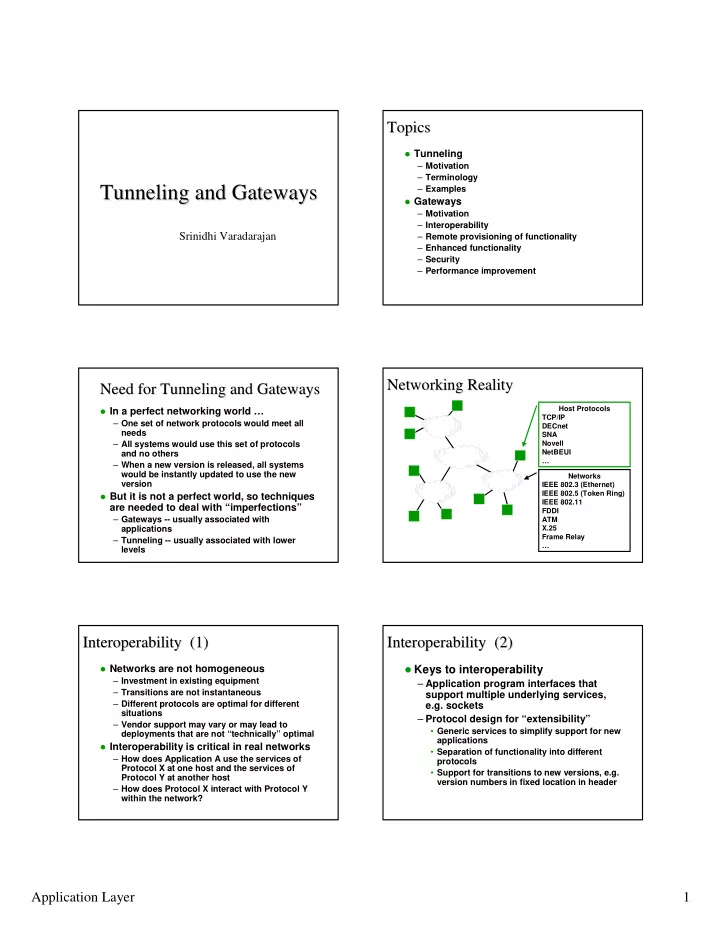
Topics Topics Tunneling Motivation Terminology Tunneling and Gateways Tunneling and Gateways Examples Gateways Motivation Interoperability Srinidhi Varadarajan Remote provisioning of functionality Enhanced


slide-1
SLIDE 1

Application Layer 1

Tunneling and Gateways Tunneling and Gateways

Srinidhi Varadarajan

Topics Topics

Tunneling

– Motivation – Terminology – Examples

Gateways

– Motivation – Interoperability – Remote provisioning of functionality – Enhanced functionality – Security – Performance improvement

Need for Tunneling and Gateways Need for Tunneling and Gateways

In a perfect networking world …

– One set of network protocols would meet all needs – All systems would use this set of protocols and no others – When a new version is released, all systems would be instantly updated to use the new version

But it is not a perfect world, so techniques

are needed to deal with “imperfections”

– Gateways -- usually associated with applications – Tunneling -- usually associated with lower levels Backbone

Networking Reality Networking Reality

Networks IEEE 802.3 (Ethernet) IEEE 802.5 (Token Ring) IEEE 802.11 FDDI ATM X.25 Frame Relay … Host Protocols TCP/IP DECnet SNA Novell NetBEUI …

Internet Internet Internet

Interoperability (1) Interoperability (1)

Networks are not homogeneous

– Investment in existing equipment – Transitions are not instantaneous – Different protocols are optimal for different situations – Vendor support may vary or may lead to deployments that are not “technically” optimal

Interoperability is critical in real networks

– How does Application A use the services of Protocol X at one host and the services of Protocol Y at another host – How does Protocol X interact with Protocol Y within the network?

Interoperability (2) Interoperability (2)

Keys to interoperability

– Application program interfaces that support multiple underlying services, e.g. sockets – Protocol design for “extensibility”

  • Generic services to simplify support for new

applications

  • Separation of functionality into different

protocols

  • Support for transitions to new versions, e.g.

version numbers in fixed location in header

slide-2
SLIDE 2

Application Layer 2

Terminology Terminology

Gateways: Provide some form of translation

between protocols at the same level

– Translate Protocol X protocol data units (PDUs) to Protocol Y protocol data units Tunneling: Use a service (at the same “level”) to

carry another service

– Use Protocol Y to carry Protocol X protocol data units Encapsulation: Using a lower layer service These terms are often used interchangeably and

with different meanings

Encapsulation Encapsulation

Protocol X PDU Protocol A PDU Protocol A PDU Protocol X PDU

Encapsulation is simply the use of a lower

level protocol data units (e.g., IEEE 802.3 frames) to carry higher layer protocol data units (e.g, IP datagrams)

Tunneling Tunneling

Tunneling uses an alternate protocol to

carry protocol data units of another protocol at the same level. Example: using IPV4 to carry IPv6 packets

Protocol X Protocol Y Protocol X encapsulates “decapsulates”

Gateways Gateways

A gateway translates from one protocol to

another, e.g. from SMTP to cc:mail.

Protocol X Protocol Y Gateway

Physical Layer Interoperability Physical Layer Interoperability

Different physical media dependent (PMD)

protocols are common

A translation is done, but the “gateway”

device is called a repeater or hub

IEEE 802.3 10Base2 (Thinwire Ethernet) IEEE 802.3 10BaseT (Twisted-pair Ethernet) Hub

MAC Layer Interoperability (1) MAC Layer Interoperability (1)

Different medium access control (MAC)

protocols are also common

– IEEE 802.2 Logical Link Control (LLC) protocol is commonly used with most MAC protocols

Interoperability provided through

– Translation -- supports communication between Protocol X host and Protocol Y host – Encapsulation -- end points must both use Protocol X, but can travel over an intermediate Protocol Y network

Example

– IEEE 802.3 (Ethernet) – Fiber Distributed Data Interface (FDDI)

slide-3
SLIDE 3

Application Layer 3

MAC Layer Interoperability (2) MAC Layer Interoperability (2)

FDDI IEEE 802.3 10Base2 Transparent Bridge FDDI PDU IEEE 802.3 PDU

MAC Layer Interoperability (3) MAC Layer Interoperability (3)

FDDI IEEE 802.3 10Base2 Encapsulating Bridge Encapsulating Bridge IEEE 802.3 PDU IEEE 802.3 PDU FDDI PDU

Network Layer Interoperability (1) Network Layer Interoperability (1)

Network layer interoperability is needed

for

– Transition between versions, e.g. IPv4 to IPv6 – Enhanced functionality, e.g. multicast services provided by the Multicast Backbone (MBONE) – Different routing protocols

Co-existence is related to interoperability

– Multiple network protocols, e.g. IPX and IP, can run over the same local area network, e.g. Ethernet – Multi-protocol routers can route different types

  • f network layer protocol data units

IPv4

Network Layer Interoperability (2) Network Layer Interoperability (2)

6Bone supports IPv6 connectivity across

IPv4 networks

Addressing

Manual configuration Auto-configure

IPv6 IPv6 IPv6

IPv6 IPv6 IPv6 IPv4 PDU

Application Layer Interoperability (1) Application Layer Interoperability (1)

Different applications using different

protocols must also interact

Gateways -- translate between different

applications providing the same service

– Mail services using cc:Mail and SMTP (Simple Mail Transfer Protocol)

Tunneling -- allow the use of different a

underlying network

– UDP- or TCP-based applications over an IPX network

Application Layer Interoperability (2) Application Layer Interoperability (2)

Mail A/B Gateway Mail B (server) Mail A (client)

Application gateway allows different

applications to interoperate

slide-4
SLIDE 4

Application Layer 4

Application Layer Interoperability (3) Application Layer Interoperability (3)

Application-level tunneling allows an application

designed for Protocol X to operate over a network that supports only Protocol Y Protocol X Client Application Socket Simulation Library OS with support for Protocol Y Protocol X Client Application Socket Simulation Library OS with support for Protocol Y Net Y

Application Gateways Application Gateways

An application gateway relays information

between a client and a desired service

– Gateway, in this context, is a program – The host running the program may be referred to as a gateway

An edge router may also be referred to as

a gateway (from a LAN to a WAN), but this is a different use of the term

Uses of an Application Gateway Uses of an Application Gateway

Interoperability

– Different applications providing similar service – Different versions of the same service

Support for clients with limited

functionality

– Move complexity to the gateway

Enhanced services

– Extending the functionality of a given protocol

Security

– Firewalls

Enhance performance

– Implement caching at the gateway

Interoperability Interoperability

Gateways can provide interoperability Example of need: electronic mail

– Internet

  • Simple Mail Transfer Protocol (SMTP)
  • Post Office Protocol (POP)
  • Internet Message Access Protocol (IMAP)

– Historical

  • BITNET
  • USENET

– Proprietary

  • cc:mail
  • MCI Mail
  • others …

Mail Interoperability (1) Mail Interoperability (1)

Gateway allows mail to be

exchanged between different types

  • f clients and servers

Gateway must deal with

– Format – Content representation – Addressing

Mail Interoperability (2) Mail Interoperability (2)

Mail A Gateway Mail B Client Mail A Client Mail B Server

Mail gateway

  • ften associated

directly with a server

slide-5
SLIDE 5

Application Layer 5

Clients With Limited Functionality Clients With Limited Functionality

Clients may not need full functionality

– Complexity – Cost – Security – Ease-of-use (emphasis on user interface)

Clients may not be able to provide full

functionality

– Handheld devices

SMTP with POP or IMAP SMTP with POP or IMAP

SMTP is used to move mail through the Internet POP or IMAP is a simpler client-server protocol

just for a mail access POP3 Client IMAP Client POP3 Server SMTP IMAP Server SMTP

AT&T Wireless Internet Mail Gateway AT&T Wireless Internet Mail Gateway

A gateway can be used to deliver mail to

very simple devices over a network other than the Internet

POP3 Client POP3 Server SMTP Mail Gateway SMTP PCS Network Internet

Enhanced Services Enhanced Services

The functionality of a protocol can be

extended by a gateway

– Client uses Protocol X to access the gateway – The gateway can then service client request using Protocol Y

Common Gateway Interface (CGI) at a

WWW server is an example of such an application gateway

– Invokes a gateway program or script – CGI defines

  • Invocation mechanism
  • Reply mechanism

Common Gateway Interface (1) Common Gateway Interface (1)

CGI operation

– Client uses HTTP to transfer request to server – Server extracts request and invokes a gateway program (defined by CGI) – Gateway program processes request, possibly accessing a remote service – Gateway program returns result to server (defined by CGI) – Server returns result to clients using HTTP

Common Gateway Interface (2) Common Gateway Interface (2)

(1) URL, param (5) HTML, text, … (2) CGI (4) HTML, text, … Web Browser HTTP Server Gateway Program (3) Process

slide-6
SLIDE 6

Application Layer 6

Common Gateway Interface (3) Common Gateway Interface (3)

http://xyz.vt.edu/cgi-bin/finger?xyz@cs.vt.edu HTML or text HTML or text finger request finger reply HTTP Server Finger Gateway Finger Server HTTP request Web Browser

Security Security

Possible security functions of a gateway

– Separate networks for security levels – Control access of external hosts to internal resources – Control access of internal hosts to external resources

Such a security gateway is a “firewall”

– Firewall examines IP datagrams between a client and server to enforce a site security policy

  • Expressly permitted
  • Expressly prohibited

Firewall Topologies (1) Firewall Topologies (1)

Dual-homed firewall

– No routed path between external and internal hosts -- bidirectional protection – Firewall must act as a proxy for all interactions – Proxy can require authentication, limit hosts, limit ports, etc. Host Firewall Host Internal External Internet LAN (Intranet)

Firewall Topologies (2) Firewall Topologies (2)

Screened-host firewall

– Router configured so that the firewall is the only reachable host from outside the LAN – Router may be varied to …

  • Allow connections initiated internally to go

to any/limited set of external hosts

  • Limit traffic to firewall
  • Allow incoming traffic to some internal

hosts, e.g. WWW server

Firewall Topologies (3) Firewall Topologies (3)

Host Router Host Internal External Firewall Internet LAN (Intranet)

Improving Performance Improving Performance

Caching can improve the performance of

the World Wide Web

– Client-based

  • Post-fetch (in standard clients)
  • Pre-fetch (not in standard clients)

– Server-based

  • Caching of frequently accessed files

– Proxy-based

  • Caching of frequently accessed files

A proxy is a form of application gateway

– Performance by caching – Security as a firewall

slide-7
SLIDE 7

Application Layer 7

You should now be able to … You should now be able to …

Define and provide examples at different

protocol levels of

– Encapsulation – Tunneling – Gateways

Describe uses of application gateways

and provide examples of different uses

Describe the architecture of example

application gateways