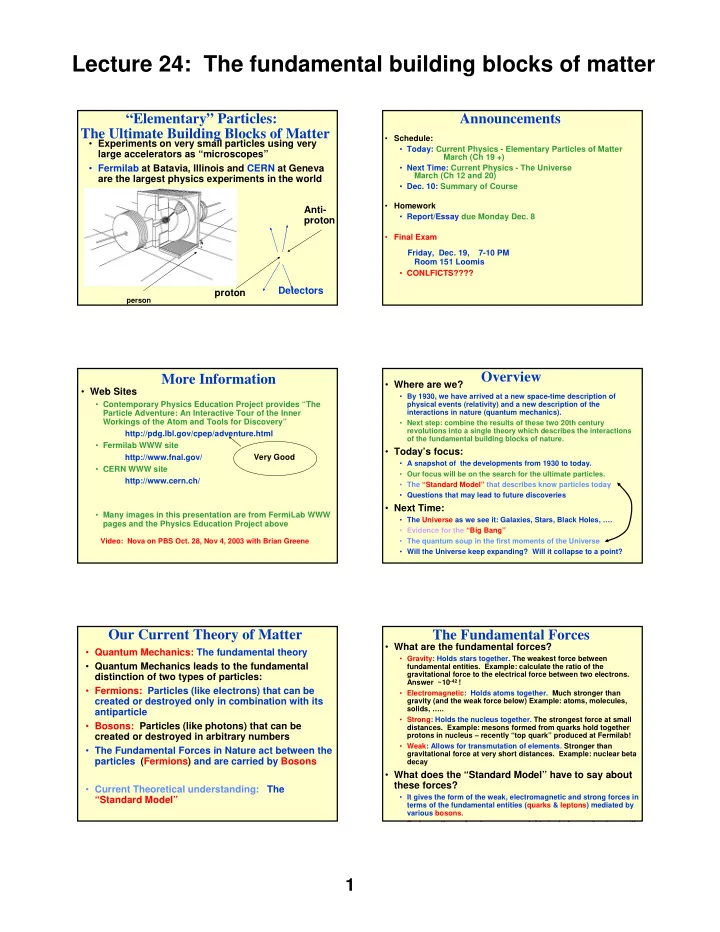
Lecture 24: The fundamental building blocks of matter Elementary - - PDF document

lecture 24 the fundamental building blocks of matter
SMART_READER_LITE
LIVE PREVIEW

Lecture 24: The fundamental building blocks of matter Elementary - - PDF document

Lecture 24: The fundamental building blocks of matter Elementary Particles: Announcements The Ultimate Building Blocks of Matter Schedule: Experiments on very small particles using very Today: Current Physics - Elementary


slide-1
SLIDE 1

Lecture 24: The fundamental building blocks of matter

1

“Elementary” Particles: The Ultimate Building Blocks of Matter

  • Experiments on very small particles using very

large accelerators as “microscopes”

  • Fermilab at Batavia, Illinois and CERN at Geneva

are the largest physics experiments in the world Anti- proton proton Detectors

person

Announcements

  • Schedule:
  • Today: Current Physics - Elementary Particles of Matter

March (Ch 19 +)

  • Next Time: Current Physics - The Universe

March (Ch 12 and 20)

  • Dec. 10: Summary of Course
  • Homework
  • Report/Essay due Monday Dec. 8
  • Final Exam

Friday, Dec. 19, 7-10 PM Room 151 Loomis

  • CONLFICTS????

More Information

  • Web Sites
  • Contemporary Physics Education Project provides “The

Particle Adventure: An Interactive Tour of the Inner Workings of the Atom and Tools for Discovery” http://pdg.lbl.gov/cpep/adventure.html

  • Fermilab WWW site

http://www.fnal.gov/

  • CERN WWW site

http://www.cern.ch/

  • Many images in this presentation are from FermiLab WWW

pages and the Physics Education Project above Very Good

Video: Nova on PBS Oct. 28, Nov 4, 2003 with Brian Greene

Overview

  • Where are we?
  • By 1930, we have arrived at a new space-time description of

physical events (relativity) and a new description of the interactions in nature (quantum mechanics).

  • Next step: combine the results of these two 20th century

revolutions into a single theory which describes the interactions

  • f the fundamental building blocks of nature.
  • Today’s focus:
  • A snapshot of the developments from 1930 to today.
  • Our focus will be on the search for the ultimate particles.
  • The “Standard Model” that describes know particles today
  • Questions that may lead to future discoveries
  • Next Time:
  • The Universe as we see it: Galaxies, Stars, Black Holes, ….
  • Evidence for the “Big Bang”
  • The quantum soup in the first moments of the Universe
  • Will the Universe keep expanding? Will it collapse to a point?

Our Current Theory of Matter

  • Quantum Mechanics: The fundamental theory
  • Quantum Mechanics leads to the fundamental

distinction of two types of particles:

  • Fermions: Particles (like electrons) that can be

created or destroyed only in combination with its antiparticle

  • Bosons: Particles (like photons) that can be

created or destroyed in arbitrary numbers

  • The Fundamental Forces in Nature act between the

particles (Fermions) and are carried by Bosons

  • Current Theoretical understanding:

The “Standard Model”

The Fundamental Forces

  • What are the fundamental forces?
  • Gravity: Holds stars together. The weakest force between

fundamental entities. Example: calculate the ratio of the gravitational force to the electrical force between two electrons. Answer ~10-42 !

  • Electromagnetic: Holds atoms together. Much stronger than

gravity (and the weak force below) Example: atoms, molecules, solids, …..

  • Strong: Holds the nucleus together. The strongest force at small
  • distances. Example: mesons formed from quarks hold together

protons in nucleus – recently “top quark” produced at Fermilab!

  • Weak: Allows for transmutation of elements. Stronger than

gravitational force at very short distances. Example: nuclear beta decay

  • What does the “Standard Model” have to say about

these forces?

  • It gives the form of the weak, electromagnetic and strong forces in

terms of the fundamental entities (quarks & leptons) mediated by various bosons. S f th h b f l t i l d it l ith

slide-2
SLIDE 2

Lecture 24: The fundamental building blocks of matter

2

Constituents of the Atom

  • Atoms as understood in 1930:
  • electrons, negatively charged “particles” described in terms of

quantum states (solutions to Schrodinger’s equation).

  • protons, the heavy positive nucleus of the hydrogen atom
  • nuclei, positively charged (must be composed of something more

fundamental from which are made the many nuclei observed)

  • 1932: Chadwick observes a penetrating neutral radiation

produced in the collision of alpha particles with berylium, the neutron, whose mass is close to that of the proton.

  • Great success & simple picture:
  • All elements are composed of three

constituents, electrons, protons and neutrons. One other fundamental entity, the photon (the quantum of electromagnetic radiation) is produced when electrons change states in the atom.

  • A given element is defined in terms of how many electrons (which

equals the number of protons) it has. Different isotopes correspond to different numbers of neutrons in the nucleus.

Nucleus

1930’s

  • Hitler comes to power in 1933
  • German Science in Turmoil - “Jewish Science”

forbidden, . . .

  • Einstein happens to be on a visit to Princeton ---

which becomes his home for the rest of his life

  • Scientists flee - Fermi, Szilard, Teller, . . .
  • America becomes the center of science research in

the world

  • Great progress in areas of quantum mechanics, but

not the revolutionary advances of the 1920’s

Nuclear Energy

  • The Discovery of the Neutron (1932) in England

paved the way for the release of nuclear energy

  • Nuclei are neutrons and protons bound by nuclear forces
  • Adding particles to make heavier nuclei increases stability up to a

point

  • For nuclei heavier than iron (Fe) stability decreases
  • Very heavy nuclei may decay to nuclei like Fe and release energy

Heavy Nucleus Lighter Nucleus Lighter Nucleus Free Neutrons Fission Kinetic Energy!

The Chain Reaction and the Release of Nuclear Energy

  • Discovered in Berlin in 1938
  • December 2, 1942, First Controlled Chain Reaction
  • Beneath Stagg Field, University of Chicago

Team led by Enrico Fermi

  • Led to the Manhattan Project

neutron + 235U Lighter nuclei + neutrons + energy

Lighter Nucleus Lighter Nucleus Neutron Kinetic Energy!

235U 235U

Neutron

Anything Else?

  • Anti-matter
  • Paul Dirac (1927) made the first successful combination of

relativity & quantum mechanics. Predicted that for every particle there is an an anti-particle

  • In 1933, Anderson used a cloud chamber to study the naturally
  • ccurring cosmic rays. Discovered the “positron”, the anti-

particle of the electron.

  • Now other antiparticles are known: anti-protons, ….
  • More
  • In 1937, Anderson & Neddermeyer discovered another new kind
  • f particle in cosmic rays. This particle, now called the muon,

like an electron, but heavier.

  • Then the pion, which decayed into a muon plus another particle

(neutrino) assumed to exist to conserve energy. Neutrino interactions were not seen until 1962.

And still more!

  • Many new particles were discovered with the advent
  • f particle accelerators in the 1950’s (e.g., the

Cosmotron at Brookhaven, the Bevatron at Berkeley).

  • Baryons: particles with lifetimes ~ 10-10 seconds, ultimately

decaying to protons. Anti-particles also seen (anti-proton in 1955)

  • Λ0, Σ+, Σ -, Σ0, Ξ-, Ξ0
  • Mesons: particles with lifetimes ~ 10-8 seconds, typically lighter

than the proton and never decaying into protons.

  • K+, K- , K0
  • Resonances: Extremely short-lived (~10-25 sec). Not seen directly

but existence inferred.

  • Baryons: Total = 53 (Ν, ∆, Λ, Σ, Ξ, Ω)
  • Mesons: Total = 25 (ρ, ω, φ, η, K*...)
  • Too many particles to all be “elementary” - must be

some underlying pattern!

slide-3
SLIDE 3

Lecture 24: The fundamental building blocks of matter

3

Quarks: Charge +/- 1/3, 2/3 e

  • Proposed by Gellman and Zweig, 1963
  • Hadrons (protons, neutrons, ...) are

made of combinations of “quarks”: u(up), d(down) & s(strange)

  • Mesons: quark-antiquark

eg π+ = ud, K+ = us

  • Baryons: quark-quark-quark

eg p = uud, Ω- = sss

  • Neutron:

(u d d) charge = 2/3 - 1/3 - 1/3 = 0

  • Proton:

(u u d) charge = 2/3 + 2/3 - 1/3 = 1 Great success! Particles grouped in families made of

  • quarks. No extra particles!

Scale of Sizes More Quarks?

  • November, 1974: J/Ψ particle discovered which

doesn’t fit!

  • Interpretation: evidence for new quark: c (charm). J/Ψ = cc
  • Similar case in 1977: Υ(Upsilon) particle discovered.
  • Interpretation: evidence for new quark: b (bottom). Y = bb
  • Five quarks in 1993. The b quark partner was missing!
  • Search for the top quark. Discovery in 1995 by CDF

experiment at Fermilab. UIUC important collaborator.

The CDF Experiment

  • CDF detects what is produced when high energy

(900 GeV) protons and anti-protons collide.

  • Momenta of charged particles determined by curvature in a

magnetic field.

  • Energies of particles determined by energy deposition in

calorimeter (measures heat).

  • All particles detected except neutrinos.

The Top Quark Discovery

  • Observe the “Jets” of particles that are decay

products of the fleeting existence of a single quark CDF event display showing fully reconstructed decay of a B meson to a J/psi and a K*. Detailed view of reconstructed charged tracks near the event vertex of a top quark decay in CDF. Quark

Our Current Theory: The Standard Model

  • Baryons (including protons, neutrons, and mesons)

are made up of quarks bound together by gluons

  • Quarks and Leptons come in pairs (e.g., an electron

and its neutrino νe)

  • Fermions: Quarks, Leptons

(e.g. electrons)

  • Bosons: Force Carriers

(e.g. photons)

  • Only the quarks feel the effects
  • f the strong nuclear force.

Quarks and leptons feel the weak nuclear force. All particles that have electric charge feel the electromagnetic force.

slide-4
SLIDE 4

Lecture 24: The fundamental building blocks of matter

4

Search for the Ultimate Theory

  • The “Theory of everything”
  • Combine quantum theory

Quarks, Leptons (electrons), photons, with Gravity (Einstein’s theory of space-time)

  • String theory!

Everything is made of strings “Curled up” dimensions

quark electron photon Video: Nova on PBS Oct. 28, Nov 4, 2003 with Brian Greene

Comments & Questions

  • The Standard Model gives a unified description of

the strong, weak & electromagnetic interactions and the fundamental fermions (quarks & leptons)

  • All known forces are included except gravity
  • What more can we want to know?
  • Are there more generations of particles to come?
  • Why is out universe made mainly of matter and not

antimatter?

  • Why do some of the fundamental particles have mass?
  • Do neutrinos have mass? A current question bearing on

the universe! (Nobel Prize in 2002)

  • Unified “theory of everything”? String theory?
  • Connections with cosmology.
  • If the universe started from a Big Bang, then the first second on

the life of the universe were a hot quantum soup of these particles! More about this next time.

Summary

  • Fundamental Forces
  • Gravity, Electromagnetic, Strong, Weak
  • Fundamental Particles
  • Fermions: Quarks, Leptons
  • Bosons: Force Carriers like the photon, gluon
  • Electrons are leptons; Neutrons, Protons are made
  • f quarks
  • Forces transmitted by exchange of quanta of the

force carriers

  • The “Standard Model” is the present unified theory
  • f all forces except gravity
  • Attempts to make the “Theory of Everything” lead to

strange “strings” far beyond the reach of current experiments

  • Future??