Blocks What is syntax (delimiters) Where can blocks be used Scope - - PowerPoint PPT Presentation

blocks
SMART_READER_LITE
LIVE PREVIEW

Blocks What is syntax (delimiters) Where can blocks be used Scope - - PowerPoint PPT Presentation

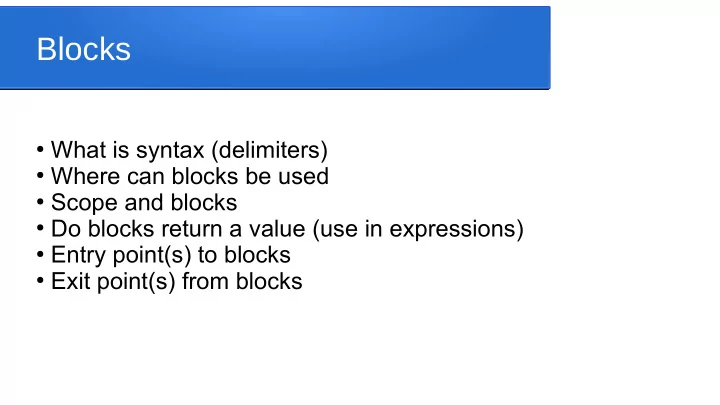
Blocks What is syntax (delimiters) Where can blocks be used Scope and blocks Do blocks return a value (use in expressions) Entry point(s) to blocks Exit point(s) from blocks Block syntax and use Typically need start/stop


slide-1
SLIDE 1

Blocks

  • What is syntax (delimiters)
  • Where can blocks be used
  • Scope and blocks
  • Do blocks return a value (use in expressions)
  • Entry point(s) to blocks
  • Exit point(s) from blocks
slide-2
SLIDE 2

Block syntax and use

  • Typically need start/stop delimiters, e.g. { }, begin end,

indentation level, etc. Again, one of the most recognizable aspects of language syntax

  • Can blocks be used anywhere you could use a single

statement, or are blocks implicitly used as parts of more complex control structures (loops, if statements, etc)?

  • Do blocks have a return value, i.e. can you use them in an

expression, and how do they return a value (syntax)?

slide-3
SLIDE 3

Block scope

  • Does each block have its own scope?
  • If so, what are the nesting rules (e.g. lexical or dynamic,

how are overlapping scope refereces handled)?

  • Are the rules consistent across all types of block (e.g. the

same in if statements as loops, and as in switch statements, etc)?

slide-4
SLIDE 4

Exit point(s)

  • At what points can you leave a block? E.g. return

statements, break statements, after executing last statement in block, etc)

  • Is there a last/final mechanism to specify actions that are

always applied when leaving the block, regardless of which exit point was used?

slide-5
SLIDE 5

Entry points

  • Most loops have a unique first instruction that is executed

upon entering loop (typically the “top” instruction in the loop)

  • Is it possible to have multiple entry points to a loop, a

variety of places you could jump in to and start at? If so, what happens if some of those entry points “skip” instructions like variable declarations/initializations (see C switch example)?