W4231: Analysis of Algorithms A trivial example 9/23/1999 An array - - PDF document

w4231 analysis of algorithms
SMART_READER_LITE
LIVE PREVIEW

W4231: Analysis of Algorithms A trivial example 9/23/1999 An array - - PDF document

W4231: Analysis of Algorithms A trivial example 9/23/1999 An array of integers a 1 a n is given such that 1 a i n and all the elements are distinct. Sorting in linear time (sometimes). Solution: output 1 , . . . , n .


slide-1
SLIDE 1

W4231: Analysis of Algorithms

9/23/1999

  • Sorting in linear time (sometimes).

– COMSW4231, Analysis of Algorithms – 1

A trivial example

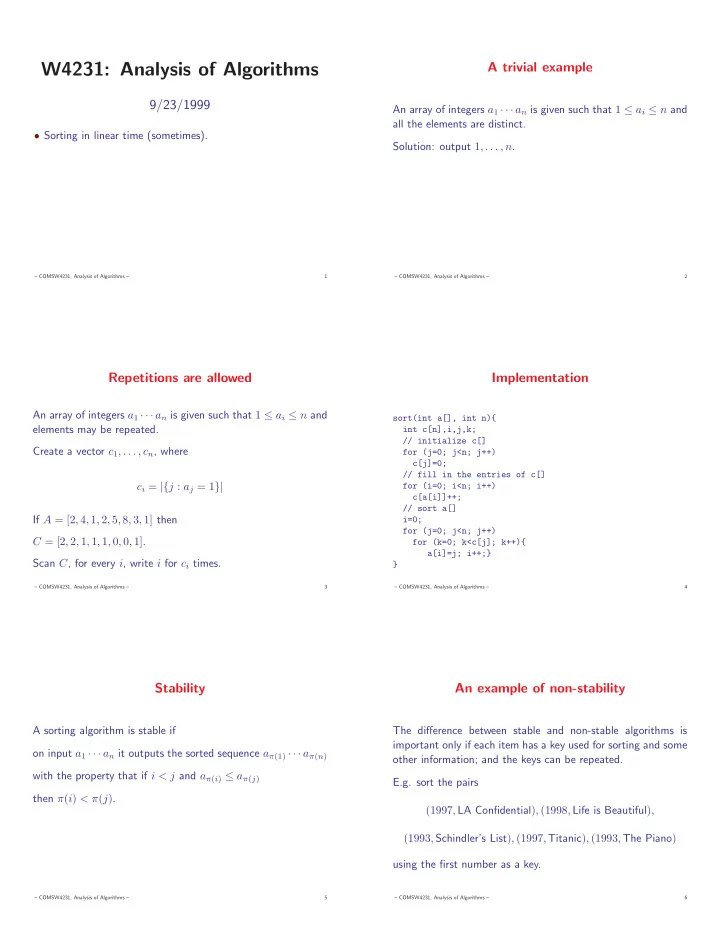
An array of integers a1 · · · an is given such that 1 ≤ ai ≤ n and all the elements are distinct. Solution: output 1, . . . , n.

– COMSW4231, Analysis of Algorithms – 2

Repetitions are allowed

An array of integers a1 · · · an is given such that 1 ≤ ai ≤ n and elements may be repeated. Create a vector c1, . . . , cn, where ci = |{j : aj = 1}| If A = [2, 4, 1, 2, 5, 8, 3, 1] then C = [2, 2, 1, 1, 1, 0, 0, 1]. Scan C, for every i, write i for ci times.

– COMSW4231, Analysis of Algorithms – 3

Implementation

sort(int a[], int n){ int c[n],i,j,k; // initialize c[] for (j=0; j<n; j++) c[j]=0; // fill in the entries of c[] for (i=0; i<n; i++) c[a[i]]++; // sort a[] i=0; for (j=0; j<n; j++) for (k=0; k<c[j]; k++){ a[i]=j; i++;} }

– COMSW4231, Analysis of Algorithms – 4

Stability

A sorting algorithm is stable if

  • n input a1 · · · an it outputs the sorted sequence aπ(1) · · · aπ(n)

with the property that if i < j and aπ(i) ≤ aπ(j) then π(i) < π(j).

– COMSW4231, Analysis of Algorithms – 5

An example of non-stability

The difference between stable and non-stable algorithms is important only if each item has a key used for sorting and some

  • ther information; and the keys can be repeated.

E.g. sort the pairs (1997, LA Confidential), (1998, Life is Beautiful), (1993, Schindler’s List), (1997, Titanic), (1993, The Piano) using the first number as a key.

– COMSW4231, Analysis of Algorithms – 6

slide-2
SLIDE 2

If the algorithm reports (1993, Schindler’s List), (1993, The Piano), (1997, Titanic), (1997, LA Confidential), (1998, Life is Beautiful) Then it is not stable

– COMSW4231, Analysis of Algorithms – 7

A Stable Version of Counting Sort

Each cj is a queue. For every i, we copy ai in the queue cj, where j is the key of ai. At the end we patch the queues together. Impossible to have an inversion. Alternative method in CLR.

– COMSW4231, Analysis of Algorithms – 8

Analysis

Let cj be the number of items of key j. Then m

j=1 cj = n.

Running time; O(m) to initialize c; O(n) to fill c; m

j=1 O(cj)+

O(1) = O(

j cj)+O(m) = O(m+n) total time is O(n+m).

Better than mergesort when m = o(n log n).

– COMSW4231, Analysis of Algorithms – 9

Radix Sort

Suppose we have in input n integers that are b-digits binary numbers. Put the numbers whose last digit is 0 before those whole last digit is 1. Proceed like that for every digit using a stable sorting. Dealing with each digit takes O(n) time. Total time: O(nb).

– COMSW4231, Analysis of Algorithms – 10

More on Radix Sort

Generalization: each number has b digits in base k. Do b passes of a stable sort. For integers in the range 1, . . . , m, we can view these integers as having logn m digits in base n. Do logn m passes of stable counting sort. Each one takes time O(n). Sort in time O(n log m/ log n).

– COMSW4231, Analysis of Algorithms – 11

Summary of Sorting Algs for Integers

Input: n integers in the range 1, . . . , m.

  • Mergesort O(n log n)-time independent of m (assuming unit-

cost RAM model).

  • Radix Sort O(n log m/ log n).
  • Counting Sort O(n + m).

Counting sort is preferable only if m = O(n). Radix sort works well for bigger m, provided m = O(nlog n). For bigger values

  • f m, Mergesort is better.

– COMSW4231, Analysis of Algorithms – 12

slide-3
SLIDE 3

Lexicographic order

Consider strings over a certain alphabet set S on which an

  • rder < is defined.

E.g. S is the set of Roman characters a, b, . . . , z and the order < is the alphabetic order. For two strings a = a1 · · · an and b = b1 · · · bm, we write a <lex b if there is a j such that

  • ai = bi for i = 1, . . . j − 1 and
  • aj < bj.
  • r if ai = bi for i = 1, . . . , n and m > n.

– COMSW4231, Analysis of Algorithms – 13

E.g platform < plausible (j = 4 in prev. definition — t < u). p l a t f

  • r

m p l a u s i b l e and also platform < platforms.

– COMSW4231, Analysis of Algorithms – 14

Sorting strings

disk dish blow true 1 2 3 4 d i s k d i s h b l

  • w

t r u e

– COMSW4231, Analysis of Algorithms – 15

We first sort the 4th component 1 2 3 4 t r u e d i s h d i s k b l

  • w

Then the 3rd 1 2 3 4 b l

  • w

d i s h d i s k t r u e

– COMSW4231, Analysis of Algorithms – 16

Then the 2nd 1 2 3 4 d i s h d i s k b l

  • w

t r u e Then the 1st 1 2 3 4 b l

  • w

d i s h d i s k t r u e

– COMSW4231, Analysis of Algorithms – 17

Running Time

If we have n strings of length l this takes linear and optimal time O(nl), provided we can do each pass in O(n) time. This is possible if we sort the array of pointers to the strings.

– COMSW4231, Analysis of Algorithms – 18

slide-4
SLIDE 4

Strings of different lengths

If the strings have different length l1, . . . , ln, and lmax is the max length, the algorithm can be adapted to work in O(nlmax)

  • time. This is not linear (neither optimal) if there are only a few

long strings. A better algorithm takes time O(ltot) where ltot =

i li.

Idea of the better algorithm: sort the lmax-th entry of strings

  • f length lmax, then the (lmax − 1)-th entry of strings of length

≥ lmax.

– COMSW4231, Analysis of Algorithms – 19

Analysis

For every 1 ≤ l ≤ lmax, call cl the number of strings of length ≥ cl. Then lmax

l=1 cl = ltot.

Can you see why? Then if we sort in time O(cl) the l-th entry of the strings who have an l-th entry, the algorithm takes time O(ltot).

– COMSW4231, Analysis of Algorithms – 20

Example

mit, columbia, rutgers, harvard, princeton, yale m i t c

  • l

u m b i a r u t g e r s h a r v a r d p r i n c e t

  • n

y a l e

– COMSW4231, Analysis of Algorithms – 21

Entry 9 m i t c

  • l

u m b i a r u t g e r s h a r v a r d p r i n c e t

  • n

y a l e Entry 8 m i t c

  • l

u m b i a r u t g e r s h a r v a r d p r i n c e t

  • n

y a l e

– COMSW4231, Analysis of Algorithms – 22

Entry 7 m i t h a r v a r d c

  • l

u m b i a p r i n c e t

  • n

r u t g e r s y a l e Entry 6 m i t c

  • l

u m b i a p r i n c e t

  • n

h a r v a r d r u t g e r s y a l e

– COMSW4231, Analysis of Algorithms – 23

Entry 5 m i t h a r v a r d p r i n c e t

  • n

r u t g e r s c

  • l

u m b i a y a l e Entry 4 m i t y a l e r u t g e r s p r i n c e t

  • n

c

  • l

u m b i a h a r v a r d

– COMSW4231, Analysis of Algorithms – 24

slide-5
SLIDE 5

Entry 3 p r i n c e t

  • n

y a l e c

  • l

u m b i a m i t r u t g e r s h a r v a r d Entry 2 y a l e h a r v a r d m i t c

  • l

u m b i a p r i n c e t

  • n

r u t g e r s

– COMSW4231, Analysis of Algorithms – 25

Entry 1 c

  • l

u m b i a h a r v a r d m i t p r i n c e t

  • n

r u t g e r s y a l e

– COMSW4231, Analysis of Algorithms – 26