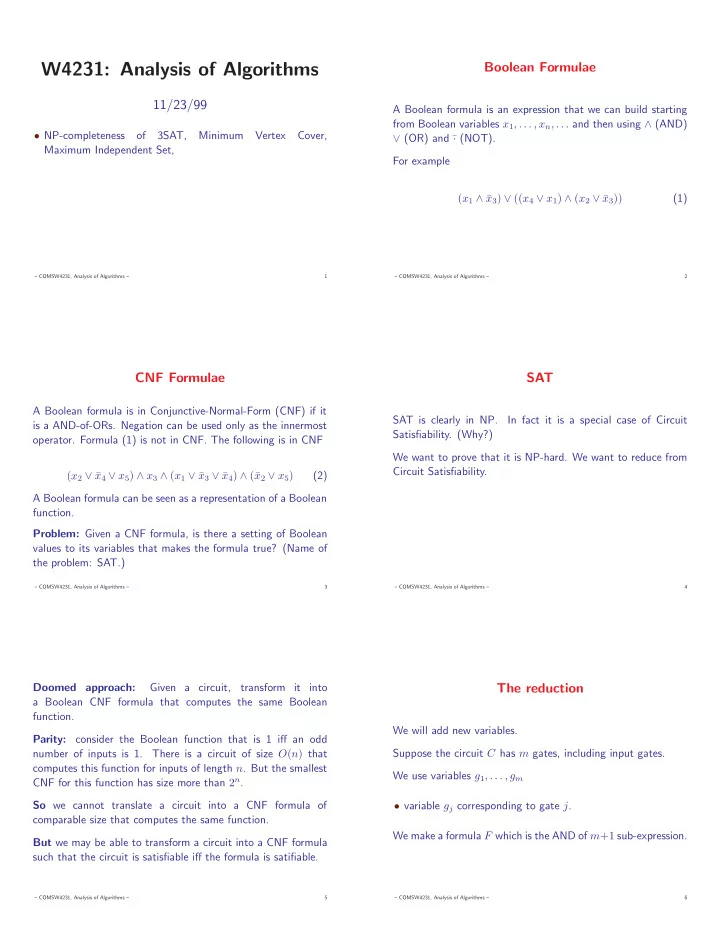

SLIDE 1
W4231: Analysis of Algorithms
11/23/99
- NP-completeness
- f
3SAT, Minimum Vertex Cover, Maximum Independent Set,
– COMSW4231, Analysis of Algorithms – 1
Boolean Formulae
A Boolean formula is an expression that we can build starting from Boolean variables x1, . . . , xn, . . . and then using ∧ (AND) ∨ (OR) and ¯ · (NOT). For example (x1 ∧ ¯ x3) ∨ ((x4 ∨ x1) ∧ (x2 ∨ ¯ x3)) (1)
– COMSW4231, Analysis of Algorithms – 2
CNF Formulae
A Boolean formula is in Conjunctive-Normal-Form (CNF) if it is a AND-of-ORs. Negation can be used only as the innermost
- perator. Formula (1) is not in CNF. The following is in CNF
(x2 ∨ ¯ x4 ∨ x5) ∧ x3 ∧ (x1 ∨ ¯ x3 ∨ ¯ x4) ∧ (¯ x2 ∨ x5) (2) A Boolean formula can be seen as a representation of a Boolean function. Problem: Given a CNF formula, is there a setting of Boolean values to its variables that makes the formula true? (Name of the problem: SAT.)
– COMSW4231, Analysis of Algorithms – 3
SAT
SAT is clearly in NP. In fact it is a special case of Circuit
- Satisfiability. (Why?)
We want to prove that it is NP-hard. We want to reduce from Circuit Satisfiability.
– COMSW4231, Analysis of Algorithms – 4
Doomed approach: Given a circuit, transform it into a Boolean CNF formula that computes the same Boolean function. Parity: consider the Boolean function that is 1 iff an odd number of inputs is 1. There is a circuit of size O(n) that computes this function for inputs of length n. But the smallest CNF for this function has size more than 2n. So we cannot translate a circuit into a CNF formula of comparable size that computes the same function. But we may be able to transform a circuit into a CNF formula such that the circuit is satisfiable iff the formula is satifiable.
– COMSW4231, Analysis of Algorithms – 5
The reduction
We will add new variables. Suppose the circuit C has m gates, including input gates. We use variables g1, . . . , gm
- variable gj corresponding to gate j.
We make a formula F which is the AND of m+1 sub-expression.
– COMSW4231, Analysis of Algorithms – 6