
SLIDE 1
1
1
Lecture 16
Public Key Certification and Revocation
2
CertificationTree / Hierarchy
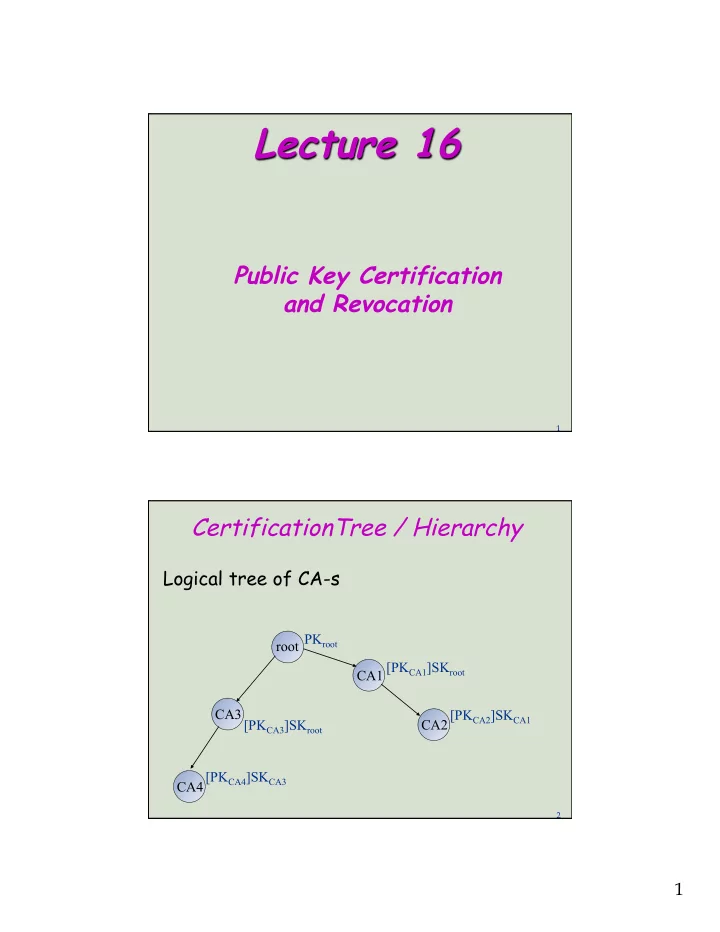
Logical tree of CA-s
root CA1 CA2 CA3 PKroot [PKCA1]SKroot [PKCA2]SKCA1 [PKCA3]SKroot CA4 [PKCA4]SKCA3
Lecture 16 Public Key Certification and Revocation 1 - - PDF document
Lecture 16 Public Key Certification and Revocation 1 CertificationTree / Hierarchy Logical tree of CA-s PK root root [PK CA1 ]SK root CA1 CA3 [PK CA2 ]SK CA1 [PK CA3 ]SK root CA2 [PK CA4 ]SK CA3 CA4 2 1 Hierarchical PKI Example UCSD
1
1
2
Logical tree of CA-s
root CA1 CA2 CA3 PKroot [PKCA1]SKroot [PKCA2]SKCA1 [PKCA3]SKroot CA4 [PKCA4]SKCA3
2
3
CAs End users
UCI UCSB UCSD UCR
4
CAs End users Upper level CAs
UCOP CSOP UCI CSULB UCLA CSUN
gtsudik@uci.edu
3
5
CAs End users Upper level CAs Root CA
State Govt.
6
4
7
UC System UMass UTexas
8
Note that no cross arrows down or up!
5
9
Derived from PKI
10
6
11
❖ Verifier must know public key of
the first CA
❖ Other public keys are
‘discovered’ one by one
❖ All CAs on the path must be
(implicitly) trusted by the verifier
12
❖ X.509v3 is the current version
– ITU standard – ISO 9495-2 is the equivalent ISO standard
❖ Defines certificate format, not PKI ❖ Identity and attribute certificates ❖ Supports both hierarchical model and cross
certificates
❖ End users cannot be CAs
7
13
❖ Assumes a distributed set of servers
maintaining a database about certificates
❖ Used in S/MIME, PEM, IPSec, SSL/TLS,
SSH
❖ RSA, DSA, SHA, MD5 are most commonly
used algorithms
14
❖ version ❖ serial number ❖ signature algorithm ID ❖ issuer name(X.500 Distinguished Name) ❖ validity period ❖ subject(user) name (X500 Distinguished Name) ❖ subject public key information ❖ issuer unique identifier (version 2 and 3 only) ❖ subject unique identifier (version 2 and 3 only) ❖ extensions (version 3 only), e.g., revocation info ❖ signature on the above fields
8
15
16
Certificate: Data: Version: 3 (0x2) Serial Number: 28 (0x1c) Signature Algorithm: md5WithRSAEncryption Issuer: C=US, O=Globus, CN=Globus Certification Authority Validity Not Before: Apr 22 19:21:50 2010 GMT Not After : Apr 22 19:21:50 2020 GMT Subject: C=US, O=Globus, O=University of Southern California, \
Subject Public Key Info: Public Key Algorithm: rsaEncryption RSA Public Key: (1024 bit) Modulus (1024 bit): 00:bf:4c:9b:ae:51:e5:ad:ac:54:4f:12:52:3a:69: <snip> b4:e1:54:e7:87:57:b7:d0:61 Exponent: 65537 (0x10001) Signature Algorithm: md5WithRSAEncryption 59:86:6e:df:dd:94:5d:26:f5:23:c1:89:83:8e:3c:97:fc:d8: <snip>
9
17
❖ X.509 certificate format is defined in
Abstract Syntax Notation 1 (ASN.1)
❖ ASN.1 structure is encoded using the
Distinguished Encoding Rules (DER)
❖ A DER-encoded binary sting is typically
base-64 encoded to get an ASCII representation
18
MIIDTzCCAvmgAwIBAgIBATANBgkqhkiG9w0BAQQFADBcMSEwHwYDVQQKExhFdXJv cGVhbiBJQ0UtVEVMIHByb2plY3QxIzAhBgNVBAsTGlYzLUNlcnRpZmljYXRpb24g QXV0aG9yaXR5MRIwEAYDVQQHEwlEYXJtc3RhZHQwHhcNOTcwNDAyMTczNTU5WhcN OTgwNDAyMTczNTU5WjBrMSEwHwYDVQQKExhFdXJvcGVhbiBJQ0UtVEVMIHByb2pl Y3QxIzAhBgNVBAsTGlYzLUNlcnRpZmljYXRpb24gQXV0aG9yaXR5MRIwEAYDVQQH EwlEYXJtc3RhZHQxDTALBgNVBAMTBFVTRVIwWTAKBgRVCAEBAgICAANLADBIAkEA qKhTY0kbk8PDC2yIEVXefmri+VKg3GklxMi/VeExqM7kqSmFmYoVmt72L+G0UF9e BHWm9HbcPA453Dq+PqRhiwIDAQABo4IBmDCCAZQwHwYDVR0jBBgwFoAUfnLy+DqG nEKINDRmdcPU/NGiETMwHQYDVR0OBBYEFJfc4B8gjSoRmLUx4Sq/ucIYiMrPMA4G A1UdDwEB/wQEAwIB8DAcBgNVHSABAf8EEjAQMAYGBCoDBAUwBgYECQgHBjBDBgNV HREEPDA6gRV1c2VyQGRhcm1zdGFkdC5nbWQuZGWGIWh0dHA6Ly93d3cuZGFybXN0 YWR0LmdtZC5kZS9+dXNlcjCBsQYDVR0SBIGpMIGmgQxnbWRjYUBnbWQuZGWGEWh0 dHA6Ly93d3cuZ21kLmRlghdzYXR1cm4uZGFybXN0YWR0LmdtZC5kZaRcMSEwHwYD VQQKExhFdXJvcGVhbiBJQ0UtVEVMIHByb2plY3QxIzAhBgNVBAsTGlYzLUNlcnRp ZmljYXRpb24gQXV0aG9yaXR5MRIwEAYDVQQHEwlEYXJtc3RhZHSHDDE0MS4xMi42 Mi4yNjAMBgNVHRMBAf8EAjAAMB0GA1UdHwQWMBQwEqAQoA6BDGdtZGNhQGdtZC5k ZTANBgkqhkiG9w0BAQQFAANBAGkM4ben8tj76GnAE803rSEGIk3oxtvxBAu34LPW DIEDzsNqPsfnJCSkkmTCg4MGQlMObwkehJr3b2OblJmD1qQ=
10
19
What if:
❖ Bob’s CA goes berserk? ❖ Bob forgets his private key? ❖ Someone steals Bob’s private key? ❖ Bob looses his private key? ❖ Bob willingly discloses his private key?
– Eve can decrypt/sign while Bob’s certificate is still valid... – Bob reports key loss to CA (or CA finds out somehow) – CA issues a Certificate Revocation List (CRL)
◆ Distributed in public announcements ◆ Published in public databases
– When verifying Bob’s signature or encrypting a message for Bob, Alice first checks if Bob’s certificate is still valid! – IMPORTANT: what about signatures “Bob” generated before he realized his key is lost?
20
❖ Certificate revocation needs to occur when:
◆ certificate holder key compromise/loss ◆ CA key compromise ◆ end of contract (e.g. certificates for employees)
❖ Certificate Revocation List (CRL) lists
certificates that are not yet naturally expired but revoked
❖ CRL reissued periodically, even if no activity! ❖ More on revocation later…
11
21
❖ Timeliness
◆ Before using a certificate, must check most recent
revocation status ❖ Efficiency
– Computation – Bandwidth and storage – Availability
❖ Security
22
❖ Implicit
◆ Each certificate is periodically (ore-issued ◆ Alice has a fresh certificate è Alice not revoked ◆ No need to distribute/publish revocation info
❖ Explicit
◆ Only revoked certificates are periodically
announced
◆ Alice’s certificate not listed among the revoked è
Alice not revoked
◆ Need to distribute/publish revocation info
12
23
❖ CRL - Certificate Revocation List
– CRL-DP, indirect CRL, dynamic CRL-DP, – delta-CRL, windowed CRL, etc. – CRT and other Authenticated Data Structures
❖ OCSP – On-line Certificate Status Protocol ❖ CRS - Certificate Revocation System
24
❖ Off-line mechanism ❖ CRL = list of revoked certificates (e.g., SNs)
signed by a revocation authority (RA)
❖ RA not always CA that issued the revoked PKC ❖ Periodically issued: daily, weekly, monthly, etc.
13
25
❖ Pros
– Simple – Don’t need secure channels for CRL distribution
❖ Cons
– Timeliness: “window of vulnerability” – CRLs can be huge – How to distribute CRLs reliably?
26
14
27
❖ On January 29 and 30, 2001, VeriSign, Inc. issued two certificates
for Authenticode Signing to an individual fraudulently claiming to be an employee of Microsoft Corporation.
❖ Any code signed by these certificates appears to be legitimately
signed by Microsoft.
❖ Users who try to run code signed with these certificates will
generally be presented with a warning dialog, but who wouldn't trust a valid certificate issued by VeriSign, and claimed to be for Microsoft?
❖ Certificates were very soon placed in a CRL, but:
– code that checks signatures for ActiveX controls, Office Macros, and so on, didn't do any CRL processing.
❖ According to Microsoft:
– since the certificates don't include a CRL Distribution Point (DP), it's impossible to find and use the CRL!
28
❖ proposed by P. Kocher (1998) ❖ based on hash trees
– hash trees first proposed by R. Merkle in another context in 1979 (one-time signatures) – improvement to Lamport-Diffie OTS scheme – based on the following idea:
◆ A wants to sign (in the future) 1 bit of information ◆ A gives B the image Y produced as Y=F(X) ◆ To sign A, reveals the pre-image: X ◆ B checks that: Y=F(X)
15
❖ Authenticate a sequence of data values
D0 , D1 , …, DN
❖ Construct binary tree over data values
T0 D0 D2 D3 D1 D4 D6 D7 D5 T1 T2 T3 T4 T5 T6
❖ Verifier knows T0 ❖ How can verifier authenticate tree leaf Di ? ❖ Solution: re-compute T0 using Di ❖ Example: to authenticate D2, send D2 and co-path=[D3 ,T3 ,T2] ❖ Verify T0 = H( H( T3 || H( D2 || D3 )) || T2 )
T0 D0 D2 D3 D1 D4 D6 D7 D5 T1 T2 T3 T4 T5 T6
16
31
❖ express ranges of SN of PKC’s as tree leaf
labels:
– E.g., (5--12) means: 5 and 12 are revoked, the
– Place the hash of the range in the leaf
❖ response includes the corresponding tree leaf,
the necessary hash values along the path to the root, the signed root
❖ the CA periodically updates the structure and
distributes to untrusted servers called Confirmation Issuers
32
Signed root (N 3,0) HASH N2,0 N1,1 N1,0
HASH
N0,1 N0,0
HASH
N0,3 N0,2
HASH
N0,5 N0,4
HASH
N0,7 N0,6
HASH
N2,1 N1,3 N1,2
HASH
(-∞ to 7)
HASH
(7 to 23)
HASH
(23 to 27)
HASH
(27 to 37)
HASH
(37 to 49)
HASH
(49 to 54)
HASH
(54 to 88)
HASH
(88 to +∞)
HASH
query: Is 67 revoked?
17
33
❖ each response represents a proof ❖ length of proof is: O(log n)
– Much shorter than CRL which is O(n) – Where n is # of revoked certificates
❖ only one “real” signature for tree root
(can be done off-line)
34
– OCSP = On-line Certificate Status Protocol (RFC 2560) - June 1999 – In place of or, as a supplement to, checking CRLs – Obtain instantaneous status of a PKC – OCSP may be used in sensitive, volatile settings, e.g., stock trades, electronic funds transfer, military
18
35
Alice OCSP responder CA Bob
2.
request
Bob
36
– all definitive responses have to be signed:
◆ either by issuing CA ◆ or by a Trusted Responder (OCSP client trusts
the TR’s PKC)
◆ or by a CA Authorized Responder which has a
special PKC (issued by the CA) saying that it can issue OCSP responses on CA’s behalf
19
37
❖ Response format:
– target PKC SN – PKC status:
◆ good - positive answer ◆ revoked - permanently/temporarily (on-hold) ◆ unknown - responder doesn’t know about the
certificate being requested
– response validity interval – optional extensions
38
❖ A response contain three timestamps:
– thisUpdate - time at which the status being indicated is known to be correct – nextUpdate - time at or before which newer information will be available – producedAt - time at which the OCSP responder signed this response. Useful for response pre-production
20
39
❖ on-line method ❖ DoS vulnerability
– flood of queries + generating signatures! – unsigned responses à false responses – pre-computing responses offers some protection against DoS, but…
❖ pre-computing responses allows replay
attacks (since no nonce included)
– but OCSP signing key can be kept off- line
40
❖ Consistency between CRL and OCSP
responses
– it’s possible to have a certificate with two different statuses.
❖ If OCSP is more timely and provides
the same information as CRLs, do we still need CRLs?
❖ Which method should come first -
OCSP or to CRL?
21
41
❖ Proposed by Micali (1996) ❖ Aims to improve CRL communication costs ❖ Basic idea: CA periodically refreshes valid
certificates
❖ Uses off-line/on-line signature scheme to
reduce update cost
❖ Versa&le cryptographic primi&ve ❖ Construc&on:
❖ Proper&es:
– Use in reverse order of construc&on: Y0 , Y1 , …, YN – Hard to compute Yi from Yj (if j<i), easy to compute Yj from Yi
◆ For example: easy to compute Y1 from Y2 since Y1=H(Y2) ◆ But, Infeasible to compute Y2 from Y1
❖ Verifier can efficiently authen&cate Yj knowing Yi (j<i):
by verifying whether Yj = Hi-j(Yi) = H(H(…H(Yi)...))
❖ This method is robust to missing values
YN-1 YN Y1 Y0 H Y2 H H H H …
22
43
❖ Two new parameters in PKC: Y0 and N
Y0 = HMAX(YMAX) N0 = H(N1)
❖ [Y0,N0] -- per-PKC secrets stored by CA ❖ H() -- public one-way function, e.g., SHA-2
ANCHOR ROOT
44
CRS example: Certificate issued for a year, refreshed daily
CA
Public Directory
daily update UPDi for each certificate
Verifier (Bob)
Q : Is Alice’s cert valid ?
NOTE: i=0 at issuance date A: UPDi