
SLIDE 1
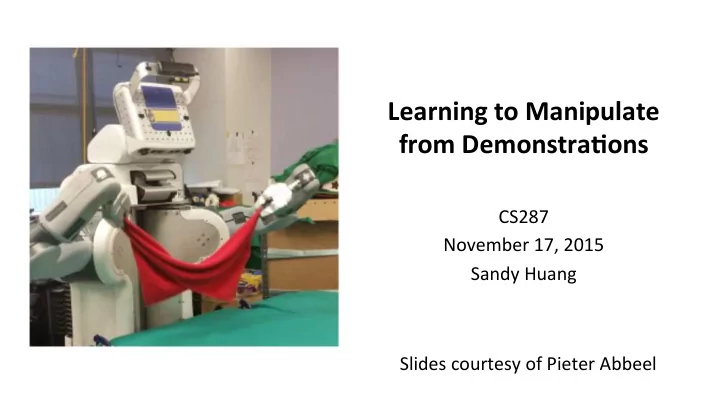
Learning to Manipulate from Demonstra3ons CS287 November 17, 2015 - - PowerPoint PPT Presentation
Learning to Manipulate from Demonstra3ons CS287 November 17, 2015 Sandy Huang Slides courtesy of Pieter Abbeel Personal RoboBcs Hardware ? PR2 Baxter UBR-1 Willow Garage Rethink RoboBcs Unbounded RoboBcs ? $400,000 $30,000 $35,000
PR2 Willow Garage $400,000 2009 ? $2,000 ? 2017? Baxter Rethink RoboBcs $30,000 2013 UBR-1 Unbounded RoboBcs $35,000 2013 ?
[MaiBn-Shepard, Cusumano Towner, Lei, Abbeel, ICRA 2010]
[van den Berg, Miller, Duckworth, Humphrey, Wan, Fu, Goldberg, Abbeel, Best Medical RoboBcs Paper, ICRA 2010]
n Open loop n If careful about iniBal condiBons
n 50% success rate
n Robot has to Be a knot in
n The problem
n Human demonstrated knot-
n
Prior work
n
Billard, Calinon and collaborators
n
Gaussian Mixture Models (GMM) and Gaussian Mixture Regression (GMR)
n
Schaal and collaborators
n
Dynamic moBon primiBves
n
Cakmak, Thomaz and collaborators
n
Human robot interacBon for robot to learn faster
n
Peters and collaborators
n
Stay close to demonstraBons distribuBon while also opBmizing reward
n
BUT
n
All of these algorithms have underlying representaBons in terms of coordinates
n
Can we alleviate need to specify coordinate frames / features and directly adapt to geometry?
n TranslaBons, rotaBons and scaling are FREE
n SoluBon has form:
Wahba, Spline models for observaBonal data. Philadelphia: Society for Industrial and Applied MathemaBcs. 1990. Evgeniou, PonBl, Poggio, RegularizaBon Networks and Support Vector Machines. Advances in ComputaBonal MathemaBcs. 2000. HasBe, Tibshirani, Friedman, Elements of StaBsBcal Learning, Chapter 5. 2008.
f∈{R3→R3}
x∈R3 kD2fk2 Frob(x)dx
train) = x(i) test 8i 2 1, . . . , m
n Thin Plate Spline Robust Point Matching (TPS-RPM) [Chui et al.
n Variant of ExpectaBon-MaximizaBon (EM); finds locally opBmal
n Using non-rigid registraBon, find a transformaBon f from
n Apply f to the demonstrated end-effector trajectory n Convert the end-effector trajectory to a joint trajectory
[J. Schulman, J. Ho, C. Lee, P. Abbeel, ISRR 2013]
n Knots Bed
n Overhand n Figure-eight n Double-overhand n Square n Clove-hitch
[J. Schulman, J. Ho, C. Lee, P. Abbeel, ISRR 2013]
[J. Schulman, A. Gupta, S. Venkatesan, M. Tayson-Frederick, P. Abbeel, IROS 2013]
n Does not consider joint limits and obstacles when finding the
n ComputaBonally expensive with >100 demonstraBons n Ignores surface normals when finding the warp funcBon n Only uses geometric informaBon of the objects, not
Step 1:
! τ f ← f τ demo
! min
f ∈registration!functions!registration_error Sdemo,!Stest
! min
τ ∈trajectories
trajectory_error τ f ,τ
s.t. τ !is!feasible!and!collision5free
Step 2:
Step 1:
! min
τ ∈trajectories
trajectory_error f τ demo
( ),τ
( )
s.t. τ !is!feasible!and!collision5free ! min
f ∈registration!functions!registration_error Sdemo,!Stest
( )
!!!!!!!!!!!!!!!!!!!!!!!!!!!!!!!!!!!!!!!!!!!+bending_energy f
( ) Step 2:
! min
f ∈registration!functions !!!!!!!!τ ∈trajectories
registration_error Sdemo,!Stest
( )
!!!!!!!!!!!!! +bending_energy f
( )
+trajectory_error f τ demo
( ),τ
( )
s.t. τ !is!feasible!and!collision7free
10 20 30 40 50 60 70 80 90 100 0.4 0.5 0.6 0.7 0.8 0.9 1
Success Rate Degree of Freedom Range Reduc3on Factor Two-step opBmizaBon Unified opBmizaBon [A. Lee, S. Huang, D. Hadfield-Menell, E. Tzeng, P. Abbeel, IROS 2014]
n Can be expected to work if the dynamics of the system are
n Repeat
n Acquire new point cloud Xtest n Using non-rigid registraBon compute distance between Xtest and each
n If i* is a “done” state, break n Apply trajectory transfer to generate new trajectory
n Doesn’t account for demonstraBon quality n Doesn’t prefer moves that make progress n Doesn’t account for reachability of trajectory
[D. Hadfield-Menell, A. Lee, C. Finn, E. Tzeng, S. Huang, P. Abbeel, ICRA 2015]
[D. Hadfield-Menell, A. Lee, C. Finn, E. Tzeng, S. Huang, P. Abbeel, ICRA 2015]
[D. Hadfield-Menell, A. Lee, C. Finn, E. Tzeng, S. Huang, P. Abbeel, ICRA 2015]
[D. Hadfield-Menell, A. Lee, C. Finn, E. Tzeng, S. Huang, P. Abbeel, ICRA 2015]
[D. Hadfield-Menell, A. Lee, C. Finn, E. Tzeng, S. Huang, P. Abbeel, ICRA 2015]
20 40 60 80 100 [Schulman et al. ISRR '13] Max Margin Q-function Estimation Beam Search (3-3) Success Rate
20 40 60 80 100 [Schulman et al. ISRR '13] Max Margin Q-function Estimation Beam Search (3-3) Success Rate
[A. Lee, M. Goldstein, S. Barrav, P. Abbeel, ICRA 2015]
n Only uses geometric informaBon to find non-rigid registraBon
n DemonstraBon selecBon also only uses geometric informaBon
n
corners-against-background
n
edges-against-background
n
edges-against-interior
n
folds-against-background
n
flat interior
n
wrinkled interior
[S. Huang, J. Pan, G. Mulcaire, P. Abbeel, IROS 2015]
n = correspondence between source point and target point n = prior probability that and should be matched n Define the new point correspondence matrix as n Normalize so that the rows and columns sum to 1
[S. Huang, J. Pan, G. Mulcaire, P. Abbeel, IROS 2015]
n Unsupervised features in registraBon n Reinforcement learning to further improve performance n Forces and torques (to extend to non-kinemaBc tasks) n More data…
Schulman et al. ISRR 2013
Schulman et al. ISRR 2013
Schulman et al. ISRR 2013
Schulman et al. ISRR 2013
Schulman et al. ISRR 2013