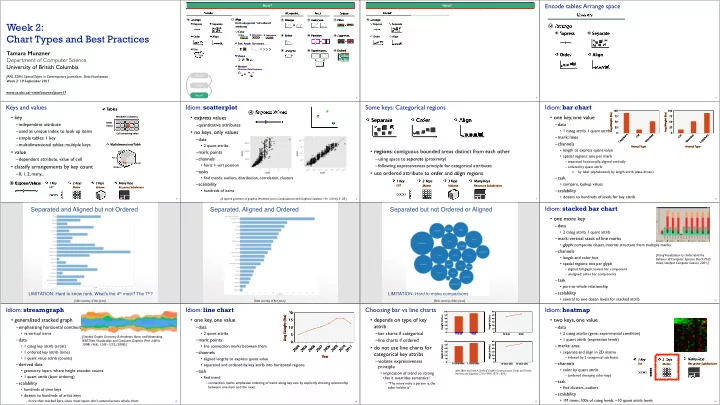
Week 2: from categorical and ordered Express Separate Express - - PowerPoint PPT Presentation

week 2
SMART_READER_LITE
LIVE PREVIEW

Week 2: from categorical and ordered Express Separate Express - - PowerPoint PPT Presentation

Encode tables: Arrange space How? How? Encode Manipulate Facet Encode Manipulate Facet Encode Encode Manipulate Facet Reduce Encode Map Arrange Change Juxtapose Filter Arrange Week 2: from categorical and ordered Express


slide-1
SLIDE 1

www.cs.ubc.ca/~tmm/courses/journ17

Week 2: 
 Chart Types and Best Practices

Tamara Munzner Department of Computer Science University of British Columbia

JRNL 520H, Special Topics in Contemporary Journalism: Data Visualization Week 2: 19 September 2017

2

Encode Arrange Express Separate Order Align Use Manipulate Facet Reduce Change Select Navigate Juxtapose Partition Superimpose Filter Aggregate Embed

How? Encode Manipulate Facet

Map Color Motion Size, Angle, Curvature, ...

Hue Saturation Luminance

Shape

Direction, Rate, Frequency, ...

from categorical and ordered attributes

3

Encode Arrange Express Separate Order Align

How? Encode Manipulate Facet

4

Encode Arrange Express Separate Order Align

Encode tables: Arrange space

5

Keys and values

  • key

–independent attribute –used as unique index to look up items –simple tables: 1 key –multidimensional tables: multiple keys

  • value

–dependent attribute, value of cell

  • classify arrangements by key count

–0, 1, 2, many...

1 Key 2 Keys 3 Keys Many Keys

List Recursive Subdivision Volume Matrix

Express Values Tables

Attributes (columns) Items (rows) Cell containing value

Multidimensional Table

Value in cell

Idiom: scatterplot

  • express values

–quantitative attributes

  • no keys, only values

–data

  • 2 quant attribs

–mark: points –channels

  • horiz + vert position

–tasks

  • find trends, outliers, distribution, correlation, clusters

–scalability

  • hundreds of items

6

[A layered grammar of graphics.

  • Wickham. Journ. Computational and Graphical Statistics 19:1 (2010), 3–28.]

Express Values

Some keys: Categorical regions

  • regions: contiguous bounded areas distinct from each other

–using space to separate (proximity) –following expressiveness principle for categorical attributes

  • use ordered attribute to order and align regions

7

1 Key 2 Keys 3 Keys Many Keys

List Recursive Subdivision Volume Matrix

Separate Order Align

Idiom: bar chart

  • one key, one value

–data

  • 1 categ attrib, 1 quant attrib

–mark: lines –channels

  • length to express quant value
  • spatial regions: one per mark

– separated horizontally, aligned vertically – ordered by quant attrib » by label (alphabetical), by length attrib (data-driven)

–task

  • compare, lookup values

–scalability

  • dozens to hundreds of levels for key attrib

8

100 75 50 25 Animal Type 100 75 50 25 Animal Type

Separated and Aligned but not Ordered

LIMITATION: Hard to know rank. What’s the 4th most? The 7th?

[Slide courtesy of Ben Jones]

Separated, Aligned and Ordered

[Slide courtesy of Ben Jones]

Separated but not Ordered or Aligned

LIMITATION: Hard to make comparisons

[Slide courtesy of Ben Jones]

Idiom: stacked bar chart

  • one more key

–data

  • 2 categ attrib, 1 quant attrib

–mark: vertical stack of line marks

  • glyph: composite object, internal structure from multiple marks

–channels

  • length and color hue
  • spatial regions: one per glyph

– aligned: full glyph, lowest bar component – unaligned: other bar components

–task

  • part-to-whole relationship

–scalability

  • several to one dozen levels for stacked attrib

12

[Using Visualization to Understand the Behavior of Computer Systems. Bosch. Ph.D. thesis, Stanford Computer Science, 2001.]

Idiom: streamgraph

  • generalized stacked graph

–emphasizing horizontal continuity

  • vs vertical items

–data

  • 1 categ key attrib (artist)
  • 1 ordered key attrib (time)
  • 1 quant value attrib (counts)

–derived data

  • geometry: layers, where height encodes counts
  • 1 quant attrib (layer ordering)

–scalability

  • hundreds of time keys
  • dozens to hundreds of artist keys

– more than stacked bars, since most layers don’t extend across whole chart

13

[Stacked Graphs Geometry & Aesthetics. Byron and Wattenberg. IEEE Trans. Visualization and Computer Graphics (Proc. InfoVis 2008) 14(6): 1245–1252, (2008).]

Idiom: line chart

  • one key, one value

–data

  • 2 quant attribs

–mark: points

  • line connection marks between them

–channels

  • aligned lengths to express quant value
  • separated and ordered by key attrib into horizontal regions

–task

  • find trend

– connection marks emphasize ordering of items along key axis by explicitly showing relationship between one item and the next

14

20 15 10 5 Year

Choosing bar vs line charts

  • depends on type of key

attrib

–bar charts if categorical –line charts if ordered

  • do not use line charts for

categorical key attribs

–violates expressiveness principle

  • implication of trend so strong

that it overrides semantics!

– “The more male a person is, the taller he/she is”

15

after [Bars and Lines: A Study of Graphic Communication. Zacks and Tversky. Memory and Cognition 27:6 (1999), 1073–1079.]

Female Male

60 50 40 30 20 10

Female Male

60 50 40 30 20 10

10-year-olds 12-year-olds

60 50 40 30 20 10 60 50 40 30 20 10

10-year-olds 12-year-olds

Idiom: heatmap

  • two keys, one value

–data

  • 2 categ attribs (gene, experimental condition)
  • 1 quant attrib (expression levels)

–marks: area

  • separate and align in 2D matrix

– indexed by 2 categorical attributes

–channels

  • color by quant attrib

– (ordered diverging colormap)

–task

  • find clusters, outliers

–scalability

  • 1M items, 100s of categ levels, ~10 quant attrib levels

16

1 Key 2 Keys

List Matrix

Many Keys

Recursive Subdivision

slide-2
SLIDE 2

Idiom: cluster heatmap

  • in addition

–derived data

  • 2 cluster hierarchies

–dendrogram

  • parent-child relationships in tree with connection line marks
  • leaves aligned so interior branch heights easy to compare

–heatmap

  • marks (re-)ordered by cluster hierarchy traversal

17 18

Axis Orientation Rectilinear Parallel Radial

Idioms: scatterplot matrix, parallel coordinates

  • scatterplot matrix (SPLOM)

–rectilinear axes, point mark –all possible pairs of axes –scalability

  • one dozen attribs
  • dozens to hundreds of items
  • parallel coordinates

–parallel axes, jagged line representing item –rectilinear axes, item as point

  • axis ordering is major challenge

–scalability

  • dozens of attribs
  • hundreds of items

19

after [Visualization Course Figures. McGuffin, 2014. http://www.michaelmcguffin.com/courses/vis/] Math Physics Dance Drama Math Physics Dance Drama Math Physics Dance Drama

100 90 80 70 60 50 40 30 20 10

Scatterplot Matrix Parallel Coordinates Math Physics Dance Drama 85 90 65 50 40 95 80 50 40 60 70 60 90 95 80 65 50 90 80 90

Table

Task: Correlation

  • scatterplot matrix

–positive correlation

  • diagonal low-to-high

–negative correlation

  • diagonal high-to-low

–uncorrelated

  • parallel coordinates

–positive correlation

  • parallel line segments

–negative correlation

  • all segments cross at halfway point

–uncorrelated

  • scattered crossings

20

[Hyperdimensional Data Analysis Using Parallel Coordinates.

  • Wegman. Journ. American Statistical Association 85:411

(1990), 664–675.] [A layered grammar of graphics.

  • Wickham. Journ.

Computational and Graphical Statistics 19:1 (2010), 3–28.]

Idioms: radial bar chart, star plot

  • radial bar chart

–radial axes meet at central ring, line mark

  • star plot

–radial axes, meet at central point, line mark

  • bar chart

–rectilinear axes, aligned vertically

  • accuracy

–length unaligned with radial

  • less accurate than aligned with rectilinear

21

[Vismon: Facilitating Risk Assessment and Decision Making In Fisheries Management. Booshehrian, Möller, Peterman, and Munzner. Technical Report TR 2011-04, Simon Fraser University, School of Computing Science, 2011.]

Radial Orientation: Radar Plots

LIMITATION: Not good when categories aren’t cyclic

[Slide courtesy of Ben Jones]

"Diagram of the causes of mortality in the army in the East" (1858)

[Slide courtesy of Ben Jones]

“Radar graphs: Avoid them (99.9% of the time)”

http://www.thefunctionalart.com/2012/11/radar-graphs-avoid-them-999-of-time.html

[Slide courtesy of Ben Jones]

Idioms: pie chart, polar area chart

  • pie chart

–area marks with angle channel –accuracy: angle/area much less accurate than line length

  • polar area chart

–area marks with length channel –more direct analog to bar charts

  • data

–1 categ key attrib, 1 quant value attrib

  • task

–part-to-whole judgements

25

[A layered grammar of graphics.

  • Wickham. Journ. Computational and Graphical Statistics 19:1 (2010), 3–28.]

Idioms: normalized stacked bar chart

  • task

–part-to-whole judgements

  • normalized stacked bar chart

–stacked bar chart, normalized to full vert height –single stacked bar equivalent to full pie

  • high information density: requires narrow rectangle
  • pie chart

–information density: requires large circle

26

http://bl.ocks.org/mbostock/3887235, http://bl.ocks.org/mbostock/3886208, http://bl.ocks.org/mbostock/3886394.

3/21/2014 bl.ocks.org/mbostock/raw/3887235/ http://bl.ocks.org/mbostock/raw/3887235/ 1/1 <5 5-13 14-17 18-24 25-44 45-64 ≥65 3/21/2014 bl.ocks.org/mbostock/raw/3886394/ http://bl.ocks.org/mbostock/raw/3886394/ 1/1 UT TX ID AZ NV GA AK MSNMNE CA OK SDCO KSWYNC AR LA IN IL MNDE HI SCMOVA IA TN KY AL WAMDNDOH WI OR NJ MT MI FL NY DC CT PA MAWV RI NHME VT 0% 10% 20% 30% 40% 50% 60% 70% 80% 90% 100% Under 5 Years 5 to 13 Years 14 to 17 Years 18 to 24 Years 25 to 44 Years 45 to 64 Years 65 Years and Over 3/21/2014 bl.ocks.org/mbostock/raw/3886208/ http://bl.ocks.org/mbostock/raw/3886208/ 1/1 CA TX NY FL IL PA OH MI GA NC NJ VA WA AZ MA IN TN MO MD WI MN CO AL SC LA KY OR OK CT IA MS AR KS UT NV NMWV NE ID ME NH HI RI MT DE SD AK ND VT DC WY 0.0 5.0M 10M 15M 20M 25M 30M 35M Population 65 Years and Over 45 to 64 Years 25 to 44 Years 18 to 24 Years 14 to 17 Years 5 to 13 Years Under 5 Years 3/21/2014 bl.ocks.org/mbostock/raw/3886394/ http://bl.ocks.org/mbostock/raw/3886394/ 1/1 UT TX ID AZ NV GA AK MSNMNE CA OK SDCO KSWYNC AR LA IN IL MNDE HI SCMOVA IA TN KY AL WAMDNDOH WI OR NJ MT MI FL NY DC CT PA MAWV RI NHME VT 0% 10% 20% 30% 40% 50% 60% 70% 80% 90% 100% Under 5 Years 5 to 13 Years 14 to 17 Years 18 to 24 Years 25 to 44 Years 45 to 64 Years 65 Years and Over

Idiom: glyphmaps

  • rectilinear good for linear vs

nonlinear trends

  • radial good for cyclic patterns

27

[Glyph-maps for Visually Exploring Temporal Patterns in Climate Data and Models. Wickham, Hofmann, Wickham, and Cook. Environmetrics 23:5 (2012), 382–393.]

28

  • rectilinear: scalability wrt #axes
  • 2 axes best
  • 3 problematic

– more in afternoon

  • 4+ impossible
  • parallel: unfamiliarity, training time
  • radial: perceptual limits

–asymmetry: angles lower precision than lengths

  • sometimes can be exploited!

Orientation limitations

Axis Orientation Rectilinear Parallel Radial

[Uncovering Strengths and Weaknesses of Radial Visualizations - an Empirical Approach. Diehl, Beck and Burch. IEEE TVCG (Proc. InfoVis) 16(6):935--942, 2010.]

29

Layout Density Dense

[Visualization of test information to assist fault localization. Jones, Harrold, Stasko. Proc. ICSE 2002, p 467-477.]

dense software overviews Basic Timelines – Working with Dates

[Slide courtesy of Ben Jones]

Column Charts

[Slide courtesy of Ben Jones]

Inverted Column Charts

[Slide courtesy of Ben Jones]

slide-3
SLIDE 3

Gantt Charts

[Slide courtesy of Ben Jones]

Slopegraphs

[Slide courtesy of Ben Jones]

Change from Previous

[Slide courtesy of Ben Jones]

Connected Scatterplots

[Slide courtesy of Ben Jones]

Dual Axis Line Plots

[Slide courtesy of Ben Jones]

Best Practices

  • meaningful title
  • axis labels
  • include legend when necessary

38

Rules of Thumb

  • No unjustified 3D
  • Resolution over immersion
  • Overview first, zoom and filter, details on demand
  • Responsiveness is required
  • Function first, form next

39

No unjustified 3D: Power of the plane

40

  • high-ranked spatial position

channels: planar spatial position

–not depth!

Magnitude Channels: Ordered Attributes Position on common scale Position on unaligned scale Length (1D size) Tilt/angle Area (2D size) Depth (3D position)

No unjustified 3D: Danger of depth

  • we don’t really live in 3D: we see in 2.05D

–acquire more info on image plane quickly from eye movements –acquire more info for depth slower, from head/body motion

41

Towards Away Up Down Right Left Thousands of points up/down and left/right We can only see the outside shell of the world

Occlusion hides information

  • occlusion
  • interaction complexity

42

[Distortion Viewing Techniques for 3D Data. Carpendale et al. InfoVis1996.]

Perspective distortion loses information

  • perspective distortion

–interferes with all size channel encodings –power of the plane is lost!

43

[Visualizing the Results of Multimedia Web Search Engines. Mukherjea, Hirata, and Hara. InfoVis 96]

3D vs 2D bar charts

  • 3D bars never a good

idea!

44

[http://perceptualedge.com/files/GraphDesignIQ.html]

No unjustified 3D example: Time-series data

  • extruded curves: detailed comparisons impossible

45

[Cluster and Calendar based Visualization of Time Series Data. van Wijk and van Selow, Proc. InfoVis 99.]

No unjustified 3D example: Transform for new data abstraction

  • derived data: cluster hierarchy
  • juxtapose multiple views: calendar, superimposed 2D curves

46

[Cluster and Calendar based Visualization of Time Series Data. van Wijk and van Selow, Proc. InfoVis 99.]

Justified 3D: shape perception

  • benefits outweigh costs

when task is shape perception for 3D spatial data

–interactive navigation supports synthesis across many viewpoints

47

[Image-Based Streamline Generation and Rendering. Li and Shen. IEEE Trans. Visualization and Computer Graphics (TVCG) 13:3 (2007), 630–640.]

Justified 3D: Economic growth curve

48

http://www.nytimes.com/interactive/2015/03/19/upshot/3d-yield-curve-economic-growth.html

slide-4
SLIDE 4

No unjustified 3D

  • 3D legitimate for true 3D spatial data
  • 3D needs very careful justification for abstract data

– enthusiasm in 1990s, but now skepticism – be especially careful with 3D for point clouds or networks

49

[WEBPATH-a three dimensional Web history. Frecon and Smith. Proc. InfoVis 1999]

Resolution beats immersion

  • immersion typically not helpful for abstract data

–do not need sense of presence or stereoscopic 3D

  • resolution much more important

–pixels are the scarcest resource –desktop also better for workflow integration

  • virtual reality for abstract data very difficult to justify

50

[Development of an information visualization tool using virtual reality. Kirner and Martins. Proc. Symp. Applied Computing 2000]

Overview first, zoom and filter, details on demand

  • influential mantra from Shneiderman
  • overview = summary

–microcosm of full vis design problem

51

[The Eyes Have It: A Task by Data Type Taxonomy for Information Visualizations.

  • Shneiderman. Proc. IEEE

Visual Languages, pp. 336–343, 1996.]

Query Identify Compare Summarise

Responsiveness is required

  • three major categories

–0.1 seconds: perceptual processing – 1 second: immediate response – 10 seconds: brief tasks

  • importance of visual feedback

52

Function first, form next

  • start with focus on functionality

–straightforward to improve aesthetics later on, as refinement –if no expertise in-house, find good graphic designer to work with

  • dangerous to start with aesthetics

–usually impossible to add function retroactively

53