Presenting Data e.g., bronze, silver, gold ordered e.g., support, - - PDF document

presenting data
SMART_READER_LITE
LIVE PREVIEW

Presenting Data e.g., bronze, silver, gold ordered e.g., support, - - PDF document

3/31/2017 Types of Variables IMGD 2905 Qualitative (Categorical) variables Can have states or subclasses e.g., rank: [platinum, diamond, gold] Can be ordered or unordered Presenting Data e.g., bronze, silver, gold


slide-1
SLIDE 1

3/31/2017 1

Presenting Data

IMGD 2905

Chapter 2

2

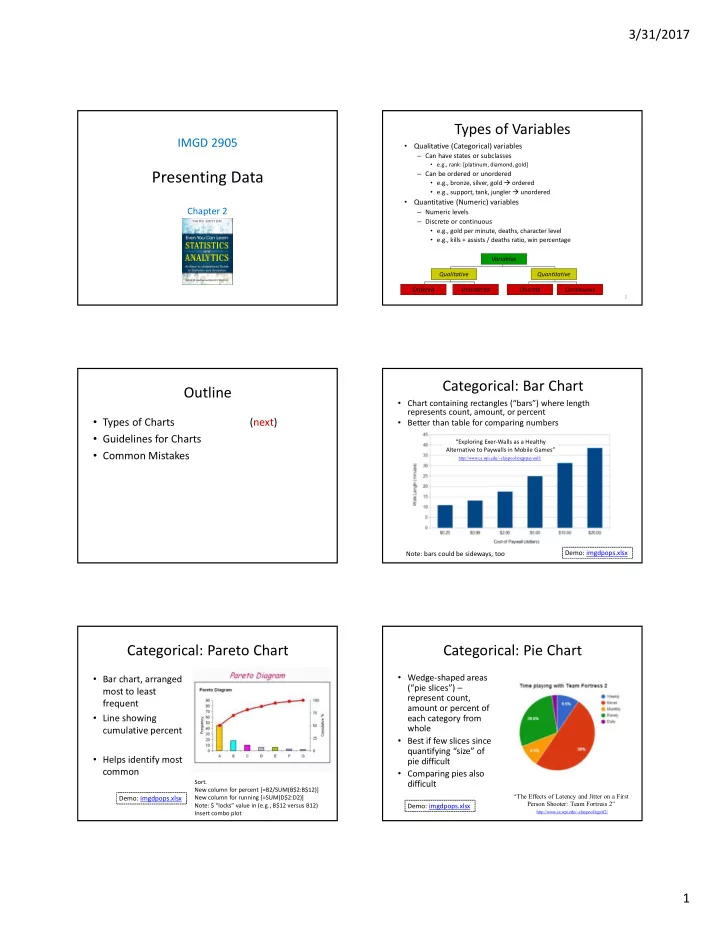
Types of Variables

  • Qualitative (Categorical) variables

– Can have states or subclasses

  • e.g., rank: [platinum, diamond, gold]

– Can be ordered or unordered

  • e.g., bronze, silver, gold  ordered
  • e.g., support, tank, jungler  unordered
  • Quantitative (Numeric) variables

– Numeric levels – Discrete or continuous

  • e.g., gold per minute, deaths, character level
  • e.g., kills + assists / deaths ratio, win percentage

Variables Qualitative Ordered Unordered Discrete Continuous Quantitative

Outline

  • Types of Charts

(next)

  • Guidelines for Charts
  • Common Mistakes

Categorical: Bar Chart

  • Chart containing rectangles (“bars”) where length

represents count, amount, or percent

  • Better than table for comparing numbers

Note: bars could be sideways, too

http://www.cs.wpi.edu/~claypool/mqp/paywall/

“Exploring Exer-Walls as a Healthy Alternative to Paywalls in Mobile Games”

Demo: imgdpops.xlsx

Categorical: Pareto Chart

  • Bar chart, arranged

most to least frequent

  • Line showing

cumulative percent

  • Helps identify most

common

Demo: imgdpops.xlsx

Sort. New column for percent [=B2/SUM(B$2:B$12)] New column for running [=SUM(D$2:D2)] Note: $ “locks” value in (e.g., B$12 versus B12) Insert combo plot

Categorical: Pie Chart

  • Wedge-shaped areas

(“pie slices”) – represent count, amount or percent of each category from whole

  • Best if few slices since

quantifying “size” of pie difficult

  • Comparing pies also

difficult

“The Effects of Latency and Jitter on a First Person Shooter: Team Fortress 2”

http://www.cs.wpi.edu/~claypool/iqp/tf2/

Demo: imgdpops.xlsx

slide-2
SLIDE 2

3/31/2017 2 Categorical: Cross-Classification Table

  • Multi-column table that presents count or percent for 2+

categorical variables

– Good for comparison across multi-categorical data Demo: grades.xlsx

Insert Pivot Chart Select Major through Grade Drag Majors to Axis Drag Grade to Axis Drag Grade to Values

Numeric: Frequency Distribution

  • Groups of numeric values

and frequency

  • e.g., Survey of Champion

“skins” bought with RP

– 1, 2, 1, 0, 3, 4, 0, 1, 1, 1, 2, 2, 3, 2, 3, 2, 1, 4, 0, 0 – Cluster into groups – Report frequency per group

  • May include percentage
  • Typically equal size

– Sometimes ends are open (for extremes)

  • Bin size/number variable

– Too many and not readable – Guide:

  • 100 or less

7-10

  • 101-200

11-15

  • 200+

13-20 Skins Freq. Percent 4 20% 1 6 30% 2 5 25% 3 3 15% 4 2 10% Poll class!

Cumulative Distribution

  • Cumulative amount of

data with value or less

  • Easy to see min, max,

median

  • Compare shapes of

distributions

“Nerfs, Buffs and Bugs - Analysis of the Impact of Patching on League of Legends”

http://www.cs.wpi.edu/~claypool/papers/lol-crawler/

Demo: lol-patches.xlsx

Select Banrate data Sort low to high New column for percent [=ROW()/42] Select column  paste down all Select both columns Insert  Scatter plot with lines

Histogram

  • Bar chart for grouped numerical data

– No (or small) gaps btwn adjacent bars

Demo: grades.xlsx

https://www.mathsisfun.com/data/images/bar-chart-vs-histogram.gif https://www.reddit.com/r/leagueoflegends/comme nts/4x5s9m/analysis_of_age_in_league_of_legends/

Ages of professional League players

http://www.leaguemath.com/e arly-vs-late-game-champions/

Select GPA data Insert  Statistics Chart  Histogram Can adjust bins, overflow/underflow

11

Stem and Leaf Display

  • “Histogram-lite” for analysis w/out software

– e.g., exam scores: 34, 81, 75, 51, 82, 96, 55, 66, 95, 87, 82, 88, 99, 50, 85, 72

9| 6 5 9 8| 1 2 7 2 8 5 7| 5 2 6| 6 5| 1 5 0 4| 3| 4

Time Series Plot

  • Associate data

with date

  • Line graph with

dates (proportionally spaced!)

http://www.soundandvision.com/content/violence-and-video-games http://www.polygon.com/2014/9/12/6141515/do- violent-video-games-actually-reduce-real-world-crime

Demo: majors.xlsx

  • Sel. year and majors

Insert  Line Chart  More Line Charts

slide-3
SLIDE 3

3/31/2017 3

Scatter Plot

  • Two numerical variables, one on each axis
  • Reveal patterns in relationship
  • Setup “right” models (later)

http://www.cs.wpi.edu/~claypool/mqp/onlive/

“Intelligent Simulation of Worldwide Application Distribution for OnLive's Server Network”

Demo: lol-rates.xlsx

Select two of {win, pick, ban} Insert  scatter plot

14

Radar Plot

  • Also called

“star charts”

  • r “kiviat

plots”

  • Good for

quick visual compare, especially when axes unequal

http://www.thescoreesports.com/lol/news/2561-using-gold-distribution-to-understand-team-dynamic-global-na-lcs-and-lpl

Gold compared to average, LoL NA teams, by role Demo: lol-rates.xlsx Select top line {win, pick, ban} + 1 row num Insert  Other  Radar scatter plot

Many More Charts!

  • Bubble
  • Waterfall
  • Tree
  • Gap
  • Polar
  • Violin
  • Candlestick
  • Kagi
  • Gantt
  • Nolan
  • Pert
  • Smith
  • Skyline
  • Vowel
  • Nomogram
  • Natal

https://en.wikipedia.org/wiki/Chart

  • If common chart effective for message, use
  • Learn/use other charts as needed

Game Analytics Charts

Gunter Wallner and Simone Kriglstein. “An Introduction to Gameplay Data Visualization”, Game Research Methods, pages 231-250, ETC Press, ISBN: 978-1-312-88473-1, 2015. http://dl.acm.org/citation.cfm?id=2812792

  • Player choices (e.g., build units)
  • Density of activities (e.g., where spend time on map)
  • Movement through levels

Player Choices – Pie-Chart

(Custom game, comparative study)

Player Location – Heat Map (1 of 2)

slide-4
SLIDE 4

3/31/2017 4

Player Location – Heat Map (2 of 2)

http://www.gamasutra.com/blogs/JonathanDankoff/20140320/213624 /Game_Telemetry_with_DNA_Tracking_on_Assassins_Creed.php

Assassin’s Creed Where play testers failed Result: Make red areas easier

Movement (1 of 2)

(game: Infinite Mario, clone of Super Mario Bros.)

Movement (2 of 2)

Player Behavior - Node-link

Game: DOGeometry - build road to veterinary house Shows exploration, where stuck

Outline

  • Types of Charts

(done)

  • Guidelines for Charts

(next)

– Again, “art” not “rules”. Learn with experience. Recognize good/bad when see it.

  • Common Mistakes

https://xkcd.com/833

Guidelines for Good Charts (1 of 5)

  • Require minimum effort from reader

– Perhaps most important metric – Given two, can pick one that takes less reader effort

24

a b c

Direct Labeling

a b c

Legend Box e.g.,

slide-5
SLIDE 5

3/31/2017 5

Guidelines for Good Charts (2 of 5)

  • Maximize information

– Make self-sufficient – Key words in place of symbols

  • e.g., “Gold IV” and not

“Player A”

  • e.g., “Daily Games Played”

not “Games Played”

– Axis labels as informative as possible

  • e.g., “Game Time (seconds)”

not “Game Time”

– Help by using captions (or title, if stand-alone)

  • e.g., “Game time in seconds

versus player skill in total hours played”

25

http://www.phplot.com/phplotdocs/conc-labels.html

Guidelines for Good Charts (3 of 5)

  • Minimize ink (1 of 2)

– Maximize information-to-ink ratio – Too much unnecessary ink makes chart cluttered, hard to read

  • e.g., no gridlines unless needed to help read

– Chart that gives easier-to-read for same data is preferred

26

1 Uptime .1 Downtime

  • Same data
  • Downtime = 1 – uptime
  • Right “better”

Guidelines for Good Charts (3 of 5)

  • Minimize ink (2 of 2)

Guidelines for Good Charts (4 of 5)

  • Use commonly accepted

practices

– Present what people expect – e.g., origin at (0,0) – e.g., independent (cause) on x-axis, dependent (effect) on y-axis – e.g., x-axis scale is linear – e.g., increase left to right, bottom to top – e.g., scale divisions equal

  • Departures are permitted,

but require extra effort from reader  so use sparingly!

28

vs.

Guidelines for Good Charts (5 of 5)

  • Avoid ambiguity

– Show coordinate axes

  • at right angles

– Show origin

  • usually at (0,0)

– Identify individual curves and bars

  • With key/legend or label

– Do not plot multiple variables on same chart

  • Single y-axis

29

http://www.carltonassociatesinc.com/images/confusion-new.jpg

vs.

Checklist for Good Charts

  • Axes

– Are both axes labeled? – Are the axis labels self-explanatory and concise? – Are the scale and divisions shown on both axes? – Are the min and max ranges appropriate? – Are the units indicated?

  • Lines/Curves/Points

– Is the number of lines/curves reasonably small? – Are curves labeled? – Are all symbols clearly distinguishable? – Is a concise, clear legend provided? – Does the legend obscure any data?

  • Information

– If the y-axis is variable, is an indication

  • f spread (error bars) shown?

– Are grid lines required to read data (if not, then remove)?

  • Scale

– Are units increasing left to right (x- axis) and bottom to top (y-axis)? – Do all charts use the same scale? – Are the scales contiguous? – Is bar chart order systematic? – Are bars appropriate width, spacing?

  • Overall

– Does the whole chart add information to reader? – Are there no curves/symbols/text that can be removed and still have the same information? – Does the chart have a title or caption (not both)? – Is the chart self-explanatory and concise? – Do the variables plotted give more information than alternatives? – Is chart referenced and discussed in any accompanying report?

slide-6
SLIDE 6

3/31/2017 6 Describing Chart in Report & Presentation

  • “Formula”

– Describe all axes

  • E.g., “The x-axis is time

since game began, in seconds”

– Describe data sets/trendlines

  • E.g., “The blue dots are the

average maze completion time”

– Then provide message

  • E.g., “Notice how the red

bar is higher than the blue, indicating that …”

  • Example on Web page

http://web.cs.wpi.edu/~imgd2905/d17 /samples/analysis-example.html

32

Guidelines for Good Charts (Summary)

  • For each chart, go over “checklist”
  • The more “yes” answers, the better

– Remember, while guidelines, art and not science – So, may consciously decide not to follow these guidelines if better without them  but have good reason!

  • In practice, takes several trials before arriving at

“best” chart

  • Want to present message the most: accurately,

simply, concisely, logically

  • Accompany with description! Text or verbal

– Remember, audience/reader has not seen! – Make sure to introduce

Outline

  • Types of Charts

(done)

  • Guidelines for Charts

(done)

  • Common Mistakes

(next)

34

Common Mistakes (1 of 6)

  • Presenting too many alternatives on one chart
  • Guidelines

– More than 5 to 7 messages is too many

  • (Maybe related to the limit of human short-term

memory?)

– Line chart with 6+ curves – Column chart with 10+ bars – Pie chart with 8+ components – Each cell in histogram fewer than 5 values

35

Common Mistakes (2 of 6)

  • Presenting many y-variables on single chart

– Better to make separate graphs – Plotting many y-variables saves space, but better to requires reader to figure out relationship – Sometimes, space constraints (e.g., journal/conference papers),

  • So may “bend” but better to remove than “break”

minions killed gold/second points

36

Common Mistakes (3 of 6)

  • Using symbols in place of text
  • More difficult to read symbols than text
  • Reader must flip through report to see

symbol mapping to text

– Even if “save” writers time, really “wastes” it since reader is likely to skip!

Y=1 Y=3 Y=5

1 game/sec 3 games/sec 5 games/sec

Player arrival rate Game launch rate

slide-7
SLIDE 7

3/31/2017 7

37

Common Mistakes (4 of 6)

  • Placing extraneous information on chart

– Goal to convey message, so extra information distracting – e.g., Using gridlines only when exact values needed – e.g., Showing “per-user” data when only average user data needed

Common Mistakes (5 of 6)

  • Selecting scale ranges

improperly

– Most prepared by automatic rules

  • Give good first-guess

– But

  • May include outlying data

points, shrinking body

  • May have endpoints hard to

read since on axis

  • May place too many (or too

few) tics

– In practice, (almost) always

  • ver-ride scale values

38

https://goo.gl/jC9QrA

39

Common Mistakes (6 of 6)

  • Using line chart instead of column chart

– Lines joining successive points signify that they can be approximately interpolated – If don’t have meaning, should not use line chart

jungle top mid support

MIPS

  • No linear relationship

between champion types

  • Instead, use column

chart

Misleading Charts

41

Non-Zero Origins to Emphasize (1 of 3)

  • Normally, both axes meet at origin
  • By moving and scaling, can magnify (or

reduce!) difference

MINE YOURS 2600 2610 MINE YOURS 5200

Which graph is better?

Non-Zero Origins to Emphasize (2 of 3)

Dun’s Review, 1938

slide-8
SLIDE 8

3/31/2017 8

43

Non-Zero Origins to Emphasize (3 of 3)

  • Choose scale so that vertical height of highest

point is at least ¾ of the horizontal offset of right-most point

– Three-quarters rule

  • (And represent origin as 0,0)

MINE YOURS 2600

44

Using Double-Whammy Graph

  • Two curves can have twice as much impact

– But if two metrics are related, knowing one predicts other … so use one!

Response Time Goodput

Number of Users

45

Plotting Quantities without Measure

  • f Spread
  • When random quantification, representing

mean (or median) alone (or single data point!) not enough

MINE YOURS MINE YOURS

(Worse) (Better)

46

Pictograms Scaled by Height

  • If scaling pictograms, do by area not height

since eye drawn to area

– e.g., twice as good  doubling height quadruples area

MINE YOURS MINE YOURS

(Worse) (Better)

47

Using Inappropriate Cell Size in Histogram

  • Getting cell size “right” always takes more

than one attempt

– If too large, all points in same cell – If too small, lacks smoothness

0-2 2-4 4-6 6-8 8-10

Frequency

0-6 6-10

Frequency

Same data. Left is “normal” and right is “exponential”

48

Using Broken Scales in Column Charts

  • By breaking scale in middle, can exaggerate

differences

– May be trivial, but then looks significant – Similar to “zero origin” problem

System A-F System A-F

slide-9
SLIDE 9

3/31/2017 9

49

Pictorial Games (1 of 2)

  • Can deceive as easily as can convey meaning

Pictorial Games (2 of 2)

  • Can deceive as easily as can convey meaning