Week 5: Manipulate, Facet, Reduce Encode Manipulate Facet Encode - - PowerPoint PPT Presentation

week 5 manipulate facet reduce
SMART_READER_LITE
LIVE PREVIEW

Week 5: Manipulate, Facet, Reduce Encode Manipulate Facet Encode - - PowerPoint PPT Presentation

Now How to handle complexity: 3 more strategies + 1 previous How? Week 5: Manipulate, Facet, Reduce Encode Manipulate Facet Encode Manipulate Facet Manipulate Reduce Manipulate Facet Reduce Map Derive Arrange Change Juxtapose


slide-1
SLIDE 1

http://www.cs.ubc.ca/~tmm/courses/journ15

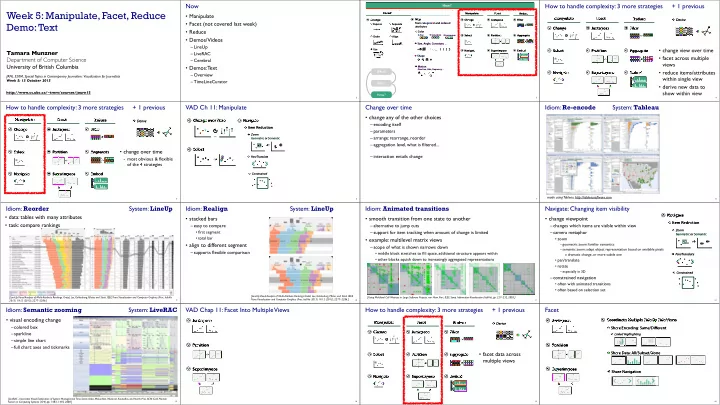
Week 5: Manipulate, Facet, Reduce Demo: Text

Tamara Munzner Department of Computer Science University of British Columbia

JRNL 520M, Special Topics in Contemporary Journalism: Visualization for Journalists Week 5: 13 October 2015

Now

  • Manipulate
  • Facet (not covered last week)
  • Reduce
  • Demos/Videos

– LineUp – LiveRAC – Cerebral

  • Demos: Text

– Overview – TimeLineCurator

2 3

Encode Arrange Express Separate Order Align Use Manipulate Facet Reduce Change Select Navigate Juxtapose Partition Superimpose Filter Aggregate Embed

How? Encode Manipulate Facet

Map Color Motion Size, Angle, Curvature, ...

Hue Saturation Luminance

Shape

Direction, Rate, Frequency, ...

from categorical and ordered attributes

How to handle complexity: 3 more strategies

4

Manipulate Facet Reduce Change Select Navigate Juxtapose Partition Superimpose Filter Aggregate Embed Derive

+ 1 previous

  • change view over time
  • facet across multiple

views

  • reduce items/attributes

within single view

  • derive new data to

show within view

How to handle complexity: 3 more strategies

5

Manipulate Facet Reduce Change Select Navigate Juxtapose Partition Superimpose Filter Aggregate Embed Derive

+ 1 previous

  • change over time
  • most obvious & flexible
  • f the 4 strategies

6

VAD Ch 11: Manipulate

Navigate Item Reduction

Zoom Pan/Translate Constrained Geometric or Semantic

Change over Time Select

Change over time

7

  • change any of the other choices

– encoding itself – parameters – arrange: rearrange, reorder – aggregation level, what is filtered... – interaction entails change

8

Idiom: Re-encode

made using Tableau, http://tableausoftware.com

System: Tableau Idiom: Reorder

9

  • data: tables with many attributes
  • task: compare rankings

System: LineUp

[LineUp: Visual Analysis of Multi-Attribute Rankings. Gratzl, Lex, Gehlenborg, Pfister, and Streit. IEEE Trans. Visualization and Computer Graphics (Proc. InfoVis 2013) 19:12 (2013), 2277–2286.]

Idiom: Realign

10

  • stacked bars

– easy to compare

  • first segment
  • total bar
  • align to different segment

– supports flexible comparison

System: LineUp

[LineUp: Visual Analysis of Multi-Attribute Rankings.Gratzl, Lex, Gehlenborg, Pfister, and Streit. IEEE Trans. Visualization and Computer Graphics (Proc. InfoVis 2013) 19:12 (2013), 2277–2286.]

Idiom: Animated transitions

  • smooth transition from one state to another

– alternative to jump cuts – support for item tracking when amount of change is limited

  • example: multilevel matrix views

– scope of what is shown narrows down

  • middle block stretches to fill space, additional structure appears within
  • other blocks squish down to increasingly aggregated representations

11

[Using Multilevel Call Matrices in Large Software Projects. van Ham. Proc. IEEE Symp. Information Visualization (InfoVis), pp. 227–232, 2003.]

Navigate: Changing item visibility

  • change viewpoint

– changes which items are visible within view – camera metaphor

  • zoom

– geometric zoom: familiar semantics – semantic zoom: adapt object representation based on available pixels » dramatic change, or more subtle one

  • pan/translate
  • rotate

– especially in 3D

– constrained navigation

  • often with animated transitions
  • often based on selection set

12

Navigate Item Reduction

Zoom Pan/Translate Constrained Geometric or Semantic

Idiom: Semantic zooming

  • visual encoding change

– colored box – sparkline – simple line chart – full chart: axes and tickmarks

13

System: LiveRAC

[LiveRAC - Interactive Visual Exploration of System Management Time-Series Data. McLachlan, Munzner, Koutsofios, and North. Proc. ACM Conf. Human Factors in Computing Systems (CHI), pp. 1483–1492, 2008.]

14

VAD Chap 11: Facet Into Multiple Views

Juxtapose Partition Superimpose

How to handle complexity: 3 more strategies

15

Manipulate Facet Reduce Change Select Navigate Juxtapose Partition Superimpose Filter Aggregate Embed Derive

+ 1 previous

  • facet data across

multiple views

Facet

16

Juxtapose Partition Superimpose Coordinate Multiple Side By Side Views Share Encoding: Same/Different Share Data: All/Subset/None Share Navigation

Linked Highlighting

slide-2
SLIDE 2

Idiom: Linked highlighting

17

System: EDV

  • see how regions

contiguous in one view are distributed within another – powerful and pervasive interaction idiom

  • encoding: different

– multiform

  • data: all shared

[Visual Exploration of Large Structured Datasets.

  • Wills. Proc. New

Techniques and Trends in Statistics (NTTS), pp. 237–246. IOS Press, 1995.]

Idiom: bird’s-eye maps

18

  • encoding: same
  • data: subset shared
  • navigation: shared

– bidirectional linking

  • differences

– viewpoint – (size)

  • overview-detail

System: Google Maps

[A Review of Overview+Detail, Zooming, and Focus+Context Interfaces. Cockburn, Karlson, and Bederson. ACM Computing Surveys 41:1 (2008), 1–31.]

Idiom: Small multiples

  • encoding: same
  • data: none shared

– different attributes for node colors – (same network layout)

  • navigation: shared

19

System: Cerebral

[Cerebral: Visualizing Multiple Experimental Conditions on a Graph with Biological Context. Barsky, Munzner, Gardy, and Kincaid. IEEE Trans. Visualization and Computer Graphics (Proc. InfoVis 2008) 14:6 (2008), 1253–1260.]

Coordinate views: Design choice interaction

20

All Subset Same Multiform Multiform, Overview/ Detail None Redundant No Linkage Small Multiples Overview/ Detail

  • why juxtapose views?

– benefits: eyes vs memory

  • lower cognitive load to move eyes between 2 views than remembering previous state with

single changing view

– costs: display area, 2 views side by side each have only half the area of one view

Partition into views

21

  • how to divide data between views

– encodes association between items using spatial proximity – major implications for what patterns are visible – split according to attributes

  • design choices

– how many splits

  • all the way down: one mark per region?
  • stop earlier, for more complex structure

within region?

– order in which attribs used to split – how many views

Partition into Side-by-Side Views

Partitioning: List alignment

  • single bar chart with grouped bars

– split by state into regions

  • complex glyph within each region showing all ages

– compare: easy within state, hard across ages

  • small-multiple bar charts

– split by age into regions

  • one chart per region

– compare: easy within age, harder across states

22

11.0 10.0 9.0 8.0 7.0 6.0 5.0 4.0 3.0 2.0 1.0 0.0 CA TK NY FL IL PA 65 Years and Over 45 to 64 Years 25 to 44 Years 18 to 24 Years 14 to 17 Years 5 to 13 Years Under 5 Years CA TK NY FL IL PA

5 11 5 11 5 11 5 11 5 11 5 11 5 11

Partitioning: Recursive subdivision

  • split by neighborhood
  • then by type
  • then time

– years as rows – months as columns

  • color by price
  • neighborhood patterns

– where it’s expensive – where you pay much more for detached type

23

[Configuring Hierarchical Layouts to Address Research Questions. Slingsby, Dykes, and

  • Wood. IEEE

Transactions on Visualization and Computer Graphics (Proc. InfoVis 2009) 15:6 (2009), 977–984.]

System: HIVE Partitioning: Recursive subdivision

  • switch order of splits

– type then neighborhood

  • switch color

– by price variation

  • type patterns

– within specific type, which neighborhoods inconsistent

24

[Configuring Hierarchical Layouts to Address Research Questions. Slingsby, Dykes, and

  • Wood. IEEE

Transactions on Visualization and Computer Graphics (Proc. InfoVis 2009) 15:6 (2009), 977–984.]

System: HIVE Partitioning: Recursive subdivision

  • different encoding for

second-level regions

– choropleth maps

25

[Configuring Hierarchical Layouts to Address Research Questions. Slingsby, Dykes, and

  • Wood. IEEE

Transactions on Visualization and Computer Graphics (Proc. InfoVis 2009) 15:6 (2009), 977–984.]

System: HIVE Superimpose layers

26

  • layer: set of objects spread out over region

– each set is visually distinguishable group – extent: whole view

  • design choices

– how many layers? – how are layers distinguished? – small static set or dynamic from many possible? – how partitioned?

  • heavyweight with attribs vs lightweight with selection
  • distinguishable layers

– encode with different, nonoverlapping channels

  • two layers achieveable, three with careful design

Superimpose Layers

Static visual layering

  • foreground layer: roads

– hue, size distinguishing main from minor – high luminance contrast from background

  • background layer: regions

– desaturated colors for water, parks, land areas

  • user can selectively focus attention
  • “get it right in black and white”

– check luminance contrast with greyscale view

27

[Get it right in black and white. Stone. 2010. http://www.stonesc.com/wordpress/2010/03/get-it-right-in-black-and-white]

Superimposing limits

  • few layers, but many lines

– up to a few dozen – but not hundreds

  • superimpose vs juxtapose: empirical study

– superimposed for local visual, multiple for global – same screen space for all multiples, single superimposed – tasks

  • local: maximum, global: slope, discrimination

28

[Graphical Perception of Multiple Time Series. Javed, McDonnel, and Elmqvist. IEEE Transactions

  • n

Visualization and Computer Graphics (Proc. IEEE InfoVis 2010) 16:6 (2010), 927–934.]

CPU utilization over time 100 80 60 40 20 05:00 05:30 06:00 06:30 07:00 07:30 08:00 05:00 05:30 06:00 06:30 07:00 07:30 08:00 100 80 60 40 20 05:00 05:30 06:00 06:30 07:00 07:30 08:00 100 80 60 40 20

Dynamic visual layering

  • interactive, from selection

– lightweight: click – very lightweight: hover

  • ex: 1-hop neighbors

29

System: Cerebral

[Cerebral: a Cytoscape plugin for layout of and interaction with biological networks using subcellular localization annotation. Barsky, Gardy, Hancock, and

  • Munzner. Bioinformatics 23:8 (2007), 1040–1042.]

Reduce items and attributes

30

  • reduce/increase: inverses
  • filter

– pro: straightforward and intuitive

  • to understand and compute

– con: out of sight, out of mind

  • aggregation

– pro: inform about whole set – con: difficult to avoid losing signal

  • not mutually exclusive

– combine filter, aggregate – combine reduce, change, facet

Reduce

Filter Aggregate Embed

Reducing Items and Attributes Filter Items Attributes Aggregate Items Attributes

Idiom: dynamic filtering

  • item filtering
  • browse through tightly coupled interaction

– alternative to queries that might return far too many or too few

31

System: FilmFinder

[Visual information seeking: Tight coupling of dynamic query filters with starfield displays. Ahlberg and Shneiderman.

  • Proc. ACM Conf. on Human Factors in Computing Systems (CHI), pp. 313–317, 1994.]

Idiom: histogram

  • static item aggregation
  • task: find distribution
  • data: table
  • derived data

– new table: keys are bins, values are counts

  • bin size crucial

– pattern can change dramatically depending on discretization – opportunity for interaction: control bin size on the fly

32

20 15 10 5 Weight Class (lbs)

slide-3
SLIDE 3

Continuous scatterplot

  • static item aggregation
  • data: table
  • derived data: table

– key attribs x,y for pixels – quant attrib: overplot density

  • dense space-filling 2D

matrix

  • color: sequential

categorical hue + ordered luminance colormap

33

[Continuous Scatterplots. Bachthaler and

  • Weiskopf. IEEE

TVCG (Proc. Vis 08) 14:6 (2008), 1428–1435. 2008. ]

Idiom: boxplot

  • static item aggregation
  • task: find distribution
  • data: table
  • derived data

– 5 quant attribs

  • median: central line
  • lower and upper quartile: boxes
  • lower upper fences: whiskers

– values beyond which items are outliers

– outliers beyond fence cutoffs explicitly shown

34

! ! ! ! ! ! ! ! !

n s k mm !2 2 4

[40 years of boxplots. Wickham and Stryjewski. 2012. had.co.nz]

Idiom: Hierarchical parallel coordinates

  • dynamic item aggregation
  • derived data: hierarchical clustering
  • encoding:

– cluster band with variable transparency, line at mean, width by min/max values – color by proximity in hierarchy

35

[Hierarchical Parallel Coordinates for Exploration of Large Datasets. Fua, Ward, and Rundensteiner.

  • Proc. IEEE

Visualization Conference (Vis ’99), pp. 43– 50, 1999.]

Spatial aggregation

  • MAUP: Modifiable Areal Unit Problem

– gerrymandering (manipulating voting district boundaries) is one example!

36

[http://www.e-education.psu/edu/geog486/l4_p7.html, Fig 4.cg.6]

Dimensionality reduction

  • attribute aggregation

– derive low-dimensional target space from high-dimensional measured space – use when you can’t directly measure what you care about

  • true dimensionality of dataset conjectured to be smaller than dimensionality of measurements
  • latent factors, hidden variables

37 46

Tumor Measurement Data

DR

Malignant Benign data: 9D measured space derived data: 2D target space

Dimensionality reduction for documents

38

Task 1 In HD data Out 2D data Produce In High- dimensional data Why? What? Derive In 2D data Task 2 Out 2D data How? Why? What? Encode Navigate Select Discover Explore Identify In 2D data Out Scatterplot Out Clusters & points Out Scatterplot Clusters & points Task 3 In Scatterplot Clusters & points Out Labels for clusters Why? What? Produce Annotate In Scatterplot In Clusters & points Out Labels for clusters

wombat

  • bag of words model for text document

39

Overview origin story: WikiLeaks meets Glimmer

  • WikiLeaks: hacker-journalist Jonathan Stray analyzing Iraq warlogs

– conjecture that existing label classification falls short of showing all meaningful structure in data

  • friendly action, criminal incident, ...

– had some NLP , needed better vis tools

  • Glimmer: multilevel dimensionality reduction algorithm

– scalability to 30K documents and terms

[Glimmer: Multilevel MDS on the GPU. Ingram, Munzner, Olano. IEEE TVCG 15(2):249-261, 2009. ]

Overview design evolution

40

v1 v3 v4

  • how to find the needle in the

haystack?

  • how to convince that the haystack

has no needles?

What/Why/How interplay

41

  • why: understand clusters
  • what: derive data of full cluster hierarchy

– explore space of possible clusterings

  • how: show cluster hierarchy

– arrange space: node-link

  • how: support tagging clusters/docs

– following or cross-cutting hierarchy!

  • simple annotation
  • progress tracking
  • user-defined semantics

Tables Dataset Types

Networks

Link Node (item)

Trees

Arrange Networks And Trees Node-link Diagrams

TREES NETWORKS

Connections and Marks

Annotate

tag

Produce

Network Data Topology

Paths

Targets

How: Idiom design decisions

42

Juxtapose and Coordinate Views Share Encoding: Same/Different Share Data: All/Subset/None

Linked Highlighting

Why? How? What?

  • facet: juxtapose linked views

– linked color coding

  • cluster hierarchy tree
  • DR scatterplot
  • tags

– reading text/keywords

  • cluster list
  • doc reader

Identity Channels: Categorical Attributes Spatial region Color hue Motion Shape

Overview video (version 1)

43

http://www.cs.ubc.ca/labs/imager/tr/2012/modiscotag/

Overview video v4

44

  • versions 3 and 4

– no DR scatterplot – tree arrangement emphasizing nodes not links – combined doc/cluster viewer

http://vimeo.com/71483614

Why: Task abstractions

45

  • what’s in this collection?

(of leaked docs)

– generate hypothesis – summarize clusters – explore clusters

  • locate evidence

(within FOIA dump)

– verify hypothesis – identify clusters/documents – locate clusters/documents

  • prove non-existence of evidence

– even harder! – exhaustive reading vs filtering out irrelevant

Search

Target known Target unknown Location known Location unknown Lookup Locate Browse Explore

Query Identify Compare Summarise Discover

Demo

46

https://www.overviewdocs.com/ http://overview.ap.org/ http://www.cs.ubc.ca/labs/imager/tr/2014/Overview/

[Overview: The Design, Adoption, and Analysis of a Visual Document Mining Tool For Investigative Journalists. Brehmer, Ingram, Stray, and, Munzner. IEEE TVCG (Proc. InfoVis 2014) 20(12), p. 2271-2280, 2014.]

Further reading

  • Visualization Analysis and Design. Tamara Munzner. CRC Press, 2014.

– Chap 11: Manipulate View – Chap 12: Facet Across Multiple Views – Chap 13: Reduce Items and Attributes

47

Lab/Assignment 5

  • Use TimeLineCurator to create visual timelines from free-form text

– work through BC History example – find 1 article where temporal story is worth telling, and curate it for TimelineJS export

  • including media/images is optional

– find 2 articles that make sense to compare with each other in a mashup

  • curate a combined timeline for TLC export

– find 1 article where there’s nothing interesting to see

  • document that it’s uninteresting with screenshot of TLC’s initial screen

48