SLIDE 1
SLIDE 2
SLIDE 3 Expedition Skills & Camp craft
- This module is aimed at Leaders wanting to expand their knowledge
and experience of guiding in their chosen environment.
- Aimed at adding value and safety and comfort to your day trips to
multi day expeditions in the UK and overseas.
- This session is discursive, inter-active, other Leaders will have their
- wn experiences which should also be shared here.
- I will share with you my top tips and views to try and offer you a
valuable insight to help you to make the most out of journeying with your chosen craft.
SLIDE 4 Planning an expedition
- To journey with a purpose, what is the purpose of your expedition?
- Planning: Aim, Factors, Courses Open, Plan
- Logistics. What factors do you need to consider: S.H.E.E.T.S
- Shared goals & commitments
- Equipment, personal, group,
- Dictated by the environment
‘No such thing as bad weather, just bad clothing’
SLIDE 5
Japan Vs South Georgia
SLIDE 6 Comparatives
No two expeditions are the same
Japan 5000 Miles 139 paddling days out of 180 Cost £3000-4000 (approximately) 4 Islands spread across 4 climatic zones South Georgia 350 Miles 13 Days 8 Hours £139,000 (approximately) Remote Island in Southern Ocean
SLIDE 7 Please Remember What Comes First
- Protection
- Rescue
- Water
- Combustion
- Food
SLIDE 8 Protection
- Protection: protect yourself & your group from obvious threats, this
can be various:
- Weather
- Environment
- Wild Life
- Human
- Themselves, moral boosting etc
SLIDE 9
SLIDE 10 Rescue
- Develop an Emergency Action Plan
- Rescue: If the situation necessitates it, instigate your EAP to initiate a
rescue:
- Flares, VHF’s/Satellite Phones, EPIRB/PLB
- Other signaling methods, Mirrors, Fires (day/night), signs, Night sticks,
features
SLIDE 11
SLIDE 12
SLIDE 13
SLIDE 14
SLIDE 15 WATER
Ensuring that suitable drinking water is available for you and the group is vital:
- Planning (3-4 liters per day?)
- Sourcing
- Hazards
- Purification methods & safe water drills
- Waste management
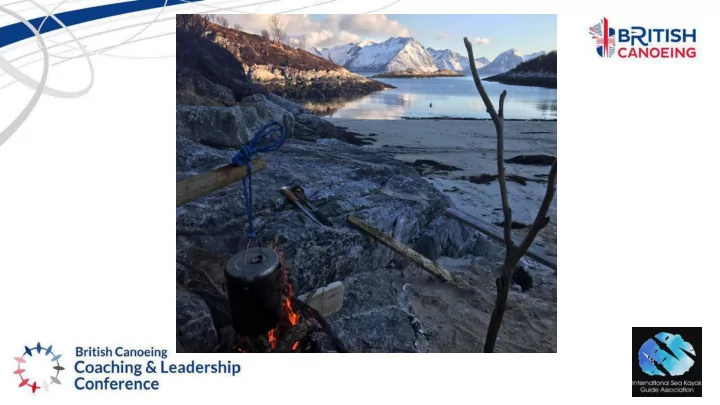
SLIDE 16 Combustion
- Combustion: Creating fire is a vital wilderness skill, guides require
several methods to light fire beyond the naked flame.
- Fire triangle, Oxygen, Heat and Fuel
- Fire Preparation
- Fuel
- Ignition
- Knife, saw & Axe safety and skill
SLIDE 17
SLIDE 18
FOOD
Energy Burn 125-lb. person burns 283 calories per hour 150-lb. person burns 340 calories per hour 175-lb. person burns 397 calories per hour 200-lb. person burns 454 calories. Higher body weight requires increased energy expenditure for activity.
SLIDE 19
SLIDE 20 Wild Life
Our Fur seal bite kit:-
- A bottle of Hydrogen Peroxide
Solution
- A tooth brush
- Antibiotics
SLIDE 21
Hanging a Bear Bag
SLIDE 22 Loading a sea kayak
- DUAL for canoe bags
- How to Load the kayak
- Deck bags
- Use of doubles on expedition
- Wing versus Touring blades
- Individual equipment
- Group equipment
- Creature comforts
SLIDE 23 Points to consider
- Maps Vs charts (Pre preg maps with tidal info)
- Shared daily goals
- Route selection
- Selecting your campsite
- ERV’s (Pointing out & Going back)
- Hard Routine ‘Travel fast go alone, travel far go with others’
- Lost person Protocols
SLIDE 24 Route selection 4 Elements planning
SLIDE 25 Camp Admin
- Camp duties
- Food management
- Waste management
- Wildlife encounters
SLIDE 26 Useful Knots
- Stopper Knot
- Joining Knot
- Hold Fast Knot
- Constriction Knot
SLIDE 27
Stopper knot
SLIDE 28
Ordinary Prussik
SLIDE 29
Double sheet bend
SLIDE 30
SLIDE 31
Over Hand
SLIDE 32
Slippery clove hitch
SLIDE 33
Double Fisherman
SLIDE 34
Honda Knot
SLIDE 35
Clove Hitch
SLIDE 36
Slippery over hand
SLIDE 37
Highwayman’s Hitch
SLIDE 38
Round turn two half hitches
SLIDE 39
Bowline
SLIDE 40 Minimal walkabout pack - The 5 C’s
- Cutting
- Combustion
- Cordage
- Container
- Cover
SLIDE 41
1 2 4 3 17 16 15 14 13 12 11 10 9 8 7 6 5 23 22 21 20 19 18 26 25 24 30 29 28 27
SLIDE 42 Handy reminder before venturing out
Plan your route and check met
Always leave a float plan and EASP
Deck map, compass, whistle, knife, ouch pouch, repair kit
Double up small dry bags and link
Less than 3 should never be
- E Equipment – safety, clothing, spares and victuals
- R
Remember the international distress signal and carry means
STOP – incident, casualty or change in met
SLIDE 43 Review
- Develop YOUR personal action plan
- Consider how this module will affect
Your paddling? Your coaching Your students Your clients