+ Expedition Dentistry Workshop Participants Handout A Brief - - PowerPoint PPT Presentation

expedition dentistry workshop participants handout a
SMART_READER_LITE
LIVE PREVIEW

+ Expedition Dentistry Workshop Participants Handout A Brief - - PowerPoint PPT Presentation

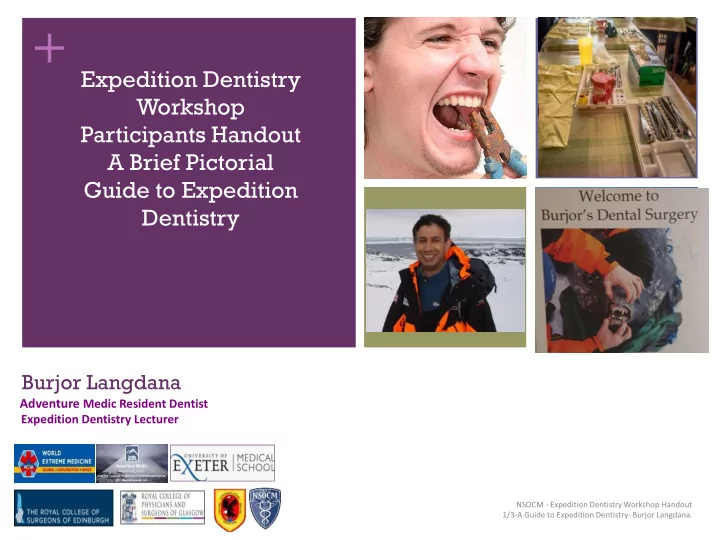
+ Expedition Dentistry Workshop Participants Handout A Brief Pictorial Guide to Expedition Dentistry Burjor Langdana Adventure Medic Resident Dentist Adventure Medic Resident Dentist Expedition Dentistry Lecturer NSOCM -


slide-1
SLIDE 1

+

Burjor Langdana

Expedition Dentistry Workshop Participants Handout A Brief Pictorial Guide to Expedition Dentistry

NSOCM - Expedition Dentistry Workshop Handout 1/3-A Guide to Expedition Dentistry- Burjor Langdana.

Adventure Medic Resident Dentist

Adventure Medic Resident Dentist

Expedition Dentistry Lecturer

slide-2
SLIDE 2

NSOCM - Expedition Dentistry Workshop Handout 1/3-A Guide to Expedition Dentistry- Burjor Langdana.

  • 1. Why are we troubled by Dental Problems so often on an Expedition?
  • 2. How can we prevent Dental Problems spoiling an Expedition?
  • 3. What causes Dental Decay?
  • 4. A brief explanation of the process of Dental Decay.
  • 5. A brief explanation of the process of Gum Disease.
  • 6. What to do to limit the factors that cause tooth and gum problems on an Expedition?
  • 7. Techniques to overcome Expedition oral hygiene blind spots.
  • 8. Flossing- Expedition questions and answers.
  • 9. What to do to protect the teeth from attack?

10.Is there need for pre-departure dental check up? 11.Steps towards doing dental treatment In the field. 12.Expedition dental problem solving. 13.Antibiotics commonly used In Expedition Dentistry. 14.Dental filling materials available for Expedition Dentistry. 15.Step by step guide of how to do a filling using pre-mixed dental filling- Cavit. Hands on Exercise 2 16.Step by step guide on how to mix dental filling- Glass Ionomer. 17.Step by step guide on placing a dental splint- Treatment of an avulsed tooth. Hands on Exercise 3 18.A guide on how to give dental local anaesthesia. Hands on Exercise 1 19.Spread of dental infection- A guide to surgical management. Hands on Exercise 5 & Practical Assessment [ Extended Workshop only]

  • 1. A guide to principles and procedures of dental extraction. Hands on Exercise 4
  • 2. Past historical expedition dental cases- How they were managed.

A Brief Guide to Expedition Dentistry- Table of Contents

slide-3
SLIDE 3

+

are we troubled by Dental Problems so

  • ften on an Expedition?

➢ Change in diet

Increased sugar intake

➢ Decreased fluid intake

Dry Mouth

➢ Difficulty in

Maintaining good Oral hygiene

➢ Exposure to cold/heat

Sensitivity

➢ No Access to Dentist

YOU ARE THE DENTIST

NSOCM - Expedition Dentistry Workshop Handout 1/3-A Guide to Expedition Dentistry- Burjor Langdana.

INCREASING CAVITY RATE

slide-4
SLIDE 4

+

can we Prevent Dental Problems spoiling an Expedition?

 1. A brief understanding on what causes tooth and gum problems.  2. Limit the factors that cause tooth and gum problems.  3. Protect the teeth from attack.  4. Pre-departure dental check up.

NSOCM - Expedition Dentistry Workshop Handout 1/3-A Guide to Expedition Dentistry- Burjor Langdana.

slide-5
SLIDE 5

+

causes Dental Decay?

. One sip of sugary energy drink Mouth Bacteria Acid Clever Saliva buffers Acid Saliva repairs acid damage to teeth

NSOCM - Expedition Dentistry Workshop Handout 1/3-A Guide to Expedition Dentistry- Burjor Langdana.

Multiple sips Mouth Bacteria A LOT of Acid for PROLONGED time. Saliva unable buffer Acid Acid dissolves tooth surface.

Frequency of sugar intake is critical

1.

slide-6
SLIDE 6

+ A BRIEF EXPLANATION OF THE PROCESS OF

DENTAL DECAY.

 Decay will eat away at the dentine

under the enamel of the tooth.

 The result is a progression: Toothache

Severe toothache Tooth dies (relief for a week or so) Infection at the end of the root. Abscess.

 A direct result of sugar + plaque

NSOCM - Expedition Dentistry Workshop Handout 1/3-A Guide to Expedition Dentistry- Burjor Langdana.

slide-7
SLIDE 7

+ A BRIEF EXPLANATION OF THE PROCESS OF

GUM DISEASE.

 Plaque build up at the gum / tooth

interface.

 Inflammation of the gums.  Detachment of the gums from the

teeth forming pockets.

 Pockets next to the teeth collect

plaque , vicious cycle resulting ultimately in tooth loss. This process causes 50% of tooth loss. 

NSOCM - Expedition Dentistry Workshop Handout 1/3-A Guide to Expedition Dentistry- Burjor Langdana.

Healthy Gum Disease Progression

slide-8
SLIDE 8

+

 1.Reduce sugar intake frequency. Diet.  2. When 1. is not possible (due to the physical demands of

an Expedition) increase the attention given to reducing

  • plaque. Oral Hygiene, brushing and flossing . Following

slides will discuss…

 a) Techniques to overcome Expedition oral hygiene blind spots  b) Flossing- Expedition questions and answers

NSOCM - Expedition Dentistry Workshop Handout 1/3-A Guide to Expedition Dentistry- Burjor Langdana.

2. to do to Limit the Factors that cause tooth and gum problems on an Expedition?

slide-9
SLIDE 9

+

NSOCM - Expedition Dentistry Workshop Handout 1/3-A Guide to Expedition Dentistry- Burjor Langdana.

Techniques to Overcome Expedition Oral Hygiene Blind Spots.

2a

1 2 3 1) Blind Spot- Food debris collection cheek side of upper last tooth. You Say- Lips are cracked and tender can’t reach there. I Say- Close your mouth partly . This will loosen your cheek muscles . Allowing you to get your brush all the way back to the cheek side of the top last tooth 2) Blind Spot- Food debris collects on the gum line of lower front teeth. You Say- But there are no mirrors around. I say- Pull your lower lip down . Allowing you to brush all the way to the gum line of the lower teeth 3) Blind Spot- Food debris collects on the tongue side of lower front teeth. You Say- Mouth’s dry, sore and tooth brush too big to get it deep down in there. I say- Keep your tooth brush vertical. So you can get deep down. Brush vertically Downwards and Upwards

slide-10
SLIDE 10

+

NSOCM - Expedition Dentistry Workshop Handout 1/3-A Guide to Expedition Dentistry- Burjor Langdana.

Flossing- Expedition questions and answers

2b

1 2 You say- I don’t floss because it bleeds every time I floss. I say- Because you don’t floss often. Debris collects between the teeth Where the toothbrush can’t reach . Irritating the gums that get inflamed .Inflamed gums bleed as soon as the floss touches them. 1 2 3 3 Solution- Concentrate on the areas that bleed. Floss better and regularly there. You say- The floss keeps catching around the fillings. You are scared it'll pull out the fillings I say- The floss is getting stuck below the overhangs of your fillings. Food debris also collects there so its important to floss there. Solution- Use a non shredding floss. DON’T rip it out vertically . Gently pull It out HORIZONTALLY

slide-11
SLIDE 11

+

NSOCM - Expedition Dentistry Workshop Handout 1/3-A Guide to Expedition Dentistry- Burjor Langdana.

to do to Protect the Teeth from Attack? Answer-Use the Correct Fluoridated toothpaste in the correct way.

3.

A) The correct way

For 2 Minutes

B) The correct Fluoridated Tooth Paste

For Cold Weather Expeditions

Expedition issue - Sensitivity Advised Toothpastes- Antisensitivity Type. Normal Fluoride Percentage with Anti Sensitivity Medication. Things to Remember i) It takes a few days to a few weeks before maximum anti- sensitivity action kicks in. Be patient. ii) You CANNOT mix and match. They all have different mechanisms of action. You have to stick to the same one. III) You CANNOT mix with normal toothpaste. This will become your regular toothpaste. Twice a day. iv) Make sure its Fluoridated.

For Warm Weather ( Desert) Expeditions

Expedition issue- Multiple sips of sugary energy drinks increase frequency of acid attack on teeth Advised Toothpastes- High Fluoride. Much Higher Fluoride Percentage. Things to Remember Like any other medicine Fluoride needs time to act. Hence just spit out the excess toothpaste. DON’T rinse after you brush or it'll just wash it away. The longer it stays on your teeth the better it is. If you do want to use a mouthwash use it in between the day.

slide-12
SLIDE 12

+

NSOCM - Expedition Dentistry Workshop Handout 1/3-A Guide to Expedition Dentistry- Burjor Langdana.

Is there need for Pre-departure Dental Check Up? Answer- It'll help in the Prevention and Diagnosis of Teeth andGum problems on an Expedition.

4.

A) Pre Departure Dental Check ups- Prevention- Pro Active involvement in making sure this is done at least

2/3 months before departure. Informing the dentist where, how long for and degree of dental cover available. i) 2/3 months gives enough time for the dentist to complete complicated treatment like Root Canal, Crowns, Extractions. 2/3 months also affords sufficient time to heal from these procedures. ii)Informing the Dentist about duration, location and degree of Expedition Dental cover. Allows him to adjust his treatment accordingly. Especially for those teeth that lie in the grey zone between conservative and radical treatment modalities 1 2 3 4 5 6

B)Pre Departure Dental Check ups- Diagnosis- To collect a Detailed Dental Charting from the Dentist and

Carry it on the Expedition. To an untrained eye the tooth may look perfect. But actually it could be a crown, a white composite filling. All these may just look like a tooth. A detailed dental charting will let you know exactly Where are the= Fillings: Amalgam and White composites Where are the = Crowns Where are the problem areas= Deep Fillings Where are the=Root Canal treated Teeth Where are the= Wisdom Teeth, are they Impacted, or have they been removed 3 4 5 6
slide-13
SLIDE 13

NSOCM - Expedition Dentistry Workshop Handout 1/3-A Guide to Expedition Dentistry- Burjor Langdana.

Steps Towards Doing Dental Treatment In the Field

1) Preparing Yourself- The Expedition Medic. 2) Location- Where will you do the Treatment. 3) Setting up the Scene- Your Field Dental Clinic. 4) Patient Position- Upper/Lower Teeth. 5) Isolation of Treatment Area- Keeping it Dry from Saliva. 6) Practice Your Movements- Path of Entry/Exit. 7) Proceed with the Final Dental Treatment

slide-14
SLIDE 14

NSOCM - Expedition Dentistry Workshop Handout 1/3-A Guide to Expedition Dentistry- Burjor Langdana.

1) Preparing Yourself- The Expedition Medic Dental treatment will push you out of you comfort zone so ▪ Make sure you are dry, well fed and relaxed. ▪ It'll be fiddly and take time- Keep good posture , padding for your knees and back. 2) Location- Where will you do the Treatment ▪ Day time- Preferably with the patient having a good back rest. Patient facing the sun to get the maximum advantage of natural light. ▪ Night Time- In a closed tent. To prevent light attracted bugs from joining in the dental treatment.

slide-15
SLIDE 15

NSOCM - Expedition Dentistry Workshop Handout 1/3-A Guide to Expedition Dentistry- Burjor Langdana.

3) Setting up the Scene- Your Field Dental Clinic.

1- Tent Floor

  • Empty. Except for Dental stuff and Padding for

Patient and Field Medics. 2- Patient Centre of padded tent floor. Knees bent to allow More freedom of movement in tight space. Assisting in dental procedure by holding dental Stuff 5 and holding light or in retraction. 3- Assistant ONE Has head light . Manual Head Rest and Retractor. 4- Field Medic- Dentist With head light . 5- Dental Stuff/ Dental Charting Well spread out and arranged. 6- Assistant TWO Waits outside to give a helping hand- Space in tent Limited.

1 2 3 4 5 5 Head Torch 6

slide-16
SLIDE 16

NSOCM - Expedition Dentistry Workshop Handout 1/3-A Guide to Expedition Dentistry- Burjor Langdana.

(A) (B) (C) (D) i) ii)

5) Isolation of Treatment Area- Keeping it Dry from Saliva. C) Position- Rotate the head to the opposite side you are treating. This allows the saliva to pool opposite to the side you are treating. D) Location of cotton rolls to reduce salivary flow into mouth. i) Uppers- Place cotton roll on cheek side of upper first molar (next to the opening of parotid duct). ii) Lowers- Place cotton roll on the tongue side of lower teeth AND lip/cheek side of lower teeth. 4) Patient Position- Upper/Lower Teeth. A)For Lower Teeth- Sitting with Lower teeth Parallel to the Floor. B)For Upper Teeth- Patient Lying supine Head rotated, Neck extended, Upper teeth at an angle of 60 degree to floor. Making direct vision possible. 6) Practice Your Movements- Path of Entry/Exit. This gives you an idea of how you will be able to place the filling. What problems you will encounter. Once that is sorted out you can then actually pick up the filling material and insert it into the tooth.

slide-17
SLIDE 17

NSOCM - Expedition Dentistry Workshop Handout 1/3-A Guide to Expedition Dentistry- Burjor Langdana.

Expedition Dental Problem Solving Key to the Images

Patient complaining of… How did this happen-The pathology behind the signs and symptoms. Expedition Dental solution options. What can you (Expedition Medic)see.

slide-18
SLIDE 18

NSOCM - Expedition Dentistry Workshop Handout 1/3-A Guide to Expedition Dentistry- Burjor Langdana.

Doc I’ve got this brown spot on my tooth, it’s very sensitive to cold. Enamel Caries- Acid from food dissolved outer surface of Enamel. This has become rough and picked up stains from food. It’s now porous, demineralised and very sensitive. 1) Isolate , dry area 2)Duraphat Fluoride Varnish 3)Apply over affected area 4)No food or water for 30 Minutes 5)Diet and oral hygiene instructions Note- If No Duraphat Fluoride Varnish available- Use any Antisensitivity Toothpaste as a compromise.

slide-19
SLIDE 19

NSOCM - Expedition Dentistry Workshop Handout 1/3-A Guide to Expedition Dentistry- Burjor Langdana.

Doc I've got a tooth that’s getting more and more sensitive. It now hurts for a while after ive finished eating my soup. I think there is a hole in it. Dentine Caries- Acid dissolving through the Enamel. Now reached the Dentine. Dissolving and hollowing the tooth. Unsupported Enamel crumbles forming a

  • hole. Getting closer to the pulp, hence increase in sensitivity.

2) Isolate , dry area 1)Clean soft cheesy leathery debris from the hole in tooth 3)Take temporary filling material- Cavit, IRM 4) Cover hole in tooth- Avoid eating for 30 minutes Note- If temporary filling material not available. Following used historically- Clove oil dipped cotton, Ski/Candle wax, Chewing Gum.

slide-20
SLIDE 20

NSOCM - Expedition Dentistry Workshop Handout 1/3-A Guide to Expedition Dentistry- Burjor Langdana.

1b)Clean soft cheesy leathery debris 2) Isolate , dry area 1a) Pluck out loose broken filling 4)Place this mild antiseptic steroid paste in the depth of the cavity 5)Take Ledermix/ Odontopaste 5) Fill rest of the cavity with Cavit/IRM May need Deep Filling, Root Canal treatment

  • r Extraction by

dentist in future Deep caries with tooth Pulp involvement- Pulp getting irritated and inflamed . This Inflammation creates pressure pain in tooth

  • centre. Pulp has NO proprioceptive receptors. Hence localisation of

pain is a problem. 6) Antibiotics and Anti-inflammatories A deep carious hole. A very large, deep, loose or broken filling. Doc the entire side of my face hurts. I can’t make out which tooth this constant throbbing pain is coming from. On questioning he may give a) History of a very deep filling done there b) History of tooth ache associated with a particular tooth.

slide-21
SLIDE 21

NSOCM - Expedition Dentistry Workshop Handout 1/3-A Guide to Expedition Dentistry- Burjor Langdana.

Doc when I eat there is a tooth that really hurts. I know exactly which one it is. It’s not very sensitive to hot and cold. But very painful when I bite on it. Tenderness or swelling adjacent to A tooth with a large filling or a deep hole. Dental Abscess- The Infection after reaching and inflaming the pulp. Finally results in pulp death. Dead necrotic stuff leaks out of the Root to result in an abscess in the bone below the root. The bone DOES have proprioceptive receptors. Hence pain can be localised. 1) Antibiotics + Anti-inflammatories 2) Avoid Extra-Oral Heat application. This would migrate the swelling extra-orally. worsening the situation 3) Dental Dressing with Ledermix or Odontopaste ( Last Slide ) may help 4)Drainage- a)Incision and drainage b) Using wide bore needle c) Extraction. May all help depending on experience, training of Exped Medic and existing situation

slide-22
SLIDE 22

NSOCM - Expedition Dentistry Workshop Handout 1/3-A Guide to Expedition Dentistry- Burjor Langdana.

Doc my gums bleed while brushing and flossing. So I’ve stopped brushing there. But its getting worse. Its bleeding more and getting even more painful. Red, inflamed gums. Poor oral hygiene. Gums bleed when you touch them Gingivitis/Periodontitis- Poor brushing flossing – Food Debris- Inflamed gums-Results in bleeding while brushing, flossing- Scares patient- Who then brushes and flosses less-This results in a vicious cycle.

4.Periodontitis

1)Bleeding while brushing and flossing indicates that he/she must brush and floss in that area better ( not more force) just better. 2) Take Corsodyl Mouth wash or Gel 3) Flush with Corsodyl Mouth Wash or paint teeth with Corsodyl Gel

slide-23
SLIDE 23

NSOCM - Expedition Dentistry Workshop Handout 1/3-A Guide to Expedition Dentistry- Burjor Langdana.

Gum boil From tooth

Dead Nerve Abscess

2

1 Doc, I've got a pimple on my gum. Is it a gum boil? A pimple on the gum. Periodontal/ Gum Abscess- Food and debris causes pocket between tooth and gums. Irritated gums get so inflamed that they close the opening of the pocket, sealing in all the debris, that liquefies causing a pimple. This has to differentiated from a Dental abscess that decompresses through a sinus to form a gum boil. Tooth abscess is situated further away from the crown, compared to gum abscess 1

2

1) Antibiotics + Anti-inflammatories 2a)Treatment-Incise and drain 2b)Curette, Clean and drain through pocket 3)Flush with Corsodyl Mouth Wash or insert Corsodyl Gel OR

slide-24
SLIDE 24

NSOCM - Expedition Dentistry Workshop Handout 1/3-A Guide to Expedition Dentistry- Burjor Langdana.

Doc I can’t open my mouth, my face hurts, and it’s swollen. The gums behind my last tooth is swollen Partly erupted wisdom tooth. Overlying gums appear swollen and inflamed. Pericoronitis (Inflammation around crown)of wisdom tooth (3rd Molar) Due to plaque build up on and between the wisdom teeth. This time it is around a wisdom tooth that is half buried in the gum: because it is so difficult to clean, the resulting infection is almost inevitable! 1) Antibiotics + Anti-inflammatories 2)Irrigation using blunt needle (Venflon outer plastic cannula) 3) Irrigate using Corsodyl or luke warm salt water 4) Insert blunt needle in the pocket between inflamed gum and partly erupted wisdom tooth. Gently flush out the debris.

slide-25
SLIDE 25

Antibiotics Commonly Used In Expedition Dentistry

NOT Allergic to Penicillin

  • Amoxycillin 500mg + Potassium

Clavulanate 125mg ( Augmentin/ Co-amoxiclav- 625mg) OR

  • Amoxycillin 500 mg +

Metronidazole 400mg History of Penicillin Allergy

  • Metronidazole 400mg +

Erythromycin 500mg OR

  • Metronidazole 400mg +

Clarithromycin 500mg OR

  • Metronidazole 400 mg +

Azithromycin 500mg

Analgesics/ Antinflammatories Commonly used in Expedition Dentistry

  • Ibuprofen 400mg OR
  • Diclofenac 50 mg
  • Paracetamol ( Acetaminophen) 500 mg can be combined with Ibuprofen or

Diclofenac

NSOCM - Expedition Dentistry Workshop Handout 1/3-A Guide to Expedition Dentistry- Burjor Langdana.

slide-26
SLIDE 26

NSOCM - Expedition Dentistry Workshop Handout 1/3-A Guide to Expedition Dentistry- Burjor Langdana.

Premixed Supplied in a sealed tube; squeeze out and apply.

  • The premixed materials (e.g.‘Cavit’) are easier to use but have less structural strength.
  • Requires a mechanically retentive cavity to stay put. i.e. a hole with walls.
  • Erodes and may require replacing as often as every few days.
  • Cavity can be a little damp but not wet.

Materials that require mixing Examples include IRM (Intermediate Restorative Material) or any glass ionomer filling material which is fussy, but also very sticky and retentive. Consider the following before starting:

  • Isolating and drying the cavity – as above
  • The exact ratio of powder to liquid is critical.
  • The mixing time is about 1 min and the setting time is similar.
  • Mix on a glass/shiny plastic slab with a flat spatula into a dough-like consistency.
  • Apply and compress into a dry cavity, immediately removing all excess material from the biting surface. A

Vaseline coated finger in ease of smoothening and shaping the filling.

  • IRM may be colour-coded: white for a clean cavity, blue for decay present, red for pulpal symptoms.

If you have no filling material available Improvisation can be attempted. Dip cotton pellet into oil of cloves or Eugenol. Swab the depth of the cavity. Then seal the cavity with candle wax, ski wax or sugarless chewing gum. Expect limited success of a very short duration.

Dental Filling Materials available for Expedition Dentistry

A B

slide-27
SLIDE 27

Filling a tooth with deep decay with a temporary filling material- Cavit and Ledermix or Odontopaste. Things you will need.

Dental floss Excavator- To remove soft decay Flat Plastic – To place cement on tooth

Ledermix Paste/ Odontopaste CAVIT- Temporary Filling material Matrix Band The Tooth ☺ Applicator brush Articulating( Biting ) Paper. Inner narrower diameter Toward the root Outer wider diameter Towards crown NSOCM - Expedition Dentistry Workshop Handout 1/3-A Guide to Expedition Dentistry- Burjor Langdana.

A

slide-28
SLIDE 28

First you will need to excavate( clean) debris from the tooth before filling.

Dental Excavator- use to clean soft leathery debris from cavity. Cleaned using CONCAVE side not CONVEX side

THE WRONG WAY Towards the pulp of the tooth FROM Soft debris TO Hard tooth

  • structure. Deep Aggressive

spooning. Can dig straight into the pulp of the tooth.

Now Clean the artificial debris From the tooth the RIGHT way. AWAY from the pulp of the tooth. FROM Hard tooth structure TO Soft

  • debris. Gentle Superficial spooning,

removing small bits at a time.

NSOCM - Expedition Dentistry Workshop Handout 1/3-A Guide to Expedition Dentistry- Burjor Langdana.

A

slide-29
SLIDE 29

Place cotton rolls on either side , to keep Tooth Dry Cotton Rolls, Balls Ear Buds Compressed air can Paper Tissue wick

Keep dabbing with ear buds, keep changing wet cotton rolls for dry ones Tooth needs to be DRY for filling to stick.

Now dry the tooth and KEEP it dry

NSOCM - Expedition Dentistry Workshop Handout 1/3-A Guide to Expedition Dentistry- Burjor Langdana.

A

slide-30
SLIDE 30

If the front or back portion of the tooth is broken then one needs to place a Matrix band ( like boxing before pouring cement) and placement of Ledermix.

Floss between the teeth, to remove all debris. To make it easier to place Matrix Band Put matrix band right way around on tooth. NARROW to ROOT, WIDER to CROWN. Dip applicator brush in Ledermix/ Odontopaste. Coating a modest amount in the depths of the cavity.

NSOCM - Expedition Dentistry Workshop Handout 1/3-A Guide to Expedition Dentistry- Burjor Langdana.

A

slide-31
SLIDE 31

1)Take some Cavit on Flat

  • Plastic. If hard roll into

a ball it'll soften. 2)Pat, Press and shape with finger. If filling too Sticky, coating the finger with Vaseline helps 3)Remove Matrix Band A black dot is shown representing the high point detected when patient bites on articulating paper. 5) Excess removed with Flat Plastic

Then place the Cavit and use Articulating Paper( Carbon Paper, Typing paper)

A

slide-32
SLIDE 32

Glass Ionomer Cement Mixing -Its stickier, sets harder, grips on to tooth better. Longer lasting filling. But fiddly to mix and place.

Liquid ( Water)

Powder Vaseline Cement mixing Spatula Mixing Pad Powder Measuring spoon Scrape of excess powder 2 Drops of liquid to 2 spoons of powder Mixing powder and liquid 1 MINUTE Putty/ Chewing gum consistency Flat Plastic to place in cavity 1 MINUTE NSOCM - Expedition Dentistry Workshop Handout 1/3-A Guide to Expedition Dentistry- Burjor Langdana.

B

slide-33
SLIDE 33

Burjor Langdana

Front tooth gets knocked out- Its now an AVULSED TOOTH- This MODULE will train you in how you can save this tooth.

slide-34
SLIDE 34

NSOCM - Expedition Dentistry Workshop Handout 1/3-A Guide to Expedition Dentistry- Burjor Langdana.

The avulsed tooth in blood and dirt. Represented by Ketchup The empty socket with blood clot represented by blue cotton Syringe to gently flush blood and dirt from the tooth The Splint that we will use to stabilise the tooth. This is obtained by Cutting and pulling out the nasal clip from the mask. We have cut some Splints and prepared them for you. We will fix the splint to model Teeth using glue dots

AVULSED TOOTH MODULE

slide-35
SLIDE 35

NSOCM - Expedition Dentistry Workshop Handout 1/3-A Guide to Expedition Dentistry- Burjor Langdana.

Blood clot forms in 8 minutes. Blood clot has to be removed To insert tooth fully into depth

  • f socket.

So remove the blue cotton ( representing blood clot) As you remove blood clot gently Stimulate bleeding this will help in healing

Removal of Blood clot and preparing the Socket

Local Anaesthesia preferable but not essential.

slide-36
SLIDE 36

NSOCM - Expedition Dentistry Workshop Handout 1/3-A Guide to Expedition Dentistry- Burjor Langdana.

Hold the tooth by the Crown

DO NOT TOUCH THE ROOT

Cleaning the tooth- How to hold it

slide-37
SLIDE 37

NSOCM - Expedition Dentistry Workshop Handout 1/3-A Guide to Expedition Dentistry- Burjor Langdana.

Cleaning the tooth- What to use

Gently flush the tooth clean For approximately

Or

Adventure Medic-Management of an avulsed tooth-Burjor Langdana & Matt Edwards

slide-38
SLIDE 38

NSOCM - Expedition Dentistry Workshop Handout 1/3-A Guide to Expedition Dentistry- Burjor Langdana.

Re-insert the Tooth

Check the adjacent teeth to make sure you reinsert the tooth the right way round

slide-39
SLIDE 39

NSOCM - Expedition Dentistry Workshop Handout 1/3-A Guide to Expedition Dentistry- Burjor Langdana.

Re-insert then hold the tooth.

Push the tooth slowly with slight digital pressure ( Do not use force) to its full depth within its socket so that it stands level height with the adjacent teeth

Hold in position until haemostasis is re-achieved typically 4–8 min. Hold in position or can bite on an Ice Cream stick For 4-8 minutes

slide-40
SLIDE 40

NSOCM - Expedition Dentistry Workshop Handout 1/3-A Guide to Expedition Dentistry- Burjor Langdana.

One or more teeth on each side are used to splint the damaged tooth

Now adapt the splint- In this case nasal clip from mask

Tuck the front and the back end of the splint inbetween the teeth if possible Try to adapt the Splint on the Midsurface of the tooth between gum line and the Top of the tooth.

slide-41
SLIDE 41

NSOCM - Expedition Dentistry Workshop Handout 1/3-A Guide to Expedition Dentistry- Burjor Langdana.

But if you don’t have a nasal clip you could also use-

A Straightened Paper clip

an alternative but weaker bond can be made by sticking the tooth to its neighbours with cyanoacrylate skin adhesive. cyanoacrylic tissue adhesive, with supplementary steristrips if needed

slide-42
SLIDE 42

NSOCM - Expedition Dentistry Workshop Handout 1/3-A Guide to Expedition Dentistry- Burjor Langdana.

Now fix the splint to the teeth- We could either use Dental filling materials- Surgical Glue ( Weak Bond)- For practice we will use Glue dots

Powder Liquid- Glass inomer Based emergency filling material 2 pastes- Composite Based emergency filling material

Glue dots for practice only NOT to be used in the mouth

slide-43
SLIDE 43

NSOCM - Expedition Dentistry Workshop Handout 1/3-A Guide to Expedition Dentistry- Burjor Langdana.

A)When do you take the splint out- 1) Till patient sees his dentist – Preferably ASAP/ or Within the next 7 days 2) If that’s not possible- Splint may be left in place for 2 to 4 weeks B)What will the Dentist do- 1) Within a week he will start Root Canal Treatment 2) Take the splint out AFTER Starting root canal Treatment. Approx 2 to 4 weeks post injury depending on time tooth was out of mouth. C) Prognosis- Upto 80% if tooth stored correctly and done within 1 Hour. Over an hour less than 20%

slide-44
SLIDE 44

NSOCM - Expedition Dentistry Workshop Handout 1/3-A Guide to Expedition Dentistry- Burjor Langdana.

Instructions after Splinting- A) Soft Food for up to 2 weeks . B) Brush Tooth gently with soft toothbrush after each meal C) Use Clorehexidine moth wash or gel twice a day for a week. D) Prescribe NSAIDs and a broad-spectrum antibiotic for at least 7 days. E) Tetanus Booster

Tuck the front and the back end of the splint inbetween the teeth if possible

slide-45
SLIDE 45

Dental Local Anaesthesia Module(a bit of hands on)

Burjor Langdana Aims and objectives 1) To familiarise you guys with the equipment used for giving LA 2) Briefly explain procedure and landmarks 3) Give you the hands on feel to locate these landmarks 4) Essentially a brief guide to get teeth numb on an expedition

NSOCM - Expedition Dentistry Workshop Handout 1/3-A Guide to Expedition Dentistry- Burjor Langdana.

Please divide in groups of Three

(1) Chief Operator (2) Patient for this exercise (3) Manual headrest

slide-46
SLIDE 46

NSOCM - Expedition Dentistry Workshop Handout 1/3-A Guide to Expedition Dentistry- Burjor Langdana.

To open needle TWIST PULL PUSH SCREW To fix needle to dental syringe To open dental syringe PULL BACK PLUNGER ALL THE WAY FLIP OPEN SYRINGE INSERT CARTRIDGE METAL END FIRST FLIP BACK TO CLOSE

LOADING A DENTAL SYRINGE

slide-47
SLIDE 47

NSOCM - Expedition Dentistry Workshop Handout 1/3-A Guide to Expedition Dentistry- Burjor Langdana.

Different ways to get Teeth numb on an Expedition

1 Local Infiltration – This is our FIRST exercise= Works for all upper teeth . All lower front teeth including and up to first premolar. The bone in these areas is soft and porous for local infiltration. 2 Mandibular Nerve block- This is our SECOND Exercise ( including long buccal and lingual nerve as a part of the package deal) =The mandibular bone posteriorly to lower second premolars is too dense for infiltration to work. Mandibular Nerve block is essential if you are working in this area. It'll anaesthetise the entire half of the lower jaw.

1 1 2 2

Intra Ligamentary-We shall discuss this= Injection between tooth and bone. Works for any tooth, teeth as a supplement to 1) and 2).

3 Key to Innervation Diagram

All Uppers- Buccal Infiltration AND Palatal Infiltration Lowers till First Premolars- Buccal AND Lingual Infiltration

slide-48
SLIDE 48

NSOCM - Expedition Dentistry Workshop Handout 1/3-A Guide to Expedition Dentistry- Burjor Langdana.

Stand to the RIGHT Pop your head torch on We will practice using the PLASTIC CANNULA as our pretend needle. One for each- hold onto your own to prevent mixing them up TAKE UP YOUR POSITIONS TO PRACTICE LOCAL ANESTHESIA TECHNIQUES Pop your gloves

  • n
slide-49
SLIDE 49

Pinch the upper lip/cheek with thumb and index finger. Pull Upwards and outwards to establish a traction line. Insert till you touch bone(Para-periositeal) Inject in the depth of the mucobuccal fold apical to the tooth being anesthetised.

BUCCAL INFILTRATION EXCERSISE

NSOCM - Expedition Dentistry Workshop Handout 1/3-A Guide to Expedition Dentistry- Burjor Langdana.

Thumb and indexfinger pull exerting traction, upwards and outwards. Inject where traction meets the apex of tooth Touch located landmark with end of suction cannula

UPPER

Where the cheek gums meet the tooth bone

slide-50
SLIDE 50

PALATAL INFILTRATION EXCERSISE

The Local Anaesthesia is injected at the softest part of hard palate (5 to 10 mm from the gum margin) approximately 45 degrees angle. Adjacent to the tooth being anesthetised.

NSOCM - Expedition Dentistry Workshop Handout 1/3-A Guide to Expedition Dentistry- Burjor Langdana.

Softest part of hard palate 5 to 10 mm from Gum margin At an angle of 45 degrees Touch located landmark with end of suction cannula 45 degree

slide-51
SLIDE 51

NSOCM - Expedition Dentistry Workshop Handout 1/3-A Guide to Expedition Dentistry- Burjor Langdana.

Thumb and indexfinger exerting traction, downwards and forwards Inject where traction meets the apex of the tooth Touch located landmark with end of suction cannula

BUCCAL INFILTRATION EXCERSISE LOWER

Pinch the lower lip/cheek with thumb and index finger. Pull downwards and forwards to establish a traction line. Insert till you touch bone (Para-periositeal) Inject in the depth of the Mucobuccal fold apical to the tooth being anesthetised

slide-52
SLIDE 52

NSOCM - Expedition Dentistry Workshop Handout 1/3-A Guide to Expedition Dentistry- Burjor Langdana.

LINGUAL INFILTRATION - IN HANDOUT ONLY

1)Retract and hold the tongue 2)Insert till you touch bone (Para-periositeal) Inject in the depth of the Mucobuccal fold apical to the tooth being anesthetised 3)You will notice ballooning and or blanching in that area as you inject the local anesthetic.

slide-53
SLIDE 53

NSOCM - Expedition Dentistry Workshop Handout 1/3-A Guide to Expedition Dentistry- Burjor Langdana.

Exercise for RIGHT Block YOU adopt THIS Position RIGHT MANDIBULAR BLOCK LEFT MANDIBULAR BLOCK Index finger(left hand) posterior border of Extra Oral mandible Lt Rt

slide-54
SLIDE 54

Put your thumb besides the last molar tooth. Feel the jaw bone as it turns upwards to the head . Rest your thumb in the depression there - the Coronoid notch. Centre part of Coronoid notch is your

Horizontal landmark

NSOCM - Expedition Dentistry Workshop Handout 1/3-A Guide to Expedition Dentistry- Burjor Langdana.

Left Thumb on bone on cheek side of last lower molar tooth

slide-55
SLIDE 55

The vertical landmark is the lateral fold line of a muscular pillar that runs from the lower teeth to the upper teeth - Pterygomandibular raphae .

NSOCM - Expedition Dentistry Workshop Handout 1/3-A Guide to Expedition Dentistry- Burjor Langdana.

slide-56
SLIDE 56

NSOCM - Expedition Dentistry Workshop Handout 1/3-A Guide to Expedition Dentistry- Burjor Langdana.

Horizontal Landmark Vertical Landmark Point of intersection

slide-57
SLIDE 57

NSOCM - Expedition Dentistry Workshop Handout 1/3-A Guide to Expedition Dentistry- Burjor Langdana.

Touch located landmark with end of suction cannula

You insert the needle at the point of intersection between the HORIZONTAL and VERTICAL landmark. The ANGLE of injection is from the OPPOSITE SIDE PREMOLARS. Insert needle till you HIT BONE.

  • 1. Advance needle to bone
  • 2. Depth of needle 20-25mm
  • 3. Withdraw slightly
  • 4. Attempt to aspirate
  • 5. DO NOT INJECT IF-

a) Bone not contacted b) Blood aspirated 6 Inject very slowly

slide-58
SLIDE 58

Hit bone too early, withdraw a little, shift syringe slightly more towards midline and insert deeper again. Gone too deep without hitting bone, withdraw a little, shift syringe slightly more towards the back and insert deeper again

Hit bone too early. Gone too deep and not hit bone yet. What do I do?

NSOCM - Expedition Dentistry Workshop Handout 1/3-A Guide to Expedition Dentistry- Burjor Langdana.

slide-59
SLIDE 59

Lingual Nerve Block Exercise ( Essentially a continuation of Mandibular Block)

The Lingual nerve will be anesthetised during the same insertion for Mandibular nerve block

NSOCM - Expedition Dentistry Workshop Handout 1/3-A Guide to Expedition Dentistry- Burjor Langdana.

Lingual Nerve Keep injecting as you withdraw needle after Mandibular Block

slide-60
SLIDE 60

Put your thumb besides the last molar tooth. Feel the jaw bone as it turns upwards to the head . Rest your thumb in the depression there - the Coronoid notch. That’s the place for long buccal nerve block.

Long Buccal Nerve Block Exercise ( Essentially a continuation of Mandibular Block)

NSOCM - Expedition Dentistry Workshop Handout 1/3-A Guide to Expedition Dentistry- Burjor Langdana.

Inject in Coronoid notch—Depression of the jaw bone as it turns upwards to the head Long Buccal Nerve

slide-61
SLIDE 61

Periodontal Ligament Injection ( essentially a supplement to the other injections)

Local Anaesthetic injected with some pressure by pacing the needle parallel to tooth, bevel towards tooth.

Requires a lot

  • f pressure

NSOCM - Expedition Dentistry Workshop Handout 1/3-A Guide to Expedition Dentistry- Burjor Langdana.

slide-62
SLIDE 62

NSOCM - Expedition Dentistry Workshop Handout 1/3-A Guide to Expedition Dentistry- Burjor Langdana.

slide-63
SLIDE 63

Spread Of Untreated

infection

infection

infection

infection

infection

Surgical Management

NSOCM - Expedition Dentistry Workshop Handout 1/3-A Guide to Expedition Dentistry- Burjor Langdana.

slide-64
SLIDE 64

Treatment- Aug + Ibu. Drainage by extraction of offending

  • tooth. If not then Incision and drainage-

Incision with 3 to 5 mm of gum margin . Palatal pressure post drainage to prevent palatal Haematoma for at least 30 mts.

slide-65
SLIDE 65

Treatment- Aug + Ibu. Drainage by extraction of offending tooth.

slide-66
SLIDE 66

Tooth firm, 2 rooted, extraction would be challenging

Incise and drain- incision in the tooth half of the swelling( within 5 mm of gum margin- away from mental nerve)- cut towards the tooth( away from blood vessels in cheek ) – go down till bone ( pus will be there)

slide-67
SLIDE 67

Drainage by extracting the offending tooth. This one is 2 rooted. But if the abscess has made it mobile and options are limited you can do it.

slide-68
SLIDE 68

Extract offending tooth ASAP to establish drainage This is a cellulitis don’t expect any drainage from extra oral incisions Intubation very difficult, beware of possible parapharyngeal abscess

slide-69
SLIDE 69

Simple Tooth Extraction Module

Burjor Langdana

slide-70
SLIDE 70

Aims and Objectives

1)To familiarise you guys with the instruments carried on an expedition for extracting teeth 2)Briefly explain procedure 3)Give you the hands on feel regarding position and use of elevators and forceps 4)Essentially a brief guide to extract teeth on an expedition

NSOCM - Expedition Dentistry Workshop Handout 1/3-A Guide to Expedition Dentistry- Burjor Langdana.

slide-71
SLIDE 71

Extraction Forceps

  • Lower forceps with fine blades are used to

extract lower incisors,premolars. All these teeth have one root.

Lower Lip Beaks parallel to long axis of tooth Acute angle in Forceps allows this without pressing on Lower lip

NSOCM - Expedition Dentistry Workshop Handout 1/3-A Guide to Expedition Dentistry- Burjor Langdana.

slide-72
SLIDE 72

Extraction Forceps

  • Lower molar forceps have pointy beaks that fits in

the furcation between the front and back roots of the molars.

  • Can be used on the right or left side.

NSOCM - Expedition Dentistry Workshop Handout 1/3-A Guide to Expedition Dentistry- Burjor Langdana.

slide-73
SLIDE 73

Extraction Forceps

  • The maxillary incisor to Premolar teeth are

extracted with the a straight or slightly curved forceps

Beaks parallel to long axis of tooth Upper Lip Forceps are Straight, allowing this, as interference from lips is minimal

NSOCM - Expedition Dentistry Workshop Handout 1/3-A Guide to Expedition Dentistry- Burjor Langdana.

slide-74
SLIDE 74

Upper Molar Extraction Forceps are also relatively straight ( compared to lowers)

  • The buccal( outer) beak of each forceps has a

pointed design, which fits into the buccal( Cheek side) bifurcation of the two buccal roots. Remember pointy bit outside, roundy bit inside ☺

Maxillary left molar forceps Maxillary right molar forceps

NSOCM - Expedition Dentistry Workshop Handout 1/3-A Guide to Expedition Dentistry- Burjor Langdana.

slide-75
SLIDE 75

CONCAVE or FLAT side of the elevator FACES the TOOTH to be EXTRACTED

Elevators ( Like small screw drivers)

NSOCM - Expedition Dentistry Workshop Handout 1/3-A Guide to Expedition Dentistry- Burjor Langdana.

slide-76
SLIDE 76

Elevator Excersise

Where Will You Stand?

  • For

all maxillary teeth and anterior mandibular teeth, the dentist is to the front and right (and to the left, for left- handed dentists) of the patient.

  • For the posterior RIGHT mandibular teeth

the dentist is positioned in front of or behind and to the right (or to the left, for left-handed dentists) of the patient

NSOCM - Expedition Dentistry Workshop Handout 1/3-A Guide to Expedition Dentistry- Burjor Langdana.

YOU stand here For this exercise

slide-77
SLIDE 77

Elevator Exercise

How Will You Support The Jaw?

Middle finger placed lingually Forefinger Buccaly Thumb along lower border Of Mandible Left Hand Lower Left Extraction Lower Right Extraction

NSOCM - Expedition Dentistry Workshop Handout 1/3-A Guide to Expedition Dentistry- Burjor Langdana.

YOU use THIS support for this excersise

slide-78
SLIDE 78

Elevator Excersise

The WRONG way and the RIGHT way of Elevator placement

The Elevator is jammed straight between the teeth . The Elevator is placed at an angle towards the root. Engaging the root surface between the tooth and bone.

NSOCM - Expedition Dentistry Workshop Handout 1/3-A Guide to Expedition Dentistry- Burjor Langdana.

slide-79
SLIDE 79

What happens then?

  • The handle serves as the axle

and the tip of the elevator acts as a wheel and engages and loosens the tooth.

  • The elevator acquires a contact

point on the root surface as a wedge to loosen tooth from socket

Axle

Wheel

Wedge

Elevator Exercise

NSOCM - Expedition Dentistry Workshop Handout 1/3-A Guide to Expedition Dentistry- Burjor Langdana.

slide-80
SLIDE 80

Exercise For Lower Front Tooth Extraction

Position of Patient(2). Mouth(2) Below elbow level of (1) Mandibular Occlusal plane parallel to floor. 2 1 First Pressure is= Strong apical pressure to expand bone and to displace centre of rotation as apically as possible . Apical

NSOCM - Expedition Dentistry Workshop Handout 1/3-A Guide to Expedition Dentistry- Burjor Langdana.

YOU stand here Left hand thumb along lower border of jaw Left hand index finger lip side of tooth Left middle finger on tongue side of tooth

slide-81
SLIDE 81

Why strong apical pressure ?

  • If center of rotation

is not far enough apically, it is too far

  • cclusally, which results in excess

movement of tooth apex.

  • Excess motion of root apex caused

by high center of rotation results in fracture of root apex.

Occlusal Apical

Root apex fracture

NSOCM - Expedition Dentistry Workshop Handout 1/3-A Guide to Expedition Dentistry- Burjor Langdana.

slide-82
SLIDE 82

Exercise For Upper Front Tooth Extraction.

Position of patient, tipped backward, maxillary occlusal plane is at 60 degrees to the floor. mouth is at Medics elbow level 1 2 Left Hand(1)= Thumb And forefinger for support Rt Hand(1) Thumb Forefinger represent Beaks of forceps First Pressure is= Strong apical pressure to expand bone and to displace centre of rotation as apically as possible .

NSOCM - Expedition Dentistry Workshop Handout 1/3-A Guide to Expedition Dentistry- Burjor Langdana.

YOU stand here Left hand Index finger rests on bone Lip side of tooth Left hand Thumb Rests on bone Roof Side of tooth

slide-83
SLIDE 83

What happens then?

  • Buccal (Cheek) or labial (Lip) pressure

applied to tooth will expand the buccal cortical plate toward the crestal bone with some lingual( Tongue side) expansion at apical end

  • f the root.
  • Lingual (Tongue side)or palatal (Roof
  • f Mouth side) pressure will expand

lingual cortical plate at crestal area and slightly expand buccal bone at apical area.

C h e e k T

  • n

g u e Apical Crestal

NSOCM - Expedition Dentistry Workshop Handout 1/3-A Guide to Expedition Dentistry- Burjor Langdana.

slide-84
SLIDE 84

And Finally! After some…

Outward Movement Inward Movement Rotary Movement Like rocking a tent stake back and forth so to widen ( expand) the hole in the ground where it is lodged. Once hole has sufficiently enlarged, stake comes out easily.

NSOCM - Expedition Dentistry Workshop Handout 1/3-A Guide to Expedition Dentistry- Burjor Langdana.

slide-85
SLIDE 85

Problem Solving Module- Dental problems medics have faced in the past on Expeditions and there management Hand out only. Burjor Langdana

NSOCM - Expedition Dentistry Workshop Handout 1/3-A Guide to Expedition Dentistry- Burjor Langdana.

slide-86
SLIDE 86

+

Mr Rudolph- Base camp- Fractures Fillings from front teeth

Not sensitive/ Marginally sensitive- Anti sensitivity toothpaste/ Duraphat Varnish Base Camp to Camp 1 –Camp 2- Base Camp-unbearable sensitivity- Wants some thing done Glass ionomer filling ( sticky/good retention)- 1) Preparation a)Cold Freezing temperatures affect setting time of filling material, so try to locate then temporarily to bring them up to body temp. b) Do a practice mix c) Make sure stainless steel instruments are not freezing cold. d) Sore Lips ( cold/altitude) Vaseline e) Care NO vaseline on your finger or tooth( use cotton rolls to isolate)

  • r filling wont stick .

f)Tell patient to breathe thru nose or exhaled moisture will affect filling sticking to tooth , and affect vision.

NSOCM - Expedition Dentistry Workshop Handout 1/3-A Guide to Expedition Dentistry- Burjor Langdana.

slide-87
SLIDE 87

+

The Filling

Bulky ( not a work of art), Bulk towards the lip side for support and strength. Flat and less towards tongue side and incisally ( interfere in bite) Join both together ( bad for gums, but will improve retention, its for a short time) Flatten and smoothen before fully set with a vaseline coated finger ( making sure it does not interfere with breathing apparatus)

NSOCM - Expedition Dentistry Workshop Handout 1/3-A Guide to Expedition Dentistry- Burjor Langdana.

slide-88
SLIDE 88

+

Mr Dasher complains of constant dull throbbing pain rt upper area. Been in base camp for a month. Worried about summit attempt

UR 5 TTP, Note the discolouration caused by hollowing out of tooth cavity between premolar and molar You don’t have xray or dental drill- pain is bearable- Dash declines leaving for dental treatment- Augmentin + Ibuprofen, Flossing ( reduce food impaction), Pain goes away. Dash happy. After 2 week pain comes back with a vengeance- he wants you to try extraction- if your attempt fails then he will bow down to medivac, Being single rooted you agree and succeed. Based on a true story

NSOCM - Expedition Dentistry Workshop Handout 1/3-A Guide to Expedition Dentistry- Burjor Langdana.

slide-89
SLIDE 89

Dashers tail with a twist If the hollow part of the tooth crumbles, if you and the patients is not that keen on jumping straight to extraction. You could try.

Ledermix/ Odontopaste with Cavit, a) In cold weather Cavit can get very hard, massage into a ball to soften before you place it in. b) In case you don’t have matrix band, push between the teeth , helps retention c) After placing , coat with Vaseline, tell patient to bite and grind to flatten

  • it. Remove any high points

NSOCM - Expedition Dentistry Workshop Handout 1/3-A Guide to Expedition Dentistry- Burjor Langdana.

slide-90
SLIDE 90

Miss Prancer complains of an ulcer on the side of his tongue. You have tried repairing the fractured filling with Cavit, Glass inomer.They have all fallen out. She is getting very irritated. Filing it downis your only option. There is no sandpaper 1) Get the finest file you can find. Its likely you wont find a fine one 2) Coat it lightly in vaseline so that it reduces the friction 3) Practice a few strokes without touching the tooth 4) Using a feather touch, file towards the tooth not away from the tooth smoothly. As this would pull filling away 5) Try not lacerating the gums filing, Pt will jump at filing sensation

NSOCM - Expedition Dentistry Workshop Handout 1/3-A Guide to Expedition Dentistry- Burjor Langdana.

slide-91
SLIDE 91

Mrs Dasher on the Inca Trail- Complains of Food keeps getting stuck between my teeth, Bleeding and irritation Lost filling noted- Dental Kit left with the main baggage-Floss regularly to remove debris, leave behind some toothpaste ( Can try Chewing gum, softened tempered cooled wax) Get to the main baggage realise no Matrix band-Clean cheesy leathery debris- Temprary filling- Cavit- Roll into ball- Excess on cheek and roof side. Remove Excess from Occlusal surface.

NSOCM - Expedition Dentistry Workshop Handout 1/3-A Guide to Expedition Dentistry- Burjor Langdana.

slide-92
SLIDE 92

+

NSOCM - Expedition Dentistry Workshop Handout 1/3-A Guide to Expedition Dentistry- Burjor Langdana.

Mrs Vixen on the transatlantic tall boats. Complains of constant ache, pus discharge around her lower right molar. But this tooth was root canal treated is therefore dead and should not give any probs Root canal treated teeth, especially without crowns are brittle, weak, can crack and fracture Fracture sucks bugs from saliva in, this can reinfect the tooth, infect the adjacent bone Extraction will be challenging, Aug + Ibu + Corsodyl+ Warm Saline ( to encourage drainage), not to eat or chew on that side

slide-93
SLIDE 93

+

Mild

Moderate

Severe Loss of Gingival Contour Tissue destruction

Mrs Vixen a heavy smoker on her year long walk across India. Complains of generalised pain, bleeding, Foul smelling breath. So painful that she cant brush her teeth.

Diagnosis is Necrotising Ulcerative Periodontitis- Mild – Moderate- Severe Cause- Bacterial Infection-Fusobacteria and Spirochaetes Treatment- Stop smoking- Maintain sufficient food and fluid intake- Improve Oral Hygiene- Metro + Ibu+ Corsodyl Mouthwash

NSOCM - Expedition Dentistry Workshop Handout 1/3-A Guide to Expedition Dentistry- Burjor Langdana.

slide-94
SLIDE 94

THE END…….

NSOCM - Expedition Dentistry Workshop Handout 1/3-A Guide to Expedition Dentistry- Burjor Langdana.

slide-95
SLIDE 95

NSOCM - Expedition Dentistry Workshop Handout 1/3-A Guide to Expedition Dentistry- Burjor Langdana.

For remote access dental queries you can contact me at expeddental@gmail.com