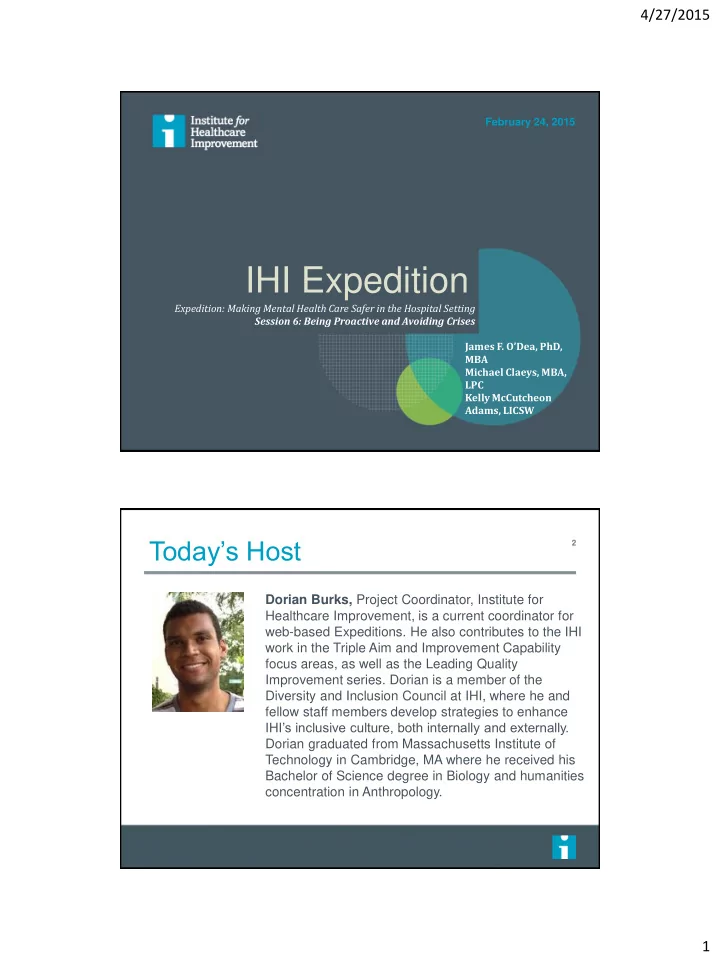
IHI Expedition Expedition: Making Mental Health Care Safer in the - - PDF document

ihi expedition
SMART_READER_LITE
LIVE PREVIEW

IHI Expedition Expedition: Making Mental Health Care Safer in the - - PDF document

4/27/2015 February 24, 2015 IHI Expedition Expedition: Making Mental Health Care Safer in the Hospital Setting Session 6: Being Proactive and Avoiding Crises James F. ODea, PhD, MBA Michael Claeys, MBA, LPC Kelly McCutcheon Adams, LICSW


slide-1
SLIDE 1

4/27/2015 1

IHI Expedition

Expedition: Making Mental Health Care Safer in the Hospital Setting Session 6: Being Proactive and Avoiding Crises February 24, 2015 James F. O’Dea, PhD, MBA Michael Claeys, MBA, LPC Kelly McCutcheon Adams, LICSW

Today’s Host

2

Dorian Burks, Project Coordinator, Institute for Healthcare Improvement, is a current coordinator for web-based Expeditions. He also contributes to the IHI work in the Triple Aim and Improvement Capability focus areas, as well as the Leading Quality Improvement series. Dorian is a member of the Diversity and Inclusion Council at IHI, where he and fellow staff members develop strategies to enhance IHI’s inclusive culture, both internally and externally. Dorian graduated from Massachusetts Institute of Technology in Cambridge, MA where he received his Bachelor of Science degree in Biology and humanities concentration in Anthropology.

slide-2
SLIDE 2

4/27/2015 2

Audio Broadcast

3

You will see a box in the top left hand corner labeled “Audio broadcast.” If you are able to listen to the program using the speakers on your computer, you have connected successfully.

Phone Connection (Preferred)

4

To join by phone: 1) Click on the “Participants” and “Chat” icon in the top, right hand side of your screen to open the necessary panels 2) Click the button on the right hand side of the screen. 3) A pop-up box will appear with the option “I will call in.” Click that option. 4) Please dial the phone number, the event number and your attendee ID to connect correctly .

slide-3
SLIDE 3

4/27/2015 3

Audio Broadcast vs. Phone Connection

If you using the audio broadcast (through your computer) you will not be able to speak during the WebEx to ask question. All questions will need to come through the chat. If you are using the phone connection (through your telephone) you will be able to raise your hand, be unmuted, and ask questions during the session. Phone connection is preferred if you have access to a phone.

5

WebEx Quick Reference

  • Please use chat to

“All Participants” for questions

  • For technology

issues only, please chat to “Host”

  • WebEx Technical

Support: 866-569-3239

  • Dial-in Info:

Communicate / Audio Conference (in menu)

6

Enter Text Select Chat recipient Raise your hand

slide-4
SLIDE 4

4/27/2015 4

7

When Chatting…

Please send your message to All Participants

Expedition Director

8

Kelly McCutcheon Adams, LICSW has been a Director at the Institute for Healthcare Improvement since 2004. Her primary areas of work with IHI have been in Critical Care and End of Life Care. She is an experienced medical social worker with experience in emergency department, ICU, nursing home, sub- acute rehabilitation, and hospice settings. Ms. McCutcheon Adams served on the faculty of the U.S. Department of Health and Human Services Organ Donation and Transplantation Collaboratives and serves on the faculty of the Gift of Life Institute in

  • Philadelphia. She has a B.A. in Political Science from

Wellesley College and an MSW from Boston College.

slide-5
SLIDE 5

4/27/2015 5

Today’s Agenda

9

Welcome Action Period Assignment Debrief Being Proactive and Avoiding Crises Closing Thank you!

Expedition Objectives

At the conclusion of this Expedition, participants will be able to: Explain the importance of partnering with patients and their families to improve safety for patients with mental health conditions Identify different areas to improve mental health care safety Describe examples of improvement efforts at other

  • rganizations

Plan tests of change to begin or continue patient safety improvement

10

slide-6
SLIDE 6

4/27/2015 6

Schedule of Calls

Session 1 – Partnering with Patients and Families Date: Tuesday, December 2, 1:00 - 2:30 PM Eastern Time Session 2 – Making the Physical Environment Safer Date: Tuesday, December 16, 1:00 - 2:00 PM Eastern Time Session 3 – Why Flow Matters Date: Tuesday, January 13, 1:00 - 2:00 PM Eastern Time Session 4 – Medication Safety Date: Tuesday, January 27, 1:00 - 2:00 PM Eastern Time Session 5 – Ensuring Staff Preparedness Date: Tuesday, February 10, 1:00 - 2:00 PM Eastern Time Session 6 – Being Proactive and Avoiding Crises Date: Tuesday, February 24, 1:00 - 2:00 PM Eastern Time

11

Action Period Assignment Debrief

Sharing examples of changing staff hiring/orientation/training/preparedness to improve mental health safety.

slide-7
SLIDE 7

4/27/2015 7

Being Proactive and Avoiding Crises

James O’Dea and Michael Claeys

13

Faculty

14

James F. O’Dea, PhD, MBA is a clinical psychologist and has been employed at Backus Hospital since 1989. He is currently the administrator for the hospital’s Level III trauma program as well as the Regional Director of the Behavioral Health services for the Hartford Healthcare East Region. Dr. O’Dea came to Backus Hospital in 1989 to practice clinical psychology in the Department of Psychiatric Services. He has been active in the development of the hospital’s bariatric surgery program, heart failure program, stroke program, and its new peripheral vascular program. Dr. O’Dea has also been actively involved in patient safety and quality initiatives, heading up the Patient Safety and Quality department for the last 15 months. In 2008, Dr. O’Dea assumed a leadership position in the award-winning Backus Cancer program. He continues in this leadership position and most recently was named the Regional Director for Cancer Services for the Hartford Healthcare East

  • Region. He has worked closely with the Eastern Connecticut

Hematology and Oncology practice and multiple physician practices on strategic and operational planning for the cancer service line. He has recently been named to a leadership position in the Hartford Healthcare Cancer Institute (HHCCI), which is currently developing the strategic and

  • perational affiliation with Memorial Sloan-Kettering (MSK), one of the

premier cancer programs in the world.

slide-8
SLIDE 8

4/27/2015 8

Faculty

15

Michael Claeys is a Licensed Professional Counselor and possesses a Master’s in Business Administration. He developed one of Georgia’s first crisis centers along with alternatives to state hospitalization at the Clayton Center CSB in 1996. From 1999 to 2009 as Executive Director of APS Healthcare, Mr. Claeys was responsible for a statewide external quality review unit for mental health providers that included extensive provider training, provider profiling, and integration of consumer recovery activities. Since 2009 Mr. Claeys has served as Executive Director of Grady Health System’s Behavioral Health services. Grady Health System is a large urban safety net hospital in Atlanta Georgia with

  • ver 117,000 emergency room visits a year. Behavioral

Health Services at Grady consist of a full array of crisis, inpatient, Assertive Community Treatment, and outpatient services.

Safety and Security

Behavioral Health Services Michael Claeys, MBA, LPC Executive Director Grady Health System

slide-9
SLIDE 9

4/27/2015 9

Hospital Overview

  • Urban, safety net hospital with Level 1 Trauma

Unit

  • People with behavioral health needs are

served throughout the hospital and community

– Emergency room – Med/Surg floors – Psychiatric specific services

The “Rights” of Safety

  • The Right mix of services
  • The Right service at the Right time: Get the

person to the correct service level quickly

  • The Right environmental safety features
  • The Right safety protocols
slide-10
SLIDE 10

4/27/2015 10

Grady’s Mix of Services

  • Emergent:

– EMS – Emergency Room – Psych Crisis Intervention Service

  • Urgent:

– Psych Inpatient – Psych Consult Services on Med/Surg floors – Assertive Community Treatment

  • Routine:

– Outpatient Clinic – Case Management – Psychosocial Rehabilitation – Peer Support Services

Grady Emergency Services

Positives: EMS with one unit staffed by paramedic and licensed behavioral health professional to prevent unnecessary ER visits

  • Dedicated rooms for

psych within ER

  • Initial Property Search

and Securing Belongings

  • Licensed BH

professionals and limited coverage by psychiatrists

  • Disposition decisions

within 7 hours Risks:

  • Risk of flight, leaving AMA
  • Environmental and physical risks are present
  • No body search
  • Increase use of restraints as no continuous

monitoring

slide-11
SLIDE 11

4/27/2015 11

Coming August 2015 – Psych ED

  • Physical plant design with specific features to

ensure safety and harm reduction

  • 24 hour coverage by Psychiatry Attending

physicians and BH trained techs

  • Supported by Licensed BH professionals
  • Medical screening conducted by psychiatrists

Psych Services on Med/Surg Units

Positives:

  • Consults based on medical

team referral, request

  • Guidelines in place to suggest

when to “consult” psychiatry

  • Psychiatric Consults completed

by psychiatrists, psych residents, Physician Assistants

  • Provide diagnostic

assessment, medication management, behavioral planning and referral to after care services including inpatient and/or outpatient care, as appropriate Risks:

  • Environmental and physical

risks are present

  • No property or body search
  • Increased use of restraints for

uncooperative patients

  • No continuous monitoring
slide-12
SLIDE 12

4/27/2015 12

Crisis Intervention (CIS) and Psych Inpatient

  • Initial Property and Body

Search to find contraband (i.e. weapons, drugs, lighters)

  • Dedicated security staff 24/7
  • Limited access through badge

swipe

CIS and Inpatient- Environmental

  • Minimize risk of harm
  • 100% completion of

Suicide Risk Monitor at appropriate intervals (i.e. 15 minute, line of sight, 1-1) Maintain adequate staffing ratios

slide-13
SLIDE 13

4/27/2015 13

Safe Furniture Choices

Immovable chairs and

  • ttomans on CIS

TVs covered and mounted high on wall Hard plastic beds (No sharp edges and bolted to floor)

CIS and Inpatient - Environmental

Anti-ligature technology

  • n doors

Soap dispensers and hand sanitizers are fully protected, tamper proof and anti-ligature Monitor for damage

slide-14
SLIDE 14

4/27/2015 14

Reducing Environmental Risks

Doors with no hinges Replace plastic liners with paper

Retro Fit – Existing Environment

Fill space between wall and handrails Replace beds, current model has no sharp edges, bolted to floor

slide-15
SLIDE 15

4/27/2015 15

Monitoring for Safety

Real time monitoring as well recorded review of incidents and activity on unit

Behavioral Management

Stimulus Reduction Room With Recliner (on CIS)

slide-16
SLIDE 16

4/27/2015 16

Construction Safety

Temporary walls with same safety features such as anti-ligature handles. Monitor tools and materials.

Readmission Prevention Strategies

  • Individualized discharge plans
  • After discharge phone calls to assure

understanding of medications, follow up appointments

  • Step-down aftercare program provides same

day access post discharge from crisis/IP services

  • Case Management & Assertive Community Tx
slide-17
SLIDE 17

4/27/2015 17

Direct questions to: mclaeys@gmh.edu Department of Behavioral Health

Making Mental Health Care Safer Being Proactive and Avoiding Crises

James F. O’Dea, Ph.D., MBA Regional Director, Hartford Healthcare Behavioral Health Network

slide-18
SLIDE 18

4/27/2015 18

Hartford Healthcare Behavioral Health Network

Largest provider of behavioral healthcare in state of Connecticut

  • Institute of Living – IOL
  • Rushford Center
  • Natchaug Hospital
  • William W. Backus Hospital
  • The Hospital of Central Connecticut
  • MidState Hospital
  • Windham Hospital

The Platform High Reliability Organizations

  • The science of safety
  • Learnings from other industries – aviation and

nuclear power

  • Safety tools – work smarter, not harder
  • Near misses, precursor events, safety events
  • Open, transparent culture
slide-19
SLIDE 19

4/27/2015 19

People

  • Partnership with staff and patients
  • Engaged, enthusiastic staff are keys to success
  • Affirmation and accountability
  • Every meeting starts with recognition of staff –

“wins”

Training and Education

  • Management of Aggressive Behavior (MOAB)
  • Therapeutic Crisis Team Intervention (TCTI)
slide-20
SLIDE 20

4/27/2015 20

Policies and procedures

  • Level system
  • Assessment process
  • Re-assessment process
  • Safety rounds

Safety Huddle

  • Review last 24 hours
  • Plan for next 24 hours
  • Shorter versions in change of shift meetings
slide-21
SLIDE 21

4/27/2015 21

Questions/Discussion

41

Raise your hand Use the chat

Checking-in

Going deeper on these topics? Future topics?

42

slide-22
SLIDE 22

4/27/2015 22

Thank you

Thank you for participating! Thank you our many great faculty. Thank you to our host, Dorian Burks. We hope to see you on another Expedition soon.

43

Expedition Communications

Listserv for session communications: MentalHealthSafety@ls.ihi.org To add colleagues, email us at info@ihi.org Pose questions, share resources, discuss barriers or successes

44