SLIDE 1
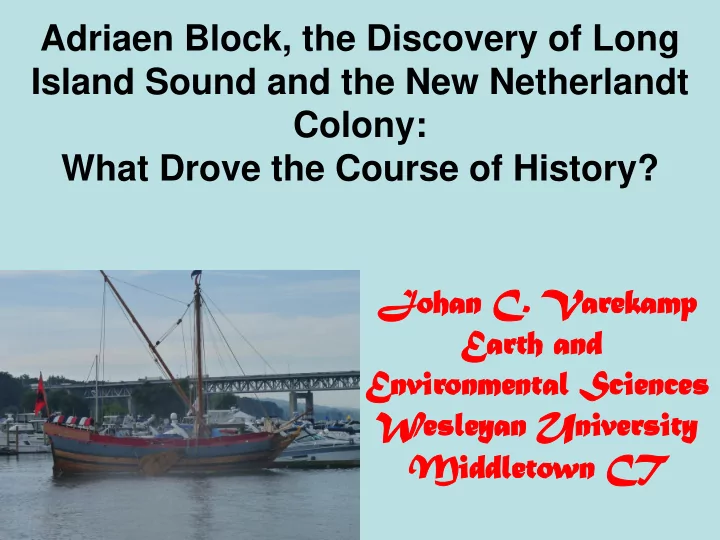
Adriaen Block, the Discovery of Long Island Sound and the New Netherlandt Colony: What Drove the Course of History?
Johan C. . Varekamp Earth and Envir ironmental Sci ciences Wesleyan University Mid iddle letown CT
SLIDE 2
SLIDE 3 Castaldi, 1556
Long Island NY JB BI
La Nuova Francia
SLIDE 4 Adriaen Block
- He shipped wood from Scandinavia to Spain
- Sailed in the Mediterranean - in 1609 conquered an illegal
ship with cargo near Portugal ==> he became wealthy!!
- Sailed one time to Indonesia (1606-1609)
- Was married and had five children
- Sailed four times to the Americas and made the first map of
Long Island Sound and surroundings A mural by Reginald Marsh in the US Customs House (near the spot where New Amsterdam was located) portrays him as a generic European (copied from an unrelated museum picture) among the great sailors of the world
SLIDE 5 Adriaen Block sailed up the
Hudson River (“Tijger”) in fall 1613 together with Hendrick Christiansen (Fortuyn). Mutiny and unease over profit sharing with captain Mossel (Nagtegael). The Tijger burned up (remnants at Devey street probably an 18th century river boat from the UK). Part of his crew become pirates stealing Mossels ship! Overwintered on Manhattan and built with natives a 40’ long, new ship (the‘Onrust’) Spring 1614 - sailed with the Onrust through the East River into LIS and up the Connecticut River (Versche Rivier) then
- n to Montauk, Block island and then RI and Cape Cod.
SLIDE 6
The modern ‘ONRUST’ in its full 2009 glory
SLIDE 7
Adriaen Block’s trip with the ONRUST, April 1614
SLIDE 8
SLIDE 9
1884
SLIDE 10
SLIDE 11 The Fig igurative Map ap
riaen Block, , 16 1614
Detail of LIS
SLIDE 12
SLIDE 13
THE DUTCH COLONIAL EMPIRE IN THE MID 1600s The VOC had Indonesia, Mauritsius, Formosa (Taiwan), the deshima in Japan, holdings in Korea and S-Africa (the Boers) VOC WIC
SLIDE 14
NN from Delaware Bay to the Connecticut River. Nassau County on LI was Dutch, whereas the Suffolk end was British. Albany (Beverwijck) was where the Dutch Fort Nassau and Fort Orange were present.
SLIDE 15
SLIDE 16 Seal of New Amsterdam, 1623
- Sigillum Novi Belgii, formal
appearance of our furry friend the beaver, like in so many Canadian seals (think-Hudson Bay Co, the French territories).
Beverwijck and many are the street names that refer to Beavers and its dams- an important part of the local economy
SLIDE 17
Map of the Connecticut River or “Versche Rivier” in Dutch colonial times (in ‘t groodt). This map stems from around 1635 – the trading post / fortification ‘t Huys de Hoop’ was already established (1623-1633) but the Dutch names were still used. The Treaty of Hartford (1650) made this area formally English property Plovers Corner Pre-1623 settlement Zeebroek = Old Saybrook Waters Veldt = Wethersfield Hoeren Eyland Hereford = Hartford
SLIDE 18
Modern course of the Connecticut River with the Wethersfield Cove and Keeney Pond as oxbows. Connecticut River prior to 1692
SLIDE 19 The growth and demise of the New Netherlands colony
- 1653 - New Amsterdam is the capital of the NN colony;
freedom of religion, entrepeneurship and rowdiness rule!
- 1664 - second Anglo-Dutch war, NA taken over by British
without much of a fight. Population of NA (then NY) is ~10,000; PS returns to Holland to report, but later goes back to the NN colony until his death.
- 1673 - Third Anglo-Dutch war - Dutch retake NY, call it New
Orange, but give it up 4 months later. Treaty of Breda - Holland gets Run (near Banda) and Surinam near Venezuela.
SLIDE 20
SLIDE 21
The Banda Islands
The center of the clove and nutmeg trade
VOC
SLIDE 22