Lake Sammamish Kokanee: Bringing Them Back from the Brink A - - PowerPoint PPT Presentation

lake sammamish kokanee bringing them back from the brink
SMART_READER_LITE
LIVE PREVIEW

Lake Sammamish Kokanee: Bringing Them Back from the Brink A - - PowerPoint PPT Presentation

Lake Sammamish Kokanee: Bringing Them Back from the Brink A Presentation for the Rotary Club of Issaquah David St. John Government Relations Administrator DNRP Directors Office March 27, 2012 Topics Kokanee Work Group background


slide-1
SLIDE 1

Lake Sammamish Kokanee: Bringing Them Back from the Brink

A Presentation for the Rotary Club of Issaquah

David St. John – Government Relations Administrator – DNRP Director’s Office
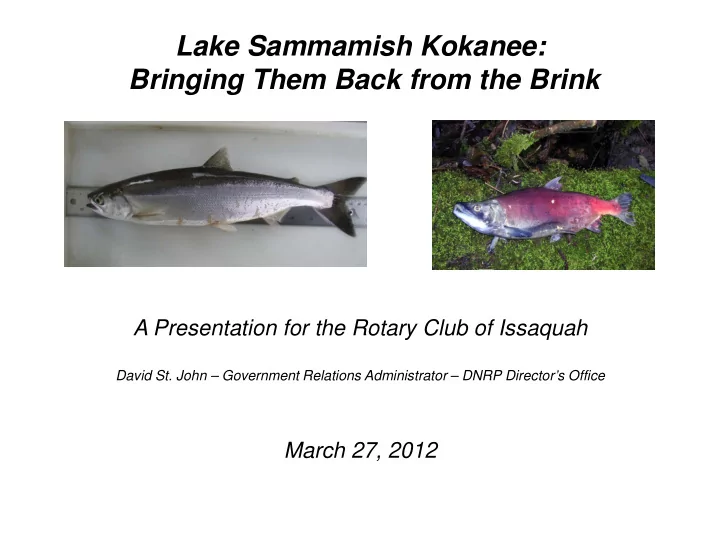
March 27, 2012

slide-2
SLIDE 2

Topics

  • Kokanee Work Group background
  • Conservation goal
  • Kokanee biology
  • Kokanee population conditions
  • Priorities
  • Actions underway
slide-3
SLIDE 3

Lake Sammamish Kokanee Work Group

  • Local collaboration formed in 2007 to focus on kokanee

conservation

  • Includes each local government, state and federal

agencies, non-governmental conservation groups, and citizens

  • King County has chaired since its formation
slide-4
SLIDE 4

Kokanee Conservation Goal “Prevent the extinction and improve the health of the native kokanee population such that it is viable and self- sustaining, and then supports fishery opportunities”

Photo by Tim Rains, US Forest Service

slide-5
SLIDE 5

Kokanee Biology

  • the landlocked, smaller form of

sockeye salmon

  • predominantly a four year life cycle
  • lives in natal streams for only a few months after hatching
  • rears entirely within Lake Sammamish before spawning

migration back to natal streams

slide-6
SLIDE 6

Current Regional Distribution

Only Two Native Puget Sound Populations Lake Sammamish Lake Whatcom

slide-7
SLIDE 7

Historic and Current Local Distribution

  • Lewis Creek
  • Lake & shoreline
  • Ebright Creek
  • Laughing Jacobs Creek

Main current* areas of use:

* Current quantity and quality of habitat may not be enough to sustain the population

slide-8
SLIDE 8

Current Kokanee Abundance Trend

10000 1008 113 145 548 1056 1066 3055 7088 740 500 1033 110 53 2405 38 1488 110 40 247 454 466 704 1431 3066 2987 2846 2340 596 424 900 652 996 2000 4000 6000 8000 10000 12000 1900s 1996- 97 1997- 98 1998- 99 1999- 00 2000- 01 2001- 02 2002- 03 2003- 04 2004- 05 2005- 06 2006- 07 2007- 08 2008- 09 2009- 10 2010- 11 2011- 12 Number Year

Kokanee Spawner Counts: 1996/97 - 2011/12

Actual count with 7 day stream life Takan into supplementation program 4 year running average

Minimum viable population level estimate = 500 spawners

(numbers reflect assumed 7-day stream life for

Historical abundance from anecdotal sources 500

slide-9
SLIDE 9

Current Kokanee Abundance Trend

10000 1008 113 145 548 1056 1066 3055 7088 740 500 1033 110 53 2405 38 1488 2000 4000 6000 8000 10000 12000 1900s 1996- 97 1997- 98 1998- 99 1999- 00 2000- 01 2001- 02 2002- 03 2003- 04 2004- 05 2005- 06 2006- 07 2007- 08 2008- 09 2009- 10 2010- 11 2011- 12 Number Year

Recent Kokanee Return Percentages

Minimum viable population level estimate = 500 spawners

(numbers reflect assumed 7-day stream life for spawners)

Historical abundance from anecdotal sources

2% 7% 481% 4% 1353%

slide-10
SLIDE 10

Population Run Timing

  • Early Run – August to October run timing; Issaquah

Creek focused

  • Middle Run – September to November run timing; Lake

Washington and Samm River tribs

  • Late Run – November to January run timing; Lake

Sammamish tribs except Issaquah(?)

  • Shoreline spawners

EXTIRPATED 58 SPAWNERS IN 2010-2011 UNKNOWN LIKELY EXTIRPATED

slide-11
SLIDE 11

2008 Kokanee Limiting Factors Study Findings

  • Supplementation is needed immediately
  • Preliminary signals of hydrologic impacts
  • Potential for problems from predation
  • Climate change could compound problems
  • Must improve our data for effective management
  • Lack of data necessitates a precautionary approach
slide-12
SLIDE 12

Kokanee Conservation Priorities Tier 1:

  • Implement aggressive artificial propagation program
  • Correct habitat conditions causing mortality or limiting

habitat access

  • Protect existing intact habitat areas at near term risk of

damage or conversion Tier 2:

  • Do the science to improve certainty of actions
  • Protect, improve or restore habitat
  • Build and maintain public awareness and support
slide-13
SLIDE 13

Supplementation Program

  • Underway with third successful year!
  • Funding from USFWS, WDFW, King

County, Sammamish, Issaquah, and Redmond

  • 2010: @25,000 marked fry
  • 2011: @14,500 marked fry
  • 2012: @64,000 marked fry
  • Program based at Issaquah Creek hatchery
  • Employing unique rearing techniques to help imprinting
  • First returns could be seen this coming fall!
slide-14
SLIDE 14

Protect, Reconnect, Restore Habitat!

slide-15
SLIDE 15

Protect, Reconnect, Restore Habitat!

  • 11 priority near term projects
  • First project completed will be the Ebright culvert

(summer 2012), ¼ mile of great spawning habitat, major private funding

  • Making progress on Zaccuse Creek culverts and

restoration

  • Grant proposals for Lewis Creek projects
  • Working with the Watershed Council to get funding
  • Long term: major project to fix the I-90 culvert blocking

access to upper Lewis Creek

slide-16
SLIDE 16

Successful Fundraiser

  • First ever fundraiser held on March 23, 2012
  • Sponsored by the Coho Café in Issaquah
  • Organized by Heather VanDorn from Coho Café
  • Raised almost $10K, including $5K from the Snoqualmie

Tribe

  • Funds will go toward high priority conservation actions
slide-17
SLIDE 17

Looking Ahead…

  • Build and maintain community support!
  • Implement our priority supplementation and habitat

projects

  • Find new ways to fund our work
  • Reintroduce kokanee to reconnected and restored

streams

slide-18
SLIDE 18

Questions?