Lake Sammamish Kokanee Conservation & Connections to the South - - PowerPoint PPT Presentation

lake sammamish kokanee conservation connections to the
SMART_READER_LITE
LIVE PREVIEW

Lake Sammamish Kokanee Conservation & Connections to the South - - PowerPoint PPT Presentation

Lake Sammamish Kokanee Conservation & Connections to the South Central LIO David St. John King County Department of Natural Resources and Parks and the Lake Sammamish Kokanee Work Group david.st.john@kingcounty.gov June 11, 2014 Photo:


slide-1
SLIDE 1

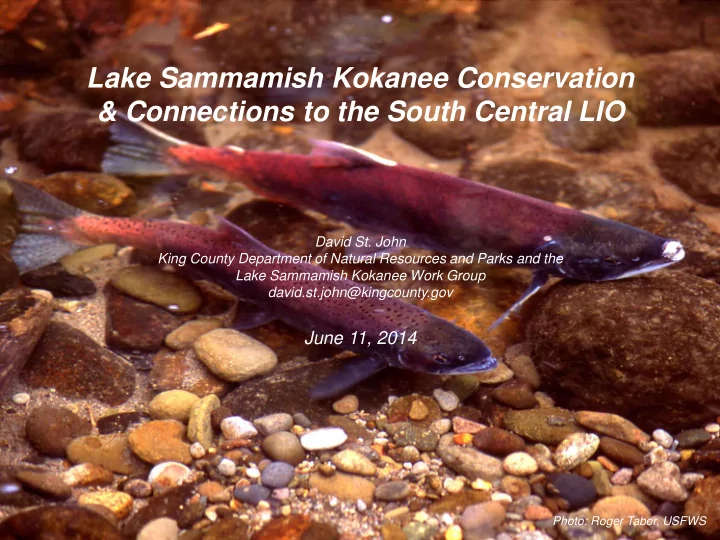
Lake Sammamish Kokanee Conservation & Connections to the South Central LIO

David St. John King County Department of Natural Resources and Parks and the Lake Sammamish Kokanee Work Group david.st.john@kingcounty.gov

June 11, 2014

Photo: Roger Tabor, USFWS

slide-2
SLIDE 2

The Story

  • Kokanee Biology 101
  • Kokanee population facts and figures
  • Limiting factors
  • Partnership for recovery
  • Action priorities
  • A new opportunity
  • Future collaboration with the South Central Caucus?
slide-3
SLIDE 3

Kokanee Biology

  • smaller form of sockeye salmon
  • life cycle is three or four years
  • lives in natal streams for only a few months after hatching
  • does not go to the ocean – rears in Lake Sammamish
  • Lake Sammamish kokanee are genetically unique

Photo: Roger Tabor, USFWS

slide-4
SLIDE 4

Current Regional Distribution

Only Two Native Kokanee Populations in Puget Sound Lake Sammamish Lake Whatcom

slide-5
SLIDE 5

Kokanee and the South Central Action Area

Lake Sammamish watershed

slide-6
SLIDE 6

Historic and Current Distribution w/ Spawning Areas

  • Lewis Creek
  • Lake & shoreline
  • Ebright Creek
  • Laughing Jacobs Creek
slide-7
SLIDE 7

Population Diversity

  • Early Run – August to October run timing; Issaquah

Creek focused

  • Middle Run – September to November run timing; Lake

Washington and Samm River tribs

  • Late Run – November to January run timing; Lake

Sammamish tribs except Issaquah(?)

  • Shoreline spawners

EXTIRPATED EXTANT UNKNOWN EXTIRPATED

slide-8
SLIDE 8

Anecdotal historical return counts in or above this range

1008 113 145 549 1090 1076 3056 7107 737 498 1011 109 53 2379 37 1488 14861 600 2000 4000 6000 8000 10000 12000 14000 16000 96-97 97-98 98-99 99-00 00-01 01-02 02-03 03-04 04-05 05-06 06-07 07-08 08-09 09-10 10-11 11-12 12-13 13-14

Red line is minimum viable population threshold: 500 fish

Actual spawner count with 7 day stream life

Current Kokanee Abundance

Hatchery releases

slide-9
SLIDE 9

Population Status Recap

  • Abundance: @20% of historic levels on average, at best
  • Distribution: spawning primarily in only three creeks
  • Diversity: two of three unique runs extirpated
  • Productivity: unknown
  • NOT legal to catch and keep kokanee on Lake Sammamish!
slide-10
SLIDE 10

2008 Kokanee Limiting Factors Study Findings

  • Supplementation is needed immediately
  • Preliminary signals of stormwater impacts
  • Potential for problems from predation
  • Climate change could compound problems
  • Must improve our data for effective management
  • Impacts of fishing continue
  • Hatchery management impacts have been reduced
slide-11
SLIDE 11

Kokanee Work Group Active Partners

  • Watershed residents
  • King County
  • Sammamish
  • Issaquah
  • Bellevue
  • Redmond
  • Snoqualmie Tribe
  • Washington State Parks
  • Washington Department of Fish and Wildlife
  • US Fish and Wildlife Service
  • Darigold
  • Coho Café
  • Trout Unlimited
  • Save Lake Sammamish
  • Friends of Pine Lake

Photo: Roger Tabor, USFWS

slide-12
SLIDE 12

Kokanee Conservation Goal “Prevent the extinction and improve the health of the native kokanee population such that it is viable and self- sustaining, and then supports fishery opportunities”

slide-13
SLIDE 13
slide-14
SLIDE 14

Priority Action: Supplementation

  • Scoped to run for twelve years of production, through

2021

  • 2007-2009, not enough spawners
  • 2009-2010 was first year of production
  • Five consecutive years of production
  • Primary funder is US Fish and Wildlife Service, with

contributions from WDFW and King County

  • All fish marked for monitoring
  • 2012-2013 - @10% of run of hatchery origin
  • 2013-2014 - @60% of run of hatchery origin
slide-15
SLIDE 15

Priority Action: Supplementation

  • Kjhf
  • Kdfjgh
  • Sadlkf gj
slide-16
SLIDE 16

Priority Action: Habitat Restoration

  • Ensure enough habitat quality and quantity when

supplementation program ends

  • Seven of eleven near term restoration projects are done
  • r underway
  • July 2014 “Kokanee Blueprint” will identify the next wave
  • f habitat projects
  • E.g., fix four culverts on two streams to protect and

restore passage – East Lake Sammamish Parkway and Trail

slide-17
SLIDE 17

Priority Action: Habitat Restoration – Pereyra Culvert

  • Privately funded by landowner - $200K+
  • Completed in summer 2012
  • Opened @ one mile of prime spawning area
  • Fish passed within one month of completion
slide-18
SLIDE 18

Priority Action: Habitat Protection

  • Heavily reliant on work by jurisdictions to implement

effective regulatory programs:

  • Stormwater programs
  • Critical Areas Ordinances
  • Shoreline Master Programs
  • Developing incentive/non-regulatory approaches in

jurisdictions:

  • TDRs
  • Acquisition
slide-19
SLIDE 19

Priority Action: Public Engagement

  • Increase awareness of kokanee and their decline
  • Encourage action now to prevent further degradation
  • Build constituency to sustain long term efforts
slide-20
SLIDE 20

Priority Action: Public Engagement – Fry Release

  • Held annually since 2010
  • Celebrates progress and provides “hands on” experience
  • Includes educational program for local schools
  • This year welcomed Interior Secretary

Sally Jewell

slide-21
SLIDE 21

New Opportunity – Urban Wildlife Refuge Partnership

  • New US Dept of Interior initiative
  • Lake Sammamish is one of eight Partnerships

nationwide

  • Kokanee Work Group is the local host entity
  • Focus is getting youth and the community into nature
  • Will help build community and regional stewardship of

the resource

slide-22
SLIDE 22

Action Agenda/Action Area Connections

  • Strategy A - Substrategy 1.1 - Identify and

environmental impacts for prioritization of areas for protection, restoration and low impact development

  • Strategy A - Substrategy 1.2 - Support local

governments adoption of plans, regulations, and policies that are consistent with recovery plans and incorporate climate change forecasts

  • Strategy A - Substrategy 2.2 - Implement and maintain

priority freshwater and terrestrial restoration projects

slide-23
SLIDE 23

Action Agenda/Action Area Connections

  • Strategy A - Substrategy 6.1, SNST13 and SC3 -

Implement high priority projects identified in each salmon recovery 3-year work plan or Salmon multi-species recovery plans

  • Strategy A - Substrategy 6.4 - Protect and recovery

steelhead and other imperiled salmonid species

  • Strategy D - Substrategy 5.1 - Prioritize targeted

stewardship issues, actions and audiences

  • Strategy D - Substrategy 5.2 and 6.5 - Collaboratively

develop and promote science-based targeted communication

slide-24
SLIDE 24

How do we work together going forward to integrate kokanee efforts into the Action Area portfolio for the Action Agenda?

slide-25
SLIDE 25

Questions?

David St. John david.st.john@kingcounty.gov (206)477-4517

slide-26
SLIDE 26

Current Habitat Project List

  • 1. Lewis Creek culvert under I-90
  • 2. Lewis Creek delta restoration
  • 3. Lewis Creek gabion reach stabilization
  • 4. Lewis Creek trash rack modification
  • 5. Ebright Creek wetland enhancement
  • 6. Ebright Creek fish passage restoration
  • 7. Zaccuse Creek culverts under East Lake Sammamish Trail and Parkway
  • 8. Laughing Jacobs Creek channel re-route
  • 9. Laughing Jacobs Creek habitat enhancement

10.Issaquah Creek Cybil-Madeleine Park habitat enhancement 11.East Fork Issaquah Creek Confluence habitat restoration 12.East Fork Issaquah Creek: Third Ave & Creek Street Habitat Enhancement

Photo: Roger Tabor, USFWS

slide-27
SLIDE 27

Project Tripled the Available Spawning Area

Newly available spawning area Former limit to spawning