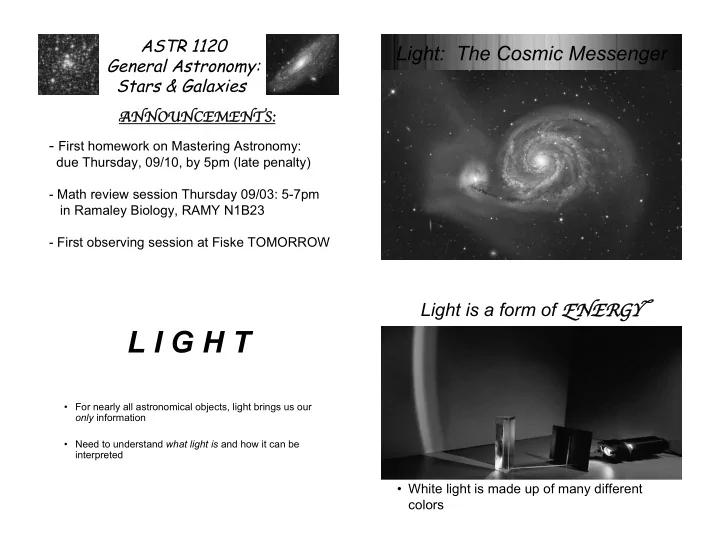
L I G H T For nearly all astronomical objects, light brings us our - - PowerPoint PPT Presentation

l i g h t
SMART_READER_LITE
LIVE PREVIEW

L I G H T For nearly all astronomical objects, light brings us our - - PowerPoint PPT Presentation

ASTR 1120 Light: The Cosmic Messenger General Astronomy: Stars & Galaxies NNOUNCEMENTS: NNOUNCEMENTS: - First homework on Mastering Astronomy: due Thursday, 09/10, by 5pm (late penalty) - Math review session Thursday 09/03: 5-7pm in


slide-1
SLIDE 1

ASTR 1120 General Astronomy: Stars & Galaxies

NNOUNCEMENTS: NNOUNCEMENTS:

  • First homework on Mastering Astronomy:

due Thursday, 09/10, by 5pm (late penalty)

  • Math review session Thursday 09/03: 5-7pm

in Ramaley Biology, RAMY N1B23

  • First observing session at Fiske TOMORROW

Light: The Cosmic Messenger

L I G H T

  • For nearly all astronomical objects, light brings us our
  • nly information
  • Need to understand what light is and how it can be

interpreted

Light is a form of NERG

  • White light is made up of many different

colors

slide-2
SLIDE 2

Four Ways in Which Light can Interact with Matter

1. Emission – matter releases energy as light 2. Absorption – matter takes energy from light 3. Transmission – matter allows light to pass through it 4. Reflection – matter repels light in another direction

Four Ways in Which Light can Interact with Matter

1. Emission – matter releases energy as light 2. Absorption – matter takes energy from light 3. Transmission – matter allows light to pass through it 4. Reflection – matter repels light in another direction

Four Ways in Which Light can Interact with Matter

1. Emission – matter releases energy as light 2. Absorption – matter takes energy from light 3. Transmission – matter allows light to pass through it 4. Reflection – matter repels light in another direction

Four Ways in Which Light can Interact with Matter

1. Emission – matter releases energy as light 2. Absorption – matter takes energy from light 3. Transmission – matter allows light to pass through it 4. Reflection – matter repels light in another direction

slide-3
SLIDE 3

Why is a rose red?

  • A. The rose emits red light.
  • B. The rose absorbs red light.
  • C. The rose transmits red light.
  • D. The rose reflects red light.

Clicker Question

Why is a rose red?

  • A. The rose emits red light.
  • B. The rose absorbs red light.
  • C. The rose transmits red light.
  • D. The rose reflects red light.

Clicker Question

Wave-Particle Duality of Light

  • Light can behave like a wave

– Frequency, wavelength, amplitude

  • Light can also behave like a particle

– Photons, discrete amounts of energy = “quanta”

= AMPLITUDE

Anatomy of a Wave

  • Speed of light is

the SAME for all wavelengths

  • The shorter the

wavelength, the more cycles pass per second

– Train analogy…

  • How to remember

equation?

– Unit Analysis!

Light as a WAVE

slide-4
SLIDE 4

Light as a PARTICLE

  • Light can also be thought of as a particle

“photon” NOT proton! A photon is a mass-less particle of electromagnetic radiation energy Wave-particle duality seen in other particles (e.g., electrons) as well

Photon Energy Depends on Frequency/and ?

E f E 1 /

Photon Energy Depends on Frequency/Wavelength

E f E 1 /

What is LIGHT?

  • A. Light is a wave, like sound only much faster.
  • B. Light is like little particles. Each one is a

photon.

  • C. Light is the absence of dark.
  • D. A kind of energy we model with some of the

properties of waves and some properties of particles.

  • E. Light is the sensation you feel when hit by

energy, visible or invisible.

Clicker Question

slide-5
SLIDE 5

What is LIGHT?

  • A. Light is a wave, like sound only much faster.
  • B. Light is like little particles. Each one is a

photon.

  • C. Light is the absence of dark.
  • D. A kind of energy we model with some of the

properties of waves and some properties of particles.

  • E. Light is the sensation you feel when hit by

energy, visible or invisible.

Clicker Question

When compared to RED light ( = 700 nm), Blue light ( = 400 nm) is:

  • A. Longer wavelength
  • B. Lower Frequency
  • C. Higher energy photons
  • D. Faster photons
  • E. None of the above

Clicker Question

When compared to RED light ( = 700 nm), Blue light ( = 400 nm) is:

  • A. Longer wavelength
  • B. Lower Frequency
  • C. Higher energy photons
  • D. Faster photons
  • E. None of the above

Clicker Question

The Electromagnetic Spectrum

slide-6
SLIDE 6

Light as Information Bearer

By studying the spectrum of an object, we can learn its:

  • Composition
  • Temperature
  • Velocity

We can separate light into its different wavelengths (spectrum).

Matter: a Material World

  • ATOM: nucleus made of protons and neutrons

A cloud made of electrons surrounds the nucleus Electrons are held onto the atom by electric force. Electrons have negative electric charge, protons are positive. Neutrons are neutral. Electrically neutral atoms have the same number of protons and electrons

But first we need a review of…

Atoms Involve Big Empty Spaces

Periodic Table of the Elements Atomic Number = # of protons in nucleus Atomic Mass Number = # of protons + neutrons

slide-7
SLIDE 7

Hydrogen: simplest and most common

Helium

  • Mostly an atom will have a certain “normal”

number of neutrons along with the protons.

  • But occasionally, an atom will have a few

more or less neutrons than normal. This is called an isotope of that element. The number of protons (!"#$%& %&'()$ ()$*+, +,!" "#$%&%#'(&)*(+"%"#(&'%),"#$(-)#%."(.(-(,'/

Carbon Isotopes

slide-8
SLIDE 8

Deuterium is an isotope of Hydrogen. Which of the following makes sense for the composition of Deuterium?

  • A. 1 proton, 0 neutrons, 1 electron
  • B. 2 protons, 0 neutrons, 2 electrons
  • C. 2 protons, 2 neutrons, 2 electrons
  • D. 1 proton, 1 neutron, 1 electron
  • E. 1 proton, 0 neutrons, 0 electrons

Clicker Question

Deuterium is an isotope of Hydrogen. Which of the following makes sense for the composition of Deuterium?

  • A. 1 proton, 0 neutrons, 1 electron
  • B. 2 protons, 0 neutrons, 2 electrons
  • C. 2 protons, 2 neutrons, 2 electrons
  • D. 1 proton, 1 neutron, 1 electron
  • E. 1 proton, 0 neutrons, 0 electrons

Clicker Question

p+ atomic number = 1 atomic mass number = 1 What if an electron is missing?

ion H+1

What if two or more atoms combine to form a particle?

p+ p+ 8p+ 8n

molecule

H2O (water)