A CDC Framework for Preven A CDC Framework for Preventing Infectious - - PowerPoint PPT Presentation

a cdc framework for preven a cdc framework for preventing
SMART_READER_LITE
LIVE PREVIEW

A CDC Framework for Preven A CDC Framework for Preventing Infectious - - PowerPoint PPT Presentation

A CDC Framework for Preven A CDC Framework for Preventing Infectious Diseases: ting Infectious Diseases: Sustaining the Sustaining the Essentials and Innovating for Essentials and Innovating for the the Future Future To provide a roadmap


slide-1
SLIDE 1

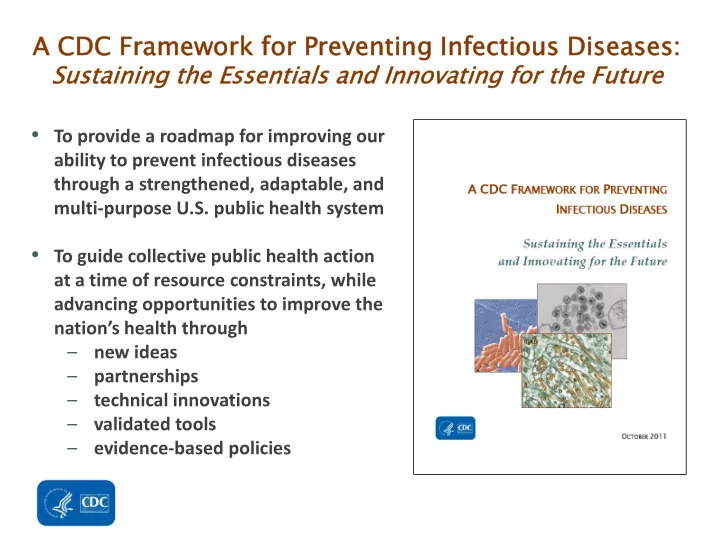
A CDC Framework for Preven A CDC Framework for Preventing Infectious Diseases: ting Infectious Diseases:

Sustaining the Sustaining the Essentials and Innovating for Essentials and Innovating for the the Future Future

  • To provide a roadmap for improving our

ability to prevent infectious diseases through a strengthened, adaptable, and multi‐purpose U.S. public health system

  • To guide collective public health action

at a time of resource constraints, while advancing opportunities to improve the nation’s health through – new ideas – partnerships – technical innovations – validated tools – evidence‐based policies

slide-2
SLIDE 2

CDC’s ID CDC’s ID FRAMEWORK FRAMEWORK Three Overarching Elements Three Overarching Elements

Element 1. Strengthen public health fundamentals, including infectious disease surveillance, laboratory detection, and epidemiologic investigation Element 2. Identify and implement high‐impact public health interventions to reduce infectious diseases Element 3. Develop and advance policies to prevent, detect, and control infectious diseases

slide-3
SLIDE 3

Priorities for Element 1 Priorities for Element 1

Element 1. Strengthen public health fundamentals, including infectious disease surveillance, laboratory detection, and epidemiologic investigation

  • Modernize infectious disease surveillance to drive

public health action

  • Expand the role of public health and clinical

laboratories in disease control and prevention

  • Improve capacity for epidemiologic investigations

and public health response

  • Advance workforce development and training to

sustain and strengthen public health practice

slide-4
SLIDE 4

Examples of Examples of Key Activities to Meet Element 1Priorities Key Activities to Meet Element 1Priorities

Modernize infectious disease surveillance

  • Improving collection and communication of timely, accurate,

and complete surveillance data

  • Advancing meaningful public health use of electronic

health records

  • Advancing partnerships, policies and incentives, and training

that enhance capacity of clinical laboratories to test for microbes of public health concern

  • Intensifying surveillance for unusual health events
  • Using evolving health IT tools to provide rapid feedback

and alerts to hospitals, clinicians, patients, and public health practitioners

– Providing feedback to hospital administrators and public health officials on the efficacy (and cost‐effectiveness)

  • f infectious disease prevention practices
slide-5
SLIDE 5

Examples of Examples of Key Activities to Meet Element 1Priorities Key Activities to Meet Element 1Priorities

Expand laboratory detection and reporting

  • Developing, validating, and disseminating diagnostic innovations

– multi‐pathogen and point‐of‐care tests – new tools and assays for detecting and characterizing emerging threats – tools and techniques for analyzing large amounts of protein

  • r nucleic acid data
  • Improving information flow among clinicians, clinical labs,

public health labs, and CDC

  • Conducting long‐range planning to ensure continued capacity

at CDC to serve as a national and global reference center for all infectious diseases

  • Developing new and advancing existing standards and protocols

for safe and rapid transfer of patient specimens to clinical and public health laboratories

slide-6
SLIDE 6

Examples of Examples of Key Activities to Meet Element 1Priorities Key Activities to Meet Element 1Priorities

Improve epidemiologic investigations and public health response

  • Developing innovative tools for outbreak investigations—

incorporating new technologies such as bioinformatics, portable digital devices, and high‐performance computing to improve information exchange across jurisdictions

  • Developing pre‐event investigative performance measures and

protocols (e.g., protocols for collecting data on risk factors, disease severity, and other clinical information)

  • Using lessons learned from outbreak responses to strengthen
  • verall preparedness, including distribution and use of emergency

medical countermeasures and diagnostics development

  • Coordinating across CDC and with external partners to facilitate

collaborative efforts for rapid response to infectious disease

  • utbreaks of unknown etiology
slide-7
SLIDE 7

Examples of Examples of Key Activities to Meet Element 1 Key Activities to Meet Element 1 Priorities Priorities

Advance workforce development and training

  • Expanding access to high‐quality public health e‐learning

products and training

  • Providing guidance and training for public health workers on

integrating IT health tools into all aspects of public health practice and “e‐health”

  • Assisting public health departments in transitioning to expanded

roles in healthcare quality assurance, assessment, and policy development

  • Engaging partners to extend the reach of public health messages

through the use of new communication tools and channels, such as working with medical/nursing schools and professional

  • rganizations to develop public health messages for use by

healthcare providers

slide-8
SLIDE 8

Priorities for Element 2 Priorities for Element 2

Element 2. Identify and implement high‐impact publi health interventions to reduce infectious diseases

  • Identify and validate

high‐impact tools for disease reduction

  • Use proven tools and

interventions to reduce high‐burden infectious diseases

c

slide-9
SLIDE 9

Priorities for Element 3 Priorities for Element 3

Element 3. Develop and advance policies to prevent, detect, and control infectious diseases

  • Ensure the availability of sound scientific data

to support the development of evidence‐ based and cost‐effective policies

  • Advance policies to improve prevention,

detection, and control of infectious diseases

slide-10
SLIDE 10

Examples of Examples of Key Activities to Meet Element 3 Key Activities to Meet Element 3 Prioritie Prioritie

Ensure availability of sound scientific data to support development of evidence‐based, cost‐effective policies

  • Assessing the national burdens of high‐mortality infectious

diseases

  • Identifying public health activities with high return on

investments

  • Developing strategies for sustaining and expanding

public/private collaborations to improve healthcare quality

  • Creating predictive models for disease emergence, disease

spread, outbreak response, and disease elimination

  • Monitoring rates of and risk factors for foodborne illness to

inform food safety policy and regulatory action

  • Monitoring the effectiveness of strategies to reduce behaviors

that increase individual risk for infectious diseases

s

slide-11
SLIDE 11

Examples of Examples of Key Activities to Meet Element 3 Key Activities to Meet Element 3 Priorities Priorities

Advance policies to improve prevention, detection, and control of infectious diseases

  • Activities that help make disease prevention a standardized,

routine part of healthcare, including policies designed to improve

↑ Healthcare delivery to encourage early disease detection

and treatment

↑ Healthcare practices to prevent HAIs and other healthcare

adverse events

↑ Secure exchange of health information ↑ Protection of both patients and healthcare workers ↑ Incentives (e.g., medical reimbursement) for preventive

services and practices

slide-12
SLIDE 12

Examples of Examples of Key Activities to Meet Element 3 Key Activities to Meet Element 3 Priorities Priorities

Advance policies to improve prevention, detection, and control of infectious diseases (cont.)

  • Efforts to increase community/individual action to prevent infectious

disease, including policies and initiatives designed to enhance

↑ Availability of public health information through new

communication channels

↑ Community resilience during outbreaks and unusual

public health events

↑ Delivery of preventive services to vulnerable and

marginalized populations

↑ Utilization of clinical and preventive services by persons with

  • r at risk for infectious diseases

↑ Judicious use of antibiotics through messages targeted to patients,

parents, and healthcare providers

↑ Understanding of the benefits of vaccination and the risks and

dangers of vaccine‐preventable diseases

↑ Health literacy and the understanding of social practices and

behaviors that facilitate or prevent disease spread