CPRIT Product Development Program FY 2020 Cycle 2 (20.2) TXCO, - - PowerPoint PPT Presentation

cprit product development program
SMART_READER_LITE
LIVE PREVIEW

CPRIT Product Development Program FY 2020 Cycle 2 (20.2) TXCO, - - PowerPoint PPT Presentation

CPRIT Product Development Program FY 2020 Cycle 2 (20.2) TXCO, RELCO, SEED RFAs Webinar: November 14, 2019 Cindy WalkerPeach, PhD Rosemary French, MBA Chief Product Development Officer Senior Program Manager Webinar Participants Hosts:


slide-1
SLIDE 1

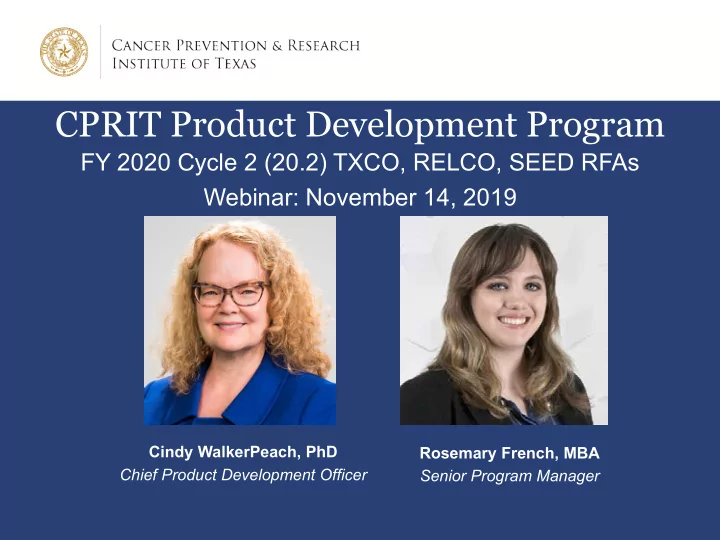
CPRIT Product Development Program

FY 2020 Cycle 2 (20.2) TXCO, RELCO, SEED RFAs Webinar: November 14, 2019

Cindy WalkerPeach, PhD Chief Product Development Officer Rosemary French, MBA Senior Program Manager
slide-2
SLIDE 2

Webinar Participants

2

Hosts:

Rosemary French, MBA Senior Program Manager Rosemary French, MBA Senior Program Manager Senior Program Manager

CPRIT Reviewers:

David Shoemaker, PhD Deputy Chair, Product Development Review Council Cindy WalkerPeach, PhD Chief Product Development Officer Jim Jordan, MBA Reviewer, Product Development

slide-3
SLIDE 3

Agenda and Q&A

Agenda

  • Overview – CPRIT Product Development Program and available

RFA grant mechanisms (SEED, TXCO, RELCO)

  • Live Q&A Session

Q&A

  • Participant lines will be muted during the webinar.
  • Participants may submit questions at any time.
  • Questions will be addressed at the end of the presentation.
  • Pease submit your questions using “Questions Box” on the

GoToWebinar control panel and clicking SEND.

3

slide-4
SLIDE 4

CPRIT Grant Award Data to 21Aug19

Academic Research 1,178 awards, $1.72 billion Combined research awards: 1,221 awards, $2.16 billion

Clinical Research (31.1%) $670.7 million Translational Research (25.1%) $540.6 million Recruitment (26.7%) $575.2 million Basic Research (14.3%) $308.9 million Research Training (2.8%) $ 59.9 million

Product Development Research 43 awards, $437.1 million Prevention 226 awards, $250.0 million

4

1,447 Awards Totaling $2.41 Billion

Updated 8-21-2019

slide-5
SLIDE 5

2020 Product Development Program Priorities

  • Funding novel projects that offer therapeutic or diagnostic

benefits not currently available; i.e., disruptive technologies

  • Funding projects addressing large or challenging unmet

medical needs

  • Investing in early-stage projects when private capital is least

available

  • Stimulation commercialization of technologies developed at

Texas institutions

  • Supporting new company formation in Texas or attracting

promising companies to Texas that will recruit staff with life science expertise, especially experienced C-level staff, to lead to seed clusters of life science expertise at various Texas locations

  • Providing appropriate return on Texas taxpayer investment

5

slide-6
SLIDE 6

Product Development Awards

6

  • Objectives

§ Identifying and funding projects to develop novel drugs, diagnostic applications, medical devices and other non-traditional products with focused relevance to cancer research, treatment and prevention § Funding Texas-based companies and companies willing to relocate to Texas are most likely to bring important products to the market § Providing funding that promotes the translation of research at Texas institutions into startup companies able to compete in the marketplace

  • Product Development Awards to date

§ 43 awards approved totaling $437.1 million § 17 awardee companies conducting active clinical trials § More than $3.15 billion in follow-on funding § 662 jobs created in Texas

slide-7
SLIDE 7

Product Development Investments

7

Austin Lubbock College Station Dallas San Antonio Houston

slide-8
SLIDE 8

Current Product Development Portfolio Mix

8

FUNDED INVESTMENTS

Therapeutics 79% Devices 9% Diagnostics 12%

August 2019

slide-9
SLIDE 9

FY 2020 Cycle 2 Award Mechanisms

9

General Criteria

  • Startup or established companies developing innovative products or services
  • Significant potential impact on cancer patient care
  • Scientific “Proof of Principle” demonstrated; business merit

Three Product Development Mechanisms

  • Texas Company Awards (TXCO)
  • Startups or established companies located in Texas
  • Up to $20M over 36 months
  • Company Relocation Awards (RELCO)
  • Startups or established companies willing to relocate to Texas
  • Up to $20M over 36 months
  • Seed Awards (SEED)
  • Startup companies based in Texas or willing to relocate to Texas
  • Up to $3M over 36 months
slide-10
SLIDE 10

Award Requirements, Part 1

  • Contracted relationship with CPRIT
  • Annual Progress Report Review – meet goals/objectives to continue funding tranches
  • 50% match requirement
  • For example, a company that applies for $1 million in CPRIT funding must raise

$500,000 in external matching funds

  • Revenue sharing commitment included as part of contract
  • Therapeutics: 3-5% royalty until 4X the award amount paid to Texas. After 4X

award amount is paid to Texas, royalty reduced to 0.5%.

  • For example, therapeutics awardee that receives a $10 million CPRIT award pays

3-5% in royalties (depending on the amount of cumulative revenue) until the total royalty payments equal $40 million, at which point royalties would drop to 0.5%

  • Devices/Diagnostics/Services: 3-5% royalty until 2.5X the award amount paid to
  • Texas. Then royalty reduced to 0.5%.
  • For example, diagnostics awardee that receives a $10 million CPRIT award pays

3-5% in royalties (depending on the amount of cumulative revenue) until the total royalty payments equal $25M million, at which point royalties would drop to 0.5%

  • More details: https://www.cprit.state.tx.us/our-programs/product-development-

research/revenue-sharing/

10

slide-11
SLIDE 11

Award Requirements, Part 2

Texas Location Criteria

  • Awardees must:
  • either already be based in Texas or,
  • commit to become Texas-based upon receipt of award
  • A company is considered to be Texas based if it fulfills or commits to

fulfilling a majority of the following criteria:

1.

The US headquarters are physically located in Texas.

2.

The Chief Executive Officer resides in Texas.

3.

A majority of the company’s personnel, including at least 2 other C-level employees (or equivalent) reside in Texas.

4.

Manufacturing activities take place in Texas.

5.

At least 90% of grant award funds are paid to individuals and entities in Texas, including salaries and personnel costs for employees and contractors.

6.

At least 1 clinical trial site is in Texas.

7.

The company collaborates with a medical research organization in Texas, including a public or private institute of higher education.

11

slide-12
SLIDE 12

Multi-Stage Review Process

Companies submit grant proposals by deadline January 29, 2020 Initial Grant Proposal Review and Scoring March 2020 In-Person Presentations April 21-24, 2020 Due Diligence Review July 2020 Program Integration Committee Review August 2020 Oversight Committee Review and Approval August 2020

12

FY 2020 Cycle 2

slide-13
SLIDE 13

Reminder: Key Dates

13

FY 2020 Cycle 2 FY 2021 Cycle 1 (tentative)

RFA Release Date Summer 2020 Applications Due Summer 2020 Award Notification February 2021 RFAs Released November 20, 2019 Application Portal Opens December 4, 2019 Applications Due January 29, 2020 In-Person Presentation April 21-24, 2020 Award Notification August 2020

slide-14
SLIDE 14

Reviewer Perspectives

David Shoemaker, PhD Deputy Chair, Product Development Review Council Jim Jordan, MBA Reviewer, Product Development

slide-15
SLIDE 15

Invest in Commercially Viable Projects

15

SEED Awards:

  • Startups, early-stage commercial concept
  • Novel technology, may not be completely at product stage
  • Drugs and Biologics, multiple candidates, no lead
  • Devices, early prototype, not fieldable
  • Diagnostics, may have a research test or LDT
  • Strong value proposition with preliminary business plan
  • Science-based personnel accessing commercial product development consultants
  • Demonstrated understanding of the commercial product development process IND/IDE

(clinical, preclinical, CMC, regulatory) TXCO/RELCO Awards:

  • Newly established or established companies
  • Novel technology, more likely at product stage
  • Drugs and Biologics, established lead (IND within a year)
  • Devices, commercial-ready prototype (IDE within a year)
  • Diagnostics, commercial-ready prototype (IDE within a year)
  • Viable commercial concept with strong Value Proposition and business plan
  • Veteran, experienced product development team (fewer consultants)
  • Veteran, experienced management team, likely to have secured independent funds
  • Deep understanding of the of commercial product development process and marketplace (clinical,

preclinical, CMC, regulatory, statistical, marketing, reimbursement, program management, post-market surveillance, competitive landscape, product life cycle, pipeline development, distribution strategy, partnering strategy)

slide-16
SLIDE 16

SEED Early Development Stage Grant

  • Startup companies
  • ~2 - 3 years from filing IND/IDE
  • Early Pharmacodynamic Proof of Concept
  • Supported by rigorous pharmacology data in multiple models
  • Preliminary Preclinical Safety Data
  • Secondary pharmacology studies (specificity)
  • Preliminary Development Plans (Clinical, Preclinical, CMC,

Regulatory)

  • Preliminary Commercialization Strategy
  • Preliminary understanding of competitive landscape and path to

market

16

slide-17
SLIDE 17

TXCO/RELCO Development Stage Grant

  • Established company, one year from filing IND/IDE or in the Clinic
  • Established Proof of Concept
  • Completed Preliminary Assay Validation Work
  • Completed Pilot Toxicology Studies (most sensitive species identified)
  • Completed Initial CMC Studies (initial small-scale batches)
  • Management and Disciplinary Expert Personnel (Medical/Clinical,

Preclinical, CMC, Regulatory, Commercial) Employed or Identified

  • Completed Target Product Profile and/or Integrated (Clinical, Nonclinical,

CMC, Regulatory) Product Development Plan through to marketing application

  • Completed Intellectual Property Strategy and Initial Filings
  • Preliminary Commercialization Plan

17

slide-18
SLIDE 18

What makes a strong device/diagnostic application?

18

Market potential Medical Device Diagnostic

  • ↑ $250 million segment
  • ↑ $100 million segment

Sales & marketing

(commercialization plan)

  • ↑ New category or improvement of

existing category

  • New category or test not offered by

major Dx player

  • Direct or distribution strategy
  • Formulary & buying group strategy
  • Direct or distribution strategy
  • Kit/product or CLIA

Technology & IP

(development plan)

  • Existing PCT’s or patents
  • Adequate IP landscape analysis
  • Design system requirement plan
  • Existing PCT’s or patents
  • Trade secrets, proprietary know-how

Clinical evidence

(clinical plan)

  • Bench data
  • Biocompatibility analysis
  • Animal data and maybe FIH
  • Human clinical data on sensitivity (w/

disease), & specificity (w/o)

  • Competitive comparable performance data

if existing category, materiality if not

Regulatory & reimbursement

  • Pathway: BLA, PMA, 510k
  • Existing DRG, ICD and/or CPT
  • Animal data and maybe FIH
  • CLIA or PMA/510k pathway
  • Coding plan for Part A & Part B, new or

existing

Team

  • Technical team in place
  • Regulatory consultants engaged
  • Technical team in place
  • Regulatory consultants engaged
  • CLIA experienced personnel in operations

Revenue

  • None
  • CLIA should have some revenue
slide-19
SLIDE 19

Contact Info

Questions: Application Portal -> CPRIT Help Desk Phone: 866-941-7146 Email: Help@CPRITGrants.org Monday through Friday, 7 a.m. to 4 p.m. CT Questions: Application Content and RFAs: Rosemary French, Senior Program Manager, Product Development Phone: 512-305-7676 Email: rfrench@cprit.texas.gov

CPRIT Website: https://www.cprit.texas.gov

19

slide-20
SLIDE 20

Q&A

  • Submit your questions using “Questions” on the GoTo

Webinar control panel.

  • You may submit a question at any time by typing your

question into the “Question Box” and clicking SEND.

20