Kaedah TRIZ TRIZ ke Arah Penyelesaian Masalah Secara Efektif dalam - - PowerPoint PPT Presentation

kaedah triz triz
SMART_READER_LITE
LIVE PREVIEW

Kaedah TRIZ TRIZ ke Arah Penyelesaian Masalah Secara Efektif dalam - - PowerPoint PPT Presentation

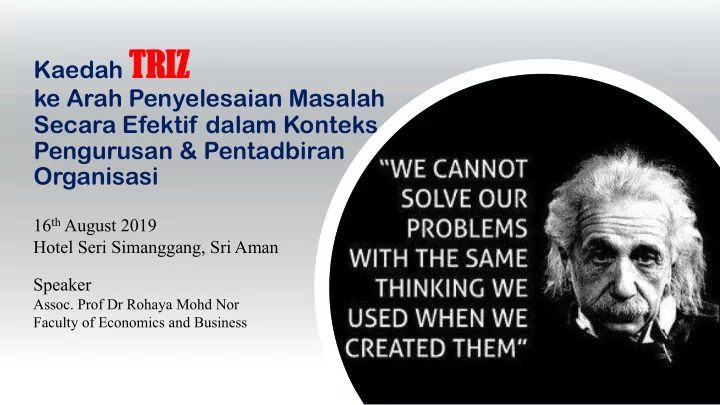
Kaedah TRIZ TRIZ ke Arah Penyelesaian Masalah Secara Efektif dalam Konteks Pengurusan & Pentadbiran Organisasi 16 th August 2019 Hotel Seri Simanggang, Sri Aman Speaker Assoc. Prof Dr Rohaya Mohd Nor Faculty of Economics and Business


slide-1
SLIDE 1

Kaedah TRIZ

TRIZ

ke Arah Penyelesaian Masalah Secara Efektif dalam Konteks Pengurusan & Pentadbiran Organisasi

16th August 2019 Hotel Seri Simanggang, Sri Aman Speaker

  • Assoc. Prof Dr Rohaya Mohd Nor

Faculty of Economics and Business

slide-2
SLIDE 2

I construct a life for me through my passion and love working with others, to help others to reach their potentials and being empowered to have meaningful purposes, and then they will be able to reach out to those in need also.

Rohaya is an associate professor at the Faculty of Economics and Business, UNIMAS. She obtained her BSc Degree in Management with MIS, from Purdue University, US. She holds a Master of Information System from Melbourne University, Australia and a PhD degree, specializing in MIS, from Imperial College London, UK. Rohaya has served UNIMAS for more than 20 years, and has assumed several key roles at the university including: Dean of Faculty of Economics and Business (2016-2017); UNIMAS Senate Member (2016-2017); Member of University Executive Committee UNIMAS (2015, 2017); Director of Strategic Planning & Quality Management Centre (2015); Head of Department of Business Management (2010 - 2013); Managing Journal Editor for IJBS (2004- 2005). Rohaya has been involved in several research projects, including three international research projects funded by the European Commission.

slide-3
SLIDE 3

1

“The Big Picture”

3

Topic 2

2 4

OUTLINES

“The Right Mindset” “Management Challenges in the 21st Century” “TRIZ as A Lean Thinking Tool for Managers”

slide-4
SLIDE 4

Strategic Thinking is the ability to develop a broad, big-picture view of the

  • rganisation and its mission.

Strategic Thinking keeps individuals and groups focused and helps decide where to invest critical resources. It includes the ability to link long-range visions and concepts to daily work. (OECD, 2014)

1

“The Big Picture” Why?

Important to have more Strategic Leaders

  • Leaders who use different styles of management, develop a vision for their
  • rganization that enables it to adapt to or remain competitive in a changing

economic and technological climate.

  • Leaders who are able to use this vision to motivate employees and departments,

fostering among them a sense of unity and direction in order to implement change within their organization.

  • Strategic leadership contexts: streamline processes, boost strategic productivity,

promote innovation and cultivate an environment that encourages employees to be productive, independent and to push forward their own ideas.

  • Strategic leaders sometimes make use of reward or incentive programs to

encourage employees and help them reach their goals.

Managers’ World Views – Master “the 4 knows”

v Knowing your environment; v Knowing your university; v Knowing your department and; v Knowing yourself.

slide-5
SLIDE 5

Examples of Competency - OECD

slide-6
SLIDE 6

Examples

slide-7
SLIDE 7

UNIMAS STRATEGIC PLANNING Bottom Line

Choice of employer Choice of provider Choice for funders

VISION

MISSION To generate, disseminate and apply knowledge strategically and innovatively to enhance the quality of the nation's culture and prosperity of its people. To become an exemplary university of internationally acknowledged stature and a scholarly institution of choice for both students and academics through the pursuit

  • f excellence in teaching, research and

scholarship.

A Five-year plan to achieve Phase 2 PSPTN A Five-year plan for Malaysia Higher Education Blueprint

slide-8
SLIDE 8

Bottom Line

Choice of employer Choice of provider Choice for funders

MISSION VISION

JAWATANKUASA

TRANSFORMATION JOURNEY SF1

EXCELLENCE IN EDUCATION & TRAINING EXCELLENCE IN INNOVATION ECOSYSTEM

SF2

GLOBAL VISIBILITY & PROMINENCE

SF3

SUSTAINABLE FINANCIAL PORTFOLIO

SF4 Being a Strategic Leader Is About Asking the Right Questions (Lai, 2017)

  • 1. What are we doing today?
  • 2. Why are you doing the work you’re doing? Why now?
  • 3. How does what we’re doing today align with the bigger picture?
  • 4. What does success look like for our team?
  • 5. What else could we do to achieve more, better, faster?

MANAGEMENT FUNCTIONS PLANNING ORGANIZING LEADING CONTROLLING

slide-9
SLIDE 9

Strategic Leadership – Middle Managers

slide-10
SLIDE 10
  • V. Souchkov, 2009

Why TRIZ is powerful?

Helps to fight psychological inertia Uses analytical logic to understand roots

  • f problems

Based on 50 years of studies that discovered patterns of strong solutions and trends of system evolution

Facilitates collaborative intelligence when working with problems and challenges Introduces knowledge- based approach to generate Innovative ideas Offers tools and processes to deal with problems and challenges in a systematic way

MANAGEMENT FUNCTIONS PLANNING ORGANIZING LEADING CONTROLLING TRIZ logic demands that we have a clear idea of where we are going, and how to get there. TRIZ helps us keep detail in its place, to see the big picture and avoid getting tripped up with irrelevance, waylaid by trivial issues or seduced by premature solutions. (Oxford Creativity, Oxford TRIZ)

slide-11
SLIDE 11

What TRIZ Offers – Recognize different Types of Resources

Functional Information Combined

All substances in the system or in the external environment All kinds of energies and fields such as electrical, electromagnetic, thermal fields, etc in the system or in the external environment All kinds of time before, during and after running of the system All kinds of data on parameters of substance, fields, change of properties

  • r of object –

typically used for measuring, detection and separation A combination of prime resources – a new resource could emerge through specific resource combination All possible functions

  • f substance, fields,

properties or object – can work as great resources

Substances Energy Time

Prioritizing resources available within a system

slide-12
SLIDE 12

2 “The Right Mindset”

I have an IMMIGRANT MENTALITY, which is that the job can be taken away at any time, so make sure you earn it every day …

~Indra Nooyi~ CEO of PepsiCo for 12 years Strategic Leaders have strategic decision making mindset

  • Leaders who use different styles of management, develop a vision for

their organization that enables it to adapt to or remain competitive in a changing economic and technological climate.

  • Leaders who are able to use this vision to motivate employees and

departments, fostering among them a sense of unity and direction in

  • rder to implement change within their organization.
  • Strategic leadership contexts: streamline processes, boost strategic

productivity, promote innovation and cultivate an environment that encourages employees to be productive, independent and to push forward their own ideas.

  • Strategic leaders sometimes make use of reward or incentive

programs to encourage employees and help them reach their goals.

slide-13
SLIDE 13
slide-14
SLIDE 14

What is Psychological Inertia?

  • The psychological meaning of the word

“inertia” implies an indisposition to change – a certain “stuckness” due to human

  • programming. It represents the inevitability
  • f behaving in a certain way – the way that

has been indelibly inscribed somewhere in the brain.

  • It also represents the impossibility – as long

as a person is guided by his habits – of ever behaving in a better way.

Source: Kowalick (1998) – https://triz-journal.com/psychological-inertia/

slide-15
SLIDE 15

Different Forms of Psychological Inertia

  • 1. The Retarding Power (or Inertia) of

a Word

  • 2. A Partial Restriction Becomes a

Blanket Restriction

  • 3. Tradition Cannot be Broken
  • 4. Words and Their Assumed

Properties or Characteristics

  • 5. Inadmissible Range of Data
  • 6. Association of Objects with

Senses

  • 7. All Information Given is Valid

Source: Kowalick (1998) – https://triz-journal.com/psychological-inertia/

slide-16
SLIDE 16

Causes of Psychological Inertia

  • 1. Having a fixed vision (model) of the

solution or the root cause.

  • 2. False assumptions (trusting the data).
  • 3. Specific terminology in a language that is

a strong carrier of psychological inertia.

  • 4. Experience, expertise, and reliance upon

previous results.

  • 5. Limited knowledge, hidden resources, or

mechanisms.

  • 6. Inflexibility (model worship), trying to

prove a specific theory, stubbornness.

  • 7. Reusing the same strategy.
  • 8. Rushing to a solution, incomplete

thinking.

slide-17
SLIDE 17
slide-18
SLIDE 18

Explore the problem at each of the three levels:

  • Super-system (or Macro

system): External environment and components that the problem

  • r system interacts or may

interact with

  • System: The problem or system

that was created

  • Subsystem (or Micro

system): A component or parts of the problem or system

https://asq.org/quality-resources/nine-windows

TRIZ Technique – Nine Windows

slide-19
SLIDE 19

TRIZ Technique – Nine Windows

Example 1 :

slide-20
SLIDE 20

TRIZ Technique – Nine Windows

Example 2 :

PAST PRESENT FUTURE Super- system Smaller company, Less need for product, Only phones No Internet, Sold-Directly to Customer Organization, Phone System, Internet, Transportation, Buyers, Wholesalers, Suppliers Larger organization, More product offerings, More staff, More customers, Outsourcing much of sales, Global Market System Customer phoned or physically came to the location Meetings are scheduled according to incoming phone calls, emails, on-line contacts for support. Meeting happen “virtually”, more product sold = more incoming calls and contact for support, increased dependence upon “magnet & virtual” staff and locations. Sub- system phones, typewriters + file cabinets (physical tangible records), Only spoke English, Only US currency Phones, Each persons computer, Personal Relationships, Multiple Languages, Locations Increased storage of records

  • n computers, People who

speak multiple languages, Translators, Done on computers
slide-21
SLIDE 21

3

“Management Challenges in the 21st Century”

  • 1. Problems/issues are getting complex to solve
  • A report from the World Economic Forum predicts that more than one-third of all

jobs across all industries will require complex problem-solving as one of their core skills by 2020.

  • 2. Extensive digitalization and disruptions from technologies/ innovations
  • 3. Competing for resources
  • 4. Pressure to comply – various emerging standards & regulations from

business environment

  • 5. Re-skilling and training issues
  • 6. Sustainability aspects
slide-22
SLIDE 22
slide-23
SLIDE 23
slide-24
SLIDE 24
slide-25
SLIDE 25 25
slide-26
SLIDE 26

Model of Managing Change

slide-27
SLIDE 27

Source: Professor Sergei Ikovenko (2008)

https://www.osaka-gu.ac.jp/php/nakagawa/TRIZ/ eTRIZ/epapers/e2009Papers/eIkovenkoKeynote2008/eIkovenko-TRIZSymp2008- 090305.html

Take TRIZ as a way to sharpen your thinking skills and strengthen problem solving skills.

slide-28
SLIDE 28

4 TRIZ as A Lean Thinking Tool for Managers

Take Home Messages

  • 1. Gain advantages learning TRIZ method as an alternative towards doing problem

solving, as it heavily rely on logic, and help to create synergy with the “Big Picture” thinking as well as with the level of details related to the problem.

  • 2. Operationalizing TRIZ effectively for problem solving necessitates a change of

mindset, and serious efforts to eliminate psychological inertia.

  • 3. TRIZ Method instil creativity and innovativeness towards problem solving, and can

enculturate innovative thinking, focus on continuous improvement and lean approach towards generating solutions.

  • 4. UNIMAS via the role of ISITI Director, Prof Nara is building a pool of UNIMAS

TRIZ trainers, at least aiming to get more for Certified Trainer TRIZ Level 2. Why not take advantage of this as part of professional development!

slide-29
SLIDE 29
slide-30
SLIDE 30

Avoid HABITS that lead to BAD DECISIONS

https://hbr.org/2014/09/9-habits-that-lead-to-terrible-decisions

  • 1. Having no strategic alignment.
  • 2. Failure to communicate the what,

where, when, and how associated with their decisions.

  • 3. Laziness
  • 4. Not anticipating unexpected events
  • 5. Indecisiveness
  • 6. Remaining locked in the past.
  • 7. Over-dependence
  • 8. Isolation
  • 9. Lack of technical depth.