Contents The Fourth TRIZ Symposium in Japan, 2008 Held at Laforet - - PowerPoint PPT Presentation

contents
SMART_READER_LITE
LIVE PREVIEW

Contents The Fourth TRIZ Symposium in Japan, 2008 Held at Laforet - - PowerPoint PPT Presentation

Contents The Fourth TRIZ Symposium in Japan, 2008 Held at Laforet Biwako (Moriyama, Shiga) on Sept. 10-12, 2008 Outline of TRIZ activities TRI Z activities in Corporate R&D Division of (1) Targets and practices (2) Execution programs


slide-1
SLIDE 1

(C) The Author & Japan 4th Japan TRIZ Symposium 2008

  • Sept. 10-12, 2008 Slide 1

TRI Z activities in Corporate R&D Division of Matsushita Electric I ndustrial Co. -Applications to system, architecture,

and software technologies -

Yojiro Fukushim a System Engineering Center Matsushita Electric I ndustrial Co., Ltd.

September 11, 2008

The Fourth TRIZ Symposium in Japan, 2008 Held at Laforet Biwako (Moriyama, Shiga)

  • n Sept. 10-12, 2008

(C) The Author & Japan 4th Japan TRIZ Symposium 2008

  • Sept. 10-12, 2008 Slide 2

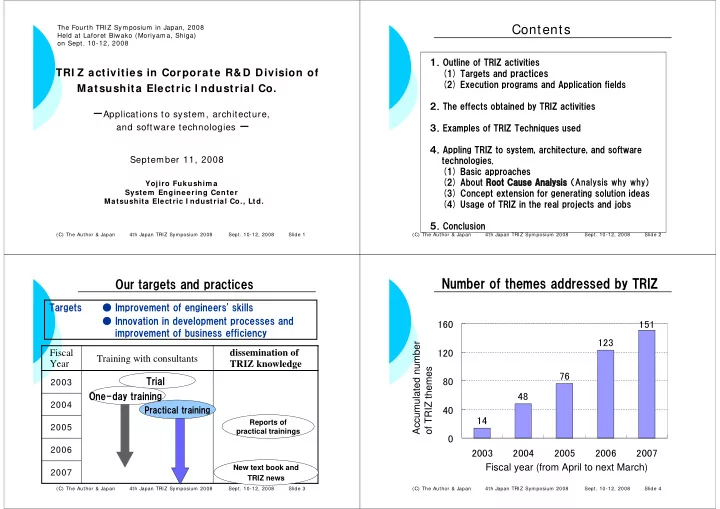
1.Outline of TRIZ activities (1) Targets and practices (2) Execution programs and Application fields 2.The effects obtained by TRIZ activities 3.Examples of TRIZ Techniques used 4.Appling TRIZ to system, architecture, and software technologies. (1) Basic approaches (2) About Root Cause Analysis (Analysis why why) (3) Concept extension for generating solution ideas (4) Usage of TRIZ in the real projects and jobs 5.Conclusion

Contents

(C) The Author & Japan 4th Japan TRIZ Symposium 2008

  • Sept. 10-12, 2008 Slide 3

dissemination of TRIZ knowledge Training with consultants Fiscal Year

2006 2007 2005 2004 2003 Practical training

One-day training Trial

New text book and TRIZ news Reports of practical trainings

Our targets and practices

  • Innovation in development processes and

improvement of business efficiency

  • Improvement of engineers' skills

Targets

(C) The Author & Japan 4th Japan TRIZ Symposium 2008

  • Sept. 10-12, 2008 Slide 4

14 48 76 123 151 40 80 120 160 2003 2004 2005 2006 2007 Fiscal year (from April to next March)

Number of themes addressed by TRIZ

Accumulated number

  • f TRIZ themes
slide-2
SLIDE 2

(C) The Author & Japan 4th Japan TRIZ Symposium 2008

  • Sept. 10-12, 2008 Slide 5

Short problem definition, Solving Problem definition, Solving Problem definition, Solving Problem definition, Solving, Evaluation Main activities Team from 3 to 6 people members Real problems in the job Theme Executed ratio Standard time required No. 1.5% 24h + free ③ 1.5% 16h ④ 21% 70h ② 76% 120h ①

Execution programs

1.Solving real problems in business 1.Solving real problems in business

About 30 persons all together hypothetical problem Basic lecture and exercises One day members Theme Main activities Standard time required

2.Understanding TRIZ 2.Understanding TRIZ

(C) The Author & Japan 4th Japan TRIZ Symposium 2008

  • Sept. 10-12, 2008 Slide 6

Fields and purposes of application

Technology fields Technology fields purposes of applicaton purposes of applicaton

Software 44.5% Method 18% System 12.5% Device 22.7% Process 0.8% Business Process (Non-technology) 2.7% New functionality 47.3% Better performance 29% High speed 12.2% Low power 5.3% Miniaturization 3.1% Low price 3.1%

(C) The Author & Japan 4th Japan TRIZ Symposium 2008

  • Sept. 10-12, 2008 Slide 7

Effects of Using TRIZ (1. in patent application)

48.2% 61.8%

0% 20% 40% 60% 80% 100%

体 Z Patents for which TRIZ was used all patents 1.Quality of patents: Comparison in the ratio of good patents.

TRIZ Acquisition period

Engineers who acquire TRIZ Engineers who did not acquire TRIZ

2.Engineer' skill: Comparison in the number

  • f patent applications

Fiscal year

(n=34)

Ratio of good patents

1 2003 2004 2005 2006 2007 1.2 1.4 1.6 Relative number of application/person

(n>500)

(C) The Author & Japan 4th Japan TRIZ Symposium 2008

  • Sept. 10-12, 2008 Slide 8

1 :Idea that may come out without cutting and trying; process is less efficient than before. 2 :Idea that may come out without cutting and trying; process is nearly the same efficiency

than before.

3 :Idea that may come out without cutting and trying; process is more efficient than before. 4 :Idea that would not come out without cuts and try. 5 :Idea that are amazing and can not expect surely even with cuts and tries.

  • Engineers' evaluations of the results obtained with TRIZ

1 4 1 2 1 7 3

distribution of engineers' evaluation on the solution development efficiency

Development process efficiency improved (levels 3 to 5)

86%

Effects of Using TRIZ (2. Business efficiency improvement)

1 2 3 4 5

slide-3
SLIDE 3

(C) The Author & Japan 4th Japan TRIZ Symposium 2008

  • Sept. 10-12, 2008 Slide 9

0% 20% 40% 60% 80% 100% SLP Effects 発明標準解 発明の原理

TRIZ techniques used (1)Idea generation

% frequency used

・Easy to understand ・Simple flow of task ・Easy to find new viewpoints ・Useful in the situations where the problem analysis is not done so deeply.

Inventive Principles Inventive Standards Effects SLP

TRIZ tools used for idea generation

(C) The Author & Japan 4th Japan TRIZ Symposium 2008

  • Sept. 10-12, 2008 Slide 10

Top 10 Inventive Principles most often used Top 10 Inventive Principles most often used

  • 7. Nested doll
  • 19. Periodic action
  • 4. Asymmetry
  • 5. Merging
  • 13. The other way round
  • 24. Intermediary
  • 28. Mechanics substitution
  • 3. Local quality
  • 2. Taking out
  • 10. Preliminary action

TRIZ technques Used (2) Inventive principles

(These 10 Inventive principles are used in 79 % of all the usage

  • f Inventive Principles. )

(C) The Author & Japan 4th Japan TRIZ Symposium 2008

  • Sept. 10-12, 2008 Slide 11

TRIZ is the thinking methods extracted from a huge number of past patents. It may be regarded as the basic, general principles when humans think, and hence should also be effective when software engineers think on their problems.

Verification1: We analyzed 13 patents in the software field. ⇒ Basic ideas of the patents can be derived by using the TRIZ

  • techniques. (Analyzed by SKI)

Verification2: Engineers' evaluations of TRIZ ⇒ No difference depending on the fields of engineers

アンケート 結果(

5 点評価)

Basic approaches for applying TRIZ to the fields of systems, architecture, and software technologies

software systems, architecture

3 1 5 4 2 1

Process Device

Useful Effect vs. time Effect of ration in the past Improvement of idea Good experience

Evaluation (Five levels)

We expected that

(C) The Author & Japan 4th Japan TRIZ Symposium 2008

  • Sept. 10-12, 2008 Slide 12

Target Current state

Hidden system conditions are now revealed.

not achieved yet

Gap = Problem Problem Problem is defined as the gap. “Analysis why why”

Why? Why? Why? Why? Why? Why? Why?

*Because it was designed in such a way, *If we design it newly, why can' we ...? <Clues to the real problem to solve> <Why we cannot ?> ・Because the way is not found. ・There is a way, but not good ・There might be a better way. ・We did not think of it. ・・・

“Analysis why why” is good to find causes, and also to reveal tacit constraints and new clues.

Porblem analysis reveals the constraints tacit in the system.

crutial task

slide-4
SLIDE 4

(C) The Author & Japan 4th Japan TRIZ Symposium 2008

  • Sept. 10-12, 2008 Slide 13

A model of problem analysis

System functions Problems Laws of physics, Structures, Components properties, etc. Thinking. Design intention, Composition, etc.

① System functions work to the full extent? ② What are the core problems?

(Objective factors) (Artifitial factors) System conditions and constraints The mechanisms need to be well understood. Viewpoint 1 Viewpoint 2

Clues to problem solving !!

(C) The Author & Japan 4th Japan TRIZ Symposium 2008

  • Sept. 10-12, 2008 Slide 14

Classification*1 Principles

  • 7. Nested doll
  • 19. Periodic action
  • 4. Asymmetry
  • 5. Merging
  • 13. The other way

round

  • 24. Intermediary
  • 28. Mechanics

substitution

  • 3. Local quality
  • 2. Taking out
  • 10. Preliminary

action Human thinking Human thinking / Physical means Human thinking Physical means Human thinking *1:Edited by Mitsubishi Research Institute Inc. “Illustration of TRIZ”

  • pp. 56~84

Extension of concepts in some TRIZ Tools

Top 10 Principles most frequently used

① Interpretation of Inventive Principles

  • 28. Mechanics substitution: (Think more flexibly.)
  • Ex. 1: Use diferent data, parameters, means, etc.
  • Ex. 2: Replace it with a diferent application.

② Use of Inventive Standards (Prediction in TOPE)

(In general use) ⇒ (In software application) ・Add a new substance ⇒ Add new data or a module. ・Add a gap ⇒ Add a flag which includes no data.

③Recent textbooks and software tools

for software application

・ Darrell Mann : 'TRIZ For Software?'

www.triz-journal.com/archives/2004/10/04.pdf

・ Innovation Suite by CREAX ・ Goldfire Innovator by Invention Machine Corporation ・ Umakant Mishra : "TRIZ Principles for Information Technology", (Draft) * These references show that all Inventive Principles will be applicable to software technology.

(C) The Author & Japan 4th Japan TRIZ Symposium 2008

  • Sept. 10-12, 2008 Slide 15

Intermediate checkpoint

Who: Manager, staff What: The viewpoint significant?

Final checkpoint

Who: Manager, staff What: Evaluation of the results

Usage of TRIZ in the real projects and jobs

-Engineer's thinking is guided to fit with the organization's policy.-

GO

  • r

No GO Turn into the regular job Problem Definition Solution Generation Project planning

Con- clusion

Project Evaluation Write down what engineers are worrying/thinking, and evluate them ★.Make engineers think from different aspects. ★Give structures to the ideas and find directions of thinking

Engineers TRIZ Instructor Guide the project planning Lead the problem definition and solution generation

(C) The Author & Japan 4th Japan TRIZ Symposium 2008

  • Sept. 10-12, 2008 Slide 16

Remarks on some of engineers complaints.

Engineers often complain: ・Solution ideas are common ones. ・ Not patentable. ・ Conventional and not new. <Suggestions for response> Build up the image of the system where the solution ideas are implemented. ★The scheme built up becomes the solution. ★If there is a problem in the scheme, it is the true problem. <Suggestions for procedure> 1.The KJ method is useful to give a structure to many ideas. ==> Good for elminating unrelevant facts and for finding new aspects. 2.Solution evaluation and combination (e.g., Pugh method): Good to modify the whole solution and enhance/compliment the solution.

★Generated ideas still stay in the generic/abstract world. ★No significant change yet in

  • ne's own thinking.

slide-5
SLIDE 5

(C) The Author & Japan 4th Japan TRIZ Symposium 2008

  • Sept. 10-12, 2008 Slide 17

How to turn the TRIZ results into the regular job: Use TRIZ without being constraint by TRIZ tools

-How to use TRIZ method more effectively -

1.Before starting to solve a problem with TRIZ, the problem/task must be positioned and evaluated in the framework of business. Write down the background, targets (final results), constraints, etc. 2.Together with TRIZ tools, it is usefull to organize knowledges by using simple, general methods: Write down all the ideas and knowledges; => Notice some new facts/aspects; => Recognize the structure of technology and find solution directions. 3.In the team activities, stimulate each other. Interest in other's tacit knowlege -> organizational knowledge => sympathy -> stimuate tacit knowledge again. Similar to SECI Model (Ikujiro Nonaka et al. " ", p. 93). 4. Combining TRIZ with familiar idea generation methods is useful. The KJ Method, Brainstorming, Brainwriting, etc.

(C) The Author & Japan 4th Japan TRIZ Symposium 2008

  • Sept. 10-12, 2008 Slide 18

Conclusion

  • We applied TRIZ to system, method, and software
  • technology. As a result, we learnt TRIZ had

contributed to the improvement of engineer's ability. In the future, we hope that many cases in this field will be researched.

  • Problem will be solved if engineer thinks well by

squeezing it in the direction of the solution that TRIZ

  • indicates. This means that the engineer who

experienced TRIZ process discovers his own ability. He begins to think deeply about problem itself. He will consider "Problem that should be solved" instead of "Problem can be solved".