
SLIDE 1
Journée du R RQSHA, 22 n 22 novembre 2016 | 2016 | RQSHA Day, November 22, 2016
Prés ésen entat ations o
- ral
ales – Ora ral P Pre resent ntations ns
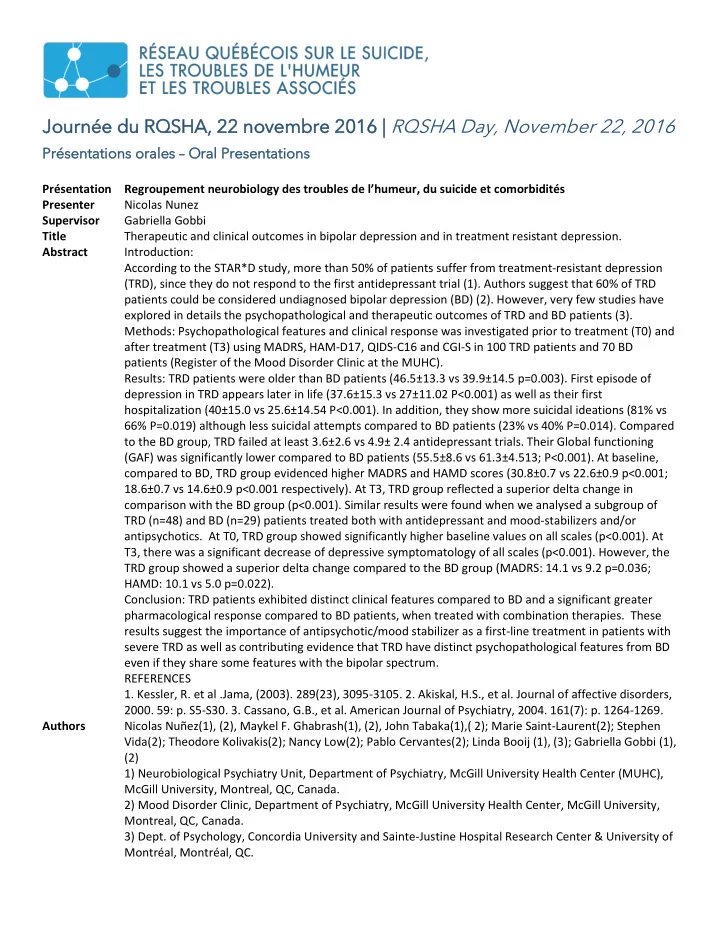
Présentation Regroupement neurobiology des troubles de l’humeur, du suicide et comorbidités Presenter Nicolas Nunez Supervisor Gabriella Gobbi Title Therapeutic and clinical outcomes in bipolar depression and in treatment resistant depression. Abstract Introduction: According to the STAR*D study, more than 50% of patients suffer from treatment-resistant depression (TRD), since they do not respond to the first antidepressant trial (1). Authors suggest that 60% of TRD patients could be considered undiagnosed bipolar depression (BD) (2). However, very few studies have explored in details the psychopathological and therapeutic outcomes of TRD and BD patients (3). Methods: Psychopathological features and clinical response was investigated prior to treatment (T0) and after treatment (T3) using MADRS, HAM-D17, QIDS-C16 and CGI-S in 100 TRD patients and 70 BD patients (Register of the Mood Disorder Clinic at the MUHC). Results: TRD patients were older than BD patients (46.5±13.3 vs 39.9±14.5 p=0.003). First episode of depression in TRD appears later in life (37.6±15.3 vs 27±11.02 P<0.001) as well as their first hospitalization (40±15.0 vs 25.6±14.54 P<0.001). In addition, they show more suicidal ideations (81% vs 66% P=0.019) although less suicidal attempts compared to BD patients (23% vs 40% P=0.014). Compared to the BD group, TRD failed at least 3.6±2.6 vs 4.9± 2.4 antidepressant trials. Their Global functioning (GAF) was significantly lower compared to BD patients (55.5±8.6 vs 61.3±4.513; P<0.001). At baseline, compared to BD, TRD group evidenced higher MADRS and HAMD scores (30.8±0.7 vs 22.6±0.9 p<0.001; 18.6±0.7 vs 14.6±0.9 p<0.001 respectively). At T3, TRD group reflected a superior delta change in comparison with the BD group (p<0.001). Similar results were found when we analysed a subgroup of TRD (n=48) and BD (n=29) patients treated both with antidepressant and mood-stabilizers and/or
- antipsychotics. At T0, TRD group showed significantly higher baseline values on all scales (p<0.001). At
T3, there was a significant decrease of depressive symptomatology of all scales (p<0.001). However, the TRD group showed a superior delta change compared to the BD group (MADRS: 14.1 vs 9.2 p=0.036; HAMD: 10.1 vs 5.0 p=0.022). Conclusion: TRD patients exhibited distinct clinical features compared to BD and a significant greater pharmacological response compared to BD patients, when treated with combination therapies. These results suggest the importance of antipsychotic/mood stabilizer as a first-line treatment in patients with severe TRD as well as contributing evidence that TRD have distinct psychopathological features from BD even if they share some features with the bipolar spectrum. REFERENCES
- 1. Kessler, R. et al .Jama, (2003). 289(23), 3095-3105. 2. Akiskal, H.S., et al. Journal of affective disorders,
- 2000. 59: p. S5-S30. 3. Cassano, G.B., et al. American Journal of Psychiatry, 2004. 161(7): p. 1264-1269.