SLIDE 1
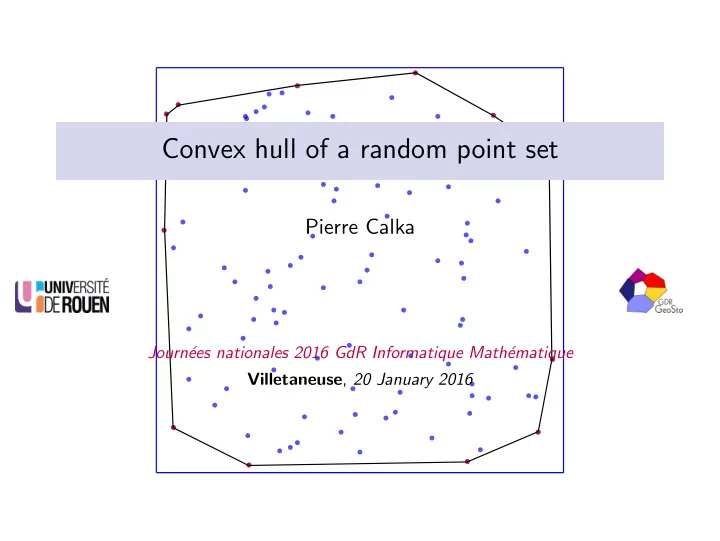
Convex hull of a random point set
Pierre Calka
Journ´ ees nationales 2016 GdR Informatique Math´ ematique Villetaneuse, 20 January 2016
SLIDE 2
default
Outline
Random polytopes: an overview Main results: variance asymptotics Case of the ball: sketch of proof and scaling limit Case of a simple polytope: sketch of proof and scaling limit Joint works with Joseph Yukich (Lehigh University, USA) & Tomasz Schreiber (Toru´ n University, Poland)
SLIDE 3
default
Outline
Random polytopes: an overview Poisson point process Uniform case Gaussian case Expectation asymptotics Main results: variance asymptotics Case of the ball: sketch of proof and scaling limit Case of a simple polytope: sketch of proof and scaling limit
SLIDE 4 default
Binomial point process
B2 B3 B4
◮ K convex body µ probability measure on K
(Xi, i ≥ 1) independent µ-distributed variables
En = {X1, · · · , Xn}
(n ≥ 1)
◮ Number of points in B1 #(En ∩ B1) binomial variable
P(#(En ∩ B1) = k) = n
k
0 ≤ k ≤ n
◮ #(En ∩ B1), · · · , #(En ∩ Bℓ) not independent
(B1, · · · , Bℓ ∈ B(R2), Bi ∩ Bj = ∅, i = j)
SLIDE 5 default
Poisson point process
B2 B3 B4
Poisson point process with intensity measure µ : locally finite subset P of Rd such that
◮ #(P ∩ B1) Poisson r.v. of mean µ(B1)
P(#(P ∩ B1) = k) = e−µ(B1) µ(B1)k
k! , k ∈ N
◮ #(P ∩ B1), · · · , #(P ∩ Bℓ) independent
(B1, · · · , Bℓ ∈ B(Rd), Bi ∩ Bj = ∅, i = j)
If µ = λdx, P said homogeneous of intensity λ
SLIDE 6
default
Uniform case
Binomial model K := convex body of Rd (Xk,k ∈ N∗):= independent and uniformly distributed in K K n := Conv(X1, · · · , Xn), n ≥ 1 K 50, K ball K 50, K square
SLIDE 7
default
Uniform case
Binomial model K := convex body of Rd (Xk,k ∈ N∗):= independent and uniformly distributed in K K n := Conv(X1, · · · , Xn), n ≥ 1 K 100, K ball K 100, K square
SLIDE 8
default
Uniform case
Binomial model K := convex body of Rd (Xk,k ∈ N∗):= independent and uniformly distributed in K K n := Conv(X1, · · · , Xn), n ≥ 1 K 500, K ball K 500, K square
SLIDE 9
default
Uniform case
Poisson model K := convex body of Rd Pλ, λ > 0:= Poisson point process of intensity measure λdx Kλ := Conv(Pλ ∩ K) K 500, K ball K 500, K square
SLIDE 10
default
Gaussian case
Poisson model ϕd(x) :=
1 (2π)d/2 e−x2/2, x ∈ Rd, d ≥ 2
Pλ, λ > 0:= Poisson point process of intensity measure λϕd(x)dx Kλ := Conv(Pλ) K100 K500
SLIDE 11 default
Considered functionals
◮ fk(·): number of k-dimensional faces, 1 ≤ k ≤ d ◮ Vol(·): volume, Vd−1(·): half-area of the boundary ◮ Vk(·): k-th intrinsic volume, 1 ≤ k ≤ d The functionals Vk are defined through Steiner formula: Vol(K+B(0, r)) =
d
r d−kκd−kVk(K), where κd := Vol(Bd) d = 2: A(K + B(0, r)) = A(K) + P(K)r + πr 2
SLIDE 12 default
Expectation asymptotics
- B. Efron’s relation (1965):
Ef0(K n) = n
Vol(K)
E[fk(Kλ)] ∼
λ→∞ cd,k
1 d+1
s
ds λ
d−1 d+1
κs := Gaussian curvature of ∂K
Uniform case, K polytope E[fk(Kλ)] ∼
λ→∞ c′
d,kF(K) logd−1(λ)
F(K) := number of flags of K
Gaussian polytope E[fk(Kλ)] ∼
λ→∞ c′′
d,k log d−1 2 (λ)
enyi & R. Sulanke (1963), H. Raynaud (1970), R. Schneider & J. Wieacker (1978), F. Affentranger & R. Schneider (1992)
SLIDE 13
default
Outline
Random polytopes: an overview Main results: variance asymptotics Uniform case, K smooth Gaussian polytopes Uniform case, K simple polytope Case of the ball: sketch of proof and scaling limit Case of a simple polytope: sketch of proof and scaling limit
SLIDE 14 default
Uniform case, K smooth: state of the art
◮ Identities relating higher moments
cλ
d−1 d+1 ≤ Var[f0(Kλ)]
◮ Number of faces and volume
cλ
d−1 d+1 ≤ Var[fk(Kλ)] ≤ Cλ d−1 d+1
◮ Intrinsic volumes
ar´ any, F. Fodor & V. Vigh (2009):
cλ− d+3
d+1 ≤ Var[Vk(Kλ)] ≤ Cλ− d+3 d+1
◮ Central limit theorems
P
- fk(Kλ) − E[fk(Kλ)]
- Var[fk(Kλ)]
≤ t
λ→∞
t
−∞
e−x2/2 dx √ 2π .
SLIDE 15 default
Uniform case, K smooth: limiting variances
K := convex body of Rd with volume 1 and with a C3 boundary
κ := Gaussian curvature of ∂K
lim
λ→∞ λ−(d−1)/(d+1)Var[fk(Kλ)] = ck,d
κ(z)1/(d+1)dz lim
λ→∞ λ(d+3)/(d+1)Var [Vol(Kλ)] = c′ d
κ(z)1/(d+1)dz
(ck,d, c′
d explicit positive constants)
Remarks. ◮ Similar results for the binomial model ◮ Case of the ball: similar results for Vk(Kλ), functional central limit theorem for the defect volume
SLIDE 16 default
Gaussian polytopes: state of the art
◮ Number of faces
- D. Hug & M. Reitzner (2005), I. B´
ar´ any & V. Vu (2007):
c log
d−1 2 (n) ≤ Var[fk(Kn)] ≤ C log d−1 2 (n)
◮ Volume
ar´ any & V. Vu (2007):
c log
d−3 2 (n) ≤ Var[Vol(Kn)] ≤ C log d−3 2 (n)
◮ Central limit theorems
ar´ any & V. Vu (2007)
◮ Intrinsic volumes
- D. Hug & M. Reitzner (2005):
Var[Vk(Kn)] ≤ C log
k−3 2 (n)
SLIDE 17 default
Gaussian polytopes: limiting variances
lim
n→∞ log− d−1
2 (λ)Var[fk(Kλ)] = cd,k ∈ (0, ∞)
lim
n→∞ log−k+ d+3
2 (λ)Var[Vk(Kλ)] = c′
d,k ∈ [0, ∞)
c′′
d,k −1 log−k/2(λ)E[Vk(Kλ)]
=
λ→∞ 1 − k log(log λ)
4 log λ + O((log−1(λ)) Remarks. ◮ Similar results for the binomial model ◮ Intrinsic volumes: for 1 ≤ k ≤ (d − 1), c′
d,k ∈ [0, ∞)
◮ Functional CLT for the defect volume
SLIDE 18 default
Uniform case, K polytope: state of the art
◮ Number of faces and volume
ar´ any & M. Reitzner (2010)
cd,kF(K) logd−1(λ) ≤ Var[fk(Kλ)] ≤ c′
d,kF(K)3 logd−1(λ)
cd,kF(K)logd−1(λ) λ2 ≤ Var[Vol(Kλ)] ≤ c′
d,kF(K)3 logd−1(λ)
λ2 ◮ Central limit theorems
ar´ any & M. Reitzner (2010b)
SLIDE 19
default
Uniform case, K simple polytope: limiting variances
K := simple polytope of Rd with volume 1 lim
λ→∞ log−(d−1)(λ)Var[fk(Kλ)] = cd,kf0(K)
lim
λ→∞ λ2 log−(d−1)(λ)Var[Vol(Kλ)] = c′ d,kf0(K)
SLIDE 20
default
Outline
Random polytopes: an overview Main results: variance asymptotics Case of the ball: sketch of proof and scaling limit Calculation of the variance of fk(Kλ) Scaling transform Dual characterization of extreme points Action of the scaling transform Case of a simple polytope: sketch of proof and scaling limit
SLIDE 21 default
Calculation of the expectation of fk(Kλ)
◮ Decomposition: E[fk(Kλ)] = E
x∈Pλ
ξ(x, Pλ) ξ(x, Pλ) :=
k+1#k-face containing x
if x extreme if not ◮ Mecke-Slivnyak formula E[fk(Kλ)] = λ
SLIDE 22 default
Calculation of the variance of fk(Kλ)
Var[fk(Kλ)] = E
x∈Pλ
ξ2(x, Pλ) +
ξ(x, Pλ)ξ(y, Pλ) − (E[fk(Kλ)])2 = λ
+ λ2
- (Bd)2 E[ξ(x, Pλ ∪ {x, y})ξ(y, Pλ ∪ {x, y})]dxdy
− λ2
- (Bd)2 E[ξ(x, Pλ ∪ {x})]E[ξ(y, Pλ ∪ {y})]dxdy
= λ
+ λ2
Cov” (ξ(x, Pλ ∪ {x}), ξ(y, Pλ ∪ {y}))dxdy
SLIDE 23 default
Scaling transform
Question: Limits of E[ξ(x, Pλ)] and ” Cov” (ξ(x, Pλ), ξ(y, Pλ))? Answer: definition of limit scores in a new space ◮ Scaling transform: T λ :
− → Rd−1 × R+ x − → (λ
1 d+1 exp−1
d−1(x/x), λ
2 d+1 (1 − x))
expd−1 : Rd−1 ≃ Tu0Sd−1 → Sd−1 exponential map at u0 ∈ Sd−1
◮ Image of a score: ξ(λ)(T λ(x), T λ(Pλ)) := ξ(x, Pλ) ◮ Convergence of Pλ: T λ(Pλ)
D
→ P where P := homogeneous Poisson point process in Rd−1 × R of intensity 1
SLIDE 24 default
Dual characterization of the extreme points
Given Kλ contains the origin, x ∈ Pλ extreme ⇐ ⇒ ∃H support hyperplane of Kλ, x ∈ H ⇐ ⇒ ∃y ∈ ∂ B x 2, x 2
- s. t. 0 and Pλ \ {x} on the same side of (x + y ⊥)
⇐ ⇒ the petal of x, B x 2, x 2
B x′ 2 , x′ 2
SLIDE 25 default
Action of the scaling transform
Π↑ := {(v, h) ∈ Rd−1 × R : h ≥ v2
2 }, Π↓ := {(v, h) ∈ Rd−1 × R : h ≤ − v2 2 }
Half-space Translate of Π↓ Boundary of the convex hull Union of portions of down paraboloids Petal Translate of ∂Π↑ Extreme point (x + Π↑) not fully covered
Bd
− →
SLIDE 26
default
Outline
Random polytopes: an overview Main results: variance asymptotics Case of the ball: sketch of proof and scaling limit Case of a simple polytope: sketch of proof and scaling limit Floating body Additivity of the variance over the vertices Scaling transform in the vicinity of a vertex Dual characterization of extreme points Action of the scaling transform
SLIDE 27
default
Floating body
v(x) := inf{Vol(K ∩ H+) : H+ half-space containing x}, x ∈ K Floating body : K(v ≥ t) := {x ∈ K : v(x) ≥ t} K(v ≥ t) is a convex body and K(v ≥ 1/λ) is close to Kλ.
SLIDE 28 default
Floating body
v(x) := inf{Vol(K ∩ H+) : H+ half-space containing x}, x ∈ K Floating body : K(v ≥ t) := {x ∈ K : v(x) ≥ t} K(v ≥ t) is a convex body and K(v ≥ 1/λ) is close to Kλ. Bd(v ≥ 1/λ) = (1 − f (λ))Bd
f (λ) ∼ cλ−
2 d+1
SLIDE 29 default
Comparison between Kλ and the floating body
◮ Expectation
B´ ar´ any & Larman (1988):
cVol(K(v ≤ 1/λ)) ≤ Vol(K)−E[Vol(Kλ)] ≤ CVol(K(v ≤ 1/λ)) ◮ Variance
B´ ar´ any & Reitzner (2010):
cλ−1Vol(K(v ≤ 1/λ)) ≤ Var[Vol(Kλ)] ◮ Sandwiching (polytope case)
B´ ar´ any & Reitzner (2010b):
P[∂Kλ ⊂ [K(v ≥ s) \ K(v ≥ T)]] = O
s :=
c λ(log(λ))4d2+d−1, T := c′ log(log(λ)) λ
SLIDE 30 default
Additivity of the variance over the vertices
◮ V(K) := set of vertices of K ◮ pδ(v) := parallelepiped with volume δd at v where δ = exp(−(log
1 d (λ)))
◮ Zv := (k + 1)−1
x∈Pλ∩pδ(v) #{k-faces containing x}
Var[fk(Kλ)] =
Var[Zv] + o(Var[fk(Kλ)]).
SLIDE 31 default
Scaling transform in the vicinity of a vertex
◮ K identified with (0, ∞)d after scaling transformation
Floating body K(v = t
λ) = {(z1, · · · , zd) ∈ (0, ∞)d : d i=1 zi = c t λ}
V := {(y1, · · · , yd) ∈ Rd : d
i=1 yi = 0} ∼
= Rd−1
◮ Scaling transform: T (λ) :
− → V × R (z1, · · · , zd) − →
d log(λ d i=1 zi)
SLIDE 32 default
Scaling transform in the vicinity of a vertex
◮ K identified with (0, ∞)d after scaling transformation
Floating body K(v = t
λ) = {(z1, · · · , zd) ∈ (0, ∞)d : d i=1 zi = c t λ}
V := {(y1, · · · , yd) ∈ Rd : d
i=1 yi = 0} ∼
= Rd−1
◮ Scaling transform: T (λ) :
− → V × R (z1, · · · , zd) − →
d log(λ d i=1 zi)
SLIDE 33 default
Scaling transform in the vicinity of a vertex
◮ K identified with (0, ∞)d after scaling transformation
Floating body K(v = t
λ) = {(z1, · · · , zd) ∈ (0, ∞)d : d i=1 zi = c t λ}
V := {(y1, · · · , yd) ∈ Rd : d
i=1 yi = 0} ∼
= Rd−1
◮ Scaling transform: T (λ) :
− → V × R (z1, · · · , zd) − →
d log(λ d i=1 zi)
SLIDE 34 default
Scaling transform in the vicinity of a vertex
◮ K identified with (0, ∞)d after scaling transformation
Floating body K(v = t
λ) = {(z1, · · · , zd) ∈ (0, ∞)d : d i=1 zi = c t λ}
V := {(y1, · · · , yd) ∈ Rd : d
i=1 yi = 0} ∼
= Rd−1
◮ Scaling transform: T (λ) :
− → V × R (z1, · · · , zd) − →
d log(λ d i=1 zi)
- ◮ Convergence of Pλ: T λ(Pλ)
D
→ P where P := Poisson point process in Rd−1 × R of intensity measure
√ dedhdvdh
SLIDE 35
default
Dual characterization of extreme points
SLIDE 36
default
Dual characterization of extreme points
SLIDE 37
default
Dual characterization of extreme points
SLIDE 38
default
Dual characterization of extreme points
SLIDE 39
default
Dual characterization of extreme points
Each point z ∈ (0, ∞)d generates a petal S(z), i.e. the set of all tangency points of surfaces K(v = t
λ), t > 0, with the hyperplanes
containing z. z is cone-extreme iff S(z) is not fully covered by the other petals.
SLIDE 40 default
Action of the scaling transform
G(v) := log
d
d
k=1 eℓk(v)
, v = (ℓ1(v), · · · , ℓd(v)) ∈ V Π↑ := {(v, h) ∈ Rd−1 × R : h ≥ G(−v)}, Π↓ := {(v, h) ∈ Rd−1 × R : h ≤ −G(v)}
Floating bodies horizontal half-spaces Boundary of the convex hull Union of portions down cone-like grains Petal Translate of ∂Π↑ Extreme point (x + Π↑) not fully covered − →
SLIDE 41
default Thank you for your attention!