Introduction to Ecology and Regulation of Tidal Wetlands in Central - - PDF document

introduction to ecology and regulation of tidal wetlands
SMART_READER_LITE
LIVE PREVIEW

Introduction to Ecology and Regulation of Tidal Wetlands in Central - - PDF document

Introduction to Ecology and Regulation of Tidal Wetlands in Central California and the San Francisco Bay August 17, 2005 Planning and Regulation of DOMINANT LAWS AND REGULATIONS GOVERNING WETLAND RESTORATION PROJ ECTS in the Wetland


slide-1
SLIDE 1

1

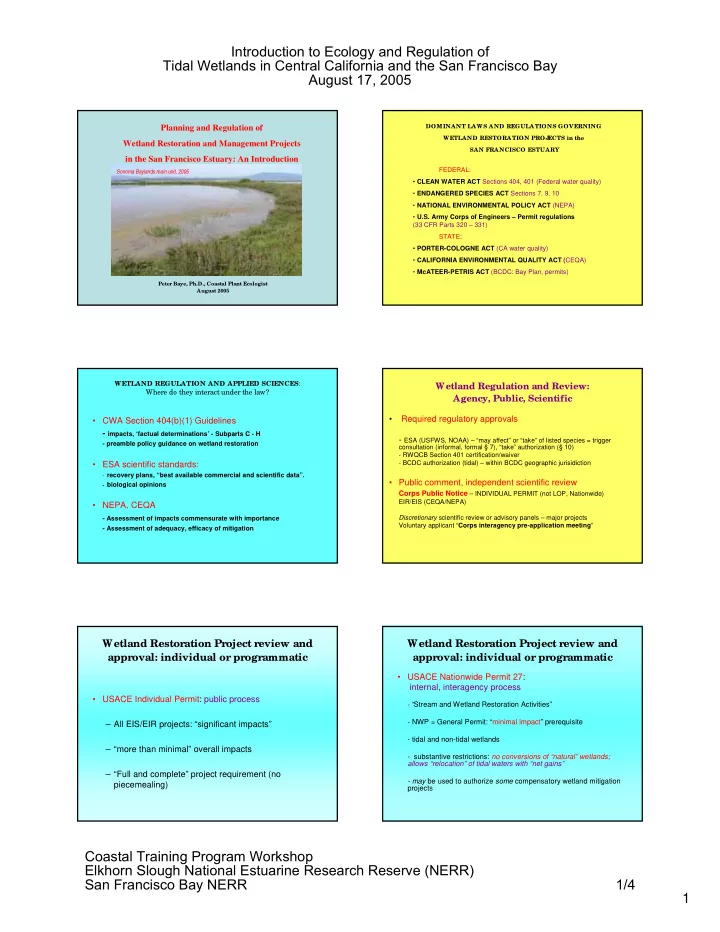
Planning and Regulation of Wetland Restoration and Management Projects in the San Francisco Estuary: An Introduction

Peter Baye, Ph.D., Coastal Plant Ecologist August 2005 Sonoma Baylands main unit, 2005

DOMINANT LAWS AND REGULATIONS GOVERNING WETLAND RESTORATION PROJ ECTS in the SAN FRANCISCO ESTUARY

FEDERAL:

  • CLEAN WATER ACT Sections 404, 401 (Federal water quality)
  • ENDANGERED SPECIES ACT Sections 7, 9, 10
  • NATIONAL ENVIRONMENTAL POLICY ACT (NEPA)
  • U.S. Army Corps of Engineers – Permit regulations

(33 CFR Parts 320 – 331) STATE:

  • PORTER-COLOGNE ACT (CA water quality)
  • CALIFORNIA ENVIRONMENTAL QUALITY ACT (CEQA)
  • McATEER-PETRIS ACT (BCDC: Bay Plan, permits)

WETLAND REGULATION AND APPLIED SCIENCES: Where do they interact under the law?

  • CWA Section 404(b)(1) Guidelines
  • impacts, ‘factual determinations’ - Subparts C - H
  • preamble policy guidance on wetland restoration
  • ESA scientific standards:
  • recovery plans, “best available commercial and scientific data”.
  • biological opinions
  • NEPA, CEQA
  • Assessment of impacts commensurate with importance
  • Assessment of adequacy, efficacy of mitigation

Wetland Regulation and Review: Agency, Public, Scientific

  • Required regulatory approvals
  • ESA (USFWS, NOAA) – “may affect” or “take” of listed species = trigger

consultation (informal, formal § 7), “take” authorization (§ 10)

  • RWQCB Section 401 certification/waiver
  • BCDC authorization (tidal) – within BCDC geographic jurisidiction
  • Public comment, independent scientific review

Corps Public Notice – INDIVIDUAL PERMIT (not LOP, Nationwide)

EIR/EIS (CEQA/NEPA) Discretionary scientific review or advisory panels – major projects Voluntary applicant “Corps interagency pre-application meeting”

Wetland Restoration Project review and approval: individual or programmatic

  • USACE Individual Permit: public process

– All EIS/EIR projects: “significant impacts” – “more than minimal” overall impacts – “Full and complete” project requirement (no piecemealing)

Wetland Restoration Project review and approval: individual or programmatic

  • USACE Nationwide Permit 27:

internal, interagency process

  • “Stream and Wetland Restoration Activities”
  • NWP = General Permit: “minimal impact” prerequisite
  • tidal and non-tidal wetlands
  • substantive restrictions: no conversions of “natural” wetlands;

allows “relocation” of tidal waters with “net gains”

  • may be used to authorize some compensatory wetland mitigation

projects

Introduction to Ecology and Regulation of Tidal Wetlands in Central California and the San Francisco Bay August 17, 2005 Coastal Training Program Workshop Elkhorn Slough National Estuarine Research Reserve (NERR) San Francisco Bay NERR 1/4

slide-2
SLIDE 2

2

Regulatory Agency jurisdiction

U.S. Army Corps of Engineers –

Fundamental federal jurisdiction test: commerce clause “may affect international or interstate commerce”

Rivers and Harbors Act § 10: all activities affecting reach and scope of “navigable waters of U.S” (e.g. breach); all work or structures below MHW (including unfilled diked sloughs) Clean Water Act § 404: Discharges of dredged or fill material in “waters of the U.S.”, including (jurisdictional) wetlands (Includes bay wetlands behind dikes, defined as “adjacent wetlands” – not “isolated”)

Regulatory Agency jurisdiction

  • CWA § 404 jurisdiction in practice:

nontidal ponds, pools, and “special aquatic sites” (with sufficient interstate commerce) below “ordinary high water line”. non-tidal wetlands (non-exempt) meeting appropriate 1987 Wetlands Delineation Manual criteria in “normal circumstances” (no violations of CWA), with sufficient interstate commerce. tidal wetlands, waters, and “special aquatic sites” (mudflats, marsh, other shorelines or waterbodies) below the plane of “High Tide Line” (non-surge extreme high tide; marked by indicators, not legally a tidal datum)

Regulatory Agency jurisdiction

  • CWA Section 404 “special aquatic sites”
  • triggers special protective presumptions, regulatory review
  • Sanctuaries and refuges
  • Wetlands (vegetated: marsh, swamps, etc.)
  • Mudflats (tidal and nontidal)
  • Vegetated shallows (submerged aquatic vegetation; e.g. Zostera,

Potamogeton, Stuckenia, Ruppia)

  • Riffle and pool complexes (freshwater streams)
  • (tropical coral reefs)

Regulatory Agency jurisdiction California state jurisdiction over wetlands

  • No explicit regulatory definition or criteria
  • Porter-Cologne authority is comprehensive: all waters of

state; discretionary assertion of wetland jurisdiction

  • In practice, because of a lack of autonomous wetland

delineation procedures or criteria, RWQCB and CEQA lead agencies normally defer to 1987 Corps Manual (Corps/NCRS approved delineations), without federal exemptions (?).

Regulatory Agency jurisdiction

  • Bay Conservation and Development Commission

(BCDC)

  • Jurisdiction over “salt ponds”
  • Jurisdiction (including wildlife-related public interest) over

all tidal reaches of San Francisco Bay

  • Limited “shoreline band” jurisdiction behind dikes; not

including wildlife-related public interest (emphasis on public access)

Regulatory Agency jurisdiction

U.S. Fish and Wildlife Service – Endangered Species Program (Sacramento)

Section 7 (FEDERAL INTERAGENCY) Consultation:

  • requires lead federal agency action (permit, project)
  • low threshold: “may affect”
  • INFORMAL consultation to determine whether “not

likely to adversely affect”, or likelihood of “take”

  • FORMAL consultation (biological opinion) with

“incidental take statement” (“take” authorization with “mandatory” terms and conditions) if “take” or “adverse effect” threshold is met.

Introduction to Ecology and Regulation of Tidal Wetlands in Central California and the San Francisco Bay August 17, 2005 Coastal Training Program Workshop Elkhorn Slough National Estuarine Research Reserve (NERR) San Francisco Bay NERR 2/4

slide-3
SLIDE 3

3

Regulatory Agency Discretion and Procedures U.S. Army Corps of Engineers

  • Public interest review (including mitigation)
  • Public comment
  • Resolution of resource agency policy or

permit conflicts

  • Compliance with CWA Section 404(b)(1)

– No “jeopardy” of listed species – No “significant degradation” of waters of U.S. – LEDPA: Least Environmentally Damaging Practicable Alternative (DESIGN, METHODS, SITE SELECTION within scope) – Mitigation to avoid, minimize, compensate for impacts – No violation of State Water Quality standards (401 cert./waiver)

Regulatory Agency Discretion and Procedures U.S. Fish and Wildlife Service

  • Issue technical assistance letter (species list) – optional
  • Issue “not likely/likely to adversely affect listed species”

letter in response to informal consultation

  • Issue formal biological opinion (formal consultation) 135

days after initiation with sufficient information. CALIFORNIA DEPARTMENT OF FISH AND GAME

  • No parallel state process for CESA biological opinion
  • Fish and Game Code “fully protected species” –

process?

Regulatory Agency Discretion and Procedures

NEPA (Federal lead agency – usually USACE)

EA/FoNSI

(Environmental Assessment/Finding of No Significant Impact)

  • limited public review, emphasis on internal process, brief assessment of

impacts, alternatives, mitigation. (often like checklist)

  • THRESHOLD: less than “SIGNIFICANT” IMPACT (positive or negative),

discretionary determination based on regulatory guidance factors (“context and intensity”

EIS (Environmental Impact Statement) – for “major construction projects”,

“significant” impacts

  • Public scoping (preliminary project description)
  • Must fully consider, compare alternatives (“heart” of EIS) aiming at less

impact, better harmony of natural resource use; substantially equal level of detail

  • Compare proposed project with “no action” baseline alternative
  • PUBLIC Draft, final; recirculate or supplement if defective
  • ROD (Record of Decision) – enforces compliance with mitigation (permit)

(cost: about $200,000 and higher; duration: one year or more)

Regulatory Agency Discretion and Procedures

CEQA

  • Based on NEPA

INITIAL STUDY/NEGATIVE DECLARATION

  • parallel with EA/FoNSI; often reduced to checklist approach, limited scientific assessment

ENVIRONMENTAL IMPACT REPORT

  • parallel with EIS; may be combined
  • Alternatives have less emphasis; mitigation is emphasis
  • Environmental baseline for impact assessment: normally “existing physical

conditions” (time of Notice of Preparation) – (may contrast with NEPA)

  • mandatory thresholds of significance (interpretation, data?) (may contrast with

NEPA)

  • “impact” defined as adverse (contrast with NEPA)
  • mandatory mitigation
  • many exemptions!

Wetland Restoration Projects: Regulatory Review and Design in Practice

Preliminary planning guidance:

San Francisco Bay Area Habitat Goals Project (1999)

  • Regional, subregional restoration goals; suggested possible projects; design
  • principles. Expressly NOT regulatory!...but relevant.
  • Companion volume: Species and Communities Profiles. Habitat requirements,

geographic range, restoration design factors, community composition

Endangered Species Recovery Plans (USFWS)

  • California Clapper Rail and Salt Marsh Harvest Mouse RP (1980)
  • Tidal Marsh Recovery Plan: Central and Northern California (2006?)
  • Western Snowy Plover, California Red-legged Frog RP

Design Guidelines for Tidal Wetland Restoration in San Francisco Bay (2005 – Philip Williams & Associates)

  • Bay Institute/California Coastal Conservancy Sponsored; peer reviewed
  • Emphasis on salt marsh restoration, PWA “house style” standard designs

Wetland Restoration Projects: Regulatory Review and Design in Practice

Learn from experience, but aim for scientifically sound innovation and improvement of wetland restoration.

  • Consider design precedents and restoration results:

useful or not useful? Agency decision precedents can resolve some

  • conflicts. Sometimes short, selective institutional memory.
  • Natural empirical model systems, reference systems with

broad ecological community objectives. Fit restoration project to

landscape setting.

  • Resilience, robustness of wetland restoration design;

idealized “ultimate” goals versus real-time real results

  • Artificial engineering for selected species as priority?
  • Preventive/adaptive invasive species management
  • Reconciling conflicting policy mandates through

restoration design (versus political process)

Introduction to Ecology and Regulation of Tidal Wetlands in Central California and the San Francisco Bay August 17, 2005 Coastal Training Program Workshop Elkhorn Slough National Estuarine Research Reserve (NERR) San Francisco Bay NERR 3/4

slide-4
SLIDE 4

4

Wetland Restoration Projects: Regulatory Review and Design in Practice

Some specific recurrent regulatory issues in restoration:

1. Avoid, minimize, compensate for existing habitat and species present on the restoration site. Can regional mosaics of

restoration projects compensate for loss of existing ecological functions, conservation values of specific restoration sites? Can surrogate or superior habitat be designed into restoration?

2. Avoid creation of “nuisance” habitat or populations – design

to minimize risks of inappropriate predator, invasive species

3. Design for realistic cost, materials, time constraints of site and project. Establish core restoration designs; guard against

escalation of amenity features that may conflict with basic restoration objectives in long term.

4. Balance physical and ecological engineering considerations in dynamic restoration designs.

Introduction to Ecology and Regulation of Tidal Wetlands in Central California and the San Francisco Bay August 17, 2005 Coastal Training Program Workshop Elkhorn Slough National Estuarine Research Reserve (NERR) San Francisco Bay NERR 4/4