The Puritas The Puritas Wetlands Wetlands A project of the - - PowerPoint PPT Presentation

the puritas the puritas
SMART_READER_LITE
LIVE PREVIEW

The Puritas The Puritas Wetlands Wetlands A project of the - - PowerPoint PPT Presentation

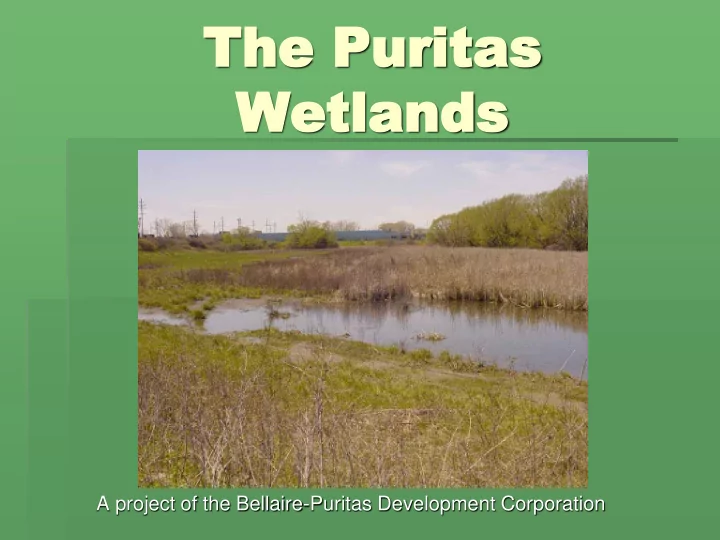
The Puritas The Puritas Wetlands Wetlands A project of the Bellaire-Puritas Development Corporation What are the Puritas What are the Puritas Wetla Wetlands? nds? 80 acre-detention basin lying in the Big Creek watershed approximately

slide-1
SLIDE 1

The Puritas The Puritas Wetlands Wetlands

A project of the Bellaire-Puritas Development Corporation

slide-2
SLIDE 2

What are the Puritas What are the Puritas Wetla Wetlands? nds?

  • 80 acre-detention basin lying in the Big Creek

watershed approximately two miles south of Lake Erie

  • located in the heart of the City of Cleveland bordered

by residential and light industrial properties

  • Home to the American Agricultural Chemical Company

until 1970, a commercial fertilizer plant

  • Today, it is a man-made channel designed to direct

stormwater runoff away from contiguous commercial, residential, and light industrial properties, as well as I- 480.

slide-3
SLIDE 3

The Puritas The Puritas Wetlands Wetlands

slide-4
SLIDE 4

The Puritas The Puritas Wetlands Wetlands

Land Use Categories: Residential = Yellow Retail = Red Industrial = Blue

slide-5
SLIDE 5

What What makes makes the the Puritas Puritas Wetlands Wetlands unique? unique?

  • The Puritas Wetlands has a robust ecological

character given its urban setting.

  • Over 138 avian species have been catalogued

at the site including the endangered Ohio yellow-bellied sapsucker, the olive-sided flycatcher, the American bittern and Wilson’s snipe.

  • Over 66 plant species have been catalogued at

the site including a county record for presence

  • f sundrops and a rare occurrence of the

whorled milkweed.

slide-6
SLIDE 6

Kestrel Goldfinch

Yellow-bellied Sapsucker

slide-7
SLIDE 7

American Bittern Wilson’s Snipe

slide-8
SLIDE 8

Sun drops

Whorled milkweed Vervain

slide-9
SLIDE 9

How How did did the the project project start? start?

  • Bill Oatey, chairman of the local plumbing products

manufacturer Oatey Co. that borders the Puritas wetlands, was the first to call attention to the wildlife activity at the site and engage the Wildlife Habitat Council.

  • In 2005 the Cleveland Museum of Natural History

surveyed and catalogued the bird and plant species in the basin.

  • In early 2005 key partners met to begin planning efforts

around enhancing and preserving the existing conditions in the basin, and to eventually offer passive learning and recreation opportunities at the site.

  • In a November 2005 a public meeting was held to

share our planning ideas with the community. We received full support for the project.

slide-10
SLIDE 10

Who are Who are the key the key project project partn partners? ers?

  • Bellaire-Puritas Development

Corporation

  • City of Cleveland Planning Department
  • City of Cleveland Division of Water

Pollution Control

  • Cleveland Museum of Natural History
  • Wildlife Habitat Council
  • Cuyahoga River Remedial Action Plan
slide-11
SLIDE 11

What have w What have we done so e done so far? far?

  • We received a $10,000 grant from the

National Fish and Wildlife Foundation.

  • We attempted to spray targeted portions
  • f the basin to control invasive plants,

and free up greater growth of native, non- invasive species.

  • On April 25, 2008 we held a spring

planting day at the site.

slide-12
SLIDE 12

Spring Spring 2008 P 2008 Planting Day lanting Day

slide-13
SLIDE 13

The Puritas The Puritas Wetlands Wetlands Septe September mber 200 2008

slide-14
SLIDE 14

What is What is next for the next for the Purit Puritas as Wetla Wetlands? nds?

  • We are planning a second planting day.
  • We are seeking additional funding for

educational enhancements to the site such as interpretive signage and informational kiosks.

  • We are looking for a location at the site to

add the passive learning and recreation space.

slide-15
SLIDE 15

What are our current What are our current cha challeng llenges? es?

  • Location, location, location…
  • The actual basin is owned by the City of Cleveland,

and falls under the Division of Water Pollution Control, thus limiting individual access to the site for educational or recreational purposes.

  • There is always the threat that publicly held land

can be sold to private developers if proper measures are not taken to preserve the area.

  • Access to the site is also limited because the land

surrounding the basin is primarily private property

  • wned by either residents or industries.
slide-16
SLIDE 16

Thank You! Thank You!

Olive-sided flycatcher