SLIDE 1
Enabling low cost tidal energy.
Andrew Scott Chief Executive Officer Scotrenewables Tidal Power Limited
SLIDE 2
SLIDE 3
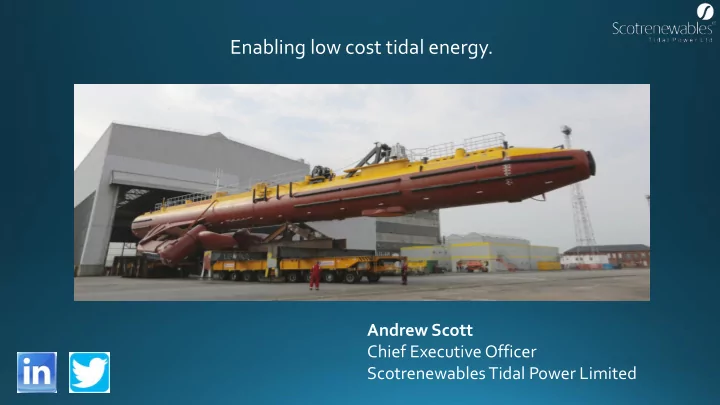
World’s largest tidal turbine – 2MW. Launched May 2016. 2 x 1MW nacelles with 16m rotor diameters. Stall regulated control. 500T turbine mass.
SLIDE 4 De- risk project economics by removing dependency on high spec, high cost, low availability specialist vessels. Complete precision turbine construction, assembly and commissioning in controlled environment. Remove offshore heavy lifts and high tolerance interfaces in offshore construction work and offshore
SLIDE 5
All site construction work and installation for SR1-2000 completed by multi-cat vessels. SR1-2000 capable of quick installation and recovery from site (in under 30 minutes) using multi- cat vessels. Modular fabrication based around low cost steel structure using standard manufacturing equipment and infrastructure. Use of available products engaged OEM’s in critical drive train components.
SLIDE 6 Maximise generator uptime by enabling rapid maintenance interventions informed by comprehensive condition monitoring and carried
- ut by locally based service team.
Reduce OPEX with use of low cost, high availability, locally stationed vessels. Maximise turbine accessibility via marine
- perations and turbine design.
SLIDE 7
Majority of turbine equipment and auxiliary systems located in hull. Hull accessible quickly via RIB at low costs (crew transit time <1hr @ EMEC). Hull accessibility demonstrated in up to 2m significant wave height therefore accessible 90%+ of the year (@ EMEC).
SLIDE 8
Vast database for MTBF of all major components in analogous applications. Demonstrated consequential costs and losses from components and systems responsible for most frequent outages and (cumulatively) longest outages.
Inverter module failure. Turbine shut down. Swapped out via RIB access within 24hrs of intervention decision whilst turbine remained on site. Turbine re-commissioned and generating within 36hr. Electrical drive and control faults. Most commonly occurring generic fault category resulting in most downtime for offshore wind turbines. Demonstrated time to reset/resolve for SR1-2000: less than 12hrs turbine downtime using RIB style vessels. Dynamic cable re-splice. Non-standard cable repair requiring turbine shut down. Single multi-cat vessel intervention to cut and re-splice subsea cable joint. Completed in less than 48hrs from vessel mobilisation in up to 1.5m Hs sea conditions. Total costs under £50k.
SR1-2000 DEMONSTRATED MAINTENANCE CASE STUDIES
SLIDE 9 Thrust and mooring loads in close correlation to simulations = good numerical characterisation of system at large scale. Ultimate mooring loads driven by controllable generation thrust (i.e. highly survivable in storm conditions). Dynamic loading variation due to surface waves manageable for generation across ~97% of annual occurrence (@ EMEC).
Measured vs Predicted Dynamic Mooring Load with turbine operating at 1MW in waves of Hs = 1.2, Tp = 8s opposing of tide of 2.3m/s
SLIDE 10
Increase generator yield by positioning rotors in fastest flow regions near the surface.
SLIDE 11
Extensive academic and industrial understanding of rotor performance. Developed industry computational models for validating yield performance. Existing sensors capable of accurately characterising and monitoring resource.
SLIDE 12
2.2MW peak output.
SLIDE 13
2.2MW peak output. 20MWh+ in 24hrs generation = 41% capacity factor.
SLIDE 14
2.2MW peak output. 20MWh+ in 24hrs generation = 41% capacity factor. 125MWh in 7 days of continuous generation = 37% capacity factor.
SLIDE 15
2.2MW peak output. 20MWh+ in 24hrs generation = 41% capacity factor. 125MWh in 7 days of continuous generation = 37% capacity factor. Provided 7%+ of entire Orkney electricity demand over 1 week of continuous generation.
SLIDE 16
2.2MW peak output. 20MWh+ in 24hrs generation = 41% capacity factor. 125MWh in 7 days of continuous generation = 37% capacity factor. Provided 7%+ of entire Orkney electricity demand over 1 week of continuous generation. Predictable source of generation.
SLIDE 17
2.2MW peak output. 20MWh+ in 24hrs generation = 41% capacity factor. 125MWh in 7 days of continuous generation = 37% capacity factor. Provided 7%+ of entire Orkney electricity demand over 1 week of continuous generation. Predictable source of generation. 0.75GWh+ and ongoing.
SLIDE 18
SLIDE 19
www.scotrenewables.com