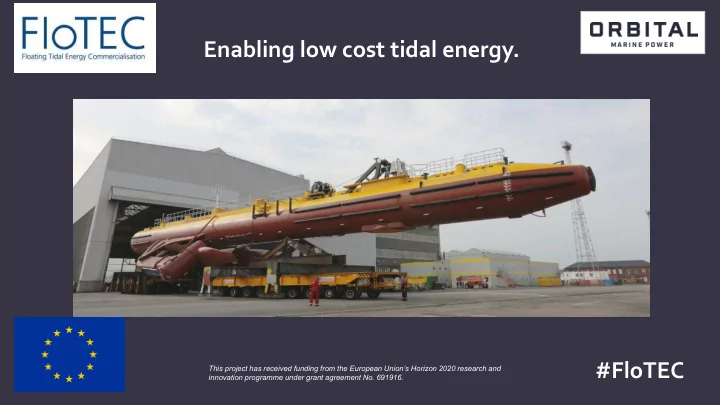
SLIDE 1 Enabling low cost tidal energy. #FloTEC
This project has received funding from the European Union’s Horizon 2020 research and innovation programme under grant agreement No. 691916.
SLIDE 2 Company incorporated: 2002 First major investment: 2006 Further major investment: 2008 World’s first grid connected floating tidal turbine: 2011 Further major investment: 2012, 2014 and 2015 Awarded flagship Horizon 2020 funding World’s largest tidal turbine starts
Company Headquarters: Kirkwall, Orkney Edinburgh office Grid connected test facility: European Marine Energy Centre
15 years focused on engineering and testing the worlds most advanced floating tidal technology. 100 years+ accumulated engineering and operational experience. 26 staff covering technical, commercial and administration. Targeted patents granted and filed on key controlling IP. £30 million invested to date (including c.£6 million grant funding).
SLIDE 3
World’s largest operating tidal turbine – 2MW. 2 x 1MW nacelles with 16m rotor diameters. Stall regulated control. 500T turbine mass.
SLIDE 4
Standard Tidal Turbine Designs
SLIDE 5 Increase generator yield by positioning rotors in fastest flow regions near the surface.
50% depth Power distribution (P ∝ V3)
2/3 of total power in upper half of water column 1/3 of total power in lower half of water column
Current velocity profile
Greater turbulence and less power available closer to seabed
SLIDE 6
No dependency on high cost specialist construction vessels. Manufacturing process analogous to ship building. Simplified offshore operations involving moorings and cable installation.
SLIDE 7
Maximise generator uptime by enabling fast response maintenance interventions. Minimise cost of repairs and service vessels via turbine design and marine operations.
SLIDE 8 Inverter module failure. Turbine shut down. Swapped out via RIB access within 24hrs of intervention decision whilst turbine remained on site. Turbine re-commissioned and generating within 36hr. Electrical drive and control faults. Most commonly occurring generic fault category resulting in most downtime for offshore wind turbines. Demonstrated time to reset/resolve for SR1-2000: less than 12hrs turbine downtime using RIB style vessels. Dynamic cable re-splice. Non-standard cable repair requiring turbine shut down. Single multi-cat vessel intervention to cut and re-splice subsea cable joint. Completed in less than 48hrs from vessel mobilisation in up to 1.5m Hs sea conditions. Total costs under £50k.
SR1-2000 DEMONSTRATED MAINTENANCE CASE STUDIES Majority of turbine equipment and auxiliary systems located in hull. Hull accessible quickly via RIB at low costs (crew transit time <1hr @ EMEC). Hull accessibility demonstrated in up to 2m significant wave height (therefore accessible 90%+
SLIDE 9
Ultimate mooring loads driven by controllable thrust generation (i.e. highly survivable in storm conditions). Loading variation due to surface waves manageable for generation across wide range of conditions.
SLIDE 10
2.2MW peak output. Best single tide = 6.3MWh. 21.7MWh+ in 24hrs generation = 45% capacity factor. 130MWh in 7 days of continuous generation = 39% capacity factor.
SLIDE 11
2.2MW peak output. Best single tide = 6.3MWh. 21.7MWh+ in 24hrs generation = 45% capacity factor. 130MWh in 7 days of continuous generation = 39% capacity factor. Provided 7%+ of entire Orkney electricity demand over 1 week of continuous generation.
SLIDE 12
2.2MW peak output. Best single tide = 6.3MWh. 21.7MWh+ in 24hrs generation = 45% capacity factor. 130MWh in 7 days of continuous generation = 39% capacity factor. Provided 7%+ of entire Orkney electricity demand over 1 week of continuous generation. Predictable source of generation.
SLIDE 13
2.2MW peak output. Best single tide = 6.3MWh. 21.7MWh+ in 24hrs generation = 45% capacity factor. 130MWh in 7 days of continuous generation = 39% capacity factor. Provided 7%+ of entire Orkney electricity demand over 1 week of continuous generation. Predictable source of generation. 450+ days on moorings. 380 days onsite in current install. 6,000hrs generation per nacelle. 3.2GWh+
SLIDE 14 Concept Design (FEED) Objectives Lessons Learned Business Strategy Product Specification
Target Lowest Levelised Cost of Energy
FloTEC target = <£200/MWh 1st Arrays target = £150 - £180/MWh 100MW target = £120 - £150/MWh
SLIDE 15 50 100 150 200 250 300 350
£/ MWh Awarded contracts Scotrenewables forecast
Worldwide CfD Strike Prices
reduction trajectory rapidly towards cost parity with
renewable generation sources.
- 100MW built capacity brings costs to
a level comparable with currently
- perating offshore wind capacity
awards of c.£150 / MWh.
build
that lands the Scotrenewables technology at £100 / MWh.
- The industry partners that deliver
the initial projects will be best placed to capture long term benefits from rapidly expanding global markets.
SLIDE 16 Enabling market for low cost tidal energy. #FloTEC
This project has received funding from the European Union’s Horizon 2020 research and innovation programme under grant agreement No. 691916.
SLIDE 17 Generation
#FloTEC
This project has received funding from the European Union’s Horizon 2020 research and innovation programme under grant agreement No. 691916.
SLIDE 18
SLIDE 19
Manufacture
SLIDE 20
Legs attached above the waterline with all hull penetrations and leg actuation system above the waterline. Legs hinged axially to present nacelles and pitch hubs to surface for servicing at same time as improving structural load-paths. 360⁰ blade pitching allows for simplified forward and aft mooring arrangement and improved yield.
Key Innovations
SLIDE 21
www.flotectidal.eu
This project has received funding from the European Union’s Horizon 2020 research and innovation programme under grant agreement No. 691916.