
Computer Science & Engineering 423/823 Design and Analysis of Algorithms
Lecture 05 — Single-Source Shortest Paths (Chapter 24) Stephen Scott (Adapted from Vinodchandran N. Variyam) sscott@cse.unl.edu
Introduction
I Given a weighted, directed graph G = (V , E) with weight function
w : E ! R
I The weight of path p = hv0, v1, . . . , vki is the sum of the weights of its
edges: w(p) =
k
X
i=1
w(vi1, vi)
I Then the shortest-path weight from u to v is
(u, v) = ( min{w(p) : u
p
v} if there is a path from u to v 1
- therwise
I A shortest path from u to v is any path p with weight w(p) = (u, v) I Applications: Network routing, driving directions
Types of Shortest Path Problems
Given G as described earlier,
I Single-Source Shortest Paths: Find shortest paths from source node
s to every other node
I Single-Destination Shortest Paths: Find shortest paths from every
node to destination t
I Can solve with SSSP solution. How?
I Single-Pair Shortest Path: Find shortest path from specific node u to
specific node v
I Can solve via SSSP; no asymptotically faster algorithm known
I All-Pairs Shortest Paths: Find shortest paths between every pair of
nodes
I Can solve via repeated application of SSSP, but can do better
Optimal Substructure of a Shortest Path
The shortest paths problem has the optimal substructure property: If p = hv0, v1, . . . , vki is a SP from v0 to vk, then for 0 i j k, pij = hvi, vi+1, . . . , vji is a SP from vi to vj Proof: Let p = v0
p0i
vi
pij
vj
pjk
vk with weight w(p) = w(p0i) + w(pij) + w(pjk). If there exists a path p0
ij from vi to vj
with w(p0
ij) < w(pij), then p is not a SP since v0 p0i
vi
p0
ij
vj
pjk
vk has less weight than p
Negative-Weight Edges (1)
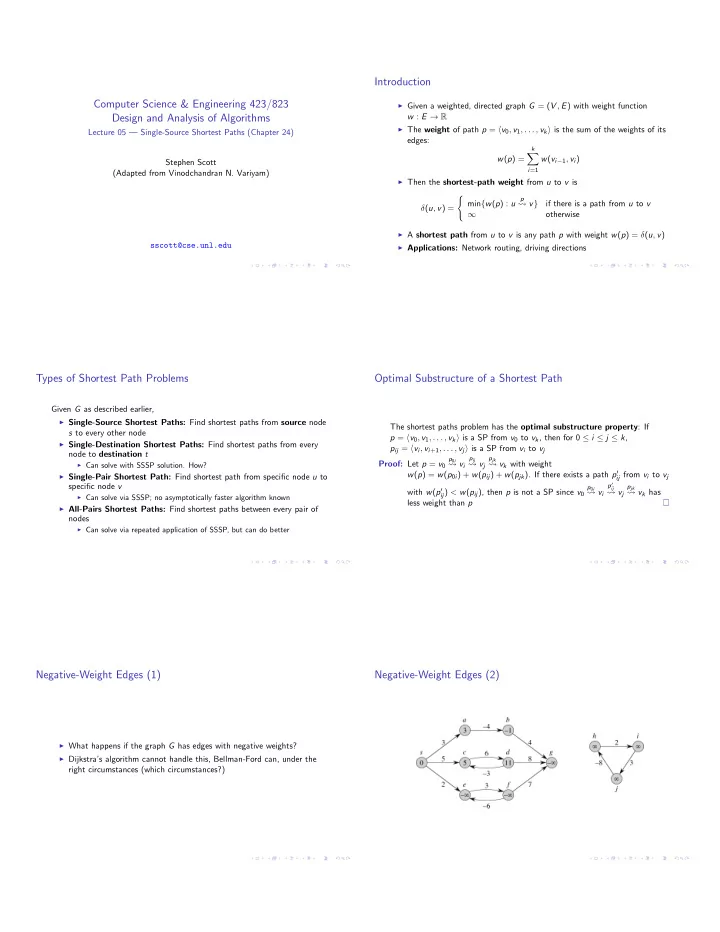
I What happens if the graph G has edges with negative weights? I Dijkstra’s algorithm cannot handle this, Bellman-Ford can, under the
right circumstances (which circumstances?)
Negative-Weight Edges (2)