
CSCE423/823 Introduction Finding Minimum and Maximum Selection of Arbitrary Order Statistic
Computer Science & Engineering 423/823 Design and Analysis of Algorithms
Lecture 01 — Medians and Order Statistics (Chapter 9) Stephen Scott (Adapted from Vinodchandran N. Variyam) Spring 2012
1 / 24 CSCE423/823 Introduction Finding Minimum and Maximum Selection of Arbitrary Order Statistic
Introduction
Given an array A of n distinct numbers, the ith order statistic of A is its ith smallest element
i = 1 ) minimum i = n ) maximum i = b(n + 1)/2c ) (lower) median
E.g. if A = [8, 5, 3, 10, 4, 12, 6] then min = 3, max = 12, median = 6, 3rd order stat = 5 Problem: Given array A of n elements and a number i 2 {1, . . . , n}, find the ith order statistic of A There is an obvious solution to this problem. What is it? What is its time complexity?
Can we do better? What if we only focus on i = 1 or i = n?
2 / 24 CSCE423/823 Introduction Finding Minimum and Maximum Selection of Arbitrary Order Statistic
Finding Minimum
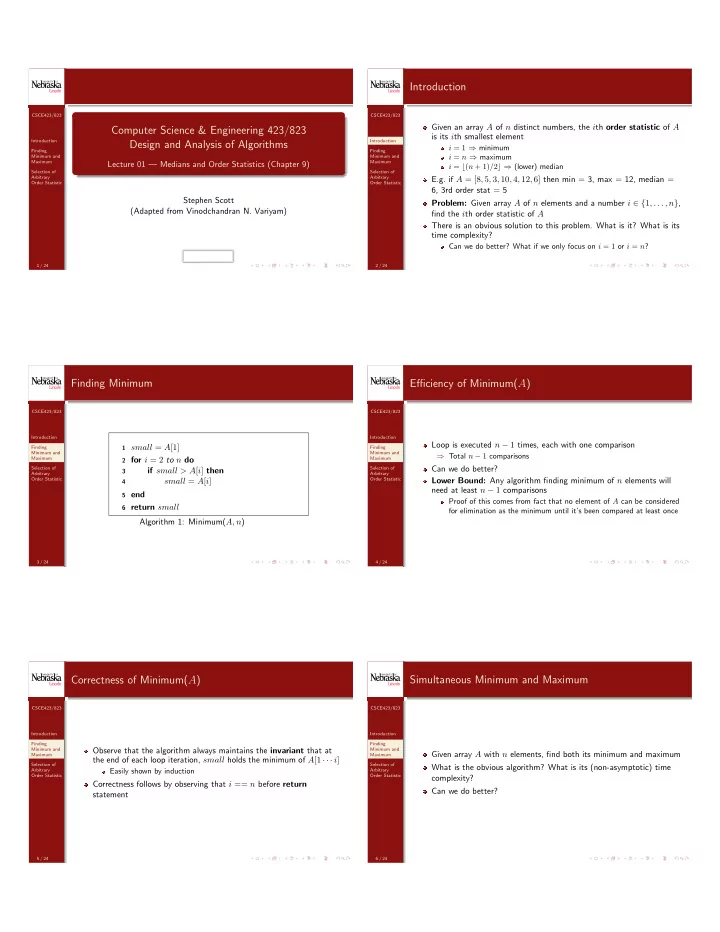
small = A[1]
1
for i = 2 to n do
2
if small > A[i] then
3
small = A[i]
4
end
5
return small
6
Algorithm 1: Minimum(A, n)
3 / 24 CSCE423/823 Introduction Finding Minimum and Maximum Selection of Arbitrary Order Statistic
Efficiency of Minimum(A)
Loop is executed n 1 times, each with one comparison
) Total n 1 comparisons
Can we do better? Lower Bound: Any algorithm finding minimum of n elements will need at least n 1 comparisons
Proof of this comes from fact that no element of A can be considered for elimination as the minimum until it’s been compared at least once
4 / 24 CSCE423/823 Introduction Finding Minimum and Maximum Selection of Arbitrary Order Statistic
Correctness of Minimum(A)
Observe that the algorithm always maintains the invariant that at the end of each loop iteration, small holds the minimum of A[1 · · · i]
Easily shown by induction
Correctness follows by observing that i == n before return statement
5 / 24 CSCE423/823 Introduction Finding Minimum and Maximum Selection of Arbitrary Order Statistic
Simultaneous Minimum and Maximum
Given array A with n elements, find both its minimum and maximum What is the obvious algorithm? What is its (non-asymptotic) time complexity? Can we do better?
6 / 24