Order Statistics on Binary Trees Goal: find the k th element (in - - PowerPoint PPT Presentation

order statistics on binary trees
SMART_READER_LITE
LIVE PREVIEW

Order Statistics on Binary Trees Goal: find the k th element (in - - PowerPoint PPT Presentation

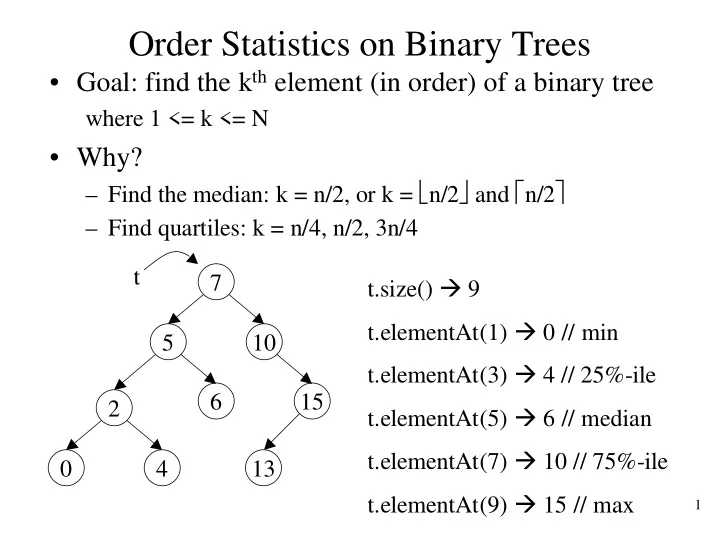
Order Statistics on Binary Trees Goal: find the k th element (in order) of a binary tree where 1 <= k <= N Why? Find the median: k = n/2, or k = n/2 and n/2 Find quartiles: k = n/4, n/2, 3n/4 t 7 t.size()


slide-1
SLIDE 1

1

Order Statistics on Binary Trees

  • Goal: find the kth element (in order) of a binary tree

where 1 <= k <= N

  • Why?

– Find the median: k = n/2, or k = n/2 and n/2 – Find quartiles: k = n/4, n/2, 3n/4 7 5 10 2 4 15 13 t.size() 9 t.elementAt(1) 0 // min t.elementAt(3) 4 // 25%-ile t.elementAt(5) 6 // median t.elementAt(7) 10 // 75%-ile t.elementAt(9) 15 // max t 6

slide-2
SLIDE 2

2

Maintaining Order Information

  • Keep count tree sizes at each node

– Update whenever tree is modified (easy) 7 5 10 2 4 15 13 t 6

9 5 3 1 3 1 1 1 2

slide-3
SLIDE 3

3

Using Order Information

  • Searching for kth element:

– If k == left.size + 1, return data – If k < left.size + 1, search for kth element in left subtree – If K > left.size + 1, search for (k-left.size-1)th element in right sub-tree 7 5 10 2 4 15 13 t 6

9 5 3 1 3 1 1 1 2

slide-4
SLIDE 4

4

Structural Induction

  • We saw induction on natural numbers:

Proof that property P holds for all natural numbers n

– base case: P(0) – inductive hypothesis: Suppose P(n) holds – inductive case: P(n + 1)

  • Natural numbers have an inductive definition:

– base case: 0 is a natural number – inductive case: if n is a natural number, so is n + 1 – (and nothing else is a natural number, except those things created using these two rules)

  • Coincidence?
slide-5
SLIDE 5

5

Structural Induction

  • We can generalize this to other structures that have

an inductive definition

  • E.g., a full binary tree can be defined as follows:

– base case: make_tree(data) is a f-b-tree (consisting of one leaf node having given data) – inductive case: if left and right are f-b-trees, so is make_tree(left, right, data) (consisting of one internal node having given data and given left and right subtrees) – (and nothing else is a f-b-tree except those things created using these two rules) – (in particular, can’t have empty f-b-tree)

  • How to do induction on these things?
slide-6
SLIDE 6

6

Tree Induction

  • Prove the following property for every f-b-tree

P(t) : # leaf nodes in t = # internal nodes in t + 1

  • Base case: P(make_tree(data))
  • Inductive Hypothesis: Suppose P(left) and P(right)

hold

  • Inductive Case: P(make_tree(left, right, data))
slide-7
SLIDE 7

7

Structural Induction

  • Now we can prove (inductively) properties about all

sorts of (inductively defined) things:

– Natural Numbers, Rational Numbers, Real Numbers – Trees, BSTs, Linked Lists, Doubly-linked lists, etc. – Expressions (e.g. E : integer | E + E) – Java programs, methods, classes, etc.

  • Ain’t induction grand?