Introducing Eclipse Plug-ins Eclipse Standard Widget Toolkit - - PDF document

introducing
SMART_READER_LITE
LIVE PREVIEW

Introducing Eclipse Plug-ins Eclipse Standard Widget Toolkit - - PDF document

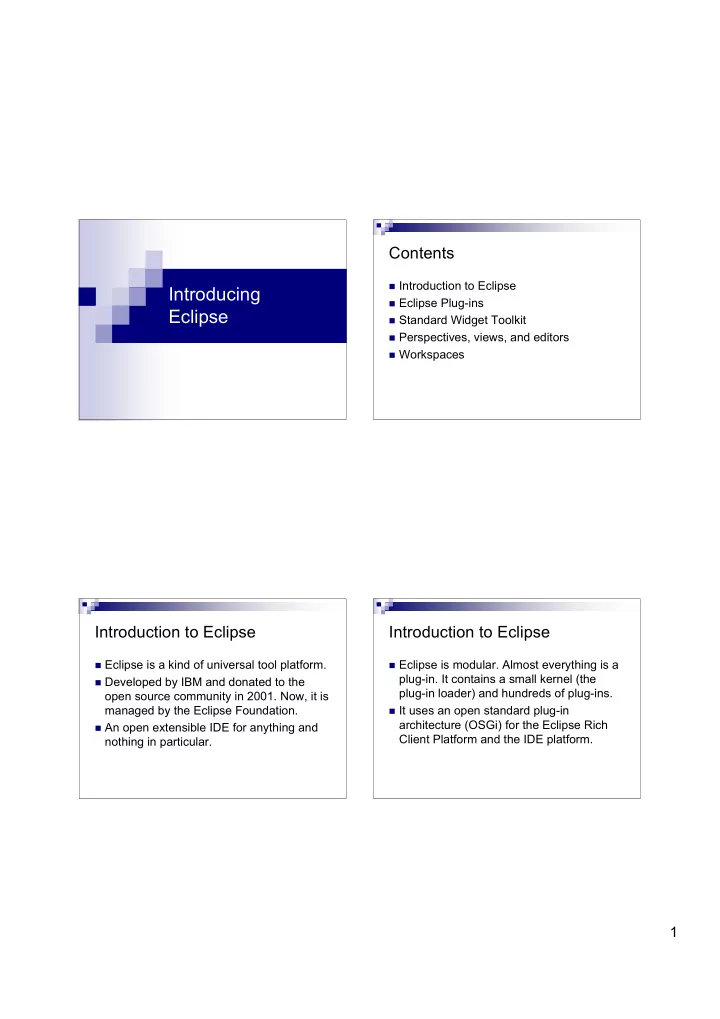
Contents Introduction to Eclipse Introducing Eclipse Plug-ins Eclipse Standard Widget Toolkit Perspectives, views, and editors Workspaces Introduction to Eclipse Introduction to Eclipse Eclipse is a kind of universal tool


slide-1
SLIDE 1

1

Introducing Eclipse

Contents

 Introduction to Eclipse  Eclipse Plug-ins  Standard Widget Toolkit  Perspectives, views, and editors  Workspaces

Introduction to Eclipse

 Eclipse is a kind of universal tool platform.  Developed by IBM and donated to the

  • pen source community in 2001. Now, it is

managed by the Eclipse Foundation.

 An open extensible IDE for anything and

nothing in particular.

Introduction to Eclipse

 Eclipse is modular. Almost everything is a

plug-in. It contains a small kernel (the plug-in loader) and hundreds of plug-ins.

 It uses an open standard plug-in

architecture (OSGi) for the Eclipse Rich Client Platform and the IDE platform.

slide-2
SLIDE 2

2

Eclipse Plug-ins

 Programming languages: PHP, Perl,

Ruby, Mathematica, etc.

 Typesetting: Latex, HTML  Network: SSH client, VNC viewer  Games: Minesweeper, Tetris

Standard Widget Toolkit

 Eclipse utilizes the Standard Widget

Toolkit (SWT), a graphical widget toolkit for Java that uses the native GUI libraries

  • f the underlying operating systems.

 Pros: fast, native look and feel, small

system resource usage.

 Cons: platform specific, not really portable.

Perspectives, views, and editors

 A perspective is a saved layout containing

any number of different editors and views.

 Eclipse ships with a number of default

perspectives (Resource, Java, Debug, etc.) that can be customized, or you can create completely new perspectives.

 Only one perspective is visible at any time.

slide-3
SLIDE 3

3

Perspectives, views, and editors

 Views are typically used to navigate

resources and modify properties of a resource.

 Editors are used to view or modify a

specific resource and follow the common

  • pen-save-close model.

Perspectives, views, and editors

 Only a single instance of any one view can

be open in a given perspective.

 The currently active view or editor has its

title bar highlighted. This is the view or editor that will be the recipient of any global actions such as cut, copy, or paste.

Workspaces

 The Eclipse IDE displays and modifies

files located in a workspace. The workspace is a directory hierarchy containing both user files such as projects, source code, and so on, and plug-in state information such as preferences.

 One user can have multiple workspaces.