Outline Naive Credal Classifier 2: an extension of Naive Bayes - - PDF document

outline naive credal classifier 2 an extension of naive
SMART_READER_LITE
LIVE PREVIEW

Outline Naive Credal Classifier 2: an extension of Naive Bayes - - PDF document

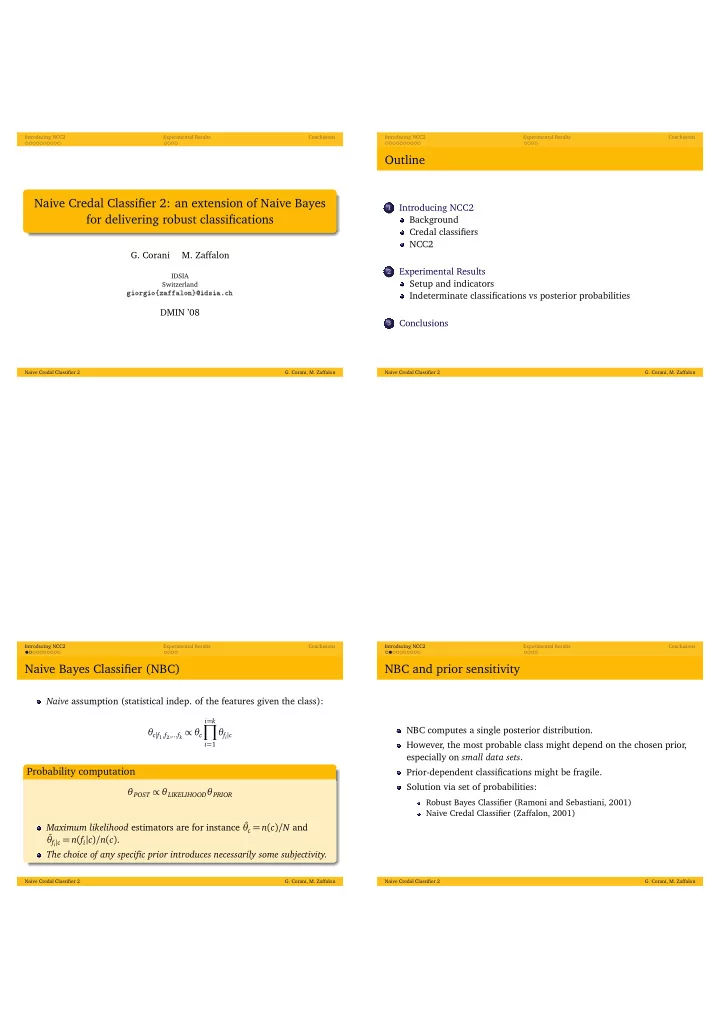
Introducing NCC2 Experimental Results Conclusions Introducing NCC2 Experimental Results Conclusions Outline Naive Credal Classifier 2: an extension of Naive Bayes Introducing NCC2 1 for delivering robust classifications Background Credal


slide-1
SLIDE 1

Introducing NCC2 Experimental Results Conclusions

Naive Credal Classifier 2: an extension of Naive Bayes for delivering robust classifications

  • G. Corani
  • M. Zaffalon

IDSIA Switzerland

❣✐♦r❣✐♦④③❛❢❢❛❧♦♥⑥❅✐❞s✐❛✳❝❤

DMIN ’08

Naive Credal Classifier 2

  • G. Corani, M. Zaffalon

Introducing NCC2 Experimental Results Conclusions

Outline

1

Introducing NCC2 Background Credal classifiers NCC2

2

Experimental Results Setup and indicators Indeterminate classifications vs posterior probabilities

3

Conclusions

Naive Credal Classifier 2

  • G. Corani, M. Zaffalon

Introducing NCC2 Experimental Results Conclusions

Naive Bayes Classifier (NBC)

Naive assumption (statistical indep. of the features given the class): θc|f1,f2,...fk ∝ θc

i=k

  • i=1

θfi|c

Probability computation

θ POST ∝ θ LIKELIHOODθ PRIOR Maximum likelihood estimators are for instance ˆ θc = n(c)/N and ˆ θfi|c = n(fi|c)/n(c). The choice of any specific prior introduces necessarily some subjectivity.

Naive Credal Classifier 2

  • G. Corani, M. Zaffalon

Introducing NCC2 Experimental Results Conclusions

NBC and prior sensitivity

NBC computes a single posterior distribution. However, the most probable class might depend on the chosen prior, especially on small data sets. Prior-dependent classifications might be fragile. Solution via set of probabilities:

Robust Bayes Classifier (Ramoni and Sebastiani, 2001) Naive Credal Classifier (Zaffalon, 2001)

Naive Credal Classifier 2

  • G. Corani, M. Zaffalon
slide-2
SLIDE 2

Introducing NCC2 Experimental Results Conclusions

Naive Credal Classifier (NCC) (Zaffalon, 2001)

Extends Naive Bayes to imprecise probabilities; it specifies a set of priors by adopting the Imprecise Dirichlet Model. The set of priors is turned into a set of posteriors set via Bayes’ rule. NCC returns the classes that are non-dominated within the set of posteriors.

Naive Credal Classifier 2

  • G. Corani, M. Zaffalon

Introducing NCC2 Experimental Results Conclusions

Test of dominance and indeterminate classifications

Definition

Class c1 dominates c2 if P(c1) > P(c2) in any distribution of the posterior credal set. If no class dominates c1, then c1 is non-dominated. If there are more non-dominated classes, NCC returns all of them: the classification is indeterminate. NCC becomes indeterminate on the instances whose classification would be prior-dependent with NBC. Indeterminate classifications proofed to be viable in real world case studies (e.g., dementia diagnosis).

Naive Credal Classifier 2

  • G. Corani, M. Zaffalon

Introducing NCC2 Experimental Results Conclusions

Incomplete data sets

Most classifiers (including NBC) ignore missing data. This is correct only if data are missing-at-random (MAR). It is not possible to test the MAR hypothesis on the incomplete data. However, ignoring Non-MAR missing data can lead to unreliable conclusions. Missing data can be MAR for some features but not for some others;

  • r can be MAR only in training and not in testing (or vice versa).

Naive Credal Classifier 2

  • G. Corani, M. Zaffalon

Introducing NCC2 Experimental Results Conclusions

NCC2: NCC with conservative treatment of missing data (I)

NCC2 receives the declaration of which features have Non-MAR missing data and at which stage (learning, testing or both). NCC2 ignores MAR missing data. NCC2 deals conservatively with Non-MAR missing data.

Conservative treatment of missing data (learning set)

All possible completions of missing data are seen as possible. A set of likelihoods is computed. A set of posteriors is computed from a set of priors and a set of likelihoods. The conservative treatment of missing data can generate additional indeterminacy.

Naive Credal Classifier 2

  • G. Corani, M. Zaffalon
slide-3
SLIDE 3

Introducing NCC2 Experimental Results Conclusions

NCC2: NCC with conservative treatment of missing data (II)

Conservative treatment of missing data in the instance to be classified

All possible completions of missing data are seen as possible, thus giving rise to several virtual instances. Test of dominance: c1 should dominate c2 on all the virtual instances. A procedure allows to find out the dominance relationships without actually building the virtual instances. Conservative treatment of missing data in the instance to classify can generate additional indeterminacy.

Naive Credal Classifier 2

  • G. Corani, M. Zaffalon

Introducing NCC2 Experimental Results Conclusions

What to expect from NCC2

By adopting imprecise probabilities, NCC2 is designed to be robust to: prior specification, especially critical on small data sets; Non-MAR missing data, critical on incomplete data sets. However, excessive indeterminacy is undesirable.

What to expect from indeterminate classifications

To preserve NCC2 reliability, avoiding too strong conclusions (a single class) on doubtful instances. To convey sensible information, dropping unlikely classes.

Naive Credal Classifier 2

  • G. Corani, M. Zaffalon

Introducing NCC2 Experimental Results Conclusions

Indicators of performance for NCC2

NCC2

determinacy (% of determinate classifications); single-accuracy (% of determ. classification that are accurate); set-accuracy (% of indeterm. classifications that contain the true class); size of indeterminate output, i.e., avg. number of classes returned when indeterminate.

Naive Credal Classifier 2

  • G. Corani, M. Zaffalon

Introducing NCC2 Experimental Results Conclusions

Indicators for comparing NBC and NCC2

NCC2 vs NBC

NBC(NCC2 D): accuracy of NBC on instances determinately classified by NCC2. NBC(NCC2 I): accuracy of NBC on instances indeterminately classified by NCC2. We expect NBC(NCC2 D) > NBC(NCC I).

Naive Credal Classifier 2

  • G. Corani, M. Zaffalon
slide-4
SLIDE 4

Introducing NCC2 Experimental Results Conclusions

Experimental setting

18 UCI complete data sets (numerical features are discretized).

MAR setting

Each observation (apart from the class) is turned into missing with 5% probability. All features declared MAR for NCC2. pippo

Non-MAR setting

Split the categories of each feature into two halves. Turn into missing with probability 5% the observations falling only in the first half values. All features declared Non-MAR for NCC2.x

Naive Credal Classifier 2

  • G. Corani, M. Zaffalon

Introducing NCC2 Experimental Results Conclusions

Results on 18 UCI data sets (10 runs of 10 folds c-v)

MAR setup: 5% missing data generated via a MAR mechanism; all features declared as MAR to NCC2. Non-MAR setup: 5% missing data generated via a Non-MAR mechanism; all features declared as Non-MAR to NCC2. Average NBC accuracy under both settings: 82%.

NBC vs NCC2

NBC (NCC2 D): 85%(95%) NBC (NCC2 I ): 36%(69%) On each data set and setup: NBC(NCC2 D)>NBC(NCC2 I)

NCC2

determinacy: 95%(52%) single accuracy: 85%(95%) set-accuracy: 85%(96%) imprecise output size: ∼ =33% of the classes Indeterminate classifications do preserve the reliability of NCC2!

Naive Credal Classifier 2

  • G. Corani, M. Zaffalon

Introducing NCC2 Experimental Results Conclusions

NBC Probabilities vs indeterminate classifications (MAR setup, average over all data sets)

60.00% 70.00% 80.00% 90.00% 100.00%

Probability estimated by NBC for the class it returns

0% 20% 40% 60% 80% 100%

Accuracy achieved by NBC

  • Avg. over 18 data sets

Determinacy NBC(NCC2 D) NBC(NCC2 I)

Higher posterior probability of NBC → higher NCC2 determinacy. At any level of posterior probability, NBC(NCC2 D)>NBC(NCC2 I). Striking drop on the instances classified confidently by NBC.

Naive Credal Classifier 2

  • G. Corani, M. Zaffalon

Introducing NCC2 Experimental Results Conclusions

NBC Probabilities vs indeterminate classifications (Non-MAR setup)

Joint analysis over all the data sets:

60.00% 70.00% 80.00% 90.00% 100.00%

Probability estimated by NBC for the class it returns

0% 20% 40% 60% 80% 100%

Accuracy achieved by NBC

  • Avg. over 18 data sets

Determinacy NBC(NCC2 D) NBC(NCC2 I)

Non-MAR missing data lead to indeterminate classifications even if the probability computed by NBC is high. At any level of posterior probability, NBC(NCC2 D)>NBC(NCC2 I).

Naive Credal Classifier 2

  • G. Corani, M. Zaffalon
slide-5
SLIDE 5

Introducing NCC2 Experimental Results Conclusions

Summary

NCC2 extends Naive Bayes to imprecise probabilities, to robustly deal with small data sets and missing data. NCC2 becomes indeterminate on instances whose classification is doubtful indeed. Indeterminate classifications preserve the classifier’ reliability while conveying sensible information. Bibliography, software and manuals: see

✇✇✇✳✐❞s✐❛✳❝❤✴⑦❣✐♦r❣✐♦✴❥♥❝❝✷✳❤t♠❧

Software with GUI to arrive soon!

Naive Credal Classifier 2

  • G. Corani, M. Zaffalon