Lazy Associative Classification Decision Tree Classifier (Eager) - - PowerPoint PPT Presentation

lazy associative classification
SMART_READER_LITE
LIVE PREVIEW

Lazy Associative Classification Decision Tree Classifier (Eager) - - PowerPoint PPT Presentation

Contents: Classification Lazy Associative Classification Decision Tree Classifier (Eager) Associative Classifier By Adriano Veloso,Wagner Meira Jr. , Mohammad J. Zaki Comparison between Decision Tree and Associative Classifier


slide-1
SLIDE 1

Lazy Associative Classification

By Adriano Veloso,Wagner Meira Jr. , Mohammad J. Zaki Presented by:

Fariba Mahdavifard

Department of Computing Science University of Alberta

Contents:

Classification

Decision Tree Classifier (Eager) Associative Classifier Comparison between Decision Tree and Associative Classifier Lazy Associative Classifier Comparison between Lazy and Eager Associative Classifier Shortcomings of Lazy Associative Classifier Conclusion

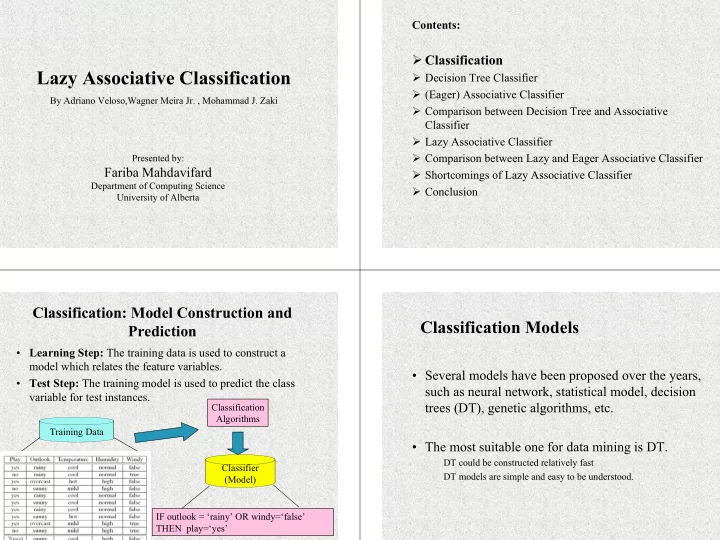
Training Data Classification Algorithms IF outlook = ‘rainy’ OR windy=‘false’ THEN play=‘yes’ Classifier (Model)

Classification: Model Construction and Prediction

  • Learning Step: The training data is used to construct a

model which relates the feature variables.

  • Test Step: The training model is used to predict the class

variable for test instances.

Classification Models

  • Several models have been proposed over the years,

such as neural network, statistical model, decision trees (DT), genetic algorithms, etc.

  • The most suitable one for data mining is DT.

DT could be constructed relatively fast DT models are simple and easy to be understood.

slide-2
SLIDE 2

Contents: Classification

Decision Tree Classifier

(Eager) Associative Classifier Comparison between Decision Tree and Associative Classifier Lazy Associative Classifier Comparison between Lazy and Eager Associative Classifier Shortcomings of Lazy Associative Classifier Conclusion

  • utlook

windy yes no yes no yes humidity sunny

  • vercast

rainy false true normal high

Decision Tree Classifier

  • At each internal node, the best

split is chosen according to the information gain criterion.

  • A DT is built using a greedy

recursive splitting strategy

  • Decision tree can be considered as

a set of disjoint decision rules, with one rule per leaf.

  • Such greedy (local) search may

prune important rules!

Test instance

Contents: Classification Decision Tree Classifier

(Eager) Associative Classifier

Comparison between Decision Tree and Associative Classifier Lazy Associative Classifier Comparison between Lazy and Eager Associative Classifier Shortcomings of Lazy Associative Classifier Conclusion

Eager Associative Classifier

  • Class association rules (CARs) :
  • CARs are essentially decision rules
  • They are ranked in decreasing order of information gain.
  • During the testing phase, Associative classifier checks weather each

CAR matches the test instance.

  • The class associated with the first match is chosen.

Note: Decision tree is a greedy search for CARs that only expands the current best rule. Eager Associative Classifier mines all possible CARs with a given minimum support.

c → χ

Antecedent is composed of feature variables Consequent is class

slide-3
SLIDE 3

1. Algorithm mines all frequent CARs 2. Sort them in descending order of information gain.

  • 3. For each test instance, the first CAR matching that, is

used to predict the class.

Eager Associative Classifier Steps:

Eager Associative Classifier

  • utlook

no yes no yes no yes no yes no yes yes no temperature humidity windy windy humidity humiditytemperature windy temperature temperature sunny sunny sunny overcast rainy true true true true false false false normal normal normal high cool cool cool mild hot yes

  • Three CARs match the test instance are:
  • utlook=sunny, temperature=cool, humidity=high -> play???
  • 1. {windy=false and temperature=cool -> play=yes}
  • 2. {outlook=sunny and humidity=high -> play=no}
  • 3. {outlook=sunny and temperature=cool -> play=yes}

The first rule would be selected, since it is the best ranked CAR.

Contents: Classification Decision Tree Classifier (Eager) Associative Classifier

Comparison between Decision Tree and Associative Classifier

Lazy Associative Classifier Comparison between Lazy and Eager Associative Classifier Shortcomings of Lazy Associative Classifier Conclusion

Comparison between Decision Tree and Associative Classifier

  • The test instance is recognized by only on rule in decision

tree.

  • The same test instance is recognized by three CARs in

associative classifier.

  • Intuitively associative classifiers perform better than

decision trees because it allows several CARs to cover the same portion of the training data.

  • Theorem1: The rules derived from a decision tree are subset
  • f the CARs mined using an eager associative classifier based
  • n information gain.
  • Theorem 2: CARs perform no worse than decision tree rules,

according to the information gain principle.

slide-4
SLIDE 4

Contents: Classification Decision Tree Classifier (Eager) Associative Classifier Comparison between Decision Tree and Associative Classifier

Lazy Associative Classifier

Comparison between Lazy and Eager Associative Classifier Shortcomings of Lazy Associative Classifier Conclusion

Lazy Learning Algorithms

  • Eager learning methods create the

classification model during the learning phase using training data

  • But lazy learning methods postpone

generalization and building the classification model until a query is given.

Lazy Associative Classifier induces CARs specific to each test instance. 1. Lazy Associative Classifier projects the training data only on features in the test instance (from all training instances, only the instances sharing at least one feature with test instance are used) 2. From this projected training data, CARs are induced and ranked, and the best CAR is used.

Lazy Associative Classifier

Contents: Classification Decision Tree Classifier (Eager) Associative Classifier Comparison between Decision Tree and Associative Classifier Lazy Associative Classifier

Comparison between Lazy and Eager Associative Classifier

Shortcomings of Lazy Associative Classifier Conclusion

slide-5
SLIDE 5

Comparison between Lazy and Eager Associative Classifier

Test Instance:

Outlook=overcast, Temperature=hot and Humidity=low -> play?

  • The set of CARs found by eager classifier (minsup=40% ) is

composed of:

  • 1. {windy=false and humidity=normal -> play=yes}
  • 2. {windy=false and humidity=cool -> play=yes}

None of the two CARs matches the test instance!

Comparison between Lazy and Eager Associative Classifier

  • Lazy Associative Classifier projects the training data (D) by the features

in the test instance A

  • The projected training data (DA) has less instances, therefore CARs not

frequent in D may be frequent in DA .

Test Instance:

Outlook=overcast, Temperature=hot and Humidity=low -> play?

  • The Lazy Associative Classifier found two CARs in DA:
  • 1. {Outlook=overcast -> play=yes}
  • 2. {Temperature=hot -> play=yes}
  • The Lazy CARs predict the correct class and they are also simpler compaerd

to the eager ones.

Comparison between Lazy and Eager Associative Classifier

  • Intuitively, lazy classifiers perform better than eager

classifiers because of two characteristic:

1. Missing CARs:

  • Eager classifiers search for CARs in a large search space.
  • This strategy generates a large rule-set, but CARs that are

important for some specific test instances may be missed!

  • Lazy classifiers focus the search for CARs in a much

smaller search space, which is induced by the features of the test instance.

Comparison between Lazy and Eager Associative Classifier

  • Intuitively, lazy classifiers perform better than eager

classifiers because of two characteristic:

  • 2. Highly Disjunctive Spaces:
  • Eager classifiers often combine small disjuncts to generate

more general predictions. It will reduce classification performance in highly disjunctive spaces where single disjunct may be important to classify specific instances.

  • Lazy classifiers generalize their training examples exactly

as needed to cover the test instance. More appropriate in complex search spaces!

slide-6
SLIDE 6

Contents: Classification Decision Tree Classifier (Eager) Associative Classifier Comparison between Decision Tree and Associative Classifier Lazy Associative Classifier Comparison between Lazy and Eager Associative Classifier

Shortcomings of Lazy Associative Classifier

Conclusion

Shortcomings of Lazy Associative Classifier

First Problem:

  • The more CARs are generated, the better is the classifier??!
  • NO! it sometimes leads to overfitting, reducing the

generalization and affecting the classification accuracy.

  • Overfitting and high sensitivity to irrelevant features are

shortcoming of lazy classifier.

  • Features should be selected carefully.

Shortcomings of Lazy Associative Classifier

Second Problem:

  • Lazy classifier typically requires more work to classify

all test instances.

  • Caching mechanism is used to decrease this workload.
  • The basic idea of caching: different test instances may

induce different rule-sets, but different rule-sets may share common CARs. Contents: Classification Decision Tree Classifier (Eager) Associative Classifier Comparison between Decision Tree and Associative Classifier Lazy Associative Classifier Comparison between Lazy and Eager Associative Classifier Shortcomings of Lazy Associative Classifier

Conclusion

slide-7
SLIDE 7

Conclusion

  • Decision tree classifiers perform a greedy search that may

discard important rules.

  • Associative classifiers perform a global search for rules,

however it may generate a large number of rules. (many of them may be useless during classification and even worse important rules may never be mined)

  • Lazy associative classifier overcome these problems by

focusing on the features of the given test instance. Lazy classifier is suitable in highly disjunctive spaces. The most important problem of lazy classifier is its

  • verfitting.

Reference

  • A. Veloso,W. Meira Jr. , M. J. Zaki. “Lazy Associative

Classification”. In ICDM ’06: Proceedings of the Sixth International Conference on Data Mining, pages 645-654, IEEE Computer Society, 2006.

  • Y. Sun, A. K.C.Wong, and Y. Wang. An overview of

associative classifiers. In Proceedings of the 2006 International Conference on Data Mining, DMIN 2006, pages 138–143. CSREA Press, 2006.

Thanks for you attention!

Question?