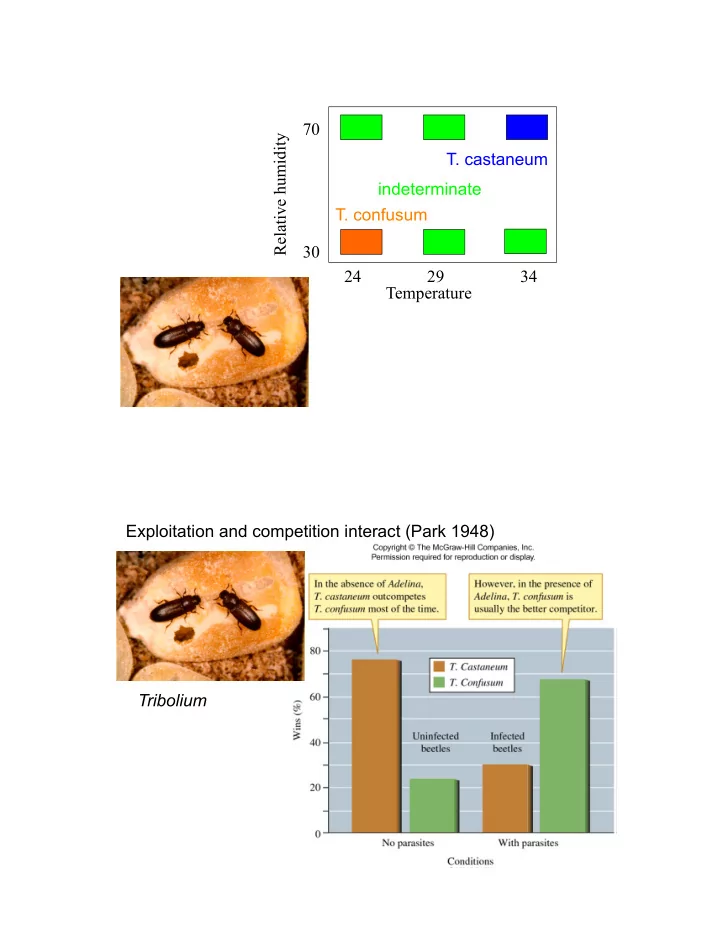
SLIDE 1 Temperature 24 29 34 R e l a t i v e h u m i d i t y 30 70
indeterminate Exploitation and competition interact (Park 1948) Tribolium
SLIDE 2
Predator - prey cycles: lynx and hare Modelling predator - prey cycles Our old friends Alfred Lotka Vito Volterra
SLIDE 3
Refuges and the importance of environmental structure Huffaker (1958) Huffaker’s results Simple universe More complex
SLIDE 4
Huffaker’s results continued - complex universe Tray design - barriers Rosenzweig - MacArthur predator-prey model Population of prey (Nh) Population of predators (Np)
SLIDE 5
Rosenzweig - MacArthur predator-prey model Population of prey (Nh) Population of predators (Np)
Prey ZNGI peaks outside Pred ZNGI
stable
Prey carrying capacity
Rosenzweig - MacArthur predator-prey model Paradox of enrichment…. Population of prey (Nh) Population of predators (Np)
Prey ZNGI peaks outside Pred ZNGI Prey ZNGI peaks inside Pred ZNGI
stable unstable
SLIDE 6
Mycorrhizal fungi – one of THE mutualisms Present in all but a few plant families (92%) >80% of plant species estimated to house mycorrhizae AM associations may have originated with the colonization of land.>400 Mya Arbuscular mycorrhizae Ectomycorrhizae Interaction Continuum Example: Mycorrizae work by Johnson et al. (1993, 1997)
SLIDE 7
Tripartite Mutualism Leaf-cutter Ants Fungus Streptomyces Combats Escovopsis
Animal Pollination – Another one of THE mutualisms
SLIDE 8
Senita cactus - senita moth A pollination-seed predator mutualism… Lophocereus schotii Upiga virescens egg Holland and DeAngelis (2002) model of the Lophocereus-Upiga mutualism
dP/dt>0 dM/dt<0 dM/dt<0 dP/dt<0 dM/dt>0
# Plants # Moths Lophocereus schottii Upiga virescens