Average Path Profile of Atmospheric Temperature and Humidity - - PowerPoint PPT Presentation

average path profile of atmospheric temperature and
SMART_READER_LITE
LIVE PREVIEW

Average Path Profile of Atmospheric Temperature and Humidity - - PowerPoint PPT Presentation

Average Path Profile of Atmospheric Temperature and Humidity Structure Parameters from a Microwave Profiling Radiometer Robert M. Manning, Ph.D. Na3onal


slide-1
SLIDE 1

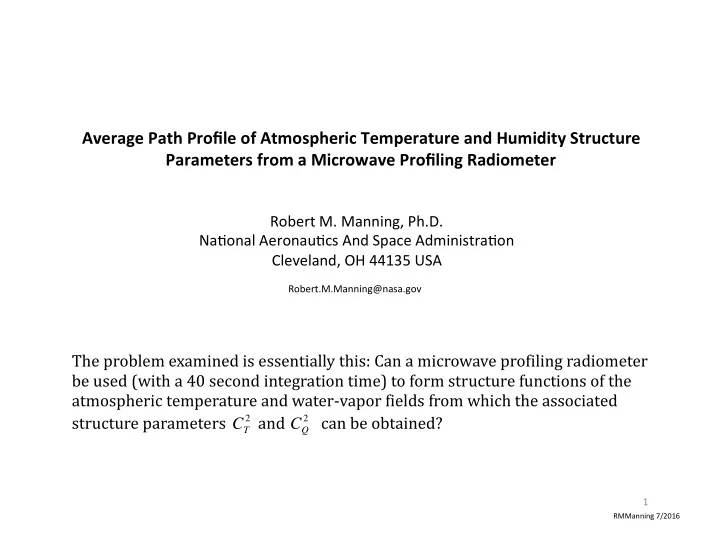
Average ¡Path ¡Profile ¡of ¡Atmospheric ¡Temperature ¡and ¡Humidity ¡Structure ¡ ¡ Parameters ¡from ¡a ¡Microwave ¡Profiling ¡Radiometer ¡

Robert ¡M. ¡Manning, ¡Ph.D. ¡ Na3onal ¡Aeronau3cs ¡And ¡Space ¡Administra3on ¡ Cleveland, ¡OH ¡44135 ¡USA ¡

Robert.M.Manning@nasa.gov ¡

The$problem$examined$is$essentially$this:$Can$a$microwave$profiling$radiometer! be#used#(with#a#40#second#integration#time)#to#form#structure#functions#of#the# atmospheric,temperature(and(water"vapor&fields&from&which&the&associated& structure'parameters! CT

2 !and!CQ 2 !!can!be!obtained?!

RMManning ¡7/2016 ¡

1 ¡

slide-2
SLIDE 2

U

Average ¡Horizontal ¡ Wind ¡Velocity ¡

Temp.Profile @t = t0 Temp.Profile @t = t0 + Δt Temp.Profile @t = t0 d = UΔt First ¡Radiometric ¡Temperature ¡ Profile ¡Forma3on ¡ Second ¡Radiometric ¡Temperature ¡ Profile ¡Forma3on ¡ ¡ ¡ ¡ ¡ ¡ ¡ ¡ ¡Seconds ¡Later ¡ Δt

!

Form First Representation

  • f Temperature Sturcture

Function T t0 + Δt

( )−T t0 ( )

( )

2

!

(and ¡so ¡on) ¡

Introduc3on ¡

RMManning ¡7/2016 ¡

2 ¡

slide-3
SLIDE 3
  • Can$ DT UΔt

( )$be$used$to$find$the$corresponding$ CT

2 $using$something$

similar$to$the$2/3$Law,$i.e.,$ DT UΔt

( ) = CT

2 UΔt

( )

2/3$even$though$

Δt ~ 40 sec $and$so$UΔt ≥ 200 m $?$

  • After& N &such&representation&formations,&perform&a&moving&average&to&get&

the&temperature&structure&function& & DT UΔt

( ) = 1

N T ti + Δt

( )−T ti ( )

( )

2 i=0 N

&

  • Characteristic*turbulence*sizes*(~*200*m)*and*acquisition*times*(~40*sec)*

are*not*conventional*quantities*to*prevail*within*the*inertial*sub=range*of*the* turbulence*spectrum*in*which*the*2/3*law*holds.*

  • Can$a$theory$for$large.scale$atmospheric$turbulence$within,$e.g.,$the$

buoyancy$sub.range,$be$obtained$from$which$one$can$obtain$a$similar$law$ $ DT UΔt

( ) = CT

2F UΔt

( ) $

$ where$the$function$ F d

( ),$ d = UΔt ,$replaces$the$2/3$law$?$

The derivation of this constitutes much of the text since it forms the fundamental basis of the entire remote-sensing method

Introduc3on ¡(cont’d) ¡

RMManning ¡7/2016 ¡

3 ¡

slide-4
SLIDE 4

A"‘Back(to(Basics”"theory"is"developed"for"large(scale"turbulence"(ignoring" molecular"diffusion"effects)"that"gives"various"turbulent" spectra" ΦTT ′ x

( )"for"a"passive"additive"(in"this"case"temperature"but"also"can"be"

water"vapor"concentration)"as"a"function"of"atmospheric"stability"and"buoyancy:" " 4x4 = 1± KΓU

2

( )

1/2

2 1+ KΓU

2

4 + KM 1/2 ⎛ ⎝ ⎜ ⎞ ⎠ ⎟

−1/2

⎧ ⎨ ⎪ ⎩ ⎪ ⎫ ⎬ ⎪ ⎭ ⎪ 1 K 3 1+ M −1/2 2 HT ⎛ ⎝ ⎜ ⎞ ⎠ ⎟ ," HT ≡1± KΓT

2

( )

1/2 1+ KΓT 2

4 # $ % & ' (

−1/2

" " where" " ΓU = dU dz bNβ 2

( )

−1/2 ε1/2,

ΓT = dT dz Nβ

( )

−1ε "

" introduces"the"prevailing"wind"shear"and"lapse"rate"of"the"atmosphere." " The"parametric"equation"given"above"is"then"solved,"within"specific"approximations," for"the"kinematic"viscosity" K = K x

( )"from"which"one"forms"

" dK x

( )

dx = − 1 2K x

( )x2 Φ x ( ) "

" to"obtain"the"spectrum"Φ x

( ) "of"velocity"fluctuations"and""

" 2x2ΦTT x

( ) =

1 4K 3x2 1+ HT

( )Φ x ( )"

" to"get"an"expression"for"the"associated"spectrum"of"temperature"(or"humidity)" fluctuations"ΦTT x

( ) "

Turbulence ¡Theory ¡for ¡the ¡Basis ¡of ¡Radiometer ¡Profiling ¡of ¡Structure ¡Parameters ¡

RMManning ¡7/2016 ¡

4 ¡

This ¡general ¡model ¡of ¡large-­‑scale ¡ turbulence ¡can ¡be ¡applied ¡to ¡many ¡ atmospheric ¡scenarios ¡involving ¡ stable ¡as ¡well ¡as ¡unstable ¡cases. ¡ ¡ ¡ Only ¡two ¡extreme ¡cases ¡are ¡considered ¡ here ¡but ¡others ¡should ¡be ¡examined ¡to ¡ a]empt ¡to ¡capture ¡spectral ¡transi3ons ¡ as ¡atmospheric ¡condi3ons ¡evolve. ¡

slide-5
SLIDE 5

Backup'for'Previous'Vu1Graph'

' ' x = k k0 , Φ = φ φ0 , ΦTT = φTT φTT ,0 ' ' are'dimensionless'variables'and'functions'where' ' k0 = γ 1/2 bNβ 2

( )

3/4 ε −5/4,

φ0 = γ −3/2 bNβ 2

( )

−5/4 ε11/4,

φTT ,0 = γ −3/2b−9/4N −1/4β −5/2ε 7/4 ' ' ' ε 'is'the'energy'dissipation'due'to'viscosity' N 'is'the'dissipation'of'temperature'fluctuations'by'thermal'conductivity' β ≡ g T 'is'the'buoyancy'parameter' b 'is'the'ratio'(~1)'of'thermal'diffusivity'to'kinematic'viscosity' γ 'a'constant'(~1)'entering'into'the'spectrum'of'the'kinematic'viscosity'' k0 'characteristic'spatial'frequency' φ0 'characteristic'spectral'amplitude'of'velocity'fluctuations' φTT ,0 'characteristic'spectral'amplitude'of'temperature'fluctuations' ' ' '

Turbulence ¡Theory ¡… ¡(cont’d) ¡

RMManning ¡7/2016 ¡

5 ¡

slide-6
SLIDE 6

Look$at$two$extremes:$ $ 1)$ KΓT

2 <<1, KΓU 2 <<1;$No#atmospheric#stratification#or#shear$

$ Solving$the$parametric$equation$in$the$approximation$ HT ≈1$and$ M ≈ K −1$

!

K x

( ) ≈

1 4 ⎛ ⎝ ⎜ ⎞ ⎠ ⎟

1/3

x−4/3 ,$$$$Φ x

( ) ≈

8 3 ⎛ ⎝ ⎜ ⎞ ⎠ ⎟ 1 4 ⎛ ⎝ ⎜ ⎞ ⎠ ⎟

2/3

x−5/3 ,$$ΦTT x

( ) ≈

2 3 ⎛ ⎝ ⎜ ⎞ ⎠ ⎟ 1 4 ⎛ ⎝ ⎜ ⎞ ⎠ ⎟

−1/3

x−5/3$ $ $ $ 2)$ KΓT

2 >>1, KΓU 2 >>1;$Significant#atmospheric#stratification#and#shear$

$ Solving$the$parametric$equation$in$the$approximation$ HT ≈ 4 KΓT

2

( )−1$and$

M ≈ K −1 !

!

K x

( ) ≈

1 2ΓU

2

⎛ ⎝ ⎜ ⎞ ⎠ ⎟

1/4

x−1 ,$$Φ x

( ) ≈ 2

1 2ΓU

2

⎛ ⎝ ⎜ ⎞ ⎠ ⎟

1/2

x−1, ΦTT x

( ) ≈

1 2ΓU

2

⎛ ⎝ ⎜ ⎞ ⎠ ⎟

−1/2

1 ΓT

2

⎛ ⎝ ⎜ ⎞ ⎠ ⎟ x−1 $ $ $ $ Form$a$combined$expression$that$convolves$both$instances$above$for$the$spectrum$

  • f$temperature$fluctuations$

$ φTT k

( ) ≈

B k ⎛ ⎝ ⎜ ⎞ ⎠ ⎟ k1/3 + kU

1/3

k + kT , kU ≡ C 2B ⎛ ⎝ ⎜ ⎞ ⎠ ⎟

3

, kT ≡ C 2A $ $ A ≡ 21/2 dU dz dT dz

−2

γ −1b−2N 2ε −1 ,! B ≡ 2 3 ⎛ ⎝ ⎜ ⎞ ⎠ ⎟ 41/3γ −2/3b−1Nε −1/3 ,!C ≡ 21/4 dU dz

1/2

γ −1/2b−1Nε −1/2 ! $ $

Turbulence ¡Theory ¡… ¡(cont’d) ¡

NOTE: ¡Other ¡intermediate ¡ cases ¡could ¡be ¡considered ¡ ¡ but, ¡for ¡purposes ¡of ¡a ¡demo ¡

  • f ¡the ¡possibili3es ¡of ¡using ¡

a ¡microwave ¡microwave ¡ ¡ profiling ¡radiometer ¡for ¡ ¡ turbulence ¡sensing, ¡these ¡ two ¡extremes ¡are ¡a ¡good ¡ ini3al ¡point ¡from ¡which ¡to ¡

  • begin. ¡

¡ Combined ¡spectrum ¡ containing ¡1) ¡and ¡2) ¡ as ¡limi3ng ¡cases ¡to ¡get ¡ this ¡form ¡(See ¡text) ¡

RMManning ¡7/2016 ¡

6 ¡
slide-7
SLIDE 7

0.01 0.1 1 10 100 10-5 0.001 0.1 10

B k

−5/3

B kU

1/3

kT k

−1

L = 2.96 φTT k

( )

k, m−1 kT kU = 1.02 z = 200m B k ⎛ ⎝ ⎜ ⎞ ⎠ ⎟ k1/3 + kU

1/3

k + kT ∂T ∂z = 0.04 K/m ∂U ∂z = 0.09 (m/s)/m

Pasquill ¡Stability ¡Class ¡F ¡Example ¡of ¡Composite ¡Spectrum ¡

(L=Stability ¡Parameter) ¡

Turbulence ¡Theory ¡… ¡(cont’d) ¡

B = 6.9 ×10⁻⁴ K2 m2/3

One$Dimensional$Spatial$Spectrum$φTT k

( ) $Displaying$Both$Buoyancy$and$Inertial$Sub9Ranges$for$an$

Unstable$Atmosphere$at$a$Height$of$z=200$m$

RMManning ¡7/2016 ¡

7 ¡

slide-8
SLIDE 8
  • An analysis performed in the text shows that there is no need for a ‘frozen-

flow’ hypothesis correction to be made in the compilation of DT UΔt

( ) using

measurements of T profiles over a temporal interval of Δt ~ 40sec at these large-scale turbulence sizes.

  • Thus, one can use the well-known expression relating to the temperature

fluctuation spectra DT UΔt

( ) = 2

1− exp −ikUΔt ⎡ ⎣ ⎤ ⎦

( )φTT k

( )

−∞ ∞

dk

  • r what is the same thing now that no corrections for Δt are required,

DT d

( ) = 2

1− exp −ikd

[ ]

( )φTT k

( )

−∞ ∞

dk, d = UΔt

Applica3on ¡to ¡Profiling ¡Radiometer ¡Measurements ¡

F UΔt

( ) = 1

2 1 kt

2/3

⎛ ⎝ ⎜ ⎞ ⎠ ⎟ 2 3 3π 1− Re Ψ 1 3;1 3;−iktUΔt ⎛ ⎝ ⎜ ⎞ ⎠ ⎟ ⎧ ⎨ ⎩ ⎫ ⎬ ⎭ Γ 2 3 ⎛ ⎝ ⎜ ⎞ ⎠ ⎟ ⎛ ⎝ ⎜ ⎜ ⎜ ⎜ ⎞ ⎠ ⎟ ⎟ ⎟ ⎟ + kU kt ⎛ ⎝ ⎜ ⎞ ⎠ ⎟

1/3

Re Ψ 1;1;−iktUΔt

( )

{ }+ 0.577 + log ktUΔt

( )

( )

⎫ ⎬ ⎪ ⎪ ⎭ ⎪ ⎪ ⎧ ⎨ ⎪ ⎪ ⎩ ⎪ ⎪

  • Using&the&composite&large1scale&turbulence&spectrum&derived&earlier,&this&

gives& & DT UΔt

( ) = CT

2 F UΔt

( ) &

& where& &

A ¡confluent ¡hypergeometric ¡ func3on ¡

RMManning ¡7/2016 ¡

8 ¡

slide-9
SLIDE 9

9 ¡

Applica3on ¡to ¡Profiling ¡Radiometer ¡Measurements ¡(cont’d) ¡

Temperature)Structure)Function)as)a)Function)of)Integration)Time)for)a)Stable)Atmosphere)with) Minimum)Expected)Value)of)CT

2 )at)a)Height)of)z=200)m.)

15 20 25 30 35 40 0.0125 0.0130 0.0135 0.0140

DT UΔt

( ), K2

Δt, s CT

2 = 0.003 K2 m-2/3

U = 5.0 m/s L = 2.96 z = 200 m CT

2 F UΔt

( )

  • From%this%example%of%minimum%expected%CT

2 ,%resolution%requirements%can%be%

  • btained:% ΔTmin ~

DTmin UΔt

( ) %@% Δt = 40sec%gives%ΔTmin ~ 0.11K .%%Similarly,%

for%the%water?vapor%case,%CQmin

2

= 0.1 g/m3

( )

2 m2/3 %giving%

ΔQmin ~ DQmin UΔt

( ) ~ 0.68 g/m3.%

%

These ¡values ¡are ¡within ¡the ¡resolution ¡range ¡of ¡currently ¡available ¡pro6iling ¡radiometers ¡

RMManning ¡7/2016 ¡

An ¡idea ¡of ¡what ¡the ¡temporal ¡evolu3on ¡look ¡like ¡of ¡the ¡temperature ¡structure ¡func3on ¡for ¡large-­‑scale ¡turbulence ¡ ¡

slide-10
SLIDE 10

10 ¡

RMManning ¡7/2016 ¡

Applica3on ¡to ¡Profiling ¡Radiometer ¡Measurements ¡(cont’d) ¡

Two additional requirements: 1) Need to get a good description of vertical profile of horizontal wind components to capture values for U . This can be done with a wind profiling radar but this represents too much overhead for a remote-sensing scenario. Use instead a statistical wind profile model that makes use of historical archive of wind data that or near the particular site. A very good modeling approach is noted and used in the text. 2) Integrating time interval of the radiometer Δt essentially ‘averages-out’ initial profiles existing from Earth surface to a threshold height hmin below which CT

2

profiles cannot be resolved. Assuming isotropic behavior of the turbulent inhomogenieties, one can simply place this minimum height at the value hmin = UΔt . Behavior of CT

2 below hmin can be obtained by simple gradient

measurements of T (and water-vapor Q ) taken at two vertical locations near the Earth’s surface, forming the prevailing gradient Richardson number, which will help secure CT

2 near the surface as well as augment estimates to help bound

values of the characteristic spatial frequencies kU and kT needed in the large- scale turbulence spectrum discussed earlier.

slide-11
SLIDE 11

11 ¡

Applica3on ¡to ¡Profiling ¡Radiometer ¡Measurements ¡(cont’d) ¡

RMManning ¡7/2016 ¡ Calculated)Vertical)Profile)of)CT

2 )from)Temperature)Measurements)Using)a)Radiometrics)Corp.))MP:3000A)

Microwave)Profiling)Radiometer.!

  • Figure confirms the potential of the remote sensing method. Description of

experiment is described in the text.

  • No concurrent atmospheric measurements were made.
  • Stable atmosphere values of kt = 0.9 m-1 and kU kt = 1.0 m-1 were used.
  • Statistical wind profile model was applied as described in text.
slide-12
SLIDE 12

12 ¡

RMManning ¡7/2016 ¡

Applica3on ¡to ¡Profiling ¡Radiometer ¡Measurements ¡(cont’d) ¡

Procedure ¡To ¡Use ¡a ¡Profiling ¡Radiometer ¡With ¡the ¡Model ¡Just ¡Presented ¡