instrumentation we can be more collaborative and sensitive to - - PowerPoint PPT Presentation

instrumentation we can be more collaborative and
SMART_READER_LITE
LIVE PREVIEW

instrumentation we can be more collaborative and sensitive to - - PowerPoint PPT Presentation

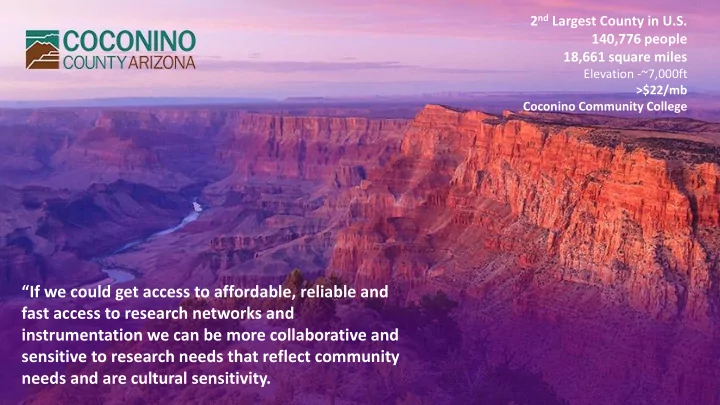
2 nd Largest County in U.S. 140,776 people 18,661 square miles Elevation -~7,000ft >$22/mb Coconino Community College If we could get access to affordable, reliable and fast access to research networks and instrumentation we can be


slide-1
SLIDE 1

2nd Largest County in U.S. 140,776 people 18,661 square miles

Elevation -~7,000ft >$22/mb Coconino Community College

“If we could get access to affordable, reliable and fast access to research networks and instrumentation we can be more collaborative and sensitive to research needs that reflect community needs and are cultural sensitivity.

slide-2
SLIDE 2

Among the fastest growing counties in the U.S. More than 4.3 Million people 9,244 square miles Elevation 1,000ft < $1/mb 10 Maricopa Community Colleges

We need convenient and effective ways to collaborate with researchers at universities and faculty at other community colleges to bridge the gap between science and workforce applications.

slide-3
SLIDE 3

115 R1 universities, representing 2.5 percent of the total.

Although these are large institutions that account for only 16

percent of all higher-education enrollments.

980 public community colleges in the United States serving

approximately 5.8 million students,

If all things were the same, there’s a 97 to 3 chance that the next Steve Jobs, J. Craig Venter, or Eileen Collins would emerge from a community

  • college. But all

things are not the same….

slide-4
SLIDE 4

In spite of the obstacles posed by lack of research funding and high teaching loads, undergraduate research is being conducted in community colleges across the nation. The reasons for supporting undergraduate research include the need to:

  • increase the number of students (especially minority students)

majoring in science, technology, engineering, and math (STEM) fields;

  • promote better understanding of STEM fields;
  • improve student engagement and persistence in college;
  • assist people in becoming better consumers of research;
  • develop better understanding of the scientific method and

research processes; and the potential for institutional recognition.*

*UNDERGRADUATE RESEARCH AT COMMUNITY COLLEGES Edited by Brent D. Cejda and Nancy Hensel National Council of Instructional Administrators Council on Undergraduate Research With support from the National Science Foundation grant No. 0603119

slide-5
SLIDE 5

NS NSF Cam Campus Cy Cyberinfrastr tructu ture PI PI an and Cy Cybersecurity ty Innovati tion for

  • r Cy

Cyberinfrastr tructu ture PI PI Wor

  • rkshop

September 23 – 25, 2019 | Minneapolis, MN Broader Impact: The network expansion advances the use of science-

  • riented workflows, high performance computing in

undergraduate research, instrument sharing, STEM education, and homework gap connectivity and introduces wide area and campus networking capacities that align with cybersecurity academic requirements. Deliverables: NAU and SCN will improve campus network performance, increasing external connectivity to each campus by connecting them to SCN as a regional aggregator By building new collaborations and by expanding connectivity, NAU and SCN improve undergraduate science and technical instruction for over 200,000 students in the Phoenix metropolitan area and northern Arizona. Challenge Project Seeks to Address: Arizona State University Chandler Gilbert Community College Coconino Community College Estrella Mountain Comm College Northern Arizona University Phoenix College University of Arizona https://sites.google.com/nau.edu/nsf-scn/home https://www.nsf.gov/awardsearch/showAward?AWD_I D=1925632

Quad Chart for: Sun Corridor Network Arizona Community College Research Expansion

Research and specialized network connectivity at Arizona community colleges are limited and generally unavailable to academic or to specialized technical programs. This project connects one of the nation’s largest community college systems and the northern NAU collaborator to the Sun Corridor Network.