SLIDE 1 CS553 Lecture Instruction Scheduling 1
Instruction Scheduling
Last time
– Register allocation
Today
– Instruction scheduling – The problem: Pipelined computer architecture – A solution: List scheduling
CS553 Lecture Instruction Scheduling 2
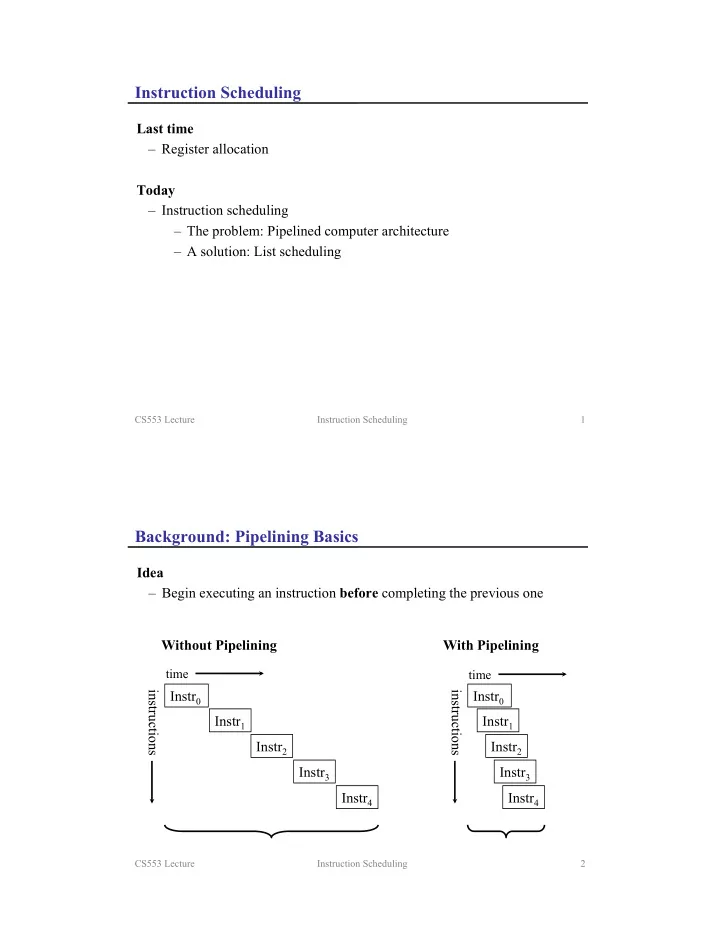
Background: Pipelining Basics
Idea
– Begin executing an instruction before completing the previous one Without Pipelining Instr0 Instr1 Instr2 Instr3 Instr4
time
instructions With Pipelining Instr0 Instr1 Instr2 Instr3 Instr4
time
instructions
SLIDE 2 CS553 Lecture Instruction Scheduling 3
Idealized Instruction Data-Path
Instructions go through several stages of execution
Stage 1 Stage 2 Stage 3 Stage 4 Stage 5 Instruction Fetch
Decode & Register Fetch Execute Memory Access
Write-back IF
time
instructions
IF ID EX MM WB IF ID EX MM WB IF ID EX MM WB IF ID EX MM WB IF ID EX MM WB IF ID EX MM WB CS553 Lecture Instruction Scheduling 4
Pipelining Details
Observations
– Individual instructions are no faster (but throughput is higher) – Potential speedup determined by number of stages (more or less) – Filling and draining pipe limits speedup – Rate through pipe is limited by slowest stage – Less work per stage implies faster clock
Modern Processors
– Long pipelines: 5 (Pentium), 14 (Pentium Pro), 20 or 31 (Pentium 4) – Issue 2 (Pentium), 4 (UltraSPARC) or more (dead Compaq EV8) instructions per cycle – Dynamically schedule instructions (from limited instruction window)
- r statically schedule (e.g., IA-64)
– Hyperthreading or simultaneous multi-threading – Speculate: Outcome of branches, Value of loads
SLIDE 3 CS553 Lecture Instruction Scheduling 5
What Limits Performance?
Data hazards
– Instruction depends on result of prior instruction that is still in the pipe
Structural hazards
– Hardware cannot support certain instruction sequences because of limited hardware resources
Control hazards
– Control flow depends on the result of branch instruction that is still in the pipe
An obvious solution
– Stall (insert bubbles into pipeline)
CS553 Lecture Instruction Scheduling 6
Stalls (Data Hazards)
Code
// $r1 is the destination
// $r4 is the destination
IF ID IF ID EX MM WB EX MM WB
time
instructions Pipeline picture
SLIDE 4 CS553 Lecture Instruction Scheduling 7
Stalls (Structural Hazards)
Code
// Suppose multiplies take two cycles
IF ID IF EX ID WB EX MM WB MM
time
instructions Pipeline Picture
EX EX CS553 Lecture Instruction Scheduling 8
Stalls (Control Hazards)
Code
// if $r1==0, branch to label
IF EX MM WB ID EX
time
instructions Pipeline Picture
MM IF ID WB
SLIDE 5 CS553 Lecture Instruction Scheduling 9
Hardware Solutions
Data hazards
– Data forwarding (doesn’t completely solve problem) – Runtime speculation (doesn’t always work)
Structural hazards
– Hardware replication (expensive) – More pipelining (doesn’t always work)
Control hazards
– Runtime speculation (branch prediction)
Dynamic scheduling
– Can address all of these issues – Very successful
CS553 Lecture Instruction Scheduling 10
Instruction Scheduling for Pipelined Architectures
Goal
– An efficient algorithm for reordering instructions to minimize pipeline stalls
Constraints
– Data dependences (for correctness) – Hazards (can only have performance implications)
Possible Simplifications
– Do scheduling after instruction selection and register allocation – Only consider data hazards
SLIDE 6 CS553 Lecture Instruction Scheduling 11
Data Dependences
Data dependence
– A data dependence is an ordering constraint on 2 statements – When reordering statements, all data dependences must be observed to preserve program correctness
True (or flow) dependences
– Write to variable x followed by a read of x (read after write or RAW)
Anti-dependences
– Read of variable x followed by a write (WAR)
Output dependences
– Write to variable x followed by another write to x (WAW) false dependences
x = 5; print (x); print (x); x = 5; x = 6; x = 5;
CS553 Lecture Instruction Scheduling 12
Register Renaming
Idea
– Reduce false data dependences by reducing register reuse – Give the instruction scheduler greater freedom
Example
add $r1, $r2, 1 st $r1, [$fp+52] mul $r1, $r3, 2 st $r1, [$fp+40] add $r1, $r2, 1 st $r1, [$fp+52] mul $r11, $r3, 2 st $r11, [$fp+40] add $r1, $r2, 1 mul $r11, $r3, 2 st $r1, [$fp+52] st $r11, [$fp+40]
SLIDE 7 CS553 Lecture Instruction Scheduling 13
Phase Ordering Problem
Register allocation
– Tries to reuse registers – Artificially constrains instruction schedule
Just schedule instructions first?
– Scheduling can dramatically increase register pressure
Classic phase ordering problem
– Tradeoff between memory and parallelism
Approaches
– Consider allocation & scheduling together – Run allocation & scheduling multiple times (schedule, allocate, schedule)
CS553 Lecture Instruction Scheduling 14
List Scheduling [Gibbons & Muchnick ’86]
Scope
– Basic blocks
Assumptions
– Pipeline interlocks are provided (i.e., algorithm need not introduce no-ops) – Pointers can refer to any memory address (i.e., no alias analysis) – Hazards take a single cycle (stall); here let’s assume there are two... – Load immediately followed by ALU op produces interlock – Store immediately followed by load produces interlock
Main data structure: dependence DAG
– Nodes represent instructions – Edges (s1,s2) represent dependences between instructions – Instruction s1 must execute before s2 – Sometimes called data dependence graph or data-flow graph
SLIDE 8 CS553 Lecture Instruction Scheduling 15
Dependence Graph Example
1 addi $r2,1,$r1 2 addi $sp,12,$sp 3 st a, $r0 4 ld $r3,-4($sp) 5 ld $r4,-8($sp) 6 addi $sp,8,$sp 7 st 0($sp),$r2 8 ld $r5,a 9 addi $r4,1,$r4 Sample code Hazards in current schedule (3,4), (5,6), (7,8), (8,9) Any topological sort is okay, but we want best one dst src src
7 9 6 8 5 4 3 2 1
Dependence graph
1 1 2 2 1 1 1 2 2 CS553 Lecture Instruction Scheduling 16
Scheduling Heuristics
Goal
– Avoid stalls
Consider these questions
– Does an instruction interlock with any immediate successors in the dependence graph? IOW is the delay greater than 1? – How many immediate successors does an instruction have? – Is an instruction on the critical path?
SLIDE 9 CS553 Lecture Instruction Scheduling 17
Scheduling Heuristics (cont)
Idea: schedule an instruction earlier when...
– It does not interlock with the previously scheduled instruction (avoid stalls) – It interlocks with its successors in the dependence graph (may enable successors to be scheduled without stall) – It has many successors in the graph (may enable successors to be scheduled with greater flexibility) – It is on the critical path (the goal is to minimize time, after all)
CS553 Lecture Instruction Scheduling 18
Scheduling Algorithm
Build dependence graph G Candidates set of all roots (nodes with no in-edges) in G while Candidates Select instruction s from Candidates {Using heuristics—in order} Schedule s Candidates Candidates ! s Candidates Candidates “exposed” nodes {Add to Candidates those nodes whose predecessors have all been scheduled}
SLIDE 10
CS553 Lecture Instruction Scheduling 19
Scheduling Example
Dependence Graph 3 st a, $r0 2 addi $sp,12,$sp 5 ld $r4,-8($sp) 4 ld $r3,-4($sp) 8 ld $r5,a 1 addi $r2,1,$r1 6 addi $sp,8,$sp 7 st 0($sp),$r2 9 addi $r4,1,$r4 Scheduled Code Hazards in new schedule (8,1)
7 9 6 8 5 4 3 2 1
Candidates 7 st 0($sp),$r2 1 addi $r2,1,$r1 2 addi $sp,12,$sp 3 st a, $r0 8 ld $r5,a 4 ld $r3,-4($sp) 5 ld $r4,-8($sp) 6 addi $sp,8,$sp 9 addi $r4,1,$r4
addi addi addi addi st st ld ld ld 1 1 1 2 1 2 2 2 1 CS553 Lecture Instruction Scheduling 20
3 st a, $r0 2 addi $sp,12,$sp 5 ld $r4,-8($sp) 4 ld $r3,-4($sp) 8 ld $r5,a 1 addi $r2,1,$r1 6 addi $sp,8,$sp 7 st 0($sp),$r2 9 addi $r4,1,$r4 Hazards in new schedule (8,1)
Scheduling Example (cont)
1 addi $r2,1,$r1 2 addi $sp,12,$sp 3 st a, $r0 4 ld $r3,-4($sp) 5 ld $r4,-8($sp) 6 addi $sp,8,$sp 7 st 0($sp),$r2 8 ld $r5,a 9 addi $r4,1,$r4 Original code Hazards in original schedule (3,4), (5,6), (7,8), (8,9)
SLIDE 11 CS553 Lecture Instruction Scheduling 21
Complexity
Quadratic in the number of instructions – Building dependence graph is O(n2) – May need to inspect each instruction at each scheduling step: O(n) – In practice: closer to linear
CS553 Lecture Instruction Scheduling 22
Example 10.6 in book
Stalls
– LD takes two clocks but – ST to same can directly follow – any LD can directly follow
Flow dependences
– i1 to i2, i3 to i4, i4 to i5, i5 to i6 – i2 to i3?
Anti dependences
– i4 to i5 – i1 to i7, i3 to i7
Output dependences
– i3 to i4, i4 to i5 – i2 to i7
LD R2, 0(R1) ST 4(R1), R2 LD R3,8(R1) ADD R3,R3,R4 ADD R3,R3,R2 ST 12(R1),R3 ST 0(R7),R7 1 1 1 2 2 2 1 1 1
i1 i2 i3 i4 i5 i6 i7
SLIDE 12 CS553 Lecture Instruction Scheduling II 23
Improving Instruction Scheduling
Techniques
– Register renaming – Scheduling loads – Loop unrolling – Software pipelining – Predication and speculation Deal with data hazards Deal with control hazards
CS553 Lecture Instruction Scheduling II 24
Register Renaming
Idea
– Reduce false data dependences by reducing register reuse – Give the instruction scheduler greater freedom
Example
add $r1, $r2, 1 st $r1, [$fp+52] mul $r1, $r3, 2 st $r1, [$fp+40] add $r1, $r2, 1 st $r1, [$fp+52] mul $r11, $r3, 2 st $r11, [$fp+40] add $r1, $r2, 1 mul $r11, $r3, 2 st $r1, [$fp+52] st $r11, [$fp+40]
SLIDE 13 CS553 Lecture Instruction Scheduling II 25
Scheduling Loads
Reality
– Loads can take many cycles (slow caches, cache misses) – Many cycles may be wasted
Most modern architectures provide non-blocking (delayed) loads
– Loads never stall – Instead, the use of a register stalls if the value is not yet available – Scheduler should try to place loads well before the use of target register
CS553 Lecture Instruction Scheduling II 26
Hiding latency
– Place independent instructions behind loads – How many instructions should we insert? – Depends on latency – Difference between cache miss and cache hits are growing – If we underestimate latency: Stall waiting for the load – If we overestimate latency: Hold register longer than necessary Wasted parallelism
1 2 3 4 5 6 7 8
Scheduling Loads (cont)
time add r4 load r2,(r1) load r1,(r3)
1 2 3 4 5 6 7 8
time load r1,(r3) add r4 load r2,(r1)
SLIDE 14 CS553 Lecture Instruction Scheduling II 27
Loop Unrolling
Idea
– Replicate body of loop and iterate fewer times – Reduces loop overhead (test and branch) – Creates larger loop body more scheduling freedom
Example
L: ldf f0,[r1] fadds f2, f0, f1 stf [r1], f2 sub r1, 4, r1 cmp r1, 0 bg L nop
1 2 3 4 5 6 7 8 9 10 11 12 13 14 15 16
ldf sub cmp bg nop ldf fadds
Cycles per iteration: 9
Loop
stf
CS553 Lecture Instruction Scheduling II 28
Loop Unrolling Example
Sample loop
L: ldf f0, [r1] fadds f2, f0, f1 ldf f10,[r1-4] fadds f12, f10, f1 stf [r1],f2 stf [r1-4], f12 sub r1, 8, r1 cmp r1, 0 bg L nop
1 2 3 4 5 6 7 8 9 10 11 12 13 14 15 16
Cycles per iteration: 12/2 = 6 (1.5 speedup!)
ldf stf sub cmp bg nop ldf fadds ldf fadds stf
The larger window lets us hide some of the latency of the fadds instruction
Loop
SLIDE 15 CS553 Lecture Instruction Scheduling II 29
Loop Unrolling Summary
Benefit
– Loop unrolling allows us to schedule code across iteration boundaries, providing more scheduling freedom
Issues
– How much unrolling should we do? – Try various unrolling factors and see which provides the best schedule? – Unroll as much as possible within a code expansion budget? – An alternative: Software pipelining
CS553 Lecture Instruction Scheduling II 30
Software Pipelining
Basic idea
– Software pipelining is a systematic approach to scheduling across iteration boundaries without doing loop unrolling – Try to move the long latency instructions to previous iterations of the loop – Use independent instructions to hide their latency – Three parts of a software pipeline – Kernel: Steady state execution of the pipeline – Prologue: Code to fill the pipeline – Epilogue: Code to empty the pipeline
SLIDE 16
CS553 Lecture Instruction Scheduling II 31
Visualizing Software Pipelining
CS553 Lecture Instruction Scheduling II 32
Software Pipelining versus Loop Unrolling
SLIDE 17
CS553 Lecture Instruction Scheduling II 33
SW Pipelining (Step 1: Construct DAG and Assign Registers)
int A[100], B[100], C[100]; for (i=0; i<100; i++) { B[i] = A[i] + B[i] + C[i]; }
Example assumes infinite functional units and single-cycle latency.
CS553 Lecture Instruction Scheduling II 34
SW Pipelining (Step 2: “Unroll”, Satisfy Latencies, Find Pattern)
This pattern does not work!!
SLIDE 18
CS553 Lecture Instruction Scheduling II 35
SW Pipelining (Step 3: Satisfy register constraints)
CS553 Lecture Instruction Scheduling II 36
SW Pipelining (Step 1: Construct DAG and Assign Registers)
int A[100], B[100], C[100]; for (i=0; i<100; i++) { B[i] = A[i] + B[i] + C[i]; }
Example assumes pg. 739 machine. 2 2
SLIDE 19
CS553 Lecture Instruction Scheduling II 37
SW Pipelining (Step 2: “Unroll”, Satisfy Latencies, Find Pattern)
This pattern does not work!!
CS553 Lecture Instruction Scheduling II 38
SW Pipelining (Step 3: Satisfy register constraints)
SLIDE 20 CS553 Lecture Instruction Scheduling II 39
SW Pipelining and Loop Unrolling Summary
- Unrolling removes branching overhead and helps tolerate data
dependence latency
- SW pipelining maintains max parallelism in steady state through
continuous tolerance of data dependence latency
- Both work best with loops that are parallel, getting ILP by taking
instructions from different iterations
CS553 Lecture Instruction Scheduling II 40
Software Pipelining
Complications
– What if there is control flow within the loop? – Use control-flow profiles to identify most frequent path through the loop – Optimize for the most frequent path – How do we identify the most frequent path? – Profiling
SLIDE 21 CS553 Lecture Instruction Scheduling 41
Concepts
Instruction scheduling
– Reorder instructions to efficiently use machine resources – List scheduling
Suggested Exercises
– for the simplifying register allocators [Chaitin and Briggs], can you prove that neither of the algorithms end up in an infinite loop where they are spilling the same temporary over and over again? – exercise 10.2.1 and 10.2.3 – for exercise 10.3.2, use list scheduling algorithm covered in class, but try with prioritized order suggested in book and heuristics discussed in class – by hand, come up with a schedule for the example on slide 19 that has no stalls
CS553 Lecture Instruction Scheduling 42
Next Time
Lecture
– Data-flow analysis theory, read chapter 9 through 9.3
Suggested Exercises
– for the simplifying register allocators [Chaitin and Briggs], can you prove that neither of the algorithms end up in an infinite loop where they are spilling the same temporary over and over again? – exercise 10.2.1 and 10.2.3 – for exercise 10.3.2, use list scheduling algorithm covered in class, but try with prioritized order suggested in book and heuristics discussed in class – by hand, come up with a schedule for the example on slide ?? that has no stalls