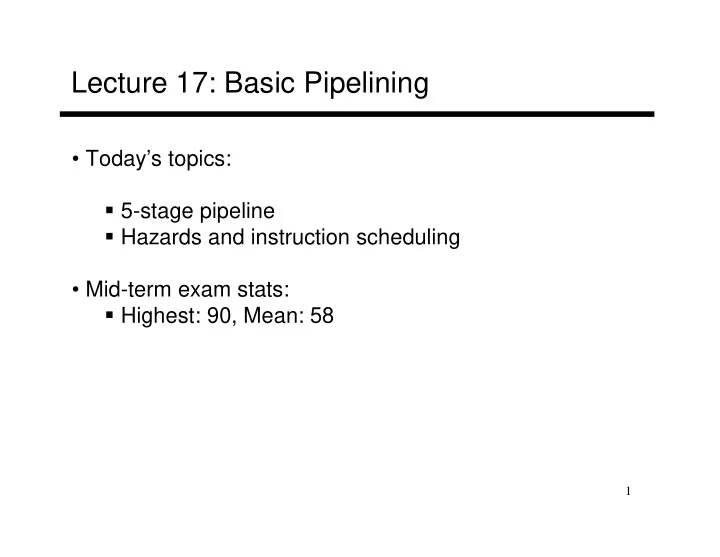
Lecture 17: Basic Pipelining Todays topics: 5-stage pipeline - - PowerPoint PPT Presentation

lecture 17 basic pipelining
SMART_READER_LITE
LIVE PREVIEW

Lecture 17: Basic Pipelining Todays topics: 5-stage pipeline - - PowerPoint PPT Presentation

Lecture 17: Basic Pipelining Todays topics: 5-stage pipeline Hazards and instruction scheduling Mid-term exam stats: Highest: 90, Mean: 58 1 Multi-Cycle Processor Single memory unit shared by instructions and memory


slide-1
SLIDE 1

1

Lecture 17: Basic Pipelining

  • Today’s topics:

5-stage pipeline Hazards and instruction scheduling

  • Mid-term exam stats:

Highest: 90, Mean: 58

slide-2
SLIDE 2

2

Multi-Cycle Processor

  • Single memory unit shared by instructions and memory
  • Single ALU also used for PC updates
  • Registers (latches) to store the result of every block
slide-3
SLIDE 3

3

The Assembly Line

A Start and finish a job before moving to the next Time Jobs Break the job into smaller stages B C A B C A B C A B C

Unpipelined Pipelined

slide-4
SLIDE 4

4

Performance Improvements?

  • Does it take longer to finish each individual job?
  • Does it take shorter to finish a series of jobs?
  • What assumptions were made while answering these

questions?

  • Is a 10-stage pipeline better than a 5-stage pipeline?
slide-5
SLIDE 5

5

Quantitative Effects

  • As a result of pipelining:

Time in ns per instruction goes up Each instruction takes more cycles to execute But… average CPI remains roughly the same Clock speed goes up Total execution time goes down, resulting in lower average time per instruction Under ideal conditions, speedup = ratio of elapsed times between successive instruction completions = number of pipeline stages = increase in clock speed

slide-6
SLIDE 6

6

A 5-Stage Pipeline

slide-7
SLIDE 7

7

A 5-Stage Pipeline

Use the PC to access the I-cache and increment PC by 4

slide-8
SLIDE 8

8

A 5-Stage Pipeline

Read registers, compare registers, compute branch target; for now, assume branches take 2 cyc (there is enough work that branches can easily take more)

slide-9
SLIDE 9

9

A 5-Stage Pipeline

ALU computation, effective address computation for load/store

slide-10
SLIDE 10

10

A 5-Stage Pipeline

Memory access to/from data cache, stores finish in 4 cycles

slide-11
SLIDE 11

11

A 5-Stage Pipeline

Write result of ALU computation or load into register file

slide-12
SLIDE 12

12

Conflicts/Problems

  • I-cache and D-cache are accessed in the same cycle – it

helps to implement them separately

  • Registers are read and written in the same cycle – easy to

deal with if register read/write time equals cycle time/2 (else, use bypassing)

  • Branch target changes only at the end of the second stage
  • - what do you do in the meantime?
  • Data between stages get latched into registers (overhead

that increases latency per instruction)

slide-13
SLIDE 13

13

Hazards

  • Structural hazards: different instructions in different stages

(or the same stage) conflicting for the same resource

  • Data hazards: an instruction cannot continue because it

needs a value that has not yet been generated by an earlier instruction

  • Control hazard: fetch cannot continue because it does

not know the outcome of an earlier branch – special case

  • f a data hazard – separate category because they are

treated in different ways

slide-14
SLIDE 14

14

Structural Hazards

  • Example: a unified instruction and data cache

stage 4 (MEM) and stage 1 (IF) can never coincide

  • The later instruction and all its successors are delayed

until a cycle is found when the resource is free these are pipeline bubbles

  • Structural hazards are easy to eliminate – increase the

number of resources (for example, implement a separate instruction and data cache)

slide-15
SLIDE 15

15

Data Hazards

slide-16
SLIDE 16

16

Bypassing

  • Some data hazard stalls can be eliminated: bypassing
slide-17
SLIDE 17

17

Data Hazard Stalls

slide-18
SLIDE 18

18

Data Hazard Stalls

slide-19
SLIDE 19

19

Example

add $1, $2, $3 lw $4, 8($1)

slide-20
SLIDE 20

20

Example

lw $1, 8($2) lw $4, 8($1)

slide-21
SLIDE 21

21

Example

lw $1, 8($2) sw $1, 8($3)

slide-22
SLIDE 22

22

Control Hazards

  • Simple techniques to handle control hazard stalls:

for every branch, introduce a stall cycle (note: every 6th instruction is a branch!) assume the branch is not taken and start fetching the next instruction – if the branch is taken, need hardware to cancel the effect of the wrong-path instruction fetch the next instruction (branch delay slot) and execute it anyway – if the instruction turns out to be

  • n the correct path, useful work was done – if the

instruction turns out to be on the wrong path, hopefully program state is not lost

slide-23
SLIDE 23

23

Branch Delay Slots

slide-24
SLIDE 24

24

Slowdowns from Stalls

  • Perfect pipelining with no hazards an instruction

completes every cycle (total cycles ~ num instructions) speedup = increase in clock speed = num pipeline stages

  • With hazards and stalls, some cycles (= stall time) go by

during which no instruction completes, and then the stalled instruction completes

  • Total cycles = number of instructions + stall cycles
slide-25
SLIDE 25

25

Title

  • Bullet