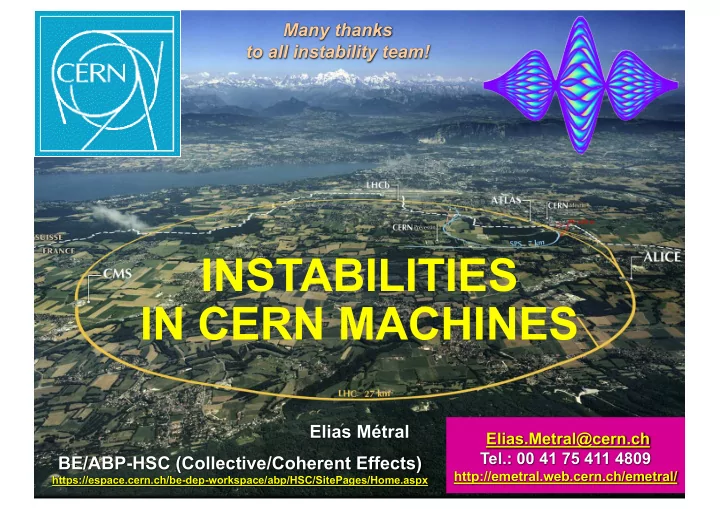
INSTABILITIES IN CERN MACHINES Elias Mtral Elias.Metral@cern.ch - - PowerPoint PPT Presentation

instabilities in cern machines
SMART_READER_LITE
LIVE PREVIEW

INSTABILITIES IN CERN MACHINES Elias Mtral Elias.Metral@cern.ch - - PowerPoint PPT Presentation

Many thanks to all instability team! INSTABILITIES IN CERN MACHINES Elias Mtral Elias.Metral@cern.ch Tel.: 00 41 75 411 4809 BE/ABP-HSC (Collective/Coherent Effects) http://emetral.web.cern.ch/emetral/


slide-1
SLIDE 1

Elias Métral, Workshop on Megawatt Rings and 2018 Annual IOTA/FAST Collaboration Meeting, Fermilab, USA, 08/05/2018 / 30 1

INSTABILITIES IN CERN MACHINES

Many thanks to all instability team!

Elias.Metral@cern.ch Tel.: 00 41 75 411 4809

http://emetral.web.cern.ch/emetral/

Elias Métral BE/ABP-HSC (Collective/Coherent Effects)

https://espace.cern.ch/be-dep-workspace/abp/HSC/SitePages/Home.aspx

slide-2
SLIDE 2

Elias Métral, Workshop on Megawatt Rings and 2018 Annual IOTA/FAST Collaboration Meeting, Fermilab, USA, 08/05/2018 / 30 2

◆ Introduction ◆ Current challenges ◆ 4 questions raised and discussed here ◆ Conclusion and next steps

CONTENTS

slide-3
SLIDE 3

Elias Métral, Workshop on Megawatt Rings and 2018 Annual IOTA/FAST Collaboration Meeting, Fermilab, USA, 08/05/2018 / 30 3

INTRODUCTION

PSB (with LINAC4) 50 (160) MeV => 1.4 (2) GeV PS (with LINAC4) 1.4 (2) GeV => 25 GeV SPS 25 GeV => 450 GeV LHC 450 GeV => 7 (6.5) TeV

slide-4
SLIDE 4

Elias Métral, Workshop on Megawatt Rings and 2018 Annual IOTA/FAST Collaboration Meeting, Fermilab, USA, 08/05/2018 / 30 3

INTRODUCTION

LIU = LHC Injectors Upgrade HL-LHC = High-Luminosity LHC

PSB (with LINAC4) 50 (160) MeV => 1.4 (2) GeV PS (with LINAC4) 1.4 (2) GeV => 25 GeV SPS 25 GeV => 450 GeV LHC 450 GeV => 7 (6.5) TeV

  • G. Rumolo (Chamonix2018)
slide-5
SLIDE 5

Elias Métral, Workshop on Megawatt Rings and 2018 Annual IOTA/FAST Collaboration Meeting, Fermilab, USA, 08/05/2018 / 30 4

INTRODUCTION

slide-6
SLIDE 6

Elias Métral, Workshop on Megawatt Rings and 2018 Annual IOTA/FAST Collaboration Meeting, Fermilab, USA, 08/05/2018 / 30 4

INTRODUCTION

~ 2 1034 cm-2s-1 with ~ 1.2 1011 p/b within ~ 2.5 𝛎m

slide-7
SLIDE 7

Elias Métral, Workshop on Megawatt Rings and 2018 Annual IOTA/FAST Collaboration Meeting, Fermilab, USA, 08/05/2018 / 30 5

CURRENT CHALLENGES

◆ For LIU

§

PSB instability during ramp (close to future injection energy) without damper => Could this be a problem in the future?

§

PS longitudinal instabilities => New Landau cavity under discussion

§

SPS longitudinal instabilities => RF power upgrade + longitudinal impedance reduction

§

New SPS horizontal instability observed with higher than nominal bunch intensity => Could this be a problem in the future?

slide-8
SLIDE 8

Elias Métral, Workshop on Megawatt Rings and 2018 Annual IOTA/FAST Collaboration Meeting, Fermilab, USA, 08/05/2018 / 30 5

CURRENT CHALLENGES

◆ For LIU

§

PSB instability during ramp (close to future injection energy) without damper => Could this be a problem in the future?

§

PS longitudinal instabilities => New Landau cavity under discussion

§

SPS longitudinal instabilities => RF power upgrade + longitudinal impedance reduction

§

New SPS horizontal instability observed with higher than nominal bunch intensity => Could this be a problem in the future?

◆ For HL-LHC

§

At LHC injection, high chromaticities, high Landau octupoles current and high damper gain are needed => What will happen for HL-LHC?

§

Why do we need more Landau octupoles current than predicted at high energy in the LHC?

§

Will we have enough Landau damping for HL-LHC (with new equipment: Crab Cavities, low-impedance collimators, etc.)?

slide-9
SLIDE 9

Elias Métral, Workshop on Megawatt Rings and 2018 Annual IOTA/FAST Collaboration Meeting, Fermilab, USA, 08/05/2018 / 30 6

4 QUESTIONS RAISED AND DISCUSSED HERE

◆ Only transverse instabilities will be discussed

slide-10
SLIDE 10

Elias Métral, Workshop on Megawatt Rings and 2018 Annual IOTA/FAST Collaboration Meeting, Fermilab, USA, 08/05/2018 / 30 6

4 QUESTIONS RAISED AND DISCUSSED HERE

◆ Only transverse instabilities will be discussed ◆ 4 questions

1) What is the effect of direct space charge on (coherent)

instabilities in CERN machines (PSB, PS, SPS and LHC)?

slide-11
SLIDE 11

Elias Métral, Workshop on Megawatt Rings and 2018 Annual IOTA/FAST Collaboration Meeting, Fermilab, USA, 08/05/2018 / 30 6

4 QUESTIONS RAISED AND DISCUSSED HERE

◆ Only transverse instabilities will be discussed ◆ 4 questions

1) What is the effect of direct space charge on (coherent)

instabilities in CERN machines (PSB, PS, SPS and LHC)?

2) LHC instabilities at injection: we need high chromaticities, high

Landau octupoles current and high damper gain => Why and what will happen for HL-LHC?

slide-12
SLIDE 12

Elias Métral, Workshop on Megawatt Rings and 2018 Annual IOTA/FAST Collaboration Meeting, Fermilab, USA, 08/05/2018 / 30 6

4 QUESTIONS RAISED AND DISCUSSED HERE

◆ Only transverse instabilities will be discussed ◆ 4 questions

1) What is the effect of direct space charge on (coherent)

instabilities in CERN machines (PSB, PS, SPS and LHC)?

2) LHC instabilities at injection: we need high chromaticities, high

Landau octupoles current and high damper gain => Why and what will happen for HL-LHC?

3) What is the “16L2 instability” observed in the LHC in 2017 (and

2018)?

slide-13
SLIDE 13

Elias Métral, Workshop on Megawatt Rings and 2018 Annual IOTA/FAST Collaboration Meeting, Fermilab, USA, 08/05/2018 / 30 6

4 QUESTIONS RAISED AND DISCUSSED HERE

◆ Only transverse instabilities will be discussed ◆ 4 questions

1) What is the effect of direct space charge on (coherent)

instabilities in CERN machines (PSB, PS, SPS and LHC)?

2) LHC instabilities at injection: we need high chromaticities, high

Landau octupoles current and high damper gain => Why and what will happen for HL-LHC?

3) What is the “16L2 instability” observed in the LHC in 2017 (and

2018)?

4) Why

do we need more Landau

  • ctupoles

current than predicted at high energy in the LHC (potential worry for HL- LHC)? => Subject I will mostly discuss, with 2 destabilising effects currently studied

slide-14
SLIDE 14

Elias Métral, Workshop on Megawatt Rings and 2018 Annual IOTA/FAST Collaboration Meeting, Fermilab, USA, 08/05/2018 / 30 7

1) EFFECT OF DIRECT SPACE CHARGE ON CERN INSTABILITIES?

slide-15
SLIDE 15

Elias Métral, Workshop on Megawatt Rings and 2018 Annual IOTA/FAST Collaboration Meeting, Fermilab, USA, 08/05/2018 / 30 8

=> At CERN, it seems that only the LHC (highest energy machine) sees the (beneficial) effect of space charge…

slide-16
SLIDE 16

Elias Métral, Workshop on Megawatt Rings and 2018 Annual IOTA/FAST Collaboration Meeting, Fermilab, USA, 08/05/2018 / 30 8

=> At CERN, it seems that only the LHC (highest energy machine) sees the (beneficial) effect of space charge…

§

PSB (ΔQsc / Qs >> 1)

  • Instabilities observed during the ramp without damper => Space

charge could potentially play a role

  • However: no important change of instability onset along the cycle

when changing bunch length (and shape) for constant intensity. Tbc

  • G. Rumolo
slide-17
SLIDE 17

Elias Métral, Workshop on Megawatt Rings and 2018 Annual IOTA/FAST Collaboration Meeting, Fermilab, USA, 08/05/2018 / 30 8

=> At CERN, it seems that only the LHC (highest energy machine) sees the (beneficial) effect of space charge…

§

PSB (ΔQsc / Qs >> 1)

  • Instabilities observed during the ramp without damper => Space

charge could potentially play a role

  • However: no important change of instability onset along the cycle

when changing bunch length (and shape) for constant intensity. Tbc

§

PS (ΔQsc / Qs >> 1)

  • Head-Tail instability with 6 nodes at injection (Q’ ~ - Q)
  • G. Rumolo
slide-18
SLIDE 18

Elias Métral, Workshop on Megawatt Rings and 2018 Annual IOTA/FAST Collaboration Meeting, Fermilab, USA, 08/05/2018 / 30 8

=> At CERN, it seems that only the LHC (highest energy machine) sees the (beneficial) effect of space charge…

§

PSB (ΔQsc / Qs >> 1)

  • Instabilities observed during the ramp without damper => Space

charge could potentially play a role

  • However: no important change of instability onset along the cycle

when changing bunch length (and shape) for constant intensity. Tbc

§

PS (ΔQsc / Qs >> 1)

  • Head-Tail instability with 6 nodes at injection (Q’ ~ - Q)

§

SPS (ΔQsc / Qs >> 1)

  • TMCI between modes - 2 and - 3 at injection (Q’ ~ 0)
  • G. Rumolo
slide-19
SLIDE 19

Elias Métral, Workshop on Megawatt Rings and 2018 Annual IOTA/FAST Collaboration Meeting, Fermilab, USA, 08/05/2018 / 30 8

=> At CERN, it seems that only the LHC (highest energy machine) sees the (beneficial) effect of space charge…

§

PSB (ΔQsc / Qs >> 1)

  • Instabilities observed during the ramp without damper => Space

charge could potentially play a role

  • However: no important change of instability onset along the cycle

when changing bunch length (and shape) for constant intensity. Tbc

§

PS (ΔQsc / Qs >> 1)

  • Head-Tail instability with 6 nodes at injection (Q’ ~ - Q)

§

SPS (ΔQsc / Qs >> 1)

  • TMCI between modes - 2 and - 3 at injection (Q’ ~ 0)

§

LHC (ΔQsc / Qs ~ 1)

  • Head-Tail instability with 1 node (Q’ ~ 5) => Stabilized by space charge

below a certain energy

  • Predicted threshold for TMCI (modes - 1 and 0) at injection (Q’ ~ 0)

increased by space charge

  • G. Rumolo
slide-20
SLIDE 20

Elias Métral, Workshop on Megawatt Rings and 2018 Annual IOTA/FAST Collaboration Meeting, Fermilab, USA, 08/05/2018 / 30 9

◆ SPS case: HEADTAIL simulations from 2014 (H. Bartosik) for

different optics WITHOUT space charge

slide-21
SLIDE 21

Elias Métral, Workshop on Megawatt Rings and 2018 Annual IOTA/FAST Collaboration Meeting, Fermilab, USA, 08/05/2018 / 30 9

◆ SPS case: HEADTAIL simulations from 2014 (H. Bartosik) for

different optics WITHOUT space charge

Q22 measured in 2017

slide-22
SLIDE 22

Elias Métral, Workshop on Megawatt Rings and 2018 Annual IOTA/FAST Collaboration Meeting, Fermilab, USA, 08/05/2018 / 30 9

◆ SPS case: HEADTAIL simulations from 2014 (H. Bartosik) for

different optics WITHOUT space charge

§

Intensity thresholds also well predicted with simple formula (which is the same as coasting-beam with peak values => Space charge is predicted to have no effect…)

§

Our simulations predict only little effect of space charge on threshold

Nb,th

y

∝ η Qy εL

Q22 measured in 2017

slide-23
SLIDE 23

Elias Métral, Workshop on Megawatt Rings and 2018 Annual IOTA/FAST Collaboration Meeting, Fermilab, USA, 08/05/2018 / 30 9

◆ SPS case: HEADTAIL simulations from 2014 (H. Bartosik) for

different optics WITHOUT space charge

§

Intensity thresholds also well predicted with simple formula (which is the same as coasting-beam with peak values => Space charge is predicted to have no effect…)

§

Our simulations predict only little effect of space charge on threshold

=> Question for theories with space charge: can they explain these 3 thresholds by changing the optics?

Nb,th

y

∝ η Qy εL

Q22 measured in 2017

slide-24
SLIDE 24

Elias Métral, Workshop on Megawatt Rings and 2018 Annual IOTA/FAST Collaboration Meeting, Fermilab, USA, 08/05/2018 / 30 10

2) LHC INSTABILITIES AT INJECTION

slide-25
SLIDE 25

Elias Métral, Workshop on Megawatt Rings and 2018 Annual IOTA/FAST Collaboration Meeting, Fermilab, USA, 08/05/2018 / 30 11

◆ E-cloud in dipoles (~ 65% of the machine) is not expected to drive

instabilities both at injection and top energy

§

Becomes better with higher intensity => No issue expected for HL-LHC

§

Becomes worse for lower intensity => Some observations already made

  • A. Romano (finalising PHD)
slide-26
SLIDE 26

Elias Métral, Workshop on Megawatt Rings and 2018 Annual IOTA/FAST Collaboration Meeting, Fermilab, USA, 08/05/2018 / 30 11

◆ E-cloud in dipoles (~ 65% of the machine) is not expected to drive

instabilities both at injection and top energy

§

Becomes better with higher intensity => No issue expected for HL-LHC

§

Becomes worse for lower intensity => Some observations already made

◆ E-cloud in quadrupoles (~ 7% of the machine) alone is a key driver

  • f instabilities at LHC injection energy

§

Explains high chroma (~ 15-20 units) + high Landau octupoles current (~ 20-40 A) + high damper gain (~ 10-20 turns) in both transverse planes => Favorable scaling with intensity expected

§

Instability suppressed when increasing beam energy up to 6.5 TeV due to increased beam rigidity

  • A. Romano (finalising PHD)
slide-27
SLIDE 27

Elias Métral, Workshop on Megawatt Rings and 2018 Annual IOTA/FAST Collaboration Meeting, Fermilab, USA, 08/05/2018 / 30 12

3) “16L2 INSTABILITY”

slide-28
SLIDE 28

Elias Métral, Workshop on Megawatt Rings and 2018 Annual IOTA/FAST Collaboration Meeting, Fermilab, USA, 08/05/2018 / 30 13

◆ 16L2: cryogenic beam vacuum at half-cell 16 left of LHC-IP2

See 2 IPAC18 papers by B. Salvant et al.

slide-29
SLIDE 29

Elias Métral, Workshop on Megawatt Rings and 2018 Annual IOTA/FAST Collaboration Meeting, Fermilab, USA, 08/05/2018 / 30 13

◆ 16L2: cryogenic beam vacuum at half-cell 16 left of LHC-IP2 ◆ 67 beam dumps in 2017 due to fast beam losses in 16L2, which led

to transverse coherent instabilities with rise-times of few 10s of turns (i.e. 1-2 orders of magnitude faster than instabilities from e- cloud or impedance)

See 2 IPAC18 papers by B. Salvant et al.

slide-30
SLIDE 30

Elias Métral, Workshop on Megawatt Rings and 2018 Annual IOTA/FAST Collaboration Meeting, Fermilab, USA, 08/05/2018 / 30 13

◆ 16L2: cryogenic beam vacuum at half-cell 16 left of LHC-IP2 ◆ 67 beam dumps in 2017 due to fast beam losses in 16L2, which led

to transverse coherent instabilities with rise-times of few 10s of turns (i.e. 1-2 orders of magnitude faster than instabilities from e- cloud or impedance)

◆ Most probable cause: accidental air inlet into LHC beam vacuum

with beam screen at 20 K at end of Technical Stop => Condensation and solidification of gases on beam screen surface in and around beam plug-in-module

See 2 IPAC18 papers by B. Salvant et al.

slide-31
SLIDE 31

Elias Métral, Workshop on Megawatt Rings and 2018 Annual IOTA/FAST Collaboration Meeting, Fermilab, USA, 08/05/2018 / 30

◆ 16L2: cryogenic beam vacuum at half-cell 16 left of LHC-IP2 ◆ 67 beam dumps in 2017 due to fast beam losses in 16L2, which led

to transverse coherent instabilities with rise-times of few 10s of turns (i.e. 1-2 orders of magnitude faster than instabilities from e- cloud or impedance)

◆ Most probable cause: accidental air inlet into LHC beam vacuum

with beam screen at 20 K at end of Technical Stop => Condensation and solidification of gases on beam screen surface in and around beam plug-in-module

◆ Interaction of LHC proton beam with flakes of these frozen gases

detaching from beam screen surface is assumed to be at the origin

  • f the beam losses in 16L2 => Ionization: ions + e-

13

See 2 IPAC18 papers by B. Salvant et al.

slide-32
SLIDE 32

Elias Métral, Workshop on Megawatt Rings and 2018 Annual IOTA/FAST Collaboration Meeting, Fermilab, USA, 08/05/2018 / 30 14

◆ Single-bunch and coupled-bunch instabilities observed ◆ Important > 0 tune shift measured: + ~ 0.01-0.02

  • T. Levens and B. Salvant
slide-33
SLIDE 33

Elias Métral, Workshop on Megawatt Rings and 2018 Annual IOTA/FAST Collaboration Meeting, Fermilab, USA, 08/05/2018 / 30 15

◆ Approximated model (as only e- are expected to oscillate within

bunch passage)

§

Equivalent impedance from an e-cloud (as F. Zimmermann et al.)

  • Measured (>0) tune shift => Deduce e- density => ~ 150 M𝛁/m shunt

impedance

  • e- frequency => ~ 2.6 GHz
  • Q = 1

§

Simulations with DELPHI Vlasov solver

◆ Note: Self-consistent simulations, taking into account both ions and

e-, are on-going (L. Mether)

slide-34
SLIDE 34

Elias Métral, Workshop on Megawatt Rings and 2018 Annual IOTA/FAST Collaboration Meeting, Fermilab, USA, 08/05/2018 / 30 16

DELPHI

Comparison with observations

10-20 turns

B1V HT pickup, 5 turns, 600 GeV

Growth rate: Radial pattern: DELPHI

  • N. Biancacci and D. Amorim

MEASUREMENTS SIMULATIONS

slide-35
SLIDE 35

Elias Métral, Workshop on Megawatt Rings and 2018 Annual IOTA/FAST Collaboration Meeting, Fermilab, USA, 08/05/2018 / 30 17

4) WHY DO WE NEED MORE LANDAU OCTUPOLES CURRENT THAN PREDICTED AT HIGH ENERGY IN THE LHC?

slide-36
SLIDE 36

Elias Métral, Workshop on Megawatt Rings and 2018 Annual IOTA/FAST Collaboration Meeting, Fermilab, USA, 08/05/2018 / 30 18

◆ 2 main issues => Already observed with 1 bunch

§

Factor ~ 2 higher Landau octupoles current in OP conditions (Q’ ~ 15, ~ 50 turns damper) => ~ 400-450 A needed vs. ~ 200-250 A

predicted

§

Even more critical for Q’ ~ 0

slide-37
SLIDE 37

Elias Métral, Workshop on Megawatt Rings and 2018 Annual IOTA/FAST Collaboration Meeting, Fermilab, USA, 08/05/2018 / 30 18

◆ 2 main issues => Already observed with 1 bunch

§

Factor ~ 2 higher Landau octupoles current in OP conditions (Q’ ~ 15, ~ 50 turns damper) => ~ 400-450 A needed vs. ~ 200-250 A

predicted

§

Even more critical for Q’ ~ 0

◆ 2 destabilising mechanisms under study

1) “Perfect” damper (for Q’ ~ 0) 2) External source of noise (e.g. damper)

slide-38
SLIDE 38

Elias Métral, Workshop on Megawatt Rings and 2018 Annual IOTA/FAST Collaboration Meeting, Fermilab, USA, 08/05/2018 / 30 18

◆ 2 main issues => Already observed with 1 bunch

§

Factor ~ 2 higher Landau octupoles current in OP conditions (Q’ ~ 15, ~ 50 turns damper) => ~ 400-450 A needed vs. ~ 200-250 A

predicted

§

Even more critical for Q’ ~ 0

◆ 2 destabilising mechanisms under study

1) “Perfect” damper (for Q’ ~ 0) 2) External source of noise (e.g. damper)

In addition to other 3 already discussed in the past: 1) Interplay octupoles & beam-beam 2) Linear coupling 3) Lattice non-linearities

slide-39
SLIDE 39

Elias Métral, Workshop on Megawatt Rings and 2018 Annual IOTA/FAST Collaboration Meeting, Fermilab, USA, 08/05/2018 / 30 19

Needed for TCBI

(Transverse Coupled- Bunch Instabilities)

4.1) DESTABILISING EFFECT OF “PERFECT” DAMPER

slide-40
SLIDE 40

Elias Métral, Workshop on Megawatt Rings and 2018 Annual IOTA/FAST Collaboration Meeting, Fermilab, USA, 08/05/2018 / 30 40

MOTIVATION

L.R. Carver et al.

LHC single-bunch instabilities with Q’ ~ 0 (2015)

slide-41
SLIDE 41

Elias Métral, Workshop on Megawatt Rings and 2018 Annual IOTA/FAST Collaboration Meeting, Fermilab, USA, 08/05/2018 / 30 41

MOTIVATION

L.R. Carver et al.

LHC single-bunch instabilities with Q’ ~ 0 (2015)

Predictions

slide-42
SLIDE 42

Elias Métral, Workshop on Megawatt Rings and 2018 Annual IOTA/FAST Collaboration Meeting, Fermilab, USA, 08/05/2018 / 30 42

MOTIVATION

L.R. Carver et al.

LHC single-bunch instabilities with Q’ ~ 0 (2015)

Predictions Measurements

slide-43
SLIDE 43

Elias Métral, Workshop on Megawatt Rings and 2018 Annual IOTA/FAST Collaboration Meeting, Fermilab, USA, 08/05/2018 / 30 43

MOTIVATION

L.R. Carver et al.

LHC single-bunch instabilities with Q’ ~ 0 (2015)

Predictions Measurements => 2 questions: 1) What is the (exact) predicted instability mechanism? 2) Is Landau damping well computed (stability diagram => 1-mode approach)?

slide-44
SLIDE 44

Elias Métral, Workshop on Megawatt Rings and 2018 Annual IOTA/FAST Collaboration Meeting, Fermilab, USA, 08/05/2018 / 30 21

NEW VLASOV SOLVER: GALACTIC (GArnier-LAclare Coherent Transverse Instabilities Code)

Note that the same approach can be used also for Longitudinal Instabilities: GALACLIC => Will be discussed at CERN at the next section meeting on 14/05/18

(https://indico.cern.ch/event/725645/) See IPAC18 paper by E. Métral et al.

slide-45
SLIDE 45

Elias Métral, Workshop on Megawatt Rings and 2018 Annual IOTA/FAST Collaboration Meeting, Fermilab, USA, 08/05/2018 / 30 22

NEW VLASOV SOLVER: GALACTIC (GArnier-LAclare Coherent Transverse Instabilities Code)

−1 − 0.23 j x − 0.55 j x − 0.92 x ⎛ ⎝ ⎜ ⎜ ⎞ ⎠ ⎟ ⎟

◆ Approximated model with Q’ = 0

(no damper, no Landau damping) α bunch intensity

slide-46
SLIDE 46

Elias Métral, Workshop on Megawatt Rings and 2018 Annual IOTA/FAST Collaboration Meeting, Fermilab, USA, 08/05/2018 / 30 22

NEW VLASOV SOLVER: GALACTIC (GArnier-LAclare Coherent Transverse Instabilities Code)

−1 − 0.23 j x − 0.55 j x − 0.92 x ⎛ ⎝ ⎜ ⎜ ⎞ ⎠ ⎟ ⎟

0.0 0.5 1.0 1.5 2.0

  • 1.5
  • 1.0
  • 0.5

0.0 0.5

x Re (Δ Q) / Q s

0.0 0.5 1.0 1.5 2.0

  • 1.0
  • 0.5

0.0 0.5 1.0

x Im (Δ Q) / Q s

TMCI

(Transverse Mode- Coupling Instability)

α bunch intensity UNSTABLE

◆ Approximated model with Q’ = 0

(no damper, no Landau damping)

slide-47
SLIDE 47

Elias Métral, Workshop on Megawatt Rings and 2018 Annual IOTA/FAST Collaboration Meeting, Fermilab, USA, 08/05/2018 / 30 23

NEW VLASOV SOLVER: GALACTIC (GArnier-LAclare Coherent Transverse Instabilities Code)

◆ Approximated model with Q’ = 0

(with damper: nd = d / 2 = 50 turns)

−1 − 0.23 j x − 0.55 j x − 0.92 x + 0.48 j ⎛ ⎝ ⎜ ⎜ ⎞ ⎠ ⎟ ⎟

slide-48
SLIDE 48

Elias Métral, Workshop on Megawatt Rings and 2018 Annual IOTA/FAST Collaboration Meeting, Fermilab, USA, 08/05/2018 / 30 23

NEW VLASOV SOLVER: GALACTIC (GArnier-LAclare Coherent Transverse Instabilities Code)

−1 − 0.23 j x − 0.55 j x − 0.92 x + 0.48 j ⎛ ⎝ ⎜ ⎜ ⎞ ⎠ ⎟ ⎟

0.0 0.5 1.0 1.5 2.0

  • 1.5
  • 1.0
  • 0.5

0.0 0.5

x Re (Δ Q) / Q s

0.0 0.5 1.0 1.5 2.0

  • 1.0
  • 0.5

0.0 0.5 1.0

x Im (Δ Q) / Q s

◆ Approximated model with Q’ = 0

(with damper: nd = d / 2 = 50 turns)

slide-49
SLIDE 49

Elias Métral, Workshop on Megawatt Rings and 2018 Annual IOTA/FAST Collaboration Meeting, Fermilab, USA, 08/05/2018 / 30 49

NEW VLASOV SOLVER: GALACTIC (GArnier-LAclare Coherent Transverse Instabilities Code)

−1 − 0.23 j x − 0.55 j x − 0.92 x + 0.48 j ⎛ ⎝ ⎜ ⎜ ⎞ ⎠ ⎟ ⎟

0.0 0.5 1.0 1.5 2.0

  • 1.5
  • 1.0
  • 0.5

0.0 0.5

x Re (Δ Q) / Q s

0.0 0.5 1.0 1.5 2.0

  • 1.0
  • 0.5

0.0 0.5 1.0

x Im (Δ Q) / Q s

0.0 0.2 0.4 0.6 0.8 1.0

  • 0.20
  • 0.15
  • 0.10
  • 0.05

0.00

x Im (Δ Q) / Q s

New ISR instability

(Imaginary tune Split & Repulsion) ◆ Approximated model with Q’ = 0

(with damper: nd = d / 2 = 50 turns)

slide-50
SLIDE 50

Elias Métral, Workshop on Megawatt Rings and 2018 Annual IOTA/FAST Collaboration Meeting, Fermilab, USA, 08/05/2018 / 30 24

IMPACT ON LANDAU DAMPING

0.0 0.2 0.4 0.6 0.8 1.0 1.2 0.0 0.2 0.4 0.6 0.8 1.0

x

Δq

Required tune spread to reach bunch stability

slide-51
SLIDE 51

Elias Métral, Workshop on Megawatt Rings and 2018 Annual IOTA/FAST Collaboration Meeting, Fermilab, USA, 08/05/2018 / 30 24

IMPACT ON LANDAU DAMPING

0.0 0.2 0.4 0.6 0.8 1.0 1.2 0.0 0.2 0.4 0.6 0.8 1.0

x

Δq

Required tune spread to reach bunch stability 1-mode approach (usual stability diagram) 2-mode approach

slide-52
SLIDE 52

Elias Métral, Workshop on Megawatt Rings and 2018 Annual IOTA/FAST Collaboration Meeting, Fermilab, USA, 08/05/2018 / 30 24

IMPACT ON LANDAU DAMPING

0.0 0.2 0.4 0.6 0.8 1.0 1.2 0.0 0.2 0.4 0.6 0.8 1.0

x

Δq

Required tune spread to reach bunch stability 1-mode approach (usual stability diagram) 2-mode approach ~ threshold for TMCI (without damper)

slide-53
SLIDE 53

Elias Métral, Workshop on Megawatt Rings and 2018 Annual IOTA/FAST Collaboration Meeting, Fermilab, USA, 08/05/2018 / 30 25

CONCLUSION for 4.1)

◆ 1st step: new (single-bunch) instability mechanism => Confirmed

and finalised (still to be confirmed by measurements)

slide-54
SLIDE 54

Elias Métral, Workshop on Megawatt Rings and 2018 Annual IOTA/FAST Collaboration Meeting, Fermilab, USA, 08/05/2018 / 30 25

CONCLUSION for 4.1)

◆ 1st step: new (single-bunch) instability mechanism => Confirmed

and finalised (still to be confirmed by measurements)

◆ 2nd step: Landau damping => To be confirmed and finalised

slide-55
SLIDE 55

Elias Métral, Workshop on Megawatt Rings and 2018 Annual IOTA/FAST Collaboration Meeting, Fermilab, USA, 08/05/2018 / 30 25

CONCLUSION for 4.1)

◆ 1st step: new (single-bunch) instability mechanism => Confirmed

and finalised (still to be confirmed by measurements)

◆ 2nd step: Landau damping => To be confirmed and finalised

§

Below ~ TMCI intensity threshold (without damper), 1-mode approach (usual stability diagram) seems fine

slide-56
SLIDE 56

Elias Métral, Workshop on Megawatt Rings and 2018 Annual IOTA/FAST Collaboration Meeting, Fermilab, USA, 08/05/2018 / 30 25

CONCLUSION for 4.1)

◆ 1st step: new (single-bunch) instability mechanism => Confirmed

and finalised (still to be confirmed by measurements)

◆ 2nd step: Landau damping => To be confirmed and finalised

§

Below ~ TMCI intensity threshold (without damper), 1-mode approach (usual stability diagram) seems fine

  • LHC currently operated below TMCI (without damper)
  • In agreement with recent tracking results (X. Buffat) and

past analytical computations below TMCI (A. Burov)

slide-57
SLIDE 57

Elias Métral, Workshop on Megawatt Rings and 2018 Annual IOTA/FAST Collaboration Meeting, Fermilab, USA, 08/05/2018 / 30 25

CONCLUSION for 4.1)

◆ 1st step: new (single-bunch) instability mechanism => Confirmed

and finalised (still to be confirmed by measurements)

◆ 2nd step: Landau damping => To be confirmed and finalised

§

Below ~ TMCI intensity threshold (without damper), 1-mode approach (usual stability diagram) seems fine

  • LHC currently operated below TMCI (without damper)
  • In agreement with recent tracking results (X. Buffat) and

past analytical computations below TMCI (A. Burov)

§

Above ~ TMCI intensity threshold (without damper), 2-mode approach needed => More tune spread required

slide-58
SLIDE 58

Elias Métral, Workshop on Megawatt Rings and 2018 Annual IOTA/FAST Collaboration Meeting, Fermilab, USA, 08/05/2018 / 30

CONCLUSION for 4.1)

◆ 1st step: new (single-bunch) instability mechanism => Confirmed

and finalised (still to be confirmed by measurements)

◆ 2nd step: Landau damping => To be confirmed and finalised

§

Below ~ TMCI intensity threshold (without damper), 1-mode approach (usual stability diagram) seems fine

  • LHC currently operated below TMCI (without damper)
  • In agreement with recent tracking results (X. Buffat) and

past analytical computations below TMCI (A. Burov)

§

Above ~ TMCI intensity threshold (without damper), 2-mode approach needed => More tune spread required

◆ Seems that destabilising effect of LHC

(resistive) transverse damper (alone) cannot explain LHC observations with Q’ ~ 0 => Another mechanism needs to be identified / added...

25

slide-59
SLIDE 59

Elias Métral, Workshop on Megawatt Rings and 2018 Annual IOTA/FAST Collaboration Meeting, Fermilab, USA, 08/05/2018 / 30 26

4.2) DESTABILISING EFFECT OF EXTERNAL SOURCE OF NOISE

slide-60
SLIDE 60

Elias Métral, Workshop on Megawatt Rings and 2018 Annual IOTA/FAST Collaboration Meeting, Fermilab, USA, 08/05/2018 / 30 27

MOTIVATION

◆ 1st

studies with white noise in 2012 (X. Buffat) but

  • ther

mechanisms (with larger effects) had to be mitigated first

slide-61
SLIDE 61

Elias Métral, Workshop on Megawatt Rings and 2018 Annual IOTA/FAST Collaboration Meeting, Fermilab, USA, 08/05/2018 / 30 27

MOTIVATION

◆ 1st

studies with white noise in 2012 (X. Buffat) but

  • ther

mechanisms (with larger effects) had to be mitigated first

§

Latency time of several minutes for noise amplitude of ~ 10−4 (in unit

  • f beam size)

§

Compatible with emittance growth measured in collision and dedicated MDs with high-brightness bunches

§

Noise amplitude compatible with ~ μm resolution of damper pick-up

§

Noise attributed mainly to damper-induced noise and power converter ripple

slide-62
SLIDE 62

Elias Métral, Workshop on Megawatt Rings and 2018 Annual IOTA/FAST Collaboration Meeting, Fermilab, USA, 08/05/2018 / 30 27

MOTIVATION

◆ 1st

studies with white noise in 2012 (X. Buffat) but

  • ther

mechanisms (with larger effects) had to be mitigated first

§

Latency time of several minutes for noise amplitude of ~ 10−4 (in unit

  • f beam size)

§

Compatible with emittance growth measured in collision and dedicated MDs with high-brightness bunches

§

Noise amplitude compatible with ~ μm resolution of damper pick-up

§

Noise attributed mainly to damper-induced noise and power converter ripple

◆ Several instabilities observed with long latency time in 2017 (up to

~ 40 min at flat-top)

slide-63
SLIDE 63

Elias Métral, Workshop on Megawatt Rings and 2018 Annual IOTA/FAST Collaboration Meeting, Fermilab, USA, 08/05/2018 / 30 27

MOTIVATION

◆ 1st

studies with white noise in 2012 (X. Buffat) but

  • ther

mechanisms (with larger effects) had to be mitigated first

§

Latency time of several minutes for noise amplitude of ~ 10−4 (in unit

  • f beam size)

§

Compatible with emittance growth measured in collision and dedicated MDs with high-brightness bunches

§

Noise amplitude compatible with ~ μm resolution of damper pick-up

§

Noise attributed mainly to damper-induced noise and power converter ripple

◆ Several instabilities observed with long latency time in 2017 (up to

~ 40 min at flat-top)

◆ Observation in 2017 (and confirmation by simulations) of an

instability triggered by a harmonic excitation during BTF (Beam Transfer Function) measurements without damper (C. Tambasco et al.)

slide-64
SLIDE 64

Elias Métral, Workshop on Megawatt Rings and 2018 Annual IOTA/FAST Collaboration Meeting, Fermilab, USA, 08/05/2018 / 30 28

LONG LATENCY

  • X. Buffat

Observations

slide-65
SLIDE 65

Elias Métral, Workshop on Megawatt Rings and 2018 Annual IOTA/FAST Collaboration Meeting, Fermilab, USA, 08/05/2018 / 30 28

LONG LATENCY

  • X. Buffat

Observations Simulations (COMBI)

~ 13 min External source

  • f noise (in unit of

beam size)

  • X. Buffat
slide-66
SLIDE 66

Elias Métral, Workshop on Megawatt Rings and 2018 Annual IOTA/FAST Collaboration Meeting, Fermilab, USA, 08/05/2018 / 30 29

CONCLUSION for 4.2)

◆ External source of (dipolar) noise (e.g. damper) is a potential

explanation for missing factor ~ 2 in octupoles

slide-67
SLIDE 67

Elias Métral, Workshop on Megawatt Rings and 2018 Annual IOTA/FAST Collaboration Meeting, Fermilab, USA, 08/05/2018 / 30 29

CONCLUSION for 4.2)

◆ External source of (dipolar) noise (e.g. damper) is a potential

explanation for missing factor ~ 2 in octupoles => Proposal (MDs): Test long-term stability model by introducing noise in a controlled way with damper on different bunches and measure latency time

slide-68
SLIDE 68

Elias Métral, Workshop on Megawatt Rings and 2018 Annual IOTA/FAST Collaboration Meeting, Fermilab, USA, 08/05/2018 / 30 29

CONCLUSION for 4.2)

◆ External source of (dipolar) noise (e.g. damper) is a potential

explanation for missing factor ~ 2 in octupoles => Proposal (MDs): Test long-term stability model by introducing noise in a controlled way with damper on different bunches and measure latency time

  • D. Amorim

NOISE

slide-69
SLIDE 69

Elias Métral, Workshop on Megawatt Rings and 2018 Annual IOTA/FAST Collaboration Meeting, Fermilab, USA, 08/05/2018 / 30 30

CONCLUSION AND NEXT STEPS

◆ Answers to 4 questions raised

1)

What is the effect of direct space charge on (coherent) instabilities in CERN machines (PSB, PS, SPS and LHC)?

=> Seems that only the LHC (highest energy machine) sees the (beneficial) effect of space charge! Tbc…

slide-70
SLIDE 70

Elias Métral, Workshop on Megawatt Rings and 2018 Annual IOTA/FAST Collaboration Meeting, Fermilab, USA, 08/05/2018 / 30 30

CONCLUSION AND NEXT STEPS

◆ Answers to 4 questions raised

1)

What is the effect of direct space charge on (coherent) instabilities in CERN machines (PSB, PS, SPS and LHC)?

=> Seems that only the LHC (highest energy machine) sees the (beneficial) effect of space charge! Tbc…

2)

LHC instabilities at injection: we need high chromaticities, high Landau octupoles current and high damper gain => Why and what will happen for HL-LHC?

=> Due to e-cloud in quadrupoles (~ 7% of the machine) => Favorable scaling with intensity expected

slide-71
SLIDE 71

Elias Métral, Workshop on Megawatt Rings and 2018 Annual IOTA/FAST Collaboration Meeting, Fermilab, USA, 08/05/2018 / 30 30

CONCLUSION AND NEXT STEPS

◆ Answers to 4 questions raised

1)

What is the effect of direct space charge on (coherent) instabilities in CERN machines (PSB, PS, SPS and LHC)?

=> Seems that only the LHC (highest energy machine) sees the (beneficial) effect of space charge! Tbc…

2)

LHC instabilities at injection: we need high chromaticities, high Landau octupoles current and high damper gain => Why and what will happen for HL-LHC?

=> Due to e-cloud in quadrupoles (~ 7% of the machine) => Favorable scaling with intensity expected

3)

What is the “16L2 instability” observed in the LHC in 2017 (and 2018)?

=> Instability due to non-conformity: accidental air inlet into the LHC beam vacuum with beam screen at 20 K

slide-72
SLIDE 72

Elias Métral, Workshop on Megawatt Rings and 2018 Annual IOTA/FAST Collaboration Meeting, Fermilab, USA, 08/05/2018 / 30 30

CONCLUSION AND NEXT STEPS

◆ Answers to 4 questions raised

1)

What is the effect of direct space charge on (coherent) instabilities in CERN machines (PSB, PS, SPS and LHC)?

=> Seems that only the LHC (highest energy machine) sees the (beneficial) effect of space charge! Tbc…

2)

LHC instabilities at injection: we need high chromaticities, high Landau octupoles current and high damper gain => Why and what will happen for HL-LHC?

=> Due to e-cloud in quadrupoles (~ 7% of the machine) => Favorable scaling with intensity expected

3)

What is the “16L2 instability” observed in the LHC in 2017 (and 2018)?

=> Instability due to non-conformity: accidental air inlet into the LHC beam vacuum with beam screen at 20 K

4)

Why do we need more Landau octupoles current than predicted at high energy in the LHC?

=> Destabilising effect of damper (for Q’ ~ 0): not enough => External source of noise (e.g. damper) could explain remaining missing factor ~ 2 and long latency time. Tbc…