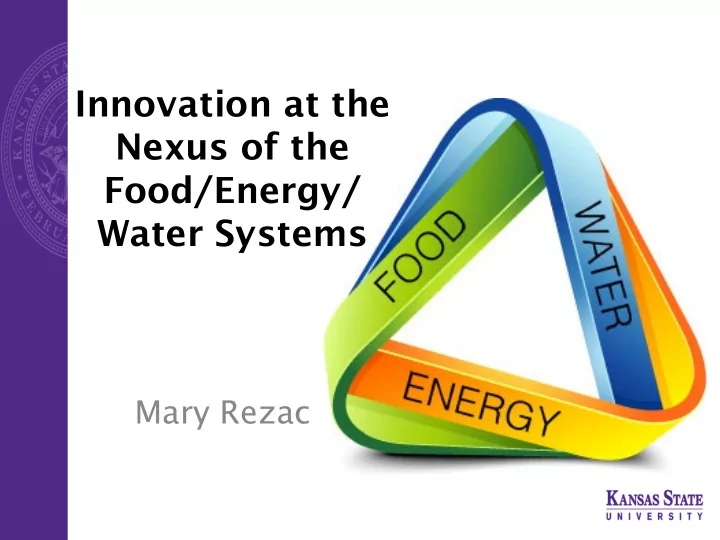
Innovation at the Nexus of the Food/Energy/ Water Systems Mary - - PowerPoint PPT Presentation
Innovation at the Nexus of the Food/Energy/ Water Systems Mary Rezac World Population Arable Land per capita (m 2 ) (Billion) 9 5000 8 7 4000 6 5 3000 4 2000 3 2 1000 1 1960 2005 2050 1960 2005 2050 Thankfully,
World Population (Billion) Arable Land per capita (m2)
1960 2005 2050 1960 2005 2050
9 8 7 6 5 4 3 2 1 5000 4000 3000 2000 1000
Thankfully, Agriculture has become more efficient
Renewable Water Resources, 2011 (m3/capita/year)
Water challenges
National Opportunities
- NSF to spend ~$45 M in FY17
- USDA AFRI ~$5M
- DoE proposed $38M for energy-
water nexus research in FY17
NSF’s investment in INFEWS will:
- Support integrated experimental research towards
creating a comprehensive food-energy-water sociotechnical systems model
- Advance knowledge/technologies that foster safer,
more secure, and more efficient use of resources within the food-energy-water nexus, and
- Support an integrated approach to build the next-
generation INFEWS workforce.
NSF’s INFEWS 2017
NSF 17-530
- $40M total budget ($35M NSF, $5M USDA)
- $2.5M max budget, 15-30 projects funded
- March 6, 2017
- 3 tracks of research:
(1) FEW System Modeling; (2) Visualization and Decision support for Cyber-Human-Physical Systems at the FEW Nexus; and (3) Research to Enable Innovative Solutions.
- A proposal may be submitted to ONLY ONE track per
competition.
- Limits on Faculty:
– 2 proposals total – 1 proposal per track – Lead PI on only 1 proposal – Applies to proposals submitted by K-State and as a sub-award from another institution.
- Team must include researchers from three or more of the
participating NSF directorates (CISE, ENG, GEO, MPS, SBE) or two (or more) directorates and USDA/NIFA (only if there’s an element that’s unique to USDA and not covered by the other two NSF directorates)
NSF INFEWS 2017
NSF 17-530
Track 1: FEW System Modeling
- Track 1 aims to significantly advance
understanding of FEW systems with advanced modeling that investigates the functioning of coupled biotic, abiotic, engineered and social
- systems. The goal is to define and understand the
couplings/linkages, feedback mechanisms and processes among the FEW systems components and to elucidate the factors that influence resilience, thresholds and criticalities. Track 1 projects should articulate clear hypotheses and/or describe what anticipated theoretical advancements will likely emerge from the modeling efforts.
Track 1: 2016 Funded Projects $10.9 M
- $2M Increasing regional to global-scale resilience in Food-Energy-
Water systems through coordinated management, technology and institutions Jennifer Adam, Washington State
- $1.9M Monitoring and managing food, energy, and water systems
under stress: California Steve Davis, UC Irvine
- $1.2M A Modeling Framework to Understand the coupling of Food,
Energy, and Water in the Teleconnected Corn and Cotton Belts Xin- Zhong Liang, Maryland
- $3M Mesoscale Data Fusion to Map and Model the U.S. Food,
Energy, and Water (FEW) System Benjamin Ruddell, Northern Arizona
- $2.8M Understanding multi-scale resilience options for vulnerable
regions Benjamin Zaitchik, Johns Hopkins
Track 2: Visualization and Decision Support for Cyber-Human-Physical Systems at the FEW Nexus
- Cyber-human-physical systems (CHPS) integrate
decision making at different spatial and temporal scales with sensing, computation, and networking measurements of the social, natural, physical and built worlds. Each FEW system is a large CHPS with human interaction influencing system outcomes.
- Track 2 seeks to develop the core system science
needed to understand the interactions between these diverse but closely coupled components that
- perate at multiple temporal and spatial scales.
Track 2: 2016 Funded Projects $6M
- $3M The sustainability-productivity tradeoff: Water
supply vulnerabilities and adaptation opportunities in California’s coupled agricultural and energy sectors Gregory Characklis, UNC at Chapel Hill
- $3M Flexible Model Compositions and Visual
Representations for Planning and Policy Decisions at the Sub-regional level of the food-energy-water nexus Ross Maciejewski, Arizona State
Track 3: Research to Enable Innovative System Solutions
- Track 3 projects will develop and examine
innovative solutions that address specific FEW system challenges and aim to enhance FEW systems’ resilience and sustainability. Track 3 research might explore sustainable management solutions, examine the drivers of resource consumption, and study the means of extending resources via methods such as reducing, recycling, recovery, and reuse, among other topics.
- Track 3 projects must take a systems approach
when researching potential solutions. A project that addresses the three components (food, energy, and water) separately is not appropriate for the INFEWS solicitation.
Track 3: 2016 Funded Projects $11.6M
- $2.6M Social-ecological-technological solutions to waste reuse in
food, energy, and water systems Lilian Alessa, U Idaho
- $1M Managing Energy, Water, and Information Flows for
Sustainability across the Advanced Food Ecosystem Callie Babbitt, Rochester Institute of Technology
- $2.7M Advancing Technologies and Improving Communication of
Urine-Derived Fertilizers for Food Production within a Risk-Based Framework Nancy Love, Michigan
- $1.1M Rethinking Dams: Innovative hydropower solutions to achieve
sustainable food and energy production, and sustainable communities Emilio Moran, Michigan State
- $2.7M Solar-Powered Integrated Greenhouse (SPRING) Systems Using
Wavelength Selective Photovoltaics for Complete Solar Utilization Brendan O’Connor, NC State
- $1.5M Reducing Household Food, Energy and Water Consumption: A
Quantitative Analysis of Interventions and Impacts of Conservation David Watkins, Michigan Tech
Finding Opportunities
- http://www.k-
state.edu/research/faculty/funding/search/
- Partnerships for International Research and
Education (PIRE) nsf 17-507 Summer 17 $4M / 5-yr award
- DE-FOA-0001428: INNOVATIVE DEVELOPMENT IN
ENERGY-RELATED APPLIED SCIENCE (IDEAS) September 2017 $500K / award
Breakout
- Break into groups
around potential proposal ideas
- Introduce yourself and identify
your specific interest in F, E, or W
- Discuss your interest in proposed idea
– Modify topic to fit the interests of the group – Identify major societal problem to be address – Identify potential research objectives – Identify research skills needed to solve this problem
- Who’s missing from the table?