Habitat loss and degradation PVA: Essay 12.2 (and adjacent text) - - PDF document

habitat loss and degradation
SMART_READER_LITE
LIVE PREVIEW

Habitat loss and degradation PVA: Essay 12.2 (and adjacent text) - - PDF document

Book reading that covers lectures up to the test Habitat loss and degradation PVA: Essay 12.2 (and adjacent text) Loss: Irreversible damage of a habitat Species invasion: p 293 - 331 (Case study 9.4 is informative Degradation: permanent or


slide-1
SLIDE 1

Book reading that covers lectures up to the test

PVA: Essay 12.2 (and adjacent text) Species invasion: p 293 - 331 (Case study 9.4 is informative

  • n biological control), no other boxes or essays. Some parts

in this chapter were not discussed in class. Overexploitation: p 257-258, p 260-262 p 265 - 274 !! (no Box or Essays) Habitat degradation: p 174-188, Essay 6.1 Habitat fragmentation: p 213-234, Essay 7.1, Box 7.1

Habitat loss and degradation

Loss: Irreversible damage of a habitat Degradation: permanent or temporal degradation (reduction

  • f its function) of a habitat

Transformation from one type into another one

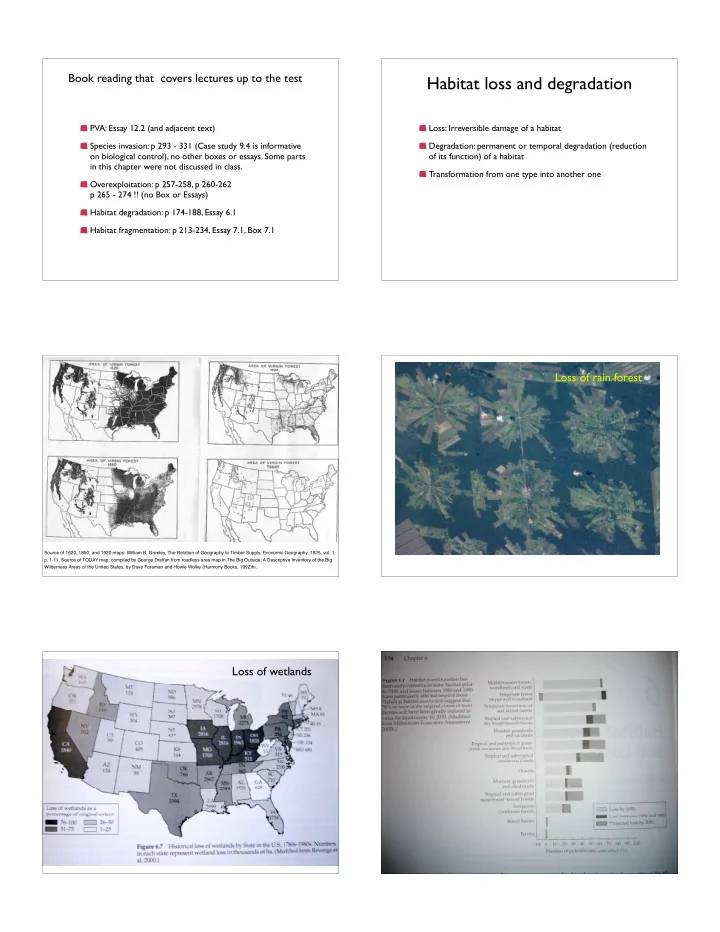
Source of 1620, 1850, and 1920 maps: William B. Greeley, The Relation of Geography to Timber Supply, Economic Geography, 1925, vol. 1,

  • p. 1-11. Source of TODAY map: compiled by George Draffan from roadless area map in The Big Outside: A Descriptive Inventory of the Big

Wilderness Areas of the United States, by Dave Foreman and Howie Wolke (Harmony Books, 1992)hi.

Loss of rain forest Loss of wetlands

slide-2
SLIDE 2

Longleaf pine forests

Fringed prairie orchid

degradation transformation loss

Effects on habitat

Fragmentation

Native habitat Transformed habitat

Time

Process of fragmentation

Gap formation Fragmentation

Western Madagascar, 500-1990 Warwickshire, England 400 - 1960

slide-3
SLIDE 3

US Pacific Northwest, 1940-1981 Willamette National Forest, Oregon, 1979

Major changes in fragmented habitats

Native habitat Transformed habitat

Size: Isolation: Edge/interior: decreases increases increases

Habitat “shredding”

natural “shreds” Shredding Patchy

Habitat fragmentation isolated patches (island biogeography) fragments have small area and (typically) a center and an edge Habitat shredding connected to “good” habitats (theory?) consists mostly of edge

slide-4
SLIDE 4

Fragmentation and Heterogeneity Fragmentation and Heterogeneity Fragmentation and Heterogeneity Fragmentation and Heterogeneity

Quantifying fragmentation

Shannon-Wiener index Shape complexity Proximity index spatial statistics

H∗ = −

k pk ln pk

ln s pk = frequency of map class k s = total number of map classes

Shannon-Wiener variant

Range of H* is scaled between 0 and 1

0 → low diversity and uneven habitat classes 1 → high diversity and even habitat classes

slide-5
SLIDE 5

Complexity of habitat patches

log A ∼ d log P A = area of a patch P = perimeter of a patch d = fractal dimension

d is found by regression and then scaled between 1 and 2. A value of two means more edge per patch and a value of 1 is equivalent with circular patches.

Comparison of such indices!

Shannon - Wiener ignores shape (interior versus edge) Complexity measures only within patch class, but takes edge versus interior into account Simple indices often do not tell the (whole) truth Effects on habitat Effects on species

Fragmentation Roads increase invasives

Fragmentation Spread if invasive species Settlement/Development Wilderness designation

Importance of roads Wilderness designation

  • Is the area 5,000 acres in size or larger? Or a roadless island?
  • Does the area generally appear to be natural and is human presence relatively unnoticeable?
  • Does the area offer the opportunity for primitive and unconfined recreational activities like camping, hiking, and skiing?
  • Does it provide opportunities for solitude?
  • Does the area contain features of ecological, geological, scientific, educational, scenic, or historical significance?

http://www.wilderness.net/index.cfm?fuse=NWPS&sec=designation total = 106,402,582acres

slide-6
SLIDE 6

Effects on habitat Effects on species Effects of smaller patches Effects of isolation

Fragmentation

Effects of fragmentation on species: small patches and isolation

Genetic drift Inbreeding Heterozygosity Population size Demographic stochasticity Migration, gene flow Colonization / Extinction Diversity Area effect, distance effects (Island biogeography theory)

Patch size Population size Demographic stochasticity Diversity Colonization Extinction risk Extinction Genetic drift, inbreeding, heterozygosity

Area effect Distance effect

Patch isolation Gene flow Migration Patch

  • ccupancy

Diversity Colonization local adaptation, FST, inbreeding, heterozygosity Metapopulation

Relaxation = reduction in diversity of a patch after fragmentation from old “equilibrium” number of species to new equilibrium number.

Elk Pronghorn Coyotes Wolves Plants Elk Pronghorn Coyotes Plants

Relaxation: adjusting to a lower level of diversity after isolation

Habitats that are fragmented will adjust to a lower level of diversity Islands that were once connected to the mainland will adjust to a lower level of diversity Islands that never were connected to a mainland will build up diversity

slide-7
SLIDE 7

Effects on habitat Effects on species Effects of smaller patches Effects of isolation

Fragmentation

Diversity , Extinction

Effects on habitat Effects on species Effects of smaller patches Effects of isolation Edge effects

Fragmentation

Diversity , Extinction

Edge effects = edges of habitat are not the same as “interior” of habitat (biotic and abiotic differences)

Forest Field Field

Edge effects

Forest “edge” Forest Field 1 Ha

  • 10 Ha
  • 100 Ha

100% edge 48% interior 53% edge 81% interior 19% edge If edge width is 50 m

The smaller the patch, the more edge relative to interior Edge effects = edges of habitat are not the same as “interior” of habitat (biotic and abiotic differences)

more light higher temperature less moisture different species higher extinction rates

Edges have:

slide-8
SLIDE 8

None of 16 species breed 6 of 16 species breed

Effects on habitat Effects on species Effects of smaller patches Effects of isolation Edge effects

Fragmentation

Diversity , Extinction Species composition changes, Extinction

Secondary Extinctions

Extinctions resulting from other extinctions

Biological Dynamics of Forest Fragments (BDFF) Brazilian Amazon

Initiated in 1979 by WWF and INPA

slide-9
SLIDE 9

Fragment sizes: 1, 10, 100, 1000 Ha; Plus continuous forest Decrease in species richness of birds, some

  • insects, primates, bees, and termites

Increase in species richness of small mammals, amphibians, and butterflies Changes in composition of communities of

  • butterflies and small mammals

Abiotic variables Biotic variables Summary of BDFF edge effects:

Plots are square with side: 100m, 316m, 1000m, 3162m

Effects on habitat Effects on species Forest fragmentation project in Brazil Landscape context Effect of urbanization

Fragmentation

Landscape context

Native habitat Transformed habitat

Study of eects of urban land on reserves: 66 study plots in four grassland types

  • Shortgrass steppe
  • Mixed grass prairie
  • Tallgrass prairie
  • Hayfields

Shortgrass steppe

slide-10
SLIDE 10

Mixed grass prairie Tallgrass prairie Hayfields

Landscape suburbanized (%)

Hispid pocket mouse

Bock et al. 2002, Conservation Biology

Measure of landscape context Grasshopper sparrow 0.5 1 1.5 2 10 20 30 Urban index Abundance index

Haire et al. 2000, Landscape and Urban Planning

slide-11
SLIDE 11

Fragmentation

“What do we know for sure?” Harrison and Bruna 1999

Species in fragmented habitats are vulnerable to extinction

Rate of extinction versus park area

(Newmark 1995)

Medium-large mammals

Fragmentation of landscape as a cause for genetic subdivision of bank vole populations.

Gabriele Gerlach and Kerstin Musolf Conservation Biology 14 (2000) 1 – 10

We studied the barrier effects of various roadways on genetic subdivision of bank vole (Clethrionomys glareolus) populations. Allele frequencies, genetic variability, and genetic distances of natural populations were calculated based

  • n polymorphism of 7 microsatellite markers. We compared bank vole

populations in control areas without such barriers with animals from both sides

  • f a country road, a railway, and a highway, all roadways older than 25 years.

Using F- and R-statistics, we demonstrated significant population subdivision in bank vole populations separated by the highway, but not in populations on either side of the other roadways or in the control area. Correlations between geographic and genetic distances were revealed by an extended method based on a Mantel analysis. This allowed us to measure genetic barrier effects and express them as additional geographic distances. For instance, statistically significant differences in allele frequencies in all 7 loci examined existed among populations in southern Germany and Switzerland, which are separated by the Rhine River and Lake Constance. The real geographic distance between bank vole populations in Konstanz and those in Lengwil, Switzerland, is 6 km. According to this analysis the genetic barrier effect of the Rhine could be defined as an additional distance of 7.7 km.