
SLIDE 1
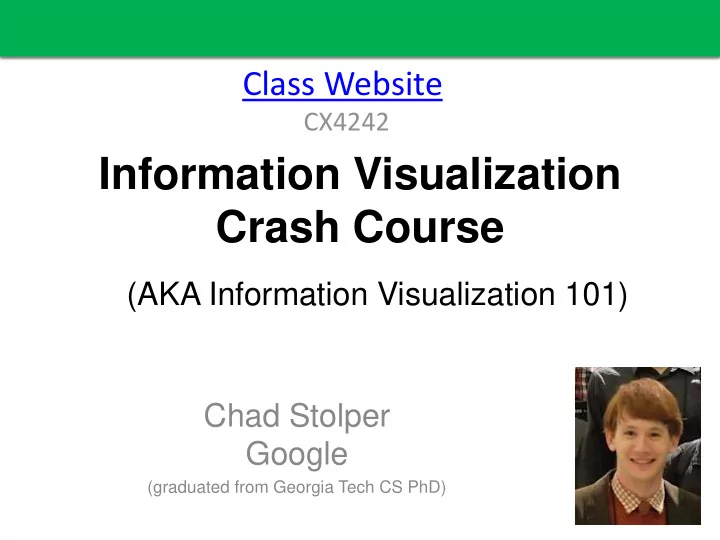
Information Visualization Crash Course
Chad Stolper Google
(graduated from Georgia Tech CS PhD)
1(AKA Information Visualization 101)
Class Website
CX4242
Information Visualization Crash Course (AKA Information - - PowerPoint PPT Presentation
Class Website CX4242 Information Visualization Crash Course (AKA Information Visualization 101) Chad Stolper Google (graduated from Georgia Tech CS PhD) 1 What is Infovis? Why is it Important? Human Perception Chart Basics (If Time,
Information Visualization Crash Course
Chad Stolper Google
(graduated from Georgia Tech CS PhD)
1(AKA Information Visualization 101)
Class Website
CX4242
What is Infovis? Why is it Important? Human Perception Chart Basics
(If Time, Some Color Theory)
The Shneiderman Mantra Where to Learn More
2 What is Information Visualization?
3 Information Visualization
“The use of computer-supported, interactive, visual representations of abstract data to amplify cognition.” Card, Mackinlay, and Shneiderman 1999
4 Communication Exploratory Data Analysis (EDA)
5 Communication
6(gone wrong)
X
Edward Tufte
An American statistician and professor emeritus of political science, statistics, and computer science at Yale University. He is noted for his writings
as a pioneer in the field of data visualization.
Space Shuttle Challenger
January 28, 1986
9Morning Temperature: 31°F
Most Watched Science Experiment
Richard Feynman, Physics Nobel laureate explained how rubber became rigid in cold temperate YouTube video: https://youtu.be/6Rwcbsn19c0
How did this happen?
14 Engineers at Morton Thiokol, the rocket maker, presented on the day before and recommended not to launch.
So, communication is extremely important.
Visualization can help with that – communicate ideas and insights.
29 http://www.ted.com/talks/hans_rosling_shows_the_best_stats_you_ve_ever_seen.html
Visualization can also help with Exploratory Data Analysis (EDA)
But why do you need to explore data at all???
31 “There are three kinds of lies: lies, damned lies, and statistics.”
33https://en.wikipedia.org/wiki/Lies,_damned_lies,_and_statistics
Mystery Data Set
34 Mystery Data Set
Property Value mean( x ) 9 variance ( x ) 11 mean( y ) 7.5 variance ( y ) 4.122 correlation ( x,y ) 0.816 Linear Regression Line y = 3 + 0.5x
35 Anscombe’s Quartet
40https://en.wikipedia.org/wiki/Anscombe%27s_quartet
Anscombe’s Quartet Sanity Checking Models Outlier Detection
41 Data visualization leverages human perception
43 Name the five senses.
44 Sense Bandwidth (bits/sec) Sight 10,000,000 Touch 1,000,000 Hearing 100,000 Smell 100,000 Taste 1,000
http://www.britannica.com/EBchecked/topic/287907/information-theory/214958/Physiology
A (Simple) Model
A (Simple) Model of Human Perception
47Parallel detection of basic features into an iconic store Serial processing of
spatial layout
Stage 1 Stage 2
Stage 1: Pre-Attentive Processing
Rapid Parallel Automatic
(Fleeting = lasting for a short time)
48 Stage 2: Serial Processing Relatively Slow (Incorporates Memory) Manual
49 Stage 1: Pre-Attentive Processing
The eye moves every 200ms (so this processing occurs every 200ms-250ms)
50 Example
1281768756138976546984506985604982826762 9809858458224509856458945098450980943585 9091030209905959595772564675050678904567 8845789809821677654876364908560912949686
51 Example
1281768756138976546984506985604982826762 9809858458224509856458945098450980943585 9091030209905959595772564675050678904567 8845789809821677654876364908560912949686
52 A few more examples from
Left Side Right Side
Raise your hand if a RED DOT is present…
(On the left or on the right?)
55 Color (hue) is pre-attentively processed.
58 Raise your hand if a RED DOT is present…
59 Shape is pre-attentively processed.
62 Determine if a RED DOT is present…
63 Hue and shape together are NOT pre-attentively processed.
66 Pre-Attentive Processing
Stephen Few “Now You See It”
Pre-Attentive Cognitive
69 Gestalt Psychology
Berlin, Early 1900s
70 Gestalt Psychology
Goal was to understand pattern perception
Gestalt (German) = “seeing the whole picture all at
Identified 8 “Laws of Grouping”
71http://study.com/academy/lesson/gestalt-psychology-definition-principles-quiz.html
Gestalt Psychology
How many groups are there?
73 Proximity
75 How many groups are there?
76 Similarity
78 How many shapes are there?
79 Closure
81 How many items are there?
82 Symmetry
84 How many sets are there?
85 Common Fate
How many objects are there?
88 Continuity
90 How many objects are there?
91 Good Gestalt
93 What is this word?
94 Past Experience
96 Pre-Attentive Processing Gestalt Laws
101 Detect Quickly
102 Detect quickly does NOT mean
detect accurately
Ideally you want both.
103 Crowdsourcing Graphical Perception: Using Mechanical Turk to Assess Visualization Design.Heer and Bostock. Proc ACM Conf. Human Factors in Computing Systems (CHI) 2010,
Crowdsourcing Graphical Perception: Using Mechanical Turk to Assess Visualization Design.Heer and Bostock. Proc ACM Conf. Human Factors in Computing Systems (CHI) 2010,
significantly find McGill’ confident “Squar ified” McGill’ “quick ” ⇥ first
Crowdsourced Results
1.0 1.5 2.0 2.5 3.0
Log Error
McGill’ confidence confidence
⇥ squarified ’ modified ified qualification April 10–15, 2010, Atlanta, GA, USA
Mackinlay, 1986
106 Stephen Few “Now You See It”
What does this tell us?
108 Barcharts, scatterplots, and line charts are really effective for quantitative data
20 40 20 40 20 40 20 40 20 40
109 (and for statistical distributions) Tukey Box Plots
110 Median Outliers Largest < Q3 + 1.5 IQR Smallest > Q1 - 1.5 IQR Largest < Q3 Smallest > Q1
112 Tufte’s Chart Principles
113Edward Tufte
Tufte’s Chart Principles
DO NOT LIE!
Maximize Data-Ink Ratio Minimize Chart Junk
116 Tufte’s Chart Principles
DO NOT LIE!
Maximize Data-Ink Ratio Minimize Chart Junk
117 “Cumulative”
http://www.perceptualedge.com/blog/?p=790
120 Tufte’s Chart Principles
DO NOT LIE!
Maximize Data-Ink Ratio Minimize Chart Junk
123 Please…
127 No pie charts. No 2.5D charts.
128 37 36 24
2 1
130 5 10 15 20 25 30 35 40
131 10 20 30 40
134 But otherwise…
138 Barcharts, scatterplots, and line charts are really effective for quantitative data
20 40 20 40 20 40 20 40 20 40
139 Anyone else bored by my color choices?
140 In fact, grayscale can be risky…
141 In fact, grayscale can be risky…
142 Color is Powerful
143 Call attention to information Increase appeal Increase memorability Another dimension to work with
Color
144 Have you heard of RGB?
RGB color model. (2017, November 20). Retrieved December 01, 2017, from https://en.wikipedia.org/wiki/RGB_color_modelAdditive color model: colors create by mixing red, green, blue light
We see in RGB, but we don’t interpret in RGB…
146 Hue Lightness Saturation
Source: color picker in Affinity DesignerHSV Color Model
Hue
Post & Greene, 1986
148 Hue
http://blog.xkcd.com/2010/05/03/color-survey-results/
149 Hue and Colorblindness
10% of males and 1% of females are Red-Green Colorblind
150 http://viz.wtf/post/98981561686/ht-matthewbgilmore-noaas-new-weather-modelling
Color and Quantitative Data
Can you order these (lowhi)?
154 http://www.personal.psu.edu/faculty/c/a/cab38/ColorSch/Schemes.html via Munzner
Color Brewer for Picking Color Scales
COLORBREWER 2.0. (n.d.). Retrieved December 01, 2017, from http://colorbrewer2.org/ Overview Zoom+Filter Details on Demand
Shneiderman Mantra (Information-Seeking Mantra)
157https://www.mat.ucsb.edu/g.legrady/academic/courses/11w259/schneiderman.pdf
http://visual.ly/every-single-death-game-thrones-series
159 http://www.babynamewizard.com/voyager
Where to learn more?
169 CS 7450 Information Visualization Every Fall
170 Visualization @GeorgiaTech
vis.gatech.edu
171 How to Make Good Charts
– http://www.edwardtufte.com/tufte/courses
Information
– http://www.edwardtufte.com/tufte/books_vdqi
Designing Tables and Graphs to Enlighten
– http://www.amazon.com/Show-Me-Numbers- Designing- Enlighten/dp/0970601972/ref=la_B001H6IQ5M_1 _2?s=books&ie=UTF8&qid=1385050724&sr=1-2
172 Visualization Theory “Books”
– http://www.cs.ubc.ca/~tmm/talks.html – http://www.cs.ubc.ca/~tmm/vadbook/
– http://www.amazon.com/Information-Visualization-Perception- Interactive-Technologies/dp/1558605118
– http://www.amazon.com/Now-You-See-Visualization- Quantitative/dp/0970601980/ref=pd_bxgy_b_img_z
– http://www.edwardtufte.com/tufte/books_ei
– http://www.edwardtufte.com/tufte/books_visex
– http://www.edwardtufte.com/tufte/books_be
– http://www.amazon.com/Visualization-Analysis-Design-AK- Peters/dp/1466508914
173 Perception and Color Websites
– http://www.csc.ncsu.edu/faculty/healey/PP/index. html
– http://colorbrewer2.org/
Workshops)
– http://www.stonesc.com/color/index.htm
NASA
– http://blog.visual.ly/subtleties-of-color/
174 Visualization Blogs
– http://flowingdata.com/
– http://infosthetics.com/
– http://www.informationisbeautiful.net/
– http://blog.visual.ly/
– http://thisisindexed.com/
175 Infographics
Visual.ly/view
(wtfviz.net)
176 Thanks!
Chad Stolper
chadstolper@gatech.edu
177 Questions?
Chad Stolper
chadstolper@gatech.edu
178thisisindexed.com Jessica Hagy