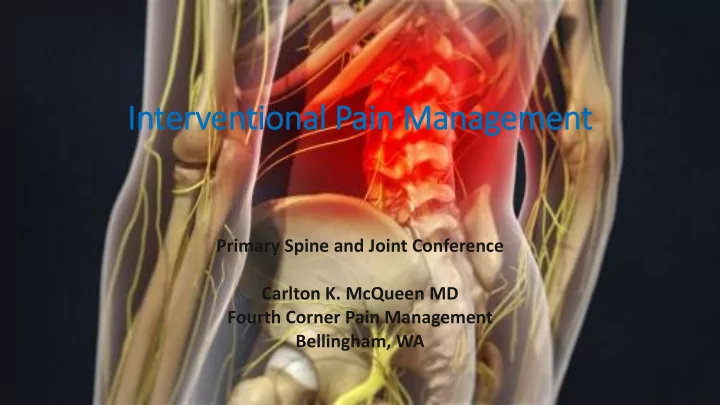
In Interv rventional Pain Management Primary Spine and Joint - - PowerPoint PPT Presentation

in interv rventional pain management
SMART_READER_LITE
LIVE PREVIEW

In Interv rventional Pain Management Primary Spine and Joint - - PowerPoint PPT Presentation

In Interv rventional Pain Management Primary Spine and Joint Conference Carlton K. McQueen MD Fourth Corner Pain Management Bellingham, WA Dolores-Presentation 77 years old 1 year history of back and bilateral leg pain. Obese,


slide-1
SLIDE 1

In Interv rventional Pain Management

Primary Spine and Joint Conference Carlton K. McQueen MD Fourth Corner Pain Management Bellingham, WA

slide-2
SLIDE 2

Dolores-Presentation

  • 77 years old
  • 1 year history of back and bilateral leg pain.
  • Obese, Diabetic, Hypertensive.
  • Positive shopping cart sign
  • MRI: L4-5 stenosis
  • X-Ray: possible instability on flexion and extension
slide-3
SLIDE 3
slide-4
SLIDE 4
slide-5
SLIDE 5

Dolores-Assessment/Plan

  • History and physical-
  • Other pain generators- Hips, SIJ ?
  • H/o neurogenic claudication ?
  • H/o gait instability ? H/o Falls ?
  • Possible instability suggested on F & E X-Ray- Refer to NSG.
  • Plan
  • Physical Therapy
  • Lumbar IL ESI at L4-5. Will use 1% lidocaine in ESI if pain generator is in doubt.

Assess anesthetic phase and therapeutic phase responses.

  • NSG for suggested instability and if gait issues are present.
slide-6
SLIDE 6
slide-7
SLIDE 7
slide-8
SLIDE 8

Dolores-Disposition

  • Return in 4 weeks and compare anesthetic and therapeutic phase

responses

  • If > 3 epidurals/12 month time-need to consider surgery.
slide-9
SLIDE 9

Chuck-Presentation

  • LBP after multiple injuries. 2009
  • L & I.
  • Previous neck fusion with residual deficits (?)
  • (-) SLR
  • Paraspinous pain
  • LEFT Thigh pain
  • Previous “ESI” in past
  • Smoker/marijuana/oxycodone (45 Meq/d)
slide-10
SLIDE 10

Chuck- Further Questions

  • Is LBP and Leg pain related or correspond in any way ?
  • Lumbar Radiculopathy vs Meralgia Paresthetica vs Hip vs SIJ
  • Further factors that exacerbate/relieve his LBP
  • Any Upper Motor Neuron signs ?
  • Recent F & E of cervical spine. Is fusion stable ?
  • Records of previous injections with (hopefully) anesthetic phase

response recorded.

  • Review of WPR. Who’s writing oxycodone ?
  • Other Meds: Cymbalta, gabapentin, tricyclics, NSAIDS ?
  • Applying for Disability ?
slide-11
SLIDE 11
slide-12
SLIDE 12

Impression:

  • 1. At L2-L3 there is an enlarging right paracentral disc protrusion which has increased

extrusion along the posterior inferior aspect of the L2 vertebral body. There is secondary severe right-sided lateral recess narrowing which is increased from the prior

  • examination. There is mild to moderate right-sided foraminal narrowing which has

increased since the prior examination.

  • 2. Otherwise stable variable multilevel degenerative disc disease, spondylosis, and facet

arthropathy with variable multilevel lateral recess narrowing, central spinal stenosis, and foraminal narrowing, as detailed above.

slide-13
SLIDE 13

Chuck-Assessment/Plan

  • DDx: Based on history and response to previous injections.
  • Discogenic
  • Facet arthropathy
  • SIJ
  • Iliolumbar ligament
  • Meralgia paresthetica
  • LSS w/o NC
  • Psychosocial/Malingering
  • First step is to identify the Pain Generator(s). Likely multiple in this gentleman.
  • Myofascial Pain/ Deconditioning. Have to address this first or diagnostic

blocks will be fruitless

slide-14
SLIDE 14

Facet Pain Workup/Treatment.

  • History/Physical
  • Para-median low back pain
  • Worse with back extension/loading
  • Pain pattern is unreliable
  • Diagnosed with Medial Branch Block after PT/NSAIDS
  • 2 separate blocks with > 60% response by pain diary.
  • Treatment is Radiofrequency Ablation
  • Greater than 50% relief for 3 months to 2 ½ years. ( 70%/9 months)
  • Nerves grow back. Temporary increase in pain after procedure
slide-15
SLIDE 15
slide-16
SLIDE 16
slide-17
SLIDE 17

Discogenic Back Pain/Treatment

  • Only test to confirm or refute discogenic back pain is Provocative

Discography.

  • Reproduce the pain and evaluate morphology of discs.
  • Clinical utility is controversial.
  • Very uncomfortable for the patient.
  • Risk for discitis. IV antibiotics. Full prep and drape.
  • I save it for last and sometimes avoid it altogether.
  • Limited treatment options for disc pain. Fusion, SCS, IDET, Experimental.
  • Chronic opioid patients
  • Can be just as informative if negative.
slide-18
SLIDE 18

For the purpose of this letter, we will take it as a given that degenerative discs can be a cause of low back pain. I will rely on a recent review article by Nikolai Bogduk MD, et al to address these issues. False Positive Tests

 Discogenic pain does occur and can be diagnosed if strict operational criteria are used to reduce the likelihood of false- positive tests. My practice uses the criteria designated by the International Spine Intervention Society (ISIS) for provocative discography.  In normal patients, abnormal discs are rarely painful on provocative discography (1).  The study you cite from Caragee 2000 is flawed in that they did not study normal volunteers and the criteria used to calculate the false-positive rate in patients with abnormal psychological profiles do not reflect the current operational criteria set by ISIS for positive provocative discography. The authors rated as positive any patient or subject who reported severe pain after stimulation of any disc at any pressure.  Studies show that 20 psi defines an absolute threshold at which normal discs should not be painful (2).  If current manometric criteria are applied to Carragee’s study, false-positive responses in asymptomatic subjects disappear while the confidence interval for false positive responses are 95% while the rates for patients with somatization are so wide as to be almost meaningless since the sample sizes are so small.  A systematic review has calculated the false-positive rate as low as 6 % (3). Although this is not zero, it is too low to invalidate disc stimulation as a diagnostic test. Anything less than 10% is generally considered clinically acceptable.  Responses to disc stimulation are not complicated by central hyperalgesia (4).  There is no difference in the false-positive rates in patients with and without somatization disorder (5).  False positive rates a kept low by first ruling out other causes of low back pain such as facet arthropathy and sacroiliitis before pursuing provocative discography.

slide-19
SLIDE 19
slide-20
SLIDE 20
slide-21
SLIDE 21

Spinal Cord Stimulator Trial

  • Recently approved for chronic LBP.
  • Post-Lami Sx, CRPS, Chronic Radiculopathy.
  • Pleasant paresthesia instead of pain. Pain relief when off.
  • Not effective for somatic pains.
  • I use as last resort
  • Psychological evaluation
  • SCS trial for 7 days with percutaneous leads
  • Permanent placed as outpatient with paddle leads
  • The whole magic is in the trial !
slide-22
SLIDE 22
slide-23
SLIDE 23
slide-24
SLIDE 24
slide-25
SLIDE 25
slide-26
SLIDE 26

SCS-Downside and Pitfalls

  • Patient selection !!!!!
  • Risk for infection. IV Abx. Full prep/drape
  • Expensive
  • MRIs in future are difficult. Chuck may have this for 30 years !
  • Technical/Physiologic failure rate is low but impactful on patient’s

quality of life.

  • Battery replacement. Reprogramming.
  • Limited activity for 6 weeks after permanent placement.
slide-27
SLIDE 27

Steve-Presentation

  • 44 years old
  • Right Leg pain, mild foot drop (!)
  • PE: positive SLR, sensory and motor deficits R L5
  • Conservative management- chiro
  • MRI- LEFT L5-S1 para-median HNP
slide-28
SLIDE 28
slide-29
SLIDE 29

Steve-Further Assessment

  • Motor weakness progressing ?
  • No Cauda Equina Sx.
  • DDx for LBP-Leg pain
  • Sacroiliitis
  • Piriformis Syndrome
  • Other somatic referred pains
slide-30
SLIDE 30

Steve-Plan

  • Start gabapentin. Titrate to 900mg PO TID. (300 mg increments)
  • Start PT
  • Refer to NSG if weakness progressing or impairs ambulation.
  • Schedule for RIGHT L5 TF ESI.
  • Confirm pain generator. (Vs piriformis or SIJ)
  • Focus steroid where pathology is
  • RTC 2 weeks and check anesthetic phase vs therapeutic phase

responses and follow up on muscle weakness.

  • Consider RIGHT paramedian L5-S1 IL ESI if 2nd injection required.
slide-31
SLIDE 31
slide-32
SLIDE 32
slide-33
SLIDE 33
slide-34
SLIDE 34

Anesthetic vs Therapeutic

  • For TF ESI and SNRB, 1.5 cc of 2% lido injected onto the suspected

nerve root.

  • 20-30 minutes later-assess pain level compared to before injection
  • Anesthetic response. Pre-procedure pain: 7/10. Post-procedure

pain: 1/10.

  • If no change, assess quality of block. Consider repeat injection.
  • Therapeutic response. How are they doing on follow up with

multimodal approach. If not improving, the degree of anesthetic response leads me to consider other pain generators, vs repeating an injection at same level or surgical referral.

slide-35
SLIDE 35
slide-36
SLIDE 36

Other imitators- Piriformis Syndrome and SIJ

  • Piriformis
  • Pain in buttock that radiates in leg in non-specific dermatome
  • Hurts to sit in a car
  • Previous history of trauma
  • Sacroiliac Joint
  • Great imitator. Somatic referred pain-esp with h/o Lumbar fusion
  • r THR
  • PSIS pain. PE findings not sensitive or specific.
slide-37
SLIDE 37
slide-38
SLIDE 38
slide-39
SLIDE 39
slide-40
SLIDE 40
slide-41
SLIDE 41

In Interv rventional Pain Management

Questions ?

Carlton K. McQueen MD Fourth Corner Pain Management Bellingham, WA

slide-42
SLIDE 42