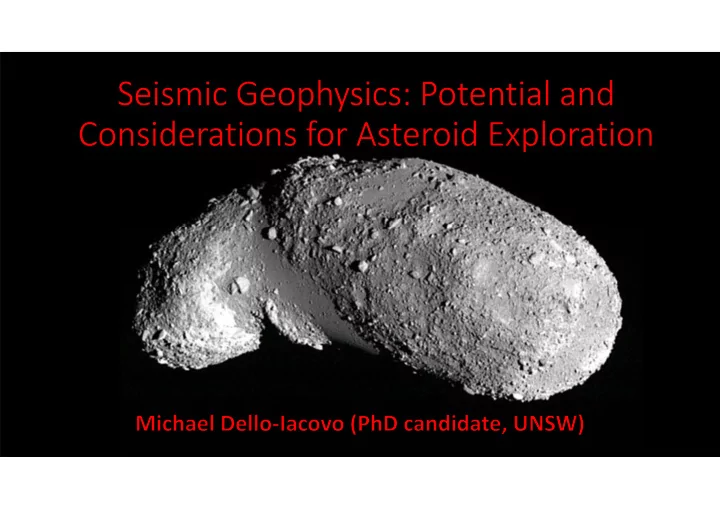
SLIDE 1
SLIDE 2 Importance of Asteroids
Science
- Origin of the Solar System
Resources
Impact mitigation
https://solarsystem.nasa.gov/planets/ceres
SLIDE 3 Asteroid structure
From Walker et al 2006
SLIDE 4 Seismic Geophysics
http://geologylearn.blogspot.com.au/2015/06/marine‐and‐land‐seismic‐aquisition.html
SLIDE 5 Seismic Geophysics
Active vs passive source What can we determine through seismic?
- 1. Seismic velocity (P‐ and S‐wave)
- From this and other data, we can infer strength and other
properties
- Fracture presence and orientation
- 2. Imaging (requires a lot of source and receiver locations)
SLIDE 6 Seismic Geophysics
http://epic.awi.de/35606/
SLIDE 7 Seismic Sources & Receivers
http://www.kgs.ku.edu/Publications/PIC/pic37.html http://www.hohoilfieldservices.co.uk/industry‐seismic.php http://www.kgs.ku.edu/Publications/PIC/pic37.html
SLIDE 8 Seismic sources and receivers
From Bagaini et al 2010
SLIDE 9 Planetary Seismic Missions
Apollo 17’s Lunar Seismic Profiling Experiment (LSPE) http://www.dlr.de/pf/en/desktopdefault.aspx/tabid‐8635/
SLIDE 10 Planetary Seismic Missions
Seismic wave travel times vs distance between source and receiver. From Kovach et al 1973.
SLIDE 11 Planetary Seismic Missions
Apollo 17’s Lunar Seismic Profiling Experiment (LSPE) http://www.dlr.de/pf/en/desktopdefault.aspx/tabid‐8635/
SLIDE 12 Planetary Seismic Missions
- Moon
- Mars
- Venus
- Future: InSIGHT – will place a
seismic receiver station on Mars
https://www.nasa.gov/press‐release/nasa‐suspends‐2016‐launch‐of‐insight‐mission‐to‐mars
SLIDE 13 Asteroid Missions
- Deep Space 1
- Hayabusa 1 & 2
- Rosetta
- AIM DART
- ARM
http://sci.esa.int/rosetta/14615‐comet‐67p/
SLIDE 14 Asteroid Seismic Geophysics
From Walker and Huebner 2004
SLIDE 15 Value of Asteroid Seismic Geophysics
- What can we determine through seismic on an asteroid that is useful?
- Structure
- Strength/rippability
- Layering and internal features
- Composition… not so much
SLIDE 16 Challenges
- Limited mass (sources and receivers, input energy, bandwidth of
returned data)
- Low gravity (potentially difficult anchoring)
- No atmosphere
- Unknown environment
- Accurate digital elevation model required for quality imaging
- Perturbation of environment during measurement
- Attenuation and scattering of seismic signal
SLIDE 17 Emplacement of Seismic Tools
- Traditional anchoring, e.g. harpoons (67P)
- Releasing a hardening fluid
- Penetrators
SLIDE 18 Emplacement of Seismic Tools
The Lunar Net penetrator design. From Smith et al (2012).
SLIDE 19 Emplacement of Seismic Tools
DS2 penetrator schematic in ground. From Lorenz et al 2000.
SLIDE 20 Emplacement of Seismic Tools
- Traditional anchoring, e.g. harpoons (67P)
- Releasing a hardening fluid
- Penetrators
- Covering an asteroid with single use receivers and using an impact
source
- Laser receiver
- More exotic designs – solar sail, ion thrusters
SLIDE 21 Open Questions
- What are the effects of an asteroid environment (gravity,
atmosphere, temperature etc) and how do they impact seismic measurement, if at all?
- Is there a correlation between surface and
subsurface/geomechanical properties of asteroids?
- Can we develop relationships between relevant
parameters and seismic data so we can predict the
- utcome of seismic exploration on asteroids?
SLIDE 22 Acknowledgements
Serkan Saydam Robert Anderson Simit Raval Andrew Dempster
SLIDE 23
References
First image credit: https://www.space.com/11093‐photos‐asteroids‐deep‐space‐ rocks.html Walker et al 2006, A preliminary analysis of seismological techniques to study Eros and other asteroids, Adv. in Space Res., 37, 142‐152. Bagaini et al 2010, Land seismic techniques for high‐quality data, Oilfield Review, 22, 28‐39. Kovach et al 1973, The structure of the lunar crust at the Apollo 17 site, Proc. of the Fourth Lunar Sci. Conf., 3, 2549‐2560. Walker and Huebner 2004, Seismological investigation of asteroid and comet interiors, in: Mitigation of Hazardous Asteroids and Comets, Cambridge University Press, Cambridge. Smith et al 2012, Lunar Net – a proposal in response to an ESA M3 call in 2010 for a medium sized mission, Exp. Astron., 33, 587‐644. Lorenz et al 2000, Penetration tests on the DS‐2 Mars microprobes: penetration depth and impact accelerometry, Plan. & Space Sci., 48, 419‐436.