Asteroids masses from future ephemerides, densities from binaries - - PowerPoint PPT Presentation

asteroids masses from future ephemerides densities from
SMART_READER_LITE
LIVE PREVIEW

Asteroids masses from future ephemerides, densities from binaries - - PowerPoint PPT Presentation

Asteroids masses from future ephemerides, densities from binaries Franois COLAS Institut de Mcanique Cleste Observatoire de Paris Petr KUCHYNKA Jet Propulsion Laboratory Densities measurements Most of the asteroids have not evolved


slide-1
SLIDE 1

François COLAS Institut de Mécanique Céleste – Observatoire de Paris Petr KUCHYNKA Jet Propulsion Laboratory Asteroids masses from future ephemerides,
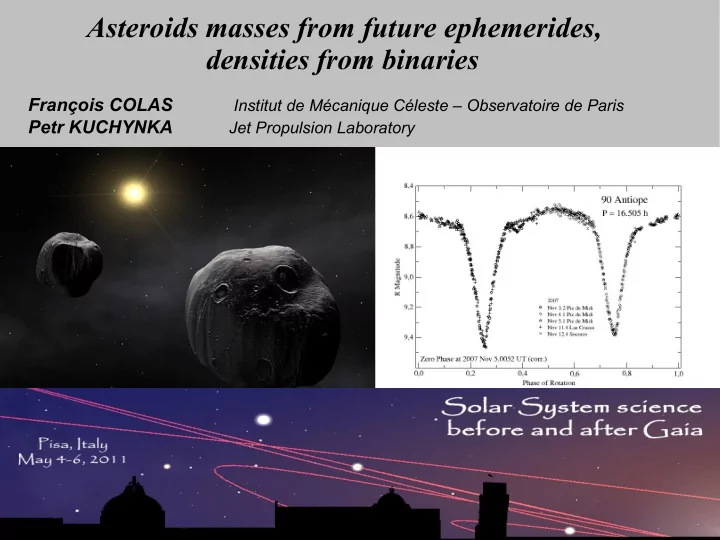
densities from binaries

slide-2
SLIDE 2

Densities measurements

Most of the asteroids have not evolved since solar system formation

  • Asteroids densities are keys for :
  • Solar system formation
  • Evolution
  • Impacts and evolution of the solar system
  • Densities + Spectroscopic observations => macro porosity
  • fracturation
  • rubble piles
  • collisional history
  • ...
slide-3
SLIDE 3

Accuracies of actual best masses (blue dots) and best densities (red dots)

Actual situation

slide-4
SLIDE 4

About 200 asteroid masses will be known in the next 10 years using different ways, Mars orbit perturbations, Mutual perturbations, Flyby, Binary asteroids GAIA will permit to determine several masses

slide-5
SLIDE 5

Mars perturbations

As we know Mars orbit with a meter accuracy and as asteroids can perturb Mars orbit of more than one kilometer, it is possible to measure some asteroids masses (INPOP-10a A.Fienga et al 2011)

  • we supposed that Mars orbit will be still known with an one meter

accuracy until 2020, we found 167 objects with masses that can be measured with an accuracy better than 50%

  • 20

40 60 80 100 120 140 160 180 10 20 30 40 50 60

Asteroid Er %

Mass determination 40% => 115 30% => 50

slide-6
SLIDE 6

Binaries

Occultations Light curves

slide-7
SLIDE 7

Single 39 Laetitia light curve Single 39 Laetitia light curve

slide-8
SLIDE 8

Binary asteroid light curves

slide-9
SLIDE 9

Expérience pédagogique niveau terminale

PHOTOMETRIE : Eléments physiques (λp,βp) – travaux pratiques Réalisation du Lycée de l'Arc

slide-10
SLIDE 10

Direct density estimation

slide-11
SLIDE 11
slide-12
SLIDE 12

Prédictions...

N N S

slide-13
SLIDE 13

Four binaries founded on 400 light curves

No bias on statistic We can do the same with Gaia by searching light curves with anomamies

slide-14
SLIDE 14

(7225) Huntress An exemple of low amplitude transit / occultation

Porb = 14.67 ± 0.01 h D2/D1 = 0.21 ± 0.02 P1 = 2.4400 ± 0.0001 h A1 = 0.11 mag P.Pravec

slide-15
SLIDE 15

We know 162 multiple astéroids (5 triples, 1 quadruple) (may 2010)

35 NEOs, 7 Mars-Crossers, 62 MBO, 2 Trojans, 56 TNOs

  • Discoveries,

– HST (47) -- – Ground based (29) – 8 m class telescopes (8-10m) with AO – Ground based, light curves (62) – Small telescopes (1m-30cm), – Radar (21) – Mainly Arecibo - NEO – Space missions (1) .....

slide-16
SLIDE 16

Low resolution spectrography : minéralogy

2005 type S (pôle N) 1996 type S (pôle N) 1997 type C (pôle S)

Infrared photometry from ground based

  • bservations

=> Thermal inertia (eclipse observations)

slide-17
SLIDE 17

Occultations

slide-18
SLIDE 18
slide-19
SLIDE 19
slide-20
SLIDE 20
slide-21
SLIDE 21

T 193 – Sutherland RSA – Pluto Occultation – june 2008

slide-22
SLIDE 22

Small size

  • bservatory !
slide-23
SLIDE 23

Video Observatory

slide-24
SLIDE 24

New observational strategy :

  • good spatial resolution
  • many small observatories
  • bright occulted star
  • go anywhere on Earth...
slide-25
SLIDE 25

Résult :-(((( We need a good astrometry !! (1 mas at 2UA = 1.5km)

slide-26
SLIDE 26
slide-27
SLIDE 27
slide-28
SLIDE 28
slide-29
SLIDE 29

Timing problems (472) Roma – 2011 July 8th

slide-30
SLIDE 30

Accuracy ?

Occultation of HIP 19388 by (345) Tercidina 17 september 2002 Apparent motion on the sky :

25.92"/h => 7.2 mas/s

Timing accuracy: 0.04s For tercidina 0.29 mas => 350m

slide-31
SLIDE 31

Occultations of binary Asteroids

(532) Herculina 1978 (216) Kleopatra 1980 (146) Lucina 1982 ( 71) Niobe 2005 ( 22) Kalliope 2006 ( 90) Antiope 2008 (216) Kleopatra 2009 (234) Barbara 2010 Et bien sur : (134340) Pluto - Charon

slide-32
SLIDE 32

Kalioppe

slide-33
SLIDE 33
slide-34
SLIDE 34

Observations

slide-35
SLIDE 35

Antiope occultation – 2011 july 19th

slide-36
SLIDE 36