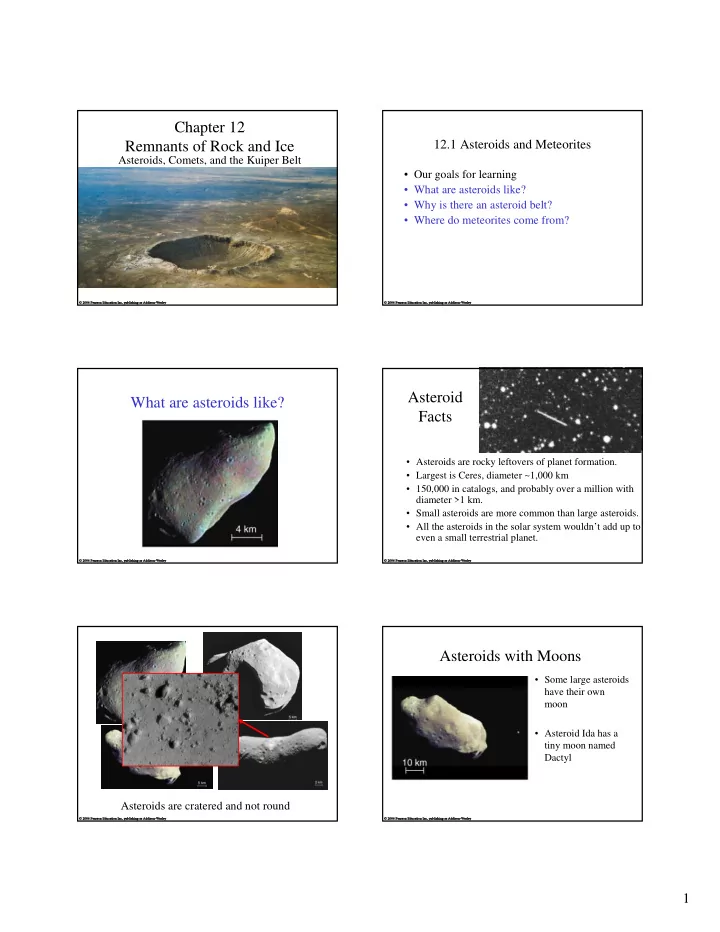
Chapter 12 12.1 Asteroids and Meteorites Remnants of Rock and Ice - - PDF document

chapter 12
SMART_READER_LITE
LIVE PREVIEW

Chapter 12 12.1 Asteroids and Meteorites Remnants of Rock and Ice - - PDF document

Chapter 12 12.1 Asteroids and Meteorites Remnants of Rock and Ice Asteroids, Comets, and the Kuiper Belt Our goals for learning What are asteroids like? Why is there an asteroid belt? Where do meteorites come from? Asteroid


slide-1
SLIDE 1

1

Chapter 12 Remnants of Rock and Ice

Asteroids, Comets, and the Kuiper Belt

12.1 Asteroids and Meteorites

  • Our goals for learning
  • What are asteroids like?
  • Why is there an asteroid belt?
  • Where do meteorites come from?

What are asteroids like? Asteroid Facts

  • Asteroids are rocky leftovers of planet formation.
  • Largest is Ceres, diameter ~1,000 km
  • 150,000 in catalogs, and probably over a million with

diameter >1 km.

  • Small asteroids are more common than large asteroids.
  • All the asteroids in the solar system wouldn’t add up to

even a small terrestrial planet.

Asteroids are cratered and not round

Asteroids with Moons

  • Some large asteroids

have their own moon

  • Asteroid Ida has a

tiny moon named Dactyl

slide-2
SLIDE 2

2

Density of Asteroids

  • Measuring orbit of

asteroid’s moon tells us asteroid’s mass

  • Mass and size tell us

asteroid’s density

  • Some asteroids are

solid rock; others just piles of rubble

Asteroid Orbits

  • Most asteroids orbit

in a belt between Mars and Jupiter

  • Trojan asteroids

follow Jupiter’s

  • rbit
  • Orbits of near-Earth

asteroids cross Earth’s orbit

Why is there an asteroid belt? Orbital Resonances

  • Asteroids in orbital

resonance with Jupiter experience periodic nudges

  • Eventually those

nudges move asteroids out of resonant orbits, leaving gaps in belt

Origin of Asteroid Belt

  • Rocky planetesimals

between Mars and Jupiter did not accrete into a planet.

  • Jupiter’s gravity,

through influence of

  • rbital resonances,

stirred up asteroid

  • rbits and prevented

their accretion into a planet.

Where do meteorites come from?

slide-3
SLIDE 3

3

Meteor Terminology

  • Meteorite: A rock from space that falls

through Earth’s atmosphere

  • Meteor: The bright trail left by a meteorite

Meteorite Impact

Chicago, March 26, 2003

Meteorite Types

1) Primitive: Unchanged in composition since they first formed 4.6 billion years ago. 2) Processed: Younger, have experienced processes like volcanism or differentiation.

Primitive Meteorites Processed Meteorites Meteorites from Moon and Mars

  • A few meteorites arrive from the Moon and

Mars

  • Composition differs from the asteroid

fragments.

  • A cheap (but slow) way to acquire moon rocks

and Mars rocks.

slide-4
SLIDE 4

4

What have we learned?

  • What are asteroids like?

– They are rocky leftovers from the era of planet formation

  • Why is there an asteroid belt?

– Orbital resonances with Jupiter prevented planetesimals between Jupiter and Mars from forming a planet

What have we learned?

  • Where do meteorites come from?

– Primitive meteorites are remnants from solar nebula – Processed meteorites are fragments of larger bodies than underwent differentiation

12.2 Comets

  • Our goals for learning
  • What are comets like?
  • Where do comets come from?

What are comets like? Comet Facts

  • Formed beyond the frost line, comets are

icy counterparts to asteroids.

  • Nucleus of comet a “dirty snowball”
  • Most comets do not have tails.
  • Most comets remain perpetually frozen in

the outer solar system.

  • Only comets that enter the inner solar

system grow tails.

Sun-grazing Comet

slide-5
SLIDE 5

5

Nucleus of Comet

  • A “dirty snowball”
  • Source of material

for comet’s tail

Deep Impact

  • Mission to study

nucleus of Comet Tempel 1

  • Projectile hit surface
  • n July 4. 2005
  • Many telescopes

studied aftermath of impact

Anatomy of a Comet

  • Coma is atmosphere

that comes from heated nucleus

  • Plasma tail is gas

escaping from coma, pushed by solar wind

  • Dust tail is pushed

by photons

Growth of Tail

Comets eject small particles that follow the comet around in its

  • rbit and cause meteor showers when Earth crosses the comet’s
  • rbit.

Meteors in a shower appear to emanate from the same area of sky because of Earth’s motion through space

slide-6
SLIDE 6

6

Where do comets come from?

Kuiper belt: On orderly orbits from 30-100 AU in disk of solar system Oort cloud: On random orbits extending to about 50,000 AU Only a tiny number of comets enter the inner solar system - most stay far from the Sun

How did they get there?

  • Kuiper belt comets formed in the Kuiper belt: flat

plane, aligned with the plane of planetary orbits,

  • rbiting in the same direction as the planets.
  • Oort cloud comets were once closer to the Sun,

but they were kicked out there by gravitational interactions with jovian planets: spherical distribution, orbits in any direction.

What have we learned?

  • What are comets like?

– Comets are like dirty snowballs – Most are far from Sun and do not have tails – Tails grow when comet nears Sun and nucleus heats up

  • Where do comets come from?

– Comets in plane of solar system come from Kuiper Belt – Comets on random orbits come from Oort cloud

12.3 Pluto: Lone Dog No More

  • Our goals for learning
  • How big can a comet be?
  • What are the large objects of the Kuiper belt

like?

  • Is “Planet X” a planet?

How big can a comet be?

slide-7
SLIDE 7

7

Pluto’s Orbit

  • Pluto will never hit Neptune, even though their orbits

cross, because of 3:2 orbital resonance

  • Neptune orbits three times during the time Pluto orbits

twice

Is Pluto a Planet?

  • By far the smallest planet.
  • Not a gas giant like other outer planets.
  • Has an icy composition like a comet.
  • Has a very elliptical, inclined orbit.
  • Pluto has more in common with comets than

with the eight major planets

Other Icy Bodies

  • There are many icy
  • bjects like Pluto on

elliptical, inclined

  • rbits beyond

Neptune.

  • The largest of these,

“Planet X” was discovered in summer 2005, is even larger than Pluto

Kuiper Belt Objects

  • These large, icy
  • bjects have orbits

similar to the smaller objects in the Kuiper Belt that become short period comets

  • So are they very

large comets or very small planets?

What are the large objects of the Kuiper belt like? What is Pluto like?

  • Its moon Charon is nearly as large as Pluto

itself (probably made by a major impact)

  • Pluto is very cold (40 K)
  • Pluto has a thin nitrogen atmosphere that

will refreeze onto the surface as Pluto’s

  • rbit takes it farther from the Sun.
slide-8
SLIDE 8

8

HST’s view of Pluto & Charon Other Kuiper Belt Objects

  • Most have been discovered very recently so

little is known about them.

  • NASA’s New Horizons mission will study

Pluto and a few other Kuiper Belt object in a planned flyby.

Is “Planet X” a planet? Pluto and “Planet X”

  • Pluto’s size was overestimated after its discovery

in 1930

  • It was considered a planet, and nothing of similar

size was discovered for several decades

  • Now other large objects have been discovered in

Kuiper Belt, including “Planet X”

  • Some scientists consider all of those objects

planets; others consider none of them planets.

What have we learned?

  • How big can a comet be?

– The Kuiper belt from which comets come contains objects as large as Pluto.

  • What are the large objects of the Kuiper

belt like?

– Large objects in the Kuiper belt have orbits and icy compositions like those of comets.

  • Is “Planet X” a planet?

– It remains a matter of opinion because scientists have not yet settled on a definition

  • f the minimum size of a planet.

12.4 Cosmic Collisions: Small Bodies Versus the Planets

  • Our goals for learning
  • Have we ever witnessed a major impact?
  • Did an impact kill the dinosaurs?
  • Is the impact threat a real danger or media

hype?

  • How do the jovian planets affect impact

rates and life on Earth?

slide-9
SLIDE 9

9

Have we ever witnessed a major impact?

Comet SL9 caused a string of violent impacts on Jupiter in 1994, reminding us that catastrophic collisions still happen. Tidal forces tore it apart during a previous encounter with Jupiter This crater chain on Callisto probably came from another comet that tidal forces tore to pieces Impact plume from a fragment

  • f comet SL9

rises high above Jupiter’s surface Dusty debris at an impact site Artist’s conception of SL9 impact

slide-10
SLIDE 10

10

Several impact sites Impact sites in infrared light

Did an impact kill the dinosaurs? Mass Extinctions

  • Fossil record shows occasional large dips in

the diversity of species: mass extinctions.

  • Most recent was 65 million years ago,

ending the reign of the dinosaurs.

Iridium: Evidence of an Impact

  • Iridium is very rare in Earth surface rocks

but often found in meteorites.

  • Luis and Walter Alvarez found a worldwide

layer containing iridium, laid down 65 million years ago, probably by a meteorite impact.

  • Dinosaur fossils all lie below this layer

Iridium Layer

Dinosaur fossils in lower rock layers No dinosaur fossils in upper rock layers Thin layer containing the rare element iridium

slide-11
SLIDE 11

11

Consequences of an Impact

  • Meteorite 10 km in size would send large

amounts of debris into atmosphere.

  • Debris would reduce sunlight reaching

Earth’s surface.

  • Resulting climate change may have caused

mass exinction.

Likely Impact Site

  • Geologists have

found a large subsurface crater about 65 million years old in Mexico Comet or asteroid about 10 km in diameter approaches Earth

slide-12
SLIDE 12

12

Is the impact threat a real danger

  • r media hype?

Facts about Impacts

  • Asteroids and comets have hit the Earth.
  • A major impact is only a matter of time: not IF but

WHEN.

  • Major impacts are very rare.
  • Extinction level events ~ millions of years.
  • Major damage ~ tens to hundreds of years.

Tunguska, Siberia: June 30, 1908 A ~40 meter object disintegrated and exploded in the atmosphere Meteor Crater, Arizona: 50,000 years ago (50 meter object)

Frequency of Impacts

  • Small impact

happen almost daily.

  • Impacts large

enough to cause mass extinctions are many millions of years apart

slide-13
SLIDE 13

13

The asteroid with our name on it

  • We haven’t seen it yet.
  • Deflection is more probable with years of

advance warning.

  • Control is critical: breaking a big asteroid

into a bunch of little asteroids is unlikely to help.

  • We get less advance warning of a killer

comet…

What are we doing about it?

  • Stay tuned to

http://impact.arc.nasa.gov

How do the jovian planets affect impact rates and life on Earth? Influence of Jovian Planets

Gravity of a jovian planet (especially Jupiter) can redirect a comet

Influence of Jovian Planets

Jupiter has directed some comets toward Earth but has ejected many more into the Oort cloud.

Was Jupiter necessary for life

  • n Earth?

Impacts can extinguish life. But were they necessary for “life as we know it”?

slide-14
SLIDE 14

14

What have we learned?

  • Have we ever witnessed a major impact?

– The most recent major impact happened in 1994, when fragments of comet SL9 hit Jupiter.

  • Did an impact kill the dinosaurs?

– Iridium layer just above dinosaur fossils suggests that an impact caused mass extinction 65 million years ago. – A large crater of that age has been found in Mexico

What have we learned?

  • Is the impact threat a real danger or media

hype?

– Large impacts do happen, but they are rare. – They can cause major extinctions about every 100 million years

  • How do the jovian planets affect impact

rates and life on Earth?

– Jovian planets sometimes deflect comets toward Earth but send many more out to Oort cloud